The Cross-Strait Entertainment Industry: Competition or Complementarity?
Eric Lin / photos Jimmy Lin / tr. by Jonathan Barnard
December 2002


If you believe that manufactur-ing pop culture idols is a mark of the prowess and influence of a nation's entertainment industry, then Taiwan is looking to be pretty powerful here at the beginning of the 21st century.
In just one summer the boy band F4 has at lightning speed captivated the hearts and minds of teenage boys and girls throughout the global Chinese community. This fall, the sequel to the band's first television series "Meteor Garden" and the band's Asia concert tour have further pushed F4 to the top of the pop heap. As a result, the state of the Chinese entertainment market has become clearer than ever, and it is Taiwan that is leading the game.
Due to its political system and cultural environment, Taiwan's pop culture has been leading mainland China's entertainment industry for decades. In cross-strait cultural exchange, it is Taiwan at the vanguard of the Chinese people. "Made in Taiwan" is a virtually a guarantee of success in the PRC, and the island's show biz types have been making for the mainland in a steady stream. Singers and actors who are has-beens in Taiwan are able to extend their careers there.
Apart from the film industry, which has been slumping on both sides of the strait, Taiwan's entertainment industry-including television production companies, the recording industry, agents and concert promoters-have all crossed over to the PRC market. What's more, a crew shooting a dramatic series in China typically includes Chinese staff from Taiwan, Hong Kong, the mainland, US, Singapore and Thailand.
With respect to cultural exchange, this is all good and well. But in show business, profit is still the number one consideration. The PRC authorities know that the entertainment industry is both leading the minds of the public and making profits. To protect the development of the local entertainment industry, it put a cap on the investment from Taiwan and Hong Kong in 2000.
While Taiwan's entertainment industry seems to be doing very well in mainland China, there is now a limit to the number of Taiwanese actors and actresses allowed to appear in a TV drama. Furthermore, a Taiwanese production company's name can't appear in the credits, it's hard for singers to get included in concert lineups, TV variety shows are only allowed to have Taiwan and Hong Kong artists four times a year.... In two short years, the power has shifted: the highest paid actor is no long Taiwanese, TV series produced by Taiwan producers are dominated by mainland actors, and concert tours by Taiwanese singers risk being banned at anytime. People in the Taiwanese entertainment industry, who once had great influence in the mainland market, now worry about being "Hong Kongized."
How is it that Taiwan, with a total potential audience of only 20 million, can affect the business opportunities that involve a billion-plus people in Mainland China? As the greater environment is changing, can Taiwan's entertainment industry still dominate the field? What will be the profit base of the future?
Deep into autumn, before the Chinese Communist Party's 16th National Congress, a cold front brought frigid air to Beijing's streets two weeks early. Changan Street, though deserted, possessed a palpable feeling of unrest. Tiananmen Square had been recently planted with lush tropical betel nut trees that looked strangely out of place that far north. Red lanterns were hung up on both sides of the road. Slogans wishing the national congress success were hung everywhere, forming an interesting contrast to the brilliant smiles on the faces of F4 in the Pepsi ads, which were equally ubiquitous.
Long before the party congress, China Central Television had started to "purify the people." One heard nothing but patriotic songs on the variety shows. In game shows, the participating teams cheered their teammates on with slogans such as "insisting on the leadership of the party" or "supporting the 'three resolves.'"
All Taiwanese and Hong Kong TV series were banned during this period. All performances and dramas under review were laid aside. Though designated a "national production," the TV series City Ladies, which was co-produced by Taiwan TV drama producer Wu Tsung-te and China International Television Corporation, has been put on hold for a year since it was finished because it depicts urban love stories. It was considered "too frivolous" to be broadcast during the party congress. Wu, worried that it will grow completely stale, has disregarded his mainland partner's opposition and decided to air it in Taiwan first.
"This happens whenever there is a party congress," explains a senior entertainment reporter for a Beijing newspaper. "Everyone's got to march to the beat of the same drum.'"
From Teresa Teng (top) and Luo Ta-you (middle) to Chyi Chin (bottom) and A-mei (opposite page), Taiwan singers have pierced the bamboo curtain, accompanied over a billion Chinese on the road of reform, and consolidated the influence of Taiwan's entertainment industry among all Chinese speakers. (photos: Sinorama archives, Lin Ching-yang)
A concert under the flag
In the southern city Shanghai there was unrest of a distinctly different nature.
A few days before November 9, groups of teenage girls started to check into hotels near Shanghai Stadium. With accents of different provinces, these girls, wearing the badges and flags of F4 pinned all over their clothing, could be found in hotel elevators and lobbies having heated discussions about strategy: How could they go about seeing their idols face to face on the day of the concert; or how could they sneak backstage before the concert in order to "bump into them"?
They fell into distinctly different groups, each supporting a different idol, and each joining a fan club for their specific age range. They chased the stars with no less "expertise" or "intensity" than shown by fans in more advanced Asian cities such as Taipei, Hong Kong and Tokyo.
Just as Beijing was abuzz with whispers about who was going to be the next national leader, the excitement in Shanghai also reached its crescendo.
On the night of the concert, nearly 80,000 fans packed Shanghai Stadium. The some 3,000 public security officers and People's Liberation Army soldiers present couldn't suppress their enthusiasm. There were a few songs the band led the entire audience in singing together, and the screaming voices of 80,000 people echoed loudly in the stadium. The entire audience stood on their chairs despite the efforts of the public security officers to restrain them-all just to see these four big boys from Taiwan. From all the excitement, some fans collapsed into sobbing fits.
Miss Chen, who came all the way from Beijing and sat in the priciest area, said, "Two thousand yuan is not at all expensive. Seeing Zai Zai (Chou Yu-min) with your own eyes is to die for." When asked if she knew that the 16th CPC National Congress was in session, she shrugged and said not to ask her such questions. But she could tell you all about the latest news on F4.
"This is Shanghai," says the senior Beijing entertainment reporter. "In Beijing, it would be impossible to have this kind of big concert within months of the 16th Party Congress."
You can see that in the PRC, even in the entertainment market-which is treated most liberally-people look for political associations. Even though you would expect Beijing and Shanghai to be on different wavelengths, the fact that the F4 concert could be held in Shanghai during the party congress has still caused endless speculation in entertainment circles on both sides of the strait.

From Teresa Teng (top) and Luo Ta-you (middle) to Chyi Chin (bottom) and A-mei (opposite page), Taiwan singers have pierced the bamboo curtain, accompanied over a billion Chinese on the road of reform, and consolidated the influence of Taiwan's entertainment industry among all Chinese speakers. (photos: Sinorama archives, Lin Ching-yang)
Low-key enthusiasm
It took delicate behind-the-scenes maneuvers to give tens of thousands of fans such a great time. The reason that the F4 concert could be held at this politically sensitive moment was that the performance was part of Shanghai's International Arts Festival, which also included performances of symphonies, Peking Opera and ballets. Only some 10 reporters were permitted into the concert. What's more, only reporters from three media outlets from Hong Kong and Taiwan were allowed in, and they were unexpectedly given only a few minutes for photos. Even Chiang Yi-peng, F4's agent, was forbidden to go in by order of security.
In this special political climate, the promotion of the concert was low key. There was minimal advertising, and the promoters were often uncooperative with media. This is hardly a typical way to run a concert for a teeny bopper band. Nevertheless, the F4 concert was an unprecedented success and set the record for the highest ticket price of a single concert in mainland China.
"The pop cultures on both sides of the strait have long been in tune with each other," said Angie Chai, also an agent for F4, explaining why F4 could become so hot in Chinese communities around the world without promotion in the largest single market, mainland China. She says that currently the entertainment center for all Chinese-speaking regions is still Taipei, and Taipei's satellite TV broadcast stations are especially well developed. As a result, any place that a satellite can reach, people only have to set up a dish to receive the first-hand entertainment news from Taipei. In addition, rampant pirating in the PRC makes DVDs of "Meteor Garden" readily available even if the album was banned.
"Fans were able to watch F4's television series, see the news about them and hear their songs, but they couldn't see them in the flesh," said Sammy Yang, the managing director and president of Asia Plus, who organized this concert. "So the fans looked forward to the concert for a whole year, and naturally it pushed their popularity to the highest level."
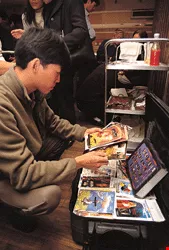
Low-costs CDs and DVDs are a recent phenomenon in China, thanks to pirated editions flooding the market. The pirates provide a wide variety of products with "zero time lag" from the international market.
All the rage
With satellite television able to reach anywhere in the world, a global Chinese entertainment market has taken shape. Taiwan has been leading the game for over a decade. During the 1980s, Hollywood movies had a serious impact on the movie industry of Hong Kong, which was also in the shadow of its looming 1997 return to mainland China. Meanwhile, Taiwan's economy was taking off. Moreover, it had a foundation of experience with various cultural movements, including a folk song movement and the "new wave" of Taiwanese film, and that experience made it well prepared to take advantage of the opportunity to take over Hong Kong's place leading Chinese-language pop culture.
During those glory days, the production costs for an hour of a prime-time television drama could run as high as NT$1 million. It was a common occurrence for an album to sell over a million copies. There were constant shows given at real estate developments. And variety show videos were sold anyplace there were Chinese.
Mainland China was only a secondary market for Taiwan's entertainment industry, largely a place for has-been stars to find their second spring. If someone who was hot went there, it would only be for a change of pace and some extra cash. Huang An, who was once a red-hot item in the global Chinese market with his song "New Butterfly Dream" says that back then he would travel to mainland China for shows because it was a refreshing thing to do. "A concert with 500,000 people! I was scared to death, but it certainly appealed to my vanity as an artist." He says that he never considered the mainland to be his main market.
Back then, the Taiwan market was red hot, and artists who "went west" too early were at a disadvantage. For example, Luo Ta-you, a writer of thoughtful, self-reflective songs, went to Hong Kong and then Beijing in the 1980s. Years later, he came back to Taiwan and released an album influenced by the style of music played by "electric flower trucks" in Taiwan, some of which were adopted by politicians campaigning during the first free presidential election in 1996. But sales were disappointing. The talented songwriter no longer had his hand on the pulse of the Taiwan audience's tastes, and so he was left out of the Taiwan market.
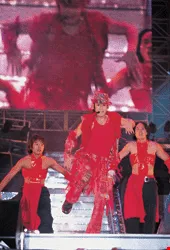
Young people who grow up in advantaged circumstances tend to be more outgoing and self-confident, necessary factors to the making of teen idols. F4 member Wu Chien-hao had 80,000 fans rocking at the F4 concert in Shanghai.
Losing the lead in TV dramas
However, starting in 2000, Taiwan's leading role began to be severely challenged.
The recession has caused the major TV stations in Taiwan to lose money month after month, and the recording industry has been hurt by pirating.
Because the PRC government keeps its media heavily restricted, Taiwan is still the center for entertainment news and variety shows. But beyond that, artists, record companies, drama producers and agents all found they need to "work the crowd" and started to look at the PRC as the main market. Some artists, such as Huang An and Chang Hsin-che, even totally gave up on the Taiwan market to concentrate on the PRC.
At this time, mainland China put a cap on investment by Taiwan and Hong Kong entertainment companies.
"In the 1980s, the PRC was thirsty for foreign capital, and a producer such as Chiung Yao would receive most favorable treatment," explains Ho Hsiu-chiung, a producer of television dramas and also the daughter-in-law of Chiung Yao. She explains that in 2000, the PRC government realized the need to cultivate and protect the local entertainment industry and started to put restrictions on television dramas produced by Taiwan or Hong Kong producers as well as to restrict the percentage of staff from outside the mainland.
The State Administration of Broadcasting and Television of the PRC divides TV series into the two categories: "national productions" and "co-productions." As the name implies, national productions mean TV dramas produced by mainland TV stations. For these, there can be at most two actors or actresses from either Taiwan or Hong Kong. Producers, playwrights and directors can be from Taiwan or Hong Kong, but their names cannot appear in the credits. And, there are only a certain number of national productions each year, so it is hard to get the rights to one.
Co-productions mean TV dramas produced by production companies from Taiwan or Hong Kong together with a mainland TV station. There is no cap on the number of dramas a company can produce, but they cannot get a prime-time spot on any station. You would be producing with prime-time costs only to be put in a second-choice slot, which just doesn't pay.
Wu Tsung-te, who wrote, directed and produced City Ladies, has a lot of gripes.
"In the studio, I was not allowed to speak when reporters came. That was my show!" He said that he hated to leave his homeland, but the NT$500,000 production budget per show that Taiwan television stations now provide for prime time is not enough to produce anything good.
To a businessman, profits come first. Hsu Ching-liang, who produced Wind and Cloud in the PRC, says that everyone feels frustrated and bad about not being able to use their Taiwan crews, but under this system they still all want to fight for the opportunities to produce national productions.
The cap on actors and actresses from Taiwan and Hong Kong, who were the hottest stars only a few years ago, has also had its impact. Producer Young Pei-pei points out that top mainland stars demand several times more than stars from Taiwan and Hong Kong. "But I still have to use them because of the regulations," she says.
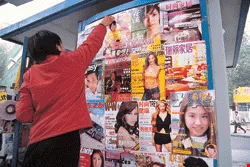
The Chinese economy has been reformed, but speech remains tightly controlled. Pop culture magazines without political content are the first wave in media liberalization in mainland China.
Don't block the money
Indeed, the measures taken by the State Administration of Broadcasting and Television have had real impact. The TV drama production standards have risen dramatically in the last two years. The most obvious example is Hunan Television Station, which has been collaborating with Chiung Yao for years. Originally it was just another unheard of provincial-level station, but after learning from Chiung Yao's crew over several years, it is now-apart from Beijing Television and CCTV-the hottest television station in the PRC, producing television serials of high standards all by itself.
Wu Tsung-te says that the broadcasting and television regulations in the PRC are something akin to the "head band tightening spell" that the monk in Journey to the West uses to control the monkey Sun Wukong; these regulations constrain and bring headaches to even the most flexible Taiwan producers. But the law protecting the local companies is not the only pitfall facing Taiwanese production companies. They also have to carefully choose partners, so that when problems occur one after another, as they inevitably will, the local partners can use their connections to sort through them.
"Before the shooting begins, you'll need signed approval papers, and after it is finished, it will have to be reviewed," says Young Pei-pei. "If something politically sensitive happens while the show is being broadcast, you'll have to make changes right then and there." These varied tasks require making different people happy, and hence you need a partner with good connections both in political and business circles.
Currently, Young collaborates with Jiuzhou, a company under the jurisdiction of the State Council's Taiwan Affairs Office. Chiung Yao, on the other hand, has chosen Hunan Television Station. Producers who have just arrived find it hard to avoid being tricked when they are getting their bearings. Hsu Ching-liang had such a painful experience. He doesn't want to name names, but he can't help complaining that he once trusted the guarantee of his collaborating company and took the whole crew to Sichuan before getting approval. Then, in the middle of the shooting, someone ratted on them and they were forced to stop shooting, causing serious financial losses.
Similar problems also happen to performers. One singer who has built his career playing joint concerts with other performers once had to pull out of a major engagement because his performance papers were not yet approved. "When I tried to get to the bottom of it, I discovered that it was all because a low-level civil servant who was in charge of rubber stamping was 'not in the mood that day,'" says this artist in disbelief.
"Finding an agency run by locals that you can trust to take charge of your career is a necessity for a performer who wants to be successful here," he notes. "The complex political and commercial relationships are not something an outsider can grasp." He sighs that in the PRC you'll know who to thank when things are done, but when obstacles are put in your way, you won't know who to blame.
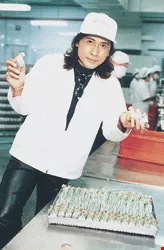
From Teresa Teng (top) and Luo Ta-you (middle) to Chyi Chin (bottom) and A-mei (opposite page), Taiwan singers have pierced the bamboo curtain, accompanied over a billion Chinese on the road of reform, and consolidated the influence of Taiwan's entertainment industry among all Chinese speakers. (photos: Sinorama archives, Lin Ching-yang)
Thank the pirates?
Back in Taiwan, things are so bad that, with the exceptions of pop-idol dramas and folk dramas, all the Mandarin speaking TV series are either from the PRC or are "mixed-blood" dramas. On the other hand, the industry is booming in the PRC.
According to a survey done in 2001 by the Chinese TV Program Rating Commission, the top ten shows there, apart from Chiung Yao's Romance in the Rain, which was number one, and one Hong Kong serial, were all mainland Chinese productions. Among these, series such as Ji Xiaolan, The Big Family and Kang Xi were all rooted in history and enjoyed good ratings when they were aired on cable TV in Taiwan. With the PRC gradually getting involved and then taking over the production of TV series, the question remains: Where does the strong suit of Taiwan's entertainment industry lie?
The Answer: the recording industry.
Hit by the recession and pirating, the recording industry in Taiwan is slumping. In the past, it was easy for an album to sell several hundred thousand copies. Now, selling over 50,000 is considered acceptable. But the creativity showed every year during the "Golden Melody Awards" still surprises people. The recording industry did not leave Taiwan for China's huge market, thanks largely to rampant pirating in the PRC.
"The population in the PRC is over one billion, but because of rampant pirating, low income and strict regulations on the contents of songs, even the hottest local rock singer Yu Quan can sell only 900,000 copies of an album priced at 18 yuan. In comparison, a 60-yuan album by singers from Taiwan and Hong Kong would be regarded as a 'luxury,'" says Wu Cheng-chung, Rock Music's general manager for China. Wu notes that the review process for Western songs is even stricter, with only five out of ten albums passing the lyric censors.
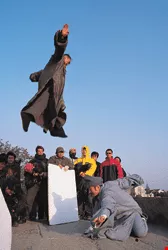
(opposte page) The scenery of China has attracted many TV production companies from Taiwan. The photo shows the Young Pei-pei Workshop shooting by Lake Tai in Suzhou. The one wielding the sword is the famous Hong Kong actor Sun Hsin.
Catching the pirates
Indeed, even in big cities like Beijing and Shanghai, it's hard to find what one wants in even the biggest record stores. But vendors, who can be found on busy streets at night, or in quiet back alleys, or who visit office buildings and bars hawking pirated albums, have everything, practically at the same time that they appear in stores in Taiwan. These CDs are all beautifully wrapped, with complete lyrics, and they cost only five to ten yuan each.
"The recording industry is still at the stage of plowing virgin soil, so companies here all keep minimal personnel," says Wu Cheng-chung, who feels confident despite everything. He says that the major record companies are planning to set prices on CDs in accordance with local income levels so as to drive away pirating with low prices. When Jay Chou's third album, Eight Dimensions was lowered to just over 10 yuan, the reaction was very enthusiastic. The new album of Richie Jen, released in October, has been priced similarly and is expected to sell 500,000 copies.
With the mainland authorities beginning to enforce pirating laws, some pirates have taken the opportunity to come clean. For example, many factories in Guangzhou that were originally in the pirating business have bought the copyrights for some Rock Records albums from the 1980s and are preparing to go legit.
"There are a lot of people and abundant creativity in the PRC, but they lack packaging skills and people to give them direction," says Wu Cheng-chung. Agents are also there because the major international record companies have demanded them. But Wu notes that China lacks the most advanced hardware and technical skills, so the albums recorded in the PRC still have to be brought back to Taiwan to be mixed.
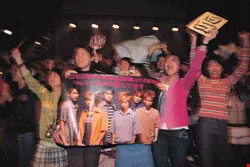
fans still lined up to see this Japanese boy group when they visited Shanghai in November.
Music comes after food
Apart from lagging behind in production and mixing techniques, China is also unable to "create" teenybopper idol singers, the most important link in the chain of recording industry success.
That Beijing reporter notes that in the 1980s, when the "Little Tigers" became popular in China, Chinese record companies started to try to create their own teeny bopper idol bands. But so far the "Heartbeat Boys B.O.B" and "Power of China" have not met with the same popularity as Korea's H.O.T., Japan's V6, and Taiwan's F4 and Su Yu-peng.
Agent Chen Shih-long explains that performers of this type are products of well-fed and well-clad societies. Apart from requiring mature packaging and operating methods, the aura of these performers has something to do with the environment that they grew up in, and it cannot be imposed upon them. Taiwan is an open society, and information here circulates fast, so that young kids here are confident that they are at the cutting edge of fashion. Their aura is naturally different from kids in mainland China.
Chen Shih-long has gone to China for his business as an agent for years, but he has not yet seen any kids there with potential. "Although the market there is big and there is no lack of capital, Taiwan's entertainment industry has deep roots. With pop idol singers leading the way, there will be no problem leading the Chinese-language market for several more years."
The success of F4 is the result of the integration of drama, television, celebrity management, and recording in Taiwan, which in turn points to the great foundations of Taiwan's entertainment industry. Although there has been a talent and technical drain, Taiwan still has what it takes for success.
Jessie Ho cites the example of Hong Kong, which long ago lost its leading status. Despite its small market and the predominance of the Cantonese dialect, it is still powerful in the pop industry. For example, the teenage girl band Twins, whose albums have never sold more than 10,000 and some odd copies in Hong Kong, is poised to conquer other areas thanks to the recording industry, agents and the media.
"That's how it is in this field-you can shop around to find where the market is," Ho argues. "Isn't it true that all of Asia now is the hinterland of Japan and Korea's entertainment industry?"
Sammy Yang, the managing director and president of Asia Plus, who has run entertainment companies in the US, Taiwan, Hong Kong and China, says that "fashion" is a matter of mutual stimulation. Taiwan's pop culture has helped bring China to a place that is more open and diverse. Today, Taiwan's entertainment industry needs the bigger market and human resources of the PRC to bring it past the bottleneck of the wilted domestic market.
There is no absolute gain and loss in the process of exchange. Influenced by culture, business and politics, the entertainment industry is charmingly always in flux. Thus, after A-mei was banned in the PRC for two years, her voice got a good rest, so that it has returned to the resonant and moving voice she had when she first emerged. As for the obstacles and misunderstandings that have cropped up in the cross-strait exchange of pop culture, one can-if one is looking for the silver lining-see these problems as necessary parts of the process of understanding each other.
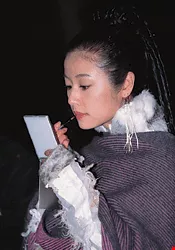
China has more than a billion potential TV viewers, drawing Hong Kong and Taiwan artists thirsty for popularity to the mainland. The young Taiwan actress Lin Hsin-ju is shown in the photo above taking advantage of a break in her shooting schedule to fix her makeup.
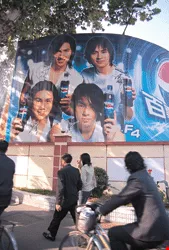
An internationally known cola company believes that Taiwan idols can attract young mainland consumers. This ad featuring F-4 can be seen everywhere in major cities in the PRC.

From Teresa Teng (top) and Luo Ta-you (middle) to Chyi Chin (bottom) and A-mei (opposite page), Taiwan singers have pierced the bamboo curtain, accompanied over a billion Chinese on the road of reform, and consolidated the influence of Taiwan's entertainment industry among all Chinese speakers. (photos: Sinorama archives, Lin Ching-yang)
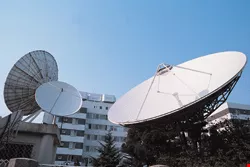
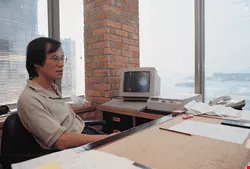
The more outsiders there are doing business in China, the more dense becomes the mainland's satellite dish net. Buildings for foreigners and luxury apartments can all get overseas satellite TV, keeping viewers in step with the latest in international pop culture.
@List.jpg?w=522&h=410&mode=crop&format=webp&quality=80)

@List.jpg?w=522&h=410&mode=crop&format=webp&quality=80)


@List.jpg?w=522&h=410&mode=crop&format=webp&quality=80)

@List.jpg?w=522&h=410&mode=crop&format=webp&quality=80)
