Crisis and Transformation for Taiwan's Publishing Industry
Andre Huang / photos Chuang Kung-ju / tr. by Tsai Nan-ting
May 2008


"There is only one word to describe what 2007 was like for the Taiwanese publishing industry: 'grim.'"
Publishing veteran Chen Ying-ching seems to speak for everyone, given the intense competition between publishers and the two mammoth chains of Kingstone and Eslite. Now, the question on everyone's mind is: Do all of the changes that have been brewing portend a bottoming out and rejuvenation of the industry in 2008?
In this age of information and innovation, it has often been said: "Culture is good business." In the past, the publishing industry has been able to successfully capitalize upon this sentiment.
And just how large is the publishing market? The Harry Potter phenomenon of recent years is a good case study. The seven-book series has been translated into 63 languages, sold 400 million copies, and generated over NT$500 billion in books, movies, and merchandise (with print products making up about 60% of that sum). J.K. Rowling, formerly a single mother on government assistance who could not even pay her heating bill, has leapt into the ranks of the world's richest people, with a net worth of NT$36 billion.
However, Harry Potter was not created in a vacuum, having been nurtured by the British publishing industry, which puts out about 120,000 new titles a year. For its part, Taiwan's vigorous publishing industry, with over 40,000 new titles in 2007, has had a fractious past half year. With accusations flying between two industry giants, Kingstone and Eslite, and the publication houses, the industry has been seriously split, to the point of Kingstone no longer carrying books by such heavyweights as Cite, Linking, and CommonWealth. This has led many to worry about the future of the industry. How long will this crisis continue? Will Taiwan follow in the footsteps of Japan's publishing industry collapse, thus scotching long-term plans for a "country built on culture"?

While the popularity of cell phones may have cut into the public’s budget for books, they also represent a new space for cell phone-based literature.
Post-martial-law boom
Like the newspaper industry, which is currently struggling for survival, Taiwan's publishing industry can trace its woes to the start of the boom that began 20 years ago. According to the published reminiscences of Locus Publishing president Rex How, the Taiwanese industry, a pillar of Chinese-language publishing, went through over a decade of growth after the end of martial law in 1987. With the end of political censorship, a range of social movements flourished, awakening the people's interest in new information and ways of thinking. Not only did publishing houses produce significant book collections, this period also saw the arrival of bestsellers such as the alarmist A Warning of Taiwan Strait War.
The contemporaneous economic boom arising out of the growth of information technology did much to expand the publishing industry. The number of new titles published jumped from 4,565 in 1980 to 16,156 in 1990 and 34,533 in 2000. Unlike the newspaper industry, which was reduced after intense competition to four main papers, annual statistics from the Government Information Office (GIO) reveal that the Taiwanese publishing industry has grown, with the exception of one period of decline (see graph), from 4,439 publishers in 1994 to a sustained level of 7,500-9,000 publishers (including government publications). Of these, 70% are firms with ten staff members or less.
The great number of small- and medium-sized publishers has brought about abundant vitality. Moreover, with no single publisher able to monopolize and control the market, the publishing world has been characterized by a diversity of viewpoints coming to market. After martial law, a spirit of freedom and openness made Taiwan the publishing capital of the Chinese-speaking world. Rex How remarks: "The beauty of Taiwanese publishing lies in its small publishers and independent bookstores."
Corresponding to this industry expansion, franchises such as Kingstone and Senseio appeared on the scene, transforming Taiwanese bookstores with spacious, tidy, and well-organized stores. Eslite, which came later, made a name for itself with its distinctive interior spaces and readers' activities. In 1999, Eslite opened a 24-hour bookstore on Dunhua South Road in Taipei, offering a unique cultural space and greatly enhancing the experience of book browsing.

The large chains have responded to a stagnant market by adopting a variety of management measures and shrinking their stores. Pictured is the Kingstone store on Taipei's Chunghsiao East Road, which in late 2007 reduced its original five floors to one, renting out half of its remaining space to a clothing store.
New books proliferate
However, the flourishing post-martial-law era also contained the seeds of the inevitable decline that would follow in the new millennium.
The number of new books published after martial law rose quickly, topping 30,000 titles in 1998 and 43,035 in 2002, and thereafter frequently maintaining a level of around 40,000. Subtracting the 40% or so of those numbers that come from direct sales (mostly in textbooks and children's books), the remaining 20,000-some books are those that you or I might pick up in a bookstore.
40,000 titles is a considerable number when the overall size of Taiwan's economy is considered. In 2002, for example, this would mean 16.77 new titles for every 10,000 people. While less than the 20.83 new titles figure for the UK, Taiwan's statistic nonetheless far exceeds Japan's 5.29 and the US's 2.32, and takes the number-two position worldwide in new books published per capita.
The number of new titles published has remained high due to demand for all kinds of knowledge in Taiwan, as well as to the nature of the reading market.
Chen Ying-ching, the head of Owl Publishing House, has written about the publishing industry under the pen name Old Cat for some time now. He points out that books are unlike foodstuffs or other consumables such as toilet paper. A person will not buy the same book twice unless the book has been lost or given away. In order to stoke up unending demand on the part of readers, publishers have developed the bad habit of putting out new books in order to raise the cash for the next book, even though most books are not profitable. In addition, bookstores need new books to keep attracting foot traffic, and the media loves introducing new books to satisfy readers' appetite for novelty. In this kind of environment, where everyone shares in the blame for the situation at hand, the whole industry seems to have been caught up in a never-ending cycle. New books keep coming out, while book returns (in 2006 between 21.7% and 52.4%) and the numbers of books lost or damaged keep mounting, creating a challenge for the entire industry.
The new titles, coming out in greater quantity than bookstores have the capacity for, are reducing shelf time for each individual title. According to a GIO survey of the publishing industry, in 2003 each new title stayed on the shelves for 4.1 months, while in 2006 that period fell to 3.8 months. Most books are quietly removed from the shelves before readers even know that they are there, and cause hardly a ripple in the marketplace. The fast depreciation of new books has ironically caused publishers to even more eagerly push out yet more new books. This causes a vicious cycle, with mounting quantities of unsold inventory.
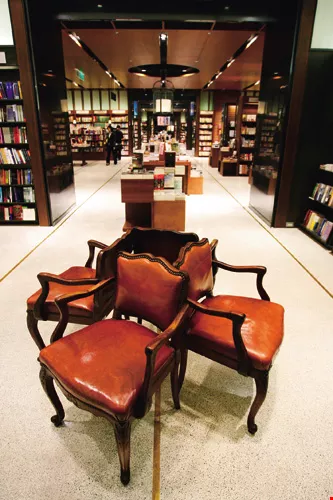
(facing page and below) Taiwan occupies the number-two spot in terms of new book titles published per capita. This has meant an open, diverse reading environment, but is also the cause of crisis for the publishing industry. Pictured is the Eslite bookstore.
Bestsellers and busts
While the 20,000-some new titles that flow through bookstores each year offer readers a rich intellectual feast, this information explosion has also caused readers to feel lost and oversaturated given the multitude of choices. To help readers filter through these new titles, key personnel in the publishing chain, including publishers, agents, and wholesalers' and retailers' purchasing staff, will first estimate a given book's chances in the market, and then make use of such sales tactics as advance purchasing, celebrity endorsements, gifts, book signings, press interviews and excerpts, and also display the book prominently in the most prestigious shopping areas.
While such marketing strategies offer harried readers some ready choices, they also tend to control and limit what readers focus on. With this uneven exposure, the underfunded independent publishers must invest more resources to compete for advantageous display locations.
Chen says, "In the past, bookstores used to treat all new titles equally. Now, publishers need a big enough marketing budget to achieve sufficient exposure. A decade ago, a publishing house simply had to concern itself with putting out good books and did not need to worry about marketing. Those days are long gone!"
With such factors as an overabundance of titles, soaring marketing costs, and the "long tail" theory of Internet sales (books that are popular for a long period of time can enjoy longer exposure and lower display- and sales-related costs through Internet distribution), the Taiwanese book market displays an "M"-shaped growth pattern. In other words, bestsellers are few, but can sell in the hundreds of thousands. Slower-selling books that are little noticed and sent back from the shelves fall into the pitiable pattern of the weak getting weaker. Those books in the midrange of sales have largely disappeared.
The persistence of this kind of market causes everyone up and down the publishing chain to fixate on bestsellers, flocking to trendy genres (fantasies, mysteries, travel books), styles, and cover designs to try and strike it rich. Those books that do not have a chance at the bestseller list are put out carelessly. The polarization of the market is only deepening.
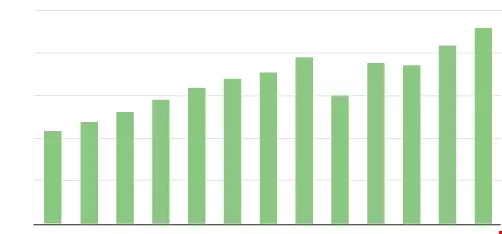
Number of publishing houses in Taiwan
Prevalence of small publishers
In the publishing industry, which projects an air of intellectualism, it is not hard to understand these current problems. The problem is that Taiwan's industry has been one filled with small- to medium-sized publishers. Each does as it sees fit, and no one is willing to bend to anyone else. This means there is no way to take advantage of collective agreements or work together to change the industry's future course.
Linden T. C. Lin, the head of Linking Publishing Company, and a representative to the Taiwan Alliance for Orderly Publishing Distribution, says that the Taiwanese marketplace is characterized by a great number of new books being introduced in a small market. This fiercely competitive atmosphere makes it necessary to engage in discounting and promotional practices. Publishers typically give out different discounts depending on the channel (large-volume franchise bookstores might receive a 35% discount, independent bookstores might get 30% off, Internet retailers might get 40%, and book discounters 43%). Different channel retailers will launch promotions at annual celebrations and book exhibitions.
Everyone agrees that the result of these price wars has been that profits from up and down the business stream have been eaten into. Not only have publishers suffered self-inflicted wounds by wreaking havoc on the prevailing order of the marketplace, traditional bookstores have been complaining about their losses, leading to the recent "declaration of war" that Kingstone and Eslite have taken to the publishers (see "Alternative Outlets for Publishers").

The market seeks novelty, but in order to survive, publishers need bestsellers with staying power. The cartoons of Old Master Q have become a classic among Chinese readers. Pictured is an Old Master Q figure and second-generation author Joseph Chak Wong.
From crisis to transformation
Publishers and bookstores have gone from a relationship of close mutual dependence to bitter enmity. The main reasons are the economic downturn of recent years; the massive exodus to mainland China of the middle class, the class that is the driving force behind consumption; declining book purchases (see graph); and the difficulty in firmly establishing strong reading habits (up to 50% of the public admits to not reading on a daily basis). With rising supply, sinking demand, and a chaotic market environment, it is no wonder that everyone is left with a sense of anger and inexpressible misery.
But is the publishing industry really dying? Actually not.
To paraphrase Dickens, one could say: "It is the best of times, it is the worst of times." Though the problems are many and complex, the diversification of channels, the move towards niche book markets, and the development of diverse readers' needs continues. One could say that in the past, the publishing industry was operating as if on the same playing field, with everyone using the same methods to race towards the same finish line. Now that everyone has slowed down and the distance between competitors is increasing, there is more opportunity than ever before to take a good look at the surroundings, and then forge a new path.
From the following new phenomena and reflections, it may be possible to see what new and transformative paths the publishing industry has taken.

Publishing houses now routinely discover new talent on the Web, showing how they have learned to live with this new medium. Here a reader gets her picture taken with author Wanwan, who began her writing career as a blogger.
1. Marketing "serious" books
In the 1980s books in the social sciences were hot for a while, satisfying public desire for understanding changing times. In the new millennium, however, such books have virtually disappeared from the market. Most, when they periodically appear, are now translated titles. However, in a rare showing for such books, Tsing Hua professor and cultural critic Chen Kuan-hsing's Towards De-Imperialization appeared on Eslite's list of recommended books for October 2006. Editions du Flaneur, which put out the nearly 500-page tome, departed from the usual bookish discretion of academic publishers by not only asking such luminaries as Hou Hsiao-hsien and Cheng Tsun-chi to recommend this work, but also putting on book launch parties and forums, among other activities. To the amazement of many, the book has sold 3,000 copies to date.
According to Zhou Yi-zheng, editor-in-chief for Flaneur: "While we specialize in continental European thought, avant-garde literature, and social issues, we don't see ourselves as elitist. Rather, we hope to bring these difficult yet important works to the market as a whole, putting them into the hands of potential readers." Having shed certain professional pretensions, they busily set to work creating a marketing plan and communicating about the book's content to industry publications. Says Zhou, "In order to diversify the readership and expand the market, some were willing to give us special rates or support us with publicity."
In an environment where books are polarized between bestsellers and those that hardly sell, Flaneur on the one hand separated itself from the bestseller battlefield, and on the other hand broke with the usual practice of academic presses of not doing much marketing. As a result of its efforts, it was able to find its own niche amidst the expansive sea of books, and its success encouraged many independent publishers.

Certain genres sell well, such as the recent trend in fantasy literature that has provided a shot in the arm to the publishing industry. Related movies and products bring in formidable profits. Pictured is Lucifer Chu (center), translator of The Lord of the Rings, attending a fan club meeting.
2. Harnessing the virtual
While television has traditionally been seen as the enemy of the book, a recent example challenges that old notion. Since the American talk show Oprah began its reading club, each of its recommended titles has triumphed in the marketplace. Bookstores sometimes even create a special area for Oprah-recommended titles. Even mammoth literary works such as Nobel laureate John Steinbeck's East of Eden have become instant bestsellers.
If a one-way medium such as television can bring about a frenzy of book sales, then the two-way nature of the Internet should be able to give rise to an entirely new way of selling books.
Many are of the opinion that the instant availability of information on the Internet has reduced the number of readers, but if you look at aNobii's website, you might change your mind completely. This Hong-Kong-originated "online bookshelf" gathers information on books from a variety of countries and genres. Users can create their own virtual bookshelves, sharing their thoughts with fellow aficionados from around the world. Many browse through others' bookshelves, searching for wish lists and compiling their own. Or, they might borrow others' books or place an order with a variety of online booksellers.
This swiftly spreading tide of reading that is sweeping the Internet has already given rise to such book-sharing platforms as Hong Kong's aNobii, Taiwan's iReading and Yumau, and China's Douban. Such sites shatter the traditional image of the Internet as taking away from the reading population, and instead provide fresh energy to the reading public.

The Web-a better medium
John Lin, book fanatic and chief editor for culture and living at Yuan-Liou Publishing, reflects upon the massive quantity of information offered by such online bookshelves: "These sites have already replaced traditional professional book reviews. They've become the means by which ordinary readers understand and develop an interest in books. Reading is in essence a private, subjective affair. But the anonymous nature of the Web provides readers with a way to honestly exchange their feelings." At the same time, these websites offer publishers a way to understand readers' tastes and tendencies. Whether gathering readers' opinions or managing reading groups, these websites allow publishers to come into direct contact with readers and gather valuable firsthand information.
Another trend that has long been flourishing is the Internet author. From the early Pi-tzu Tsai to the currently fashionable Wanwan and Giddens, such authors went from toiling in obscurity to developing their own reputation based on their hard work and talent, and finally to publishing their works through publishing houses. This is a different model than the past reliance on literary prizes or selection by professional critics in the mainstream press. Now, such authors not only have their own market base, they are also able to create a new reading experience and expand the publishing market.
According to Chen Ying-ching, the main challenge that the Internet poses to publishers is that print works that offer search capabilities and have limited shelf life will gradually be eclipsed by online services. These include traditional types of works such as encyclopedias, dictionaries, stock analyses, and so forth. But rather than sounding the death-knell for publishers, it might be better to say that this is the end for the printing industry. For publishers continue to need to gather and edit information. It is simply that the medium has shifted from traditional paper to Web-based services.
Linden Lin says, "The rise of the Internet has not caused a reduction in the number of readers. People who go online instead of reading were probably never readers to begin with." In addition, not reading books does not mean that one is not a reader. Aside from the phenomenon of Internet authors, recent years have seen a gradual rise of a new publishing frontier in the cell phone novel. Thus, rather than looking at the Internet as the enemy of the book, it would be better to see it as opening up a new arena that awaits publishers to harness its unlimited potential.
3. Content is still king
In the last two years, which have seen the turbulence surrounding Kingstone and Eslite, many have attacked their attempts to introduce post-sale payment or consignment sale systems. Yet the new realities have forced publishers to more directly respond to market needs and thoroughly dismantle the old tactics of publishing to raise cash, and of publishing one book to subsidize another. Says Lin, "Publishing houses have been forced to be more precise about what they put out, and publishers' creativity and vision are more important than ever."
To be fair, the quality of works published in Taiwan has been rising in this past decade, and readers are ever more demanding when it comes to content.
Wang Chien-jen, former editor at book4u.com and currently a freelance writer, has been observing Taiwanese publishing for a long while now. He observes that in the past ten years, the audience for popular literature and management books has matured. Foreign authors with substantive works enjoy solid sales, and good content has found a receptive market here.
However, Taiwan has found it hard to overcome cultural imperialism and the dominance of translated works. Even though translated works make up only 25% of the market, seven or eight out of ten bestsellers tend to be translations of American or Japanese works. In recent years, mainland Chinese authors have weighed in with historical novels, causing Taiwan to lose ground in works on traditional Chinese culture, an area it had formerly led.
Seeking a Taiwanese J.K. Rowling
Little Soldier Publishing Company, which is committed to publishing children's books by Taiwanese authors, may be said to be going against the tide. With a staff of only five, this publishing house has put out over 100 titles in 16 years, proving its ability to sell books over the long term. For example, My Secret Weapon, by chief editor Ko Tsuo-ching (pen name Ke-pai) has sold 100,000 copies to date. Ko feels that, established authors aside, it takes an experienced, talented editor who is willing to spend the time it takes to cultivate authors with potential to truly develop good content.
Thus, the publishing house holds repeated conversations with the author of each book, in one case exchanging over 500 e-mails back and forth. This long-term cultivation has not only produced such prominent Taiwanese authors as Wang Wen-hua, it has also garnered a number of awards for content, which the Taiwanese public find highly relevant. In a market where translations and marketing ploys abound, Little Soldier has managed to make a name for itself in Taiwanese children's literature through offering exciting content.
On the journey that has taken Taiwan from traditional manufacturing to information technology to an information and innovation economy, can Taiwanese culture keep pace? This will become a key factor in whether or not Taiwan can transform itself over the next decade.
In the past few years, the publishing industry has stumbled through rocky times. On the surface, this is an age-old industry. But in the age of an information economy that champions the business of cultural creativity, the publishing industry has become a vessel for Taiwanese cultural strength. The situation faced by all sectors of the industry seems to symbolize that faced by Taiwanese society as a whole as it hovers between transformation and stagnation, searching for a way forward.


@List.jpg?w=522&h=410&mode=crop&format=webp&quality=80)


