

In his May 20th inaugural address, Chen Shui-bian (left) declared the advent of a new era. Shown at right is Vice President Annette Lu. (photo by Diago Chiu)
The Republic of China's tenth-term president and vice president, Chen Shui-bian and Annette Lu, took the oath of office on 20 May, 2000 in the first-ever transfer of power in Chinese history to a popularly elected leader from the opposition. In his inaugural speech, Chen touched on a wide range of issues of concern to voters in Taiwan. On the domestic front, he discussed the alternation of political parties in power, democratic reforms, a fair and just society, a government for all the people, nonpartisan government by a coalition of forces opposed to corruption, the establishment of an efficient and dynamic government, a knowledge-based economy, law and order, environmental preservation, education, culture, reconstruction from last year's September 21st earthquake, and various other issues. The common thread running through his domestic policy remarks was an emphasis on reform. On the sensitive topic of cross-strait relations, he sent a number of positive signals to Beijing. The speech put a heavy stress on democracy and human rights, a reflection of the high expectations the public holds for the government on these fronts.
Later in the day, post-inaugural celebrations kicked off around the island and commentary on Chen Shui-bian's address came pouring in from across the political spectrum. What was the overseas reaction? What did domestic commentators have to say? How will Chen's presidency change Taiwan?
The new president's inaugural ceremony began at 9:00 am on 20 May at the Presidential Palace. Chen Shui-bian and Annette Lu were sworn in by Weng Yueh-sheng, president of the Judicial Yuan, then Legislative Yuan Speaker Wang Jin-pyng presented Chen with the official seal of the Republic of China and three other presidential seals. Chen took his first act as president by signing his name to the appointments of Tang Fei as premier, Chang Chun-hsiung as secretary-general of the Office of the President, and Chuang Ming-yao as secretary-general of the National Security Council. After Tang took his oath, he submitted his Cabinet nominations to Chen for formal appointment. The most remarkable moment of the inauguration came at 11:00 am when Chen strolled into the open air to take the oath of office and deliver his inaugural address to the nation in front of the Presidential Palace.
Featuring aboriginal folk songs and a rendition of the ROC national anthem by pop queen Chang Hui-mei, the ceremony was attended by over 10,000 foreign guests, overseas Chinese, and local citizens. After the national anthem, Chen Shui-bian delivered his much anticipated inaugural address. Observers at home and around the world were waiting and wondering-would he address the "one China" issue?
In his 40-minute speech, Chen declared the determination of the people of Taiwan to carry out a peaceful transfer of power between political parties, and to continue forward with their democratic political system. He called for a government for all the people and a non-partisan coalition of the forces opposed to corruption, and declared the new government's determination to improve law and order, the economy, the environment, post-earthquake reconstruction, and other aspects of life in Taiwan.
On the subject of cross-strait relations, Chen stressed that the people of Taiwan and mainland China share a common ancestral, cultural, and historical background, and he stated his belief that the leaders on both sides have the wisdom and creativity to jointly deal with the question of a future "one China." He also promised that during his presidency, as long as the Communist Party regime renounces the use of military force against Taiwan, he will: (1) not declare independence; (2) not change the nation's name; (3) not push for the inclusion of the "state-to-state" formula in the constitution; (4) not promote a referendum on Taiwan independence; and (5) not seek to abolish the National Reunification Council or the National Reunification Guidelines.
He also had a message for his international audience, promising to make a more active contribution to safeguarding international human rights. He stated that Taiwan would abide by the Universal Declaration of Human Rights, the International Covenant on Civil and Political Rights, and the Vienna Declaration and Program of Action. He also indicated that the new government would request the Legislative Yuan to pass and ratify the International Bill of Rights as a domestic law of Taiwan, so that it would formally become the "Taiwan Bill of Rights."
Later in the day, Taiwan's various political parties all released statements on the inaugural address. Chang Jung-kung, director-general of the Kuomintang's Department of Mainland Affairs, stated that Chen failed to break any new ground in his statements on cross-strait relations, and said that while Chen had succeeded in calming the atmosphere for the time being, the stalemate remains unresolved. The People First Party (PFP) and New Party (NP) gave a more positive evaluation. PFP Secretary-General David Chung felt that the president had sent a positive signal to the mainland, but that his domestic policy lacked the sense of direction that would come from a comprehensive vision. NP convener Hau Lung-pin commended Chen for his finessing of the "one China" issue.
Beijing responded almost immediately to Chen's speech. While expressing dissatisfaction at his avoidance of the "one China" issue, they also stated that it might be possible to re-start cross-strait negotiations if Taiwan were willing to return to the one China formula adopted during talks in 1992, when it was agreed that each side could maintain its own interpretation of what "one China" means.
US President Bill Clinton praised Chen's speech as pragmatic and constructive, and stated his hope that the two sides would be able to resume dialogue at an early date. Japan's Foreign Minister Yohei Kono also commented favorably, indicating his government's hope that the two sides can engage in dialogue and work for a peaceful resolution of the cross-strait issue now that the new president has taken office.
In addition to heads of state and representatives from countries with which Taiwan enjoys either formal diplomatic ties or friendly relations, the inaugural was also attended by three generations of democracy activists from mainland China (Lin Xiling, Wei Jingsheng, and Wang Dan) and Lech Walesa, the 1983 Nobel Peace Prize winner and former president of Poland. All these visitors complimented Chen Shui-bian for his speech and expressed support for Taiwan's determination to follow the path of democracy, freedom, and peace.
On the evening of inauguration day, Chen Shui-bian carried out two functions at the Grand Hotel. After hosting a gathering of DPP members on one floor of the hotel, the president then proceeded to an official state banquet for VIPs on another floor of the same hotel. At the DPP function, party chairman Lin Yi-hsiung had a word of caution for his fellow party members: "We must not let our newly attained power go to our heads." There was also a big inaugural celebration on the big square that evening at the Chiang Kai-shek Memorial. The celebration moved the next evening to Kaohsiung, and other celebrations went on all across the island. The Sun Yat-sen Memorial Hall marked the occasion by holding a special exhibit of contemporary Chinese painting, and all sorts of hot-selling commemorative products appeared on the market, including alcoholic beverages, coins, pens, etc.
Everyone has high hopes for the new presidency, but we must remember that May 20th is just the first step on a long journey. If a brighter future is to actually take shape, the government and citizens will have to work for it.
p.75
In his May 20th inaugural address, Chen Shui-bian (left) declared the advent of a new era. Shown at right is Vice President Annette Lu. (photo by Diago Chiu)
p.76
To highlight the new president's humble beginnings, the post-inaugural state banquet went long on typical Taiwanese dishes. The menus were printed on fans like the one shown here. (photo by Hsueh Chi-kuang)
p.77
Pop diva Chang Hui-mei sang the ROC national anthem at the inaugural and angered the Chinese communists, who reacted by pulling her long-running Sprite commercials from the air and banning the sale of her music. No one had expected a pop star like Ah-mei to get embroiled in cross-strait politics. (photo by Diago Chiu)
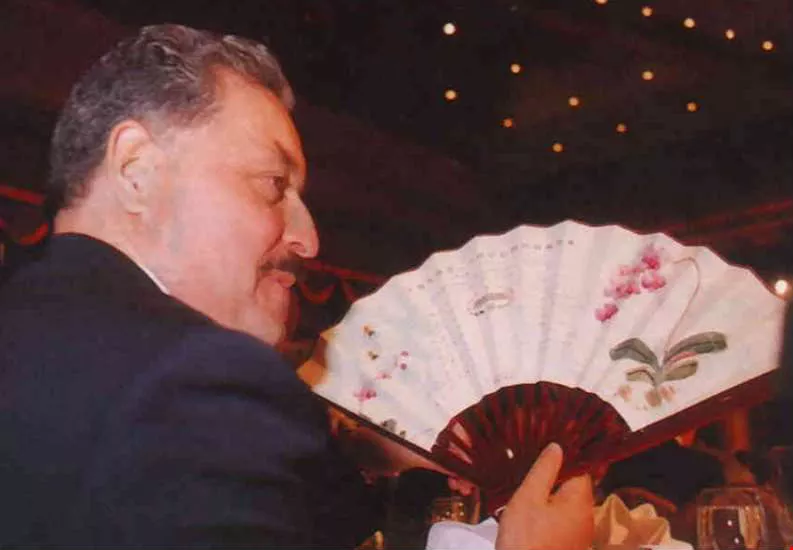
To highlight the new president's humble beginnings, the post-inaugural state banquet went long on typical Taiwanese dishes. The menus were printed on fans like the one shown here. (photo by Hsueh Chi-kuang)
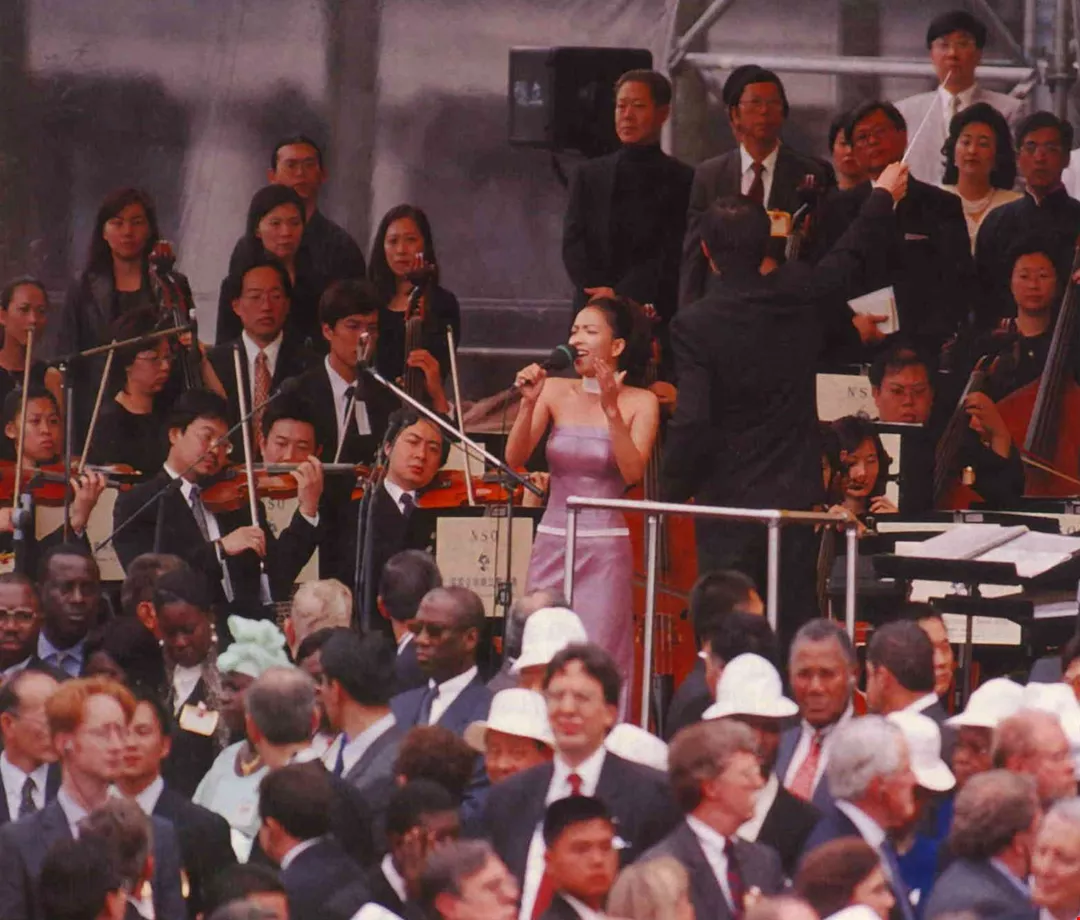
Pop diva Chang Hui-mei sang the ROC national anthem at the inaugural and angered the Chinese communists, who reacted by pulling her long-running Sprite commercials from the air and banning the sale of her music. No one had expected a pop star like Ah-mei to get embroiled in cross-strait politics. (photo by Diago Chiu)

@List.jpg?w=522&h=410&mode=crop&format=webp&quality=80)


@List.jpg?w=522&h=410&mode=crop&format=webp&quality=80)
@List.jpg?w=522&h=410&mode=crop&format=webp&quality=80)
