The Modernity of Classical Furniture
Claire Liu / photos Vincent Chang / tr. by Robert Taylor
September 1995


Like many other forms of Chinese art, Ming style furniture is studied in both China and the West. But in this particular instance of cultural exchange, the first efforts seem to have been made by Westerners, with the Chinese picking up the baton later to create a movement which has gradually gathered momentum. So is this another example of Chinese style gaining international popularity, or of the Chinese adopting Western interests?
The collection and study of Ming furniture began in the 1930s and 40s among foreign residents in Beijing. At that time modernism was on the rise in the West as a reaction against the over-elaborate decoration which still persisted from the Victorian era. The Bauhaus movement, which combined the artistic and the industrial, was popular in Europe and America for a time. It strove for functionality and clean lines, and this brought favorable attention to Ming furniture, which expresses much the same ideals though in different ways. Ming furniture was called "timelessly modern." Gustav Ecke, who in 1944 published a book on Ming furniture entitled Chinese Domestic Furniture, was a native of Germany, the birthplace of the Bauhaus movement.
After 1949 these enthusiasts returned to Europe and America, and the furniture they had collected went with them, to find its way into museums and private collections.
For instance, the Nelson-Atkins Museum of Art in Kansas City, Missouri, the Philadelphia Museum of Art, the Honolulu Academy of Art in Hawaii, the Victoria and Albert Museum in London and the Royal Ontario Museum in Canada all have substantial collections of Chinese furniture. In 1982 craftsmen from mainland China went to New York to construct the "Astor Court" in the Metropolitan Museum of Art, with a Chinese garden and a Ming Room displaying hardwood furniture. However, the exhibit rather gives the impression of putting stereotyped symbols of a "country of ancient culture" on a pedestal.
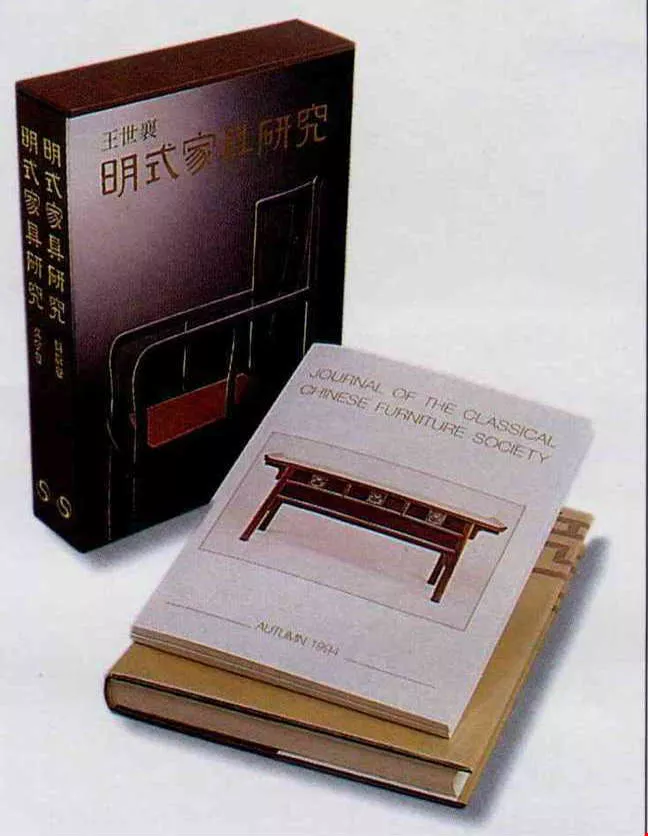
Research into Ming furniture began in the middle of this century and has been pursued in both China and the West. Today, its different currents are beginning to flow together.
A balance of simplicity and richness
But what of research by the Chinese themselves? In fact the foreign collectors in Beijing in those days directly or indirectly influenced a number of Chinese, among them Wang Shixiang. Wang got to know Ecke and others when he was still a student, and he would often go to their homes to look at the furniture. He was very interested in the way the pieces were constructed, and began to collect Ming furniture himself.
In 1985 Wang Shixiang published his Classic Chinese Furniture, the culmination of 40 years of study. This was the first book to illustrate pieces from Chinese collections. Some of the examples presented in the book were more ornate than would have suited the aesthetic standards of the early Western collectors. The book's publication sparked off a real furniture craze, and not only attracted the attention of collectors, but also became a patternbook for antique dealers, who went looking for furniture whose style matched the book's illustrations. At that time mainland China was comparatively open politically, and much old furniture found its way onto Hong Kong's antique market. Wang's book helped this trend. In 1985 the Asia-Pacific region's first exhibition of Ming furniture was held in Hong Kong, and from then on the quantity of Ming furniture appearing at New York auctions grew, and the number of shops specializing in Ming furniture also gradually increased. In 1989 Wang Shixiang published an expanded version of Classic Chinese Furniture: the two-volume Connoisseurship of Chinese Furniture: Ming and Early Qing Dynasties, which we can say marked the end of this period of development.
In a telephone interview with Wang Shixiang in Beijing, we asked him his motives for publishing his books. Wang, now in his 80s, said quite casually: "We shouldn't just leave writing to the foreigners, we Chinese should also write, to fill in this gap." One of his reasons for writing was to correct some misconceptions about Ming furniture, because "strictly speaking they [the early foreign collectors] were biased, for they neglected the fact that there is also a side to Ming furniture of fine carving and intricate decoration, which of course is quite different from the elaborate ornamentation of Qing dynasty palace-style furniture."
Because of this Wang Shixiang wrote about both the "merits" and "defects" of Ming furniture. With the help of illustrations of actual pieces, he showed how in Ming furniture one finds a "balance of simplicity and richness." Clean and simple elegance is as attractive as ever, but sumptuous ornamentation also has its place. Thus he "took the opportunity to redress the balance of the foreigners' opinions."
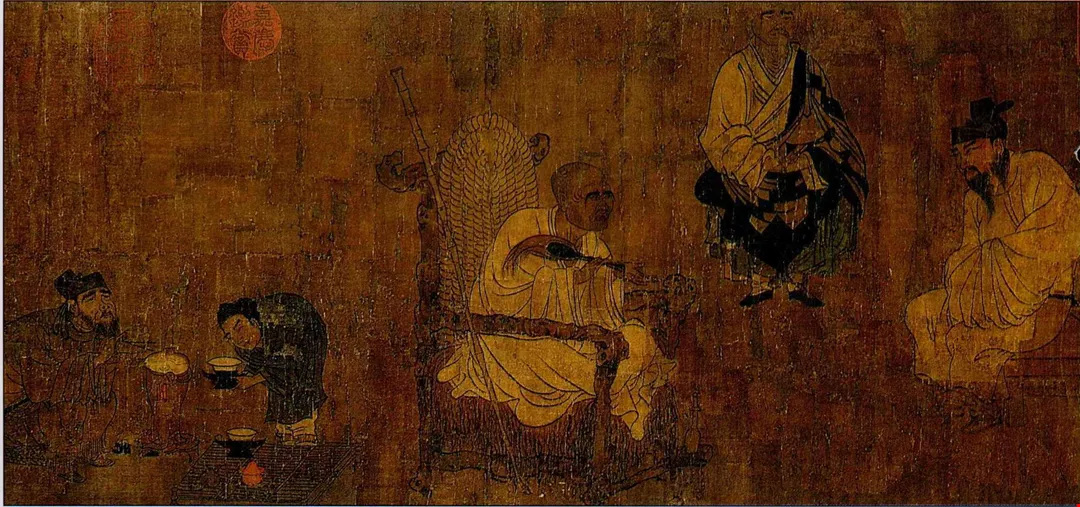
When dating paintings, the style of furniture depicted in them can sometimes provide invaluable clues. Twenty years ago Chuang Yen, the late vice-director of the National Palace Museum, used his knowledge that chairs with backs were unknown in Tang-dynasty China to determine that the painting Xiao Yi Imitates "The Orchid Pavilion" is not the work of Tang painter Yan Liben. (courtesy of the National Palace Museum)
Chinese and Western research flow together
In 1990 the opening of the Museum of Classical Chinese Furniture, the establishment of the Classical Chinese Furniture Society, and the publication of the society's quarterly journal, brought together the previously isolated efforts of individuals. Especially as private collections are not easily accessible to the public and museums are widely scattered, the Museum of Classial Chinese Furniture has become a mecca for lovers of Chinese furniture. Despite its rural location the museum attracts visitors from far and wide.
From that time onward the Hong-Kong-based oriental art magazine Orientations carried many articles devoted to Ming furniture, and several international symposia on and large-scale exhibitions of classical Chinese furniture were held. From Hong Kong, Beijing and Suzhou to San Francisco, the currents of Chinese and Western research began to flow together. The Palace Museum in Beijing also began to bring out Ming dynasty huanghuali furniture from its storerooms to put on display in addition to the familiar Qing style furniture.
So far it Taiwan, despite the rapid increase in the number of collectors, few monographs have appeared on the subject of furniture. Chi Juo-hsin, an assistant researcher in the Department of Antiques at the National Palace Museum, admits frankly: "The Museum doesn't have many examples, and we've done little research." Apart from some pieces of zitan furniture from the mansion of the Qing dynasty Prince Gong, bought from a Hong Kong collector in 1983, the National Palace Museum has almost nothing in the way of Ming furniture. Why is this? When the Palace collection was rushed to Taiwan in the war, understandably priority was given to the most exquisite pieces. Because furniture is bulky, and less valuable than the porcelain jade and paintings," it had to be reluctantly left behind.
In recent years, now that the importation of antiques over 100 years old from mainland China is permitted, a craze for furniture has arisen in Taiwan. But most of the pieces to be found on the market are Ming furniture only in the "broad sense": they were made in the late Qing dynasty, and although they largely keep to the proportions of Ming furniture, they are often made from softer woods such as elm or zelkova, or are lacquered and carved. Genuine hardwood furniture from the late Ming or early Qing has long commanded astronomical prices, and very rarely appears on the market, or has remained unrecognized.
Connoisseurs have suggested that people in Taiwan should set up a furniture research society, publish books on the subject and even open a furniture museum. John Ang of Artasia Fine Asian Antiques and Art Consultancy researches furniture as well as trading in it. He acknowledges having been very deeply influenced by the Museum of Classical Chinese Furniture. But he freely admits that this extra work is becoming too great a burden, and if he cannot get some funding it will be very difficult for him to continue with it.
Meanwhile Wang Shixiang says that to research furniture, one must of course start by observing and studying real pieces. One must dismantle, measure and draw them, and get to know them intimately. But unfortunately it is foreign buyers who have the money to buy such furniture, so that much of what has survived in China is being exported. Furthermore, as far as research into the techniques used in making the furniture is concerned, the Chinese craftsmen who understand this aspect do not write down what they know, while most intellectuals are unable to acquire a deep understanding of it. Back when Wang Shixiang himself first became interested in furniture, with his legendary enthusiasm he started solidly studying from the basics, squatting down in workshops to chat and making friends with old cabinet makers. The 1000 or more technical terms listed in an appendix to Connoisseurship of Chinese Furniture were collected in this way. The third element is to find supporting written materials. This may be more difficult overseas, "but this is the final step, because the materials aren't necessarily accurate, and sometimes you might search the libraries for a month and not find anything."
Wang also feels deeply that today Ming furniture seems to have won back its status, but although there is no lack of people trying to make money or make a name for themselves, there are very few genuinely engaging in serious research.
This year, following the exhibition of masterpieces from the Museum of Classical Chinese Furniture at the Pacific Heritage Museum in San Francisco, there will be a number of other major events to look forward to in the world of furniture. One is an exhibition of the collection carefully put together over 50 years by Wang Shixiang, to be put on in the new galleries of the Shanghai Museum. The exhibition is expected to be ready to open late this year or early next year. And for 1996 the Museum of Fine Arts in Boston is planning an exhibition of Ming furniture from many collections, set out in a typical 17th century domestic setting. Many of the pieces will be on public display for the first time.
[Picture Caption]
p.82
Eroticism apart, The Golden Lotus describes material life in the Ming dynasty in minute detail. The wood block prints in the book illustrate the design of Ming furniture. (courtesy of Artasia Fine Asian Antiques and Art Consultancy)
p.83
Research into Ming furniture began in the middle of this century and has been pursued in both China and the West. Today, its different currents are beginning to flow together.
p.84
When dating paintings, the style of furniture depicted in them can sometimes provide invaluable clues. Twenty years ago Chuang Yen, the late vice-director of the National Palace Museum, used his knowledge that chairs with backs were unknown in Tang-dynasty China to determine that the painting Xiao Yi Imitates "The Orchid Pavilion" is not the work of Tang painter Yan Liben. (courtesy of the National Palace Museum)
p.85
When antique furniture is brought into our modern living space, it has both aesthetic and practical value. See how comfortably the dog is sleeping on this stool.

When antique furniture is brought into our modern living space, it has both aesthetic and practical value. See how comfortably the dog is sleeping on this stool.

@List.jpg?w=522&h=410&mode=crop&format=webp&quality=80)

@List.jpg?w=522&h=410&mode=crop&format=webp&quality=80)


