Musical Wanderer--Lim Giong
Lin Hsin-ching / photos Hsueh Chi-kuang / tr. by Scott Gregory
October 2008


In the Taiwanese music scene of the 1990s, there was one meteoric figure-his wavy hair in a bowl cut, dancing in the then-new Taipei train station and singing "Oh! I'm not afraid of anything! Oh! Marching forward!" The easy rhythm and aspirational lyrics filled people with hope for the future.
That's right, it was Lim Giong. As a singer, he changed the Taiwanese-language music world with his song "Marching Forward." A favorite casting choice of renowned directors like Hou Hsiao-hsien, Chen Kuo-fu, and Lin Cheng-sheng, he also gave acting performances in films like The Puppetmaster, Good Men, Good Women, and Goodbye South, Goodbye that are still talked about by film fans today.
He's been mostly out of the media spotlight for the last decade, however, leading many to think that he's one of those celebrities who choose to disappear from the public eye once they can't make another hit.
Actually, Lim Giong never disappeared. He just left the mainstream commercial pop world and returned to the music that is his passion. Over the last few years, he's been active producing electronic and digital music as well as creating soundtracks for many commercials and films, and has won numerous awards. Now that he's dropped his pop-idol mask, he's revealed himself as a boundary-crossing musical traveler.
The sounds of a ship's whistle, people's conversations, clacking mahjongg tiles, and cellphone chatter fill the air. The camera moves across the deck of a boat of migrants sailing through misty waters. The migrants are in different poses, doing different things. In the background is an aria from the Sichuan Opera Lin Chong Flees by Night accompanied by lingering synthesizer tones that add to the detached feeling.

Above: stills from the film Still Life.
Sound and vision
This is the opening to Chinese director Jia Zhang-ke's 2006 Venice-Golden-Lion-winning film Still Life, set around the Sanxia dam project that attracted the world's attention. Through the stories of a man and a woman who come from afar looking for their respective spouses, it shows the effect the dam project has had on the local people's lives. The film is also a record of Fengjie, Sichuan Province-with scenes from the last days of this ancient town before it is submerged, this drama is almost a documentary.
And the entire film's score is made up of ambient sounds and sounds from traditional theater mixed with modern, high-tech synthesizer tones. These three elements would not seem to go together but the blend is a natural. One can't help but wonder who created this music that so skillfully puts together the imaginative and the actual to create just the right mood.
The end credits reveal the answer: Music by Lim Giong. That's right, you didn't misread it-it's the same Lim Giong we know so well. The singer who became famous with his song "Marching Forward" is now Taiwan's best-known electronic music producer and a film score composer much appreciated by directors from Taiwan and mainland China.

Lim Giong has spent the last decade out of the public eye, immersed in producing electronic music. He's become a film score composer and multimedia artist who is in demand at home and abroad.Above: stills from the film Still Life.
Musical discovery
Lim Giong was born Lin Chih-feng in 1964 in Changhua City. Though he grew up near the city's Confucian Temple, it had no effect on him as he never cared for studying. He says, "Others said the more they read their textbooks the more they hated them. I didn't even get around to hating them-I fell asleep right away."
Maybe it was the influence of his father, who loved traditional Japanese enka singing, that turned Lim Giong into a music fan in junior high school. As the "campus folk" movement was spreading through Taiwan, Lim would place a songbook in his school desk drawer and secretively hum the songs as his teacher lectured. He made his way from folk songs like "Cotton Tree Way" and "A Breeze from the Past" through songs by Western artists like the Village People, ABBA, and the Bee Gees.
When Lim was in high school, his family moved from Changhua to Taichung and opened a restaurant specializing in pigs' trotters. This restaurant is the now-famed A-Shui Shih Trotter King.
Music fan Lim didn't have much interest in trotters, however. He picked up the guitar and started a band with some classmates. They'd spend all day practicing away in the basement. "Sometimes while the shop was open in the day, customers would ask if we were running a nightclub downstairs," he laughs.
Even in those days, Lim did more than sing cover versions of other people's songs. He was trying his hand at writing his own songs. As he spent so much time on music, his grades obviously suffered. "I was never a good student. In five years, I went to three different high schools. In the end, my mom pulled some strings and I graduated from Youth Senior High's Department of Music," he laughs.

Accidental fame
"The train pulls away slowly / Farewell to my hometown and my family / Dear Mother and Father, farewell! / Goodbye to my friends / I'm striking out for Taipei / I've heard that they've got it all there / My friends laugh and say I'm a foolish dreamer / I don't care-I'll follow my own path."
This is the beginning to Lim Giong's classic song "Marching Forward," and the words really capture the feelings Lim had when he left his hometown to follow his dreams in far-off Taipei. Once he'd graduated from high school and completed his mandatory military service, he decided to head north in search of opportunity. To reassure his parents, he told them that if he couldn't find a suitable job in Taipei he would come back and work at the family restaurant.
With his unimpressive academic record, it was of course difficult for him to find a job at first. He worked selecting videos for order at an MTV parlor, and as a clerk at Haishan Records, a well-known record shop. In 1988, he entered the Wooden Ark Folk Song Contest. In the finals, all of the other contestants sang in Mandarin Chinese. Lim sang a Taiwanese-language song he'd written himself, "Uncertainty, Frustration, Dreams." Mandala Works International Communications head Ni Chung-hua thought that Lim was an interesting young man and signed him on as a production assistant.
Lim continued with his own music as he worked as an assistant. His boss played his songs to Rock Records artists like Jonathan Lee and Bobby Chen. Everyone felt that the song "Marching Forward" was unique, so his boss decided to help him put out his own album. It was late 1990, and Lim Giong was 27 years old.
Before the album Marching Forward was released, most people thought of Taiwanese-language music as mostly sticking to melodramatic themes of romance or hard luck. No one thought to use the Taiwanese language in rock to positively reflect personal experiences and dreams and give the music a rootsy vitality.
It must have been because Taiwan had never before heard a song in such a style that "Marching Forward" hit like a bomb on the local music scene. It received a lot of attention and media coverage, and was the most popular Taiwanese-language song on the top variety show of the day for 40 weeks. Lim, a simple country boy, had become a pop idol overnight.

In Goodbye, South, Goodbye, Lim played a gangster. To get into character, he hung around with some real-life mobsters. This was also the first film for which he wrote a score.
Unhappy stardom
This instant success put Lim Giong ill at ease, however. As a packaged pop star, he had to give up his casual, street-stall style in favor of Armani, and he had to engage in meaningless banter with variety show hosts. What's more, as he'd been tagged as the founder of a "New Taiwanese Song Revival" movement, he was pressured by his record company to project the points of view it decided upon for him and maintain a healthy and fresh image at all times.
"Actually, I know I am a very average person. I just like music and film. Now because my song happened to get famous, everyone was imagining all kinds of things about me, but that was nothing but manipulation in the commercial interests of the record company and the media," he sighs.
In 1992, he put out his second album, Spring Breeze Young Brother. It was as successful as the first, selling 500,000 copies. But the marks of the record company's chiseling of his image were even more obvious-it refused to include three of his own compositions, which were outside the mainstream of the time, as well as some of his collaborations with Bobby Chen. Lim was both disappointed and disheartened.
Lim points out that the style of Spring Breeze Young Brother is quite similar to the Marching Forward album, and the conflict between him and his record company is apparent on it as well. Lim wanted to expand his boundaries, but the record company only wanted another record like Marching Forward, but even better selling.
"Maybe if I really wanted to be a pop idol I could have compromised in the pursuit of fame and profit. But in reality I didn't want it, so I was very unhappy," he says.
Because he was unhappy, Lim admits, he became ill-tempered and would often explode over small things. When he couldn't relate to an interviewer he would just walk out. "A lot of reporters criticized me, saying that fame had gone to my head. Nobody knew the struggle and dissatisfaction I was going through," he sighs.
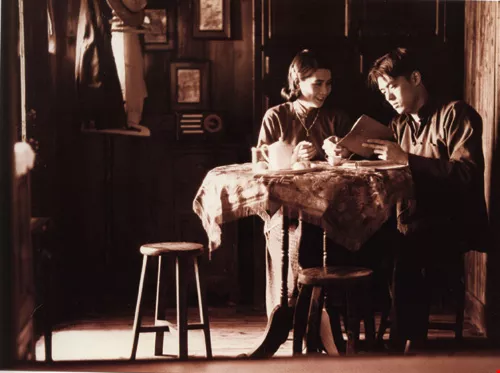
Renowned director Hou Hsiao-hsien insightfully cast Lim Giong, who had no formal training or experience, as the lead in his The Puppetmaster. Lim gave a solid performance.
Goodbye to the mainstream
"I turn on the TV and see a bunch of smiling faces / I turn on the radio-isn't there more to life to sing about than love? / I turn on the TV and see a bunch of singers acting stupid and becoming the butt of jokes... / The entertainment world, a joyous world, an idiotic world, a crazy world...."
Lim finally exposed the exploitative environment he'd seen in his years in the entertainment industry and satirized his life as a pop star in 1994's Entertainment World.
Entertainment World mixes electronica and rock styles and is full of dance beats, industrial noise, and electric guitars. The currents it releases assault the strongest and weakest points of the listener's heart. Adding to the effect is the strange, abstract cover art, which is completely the opposite of the studio portrait adorning most pop stars' albums.
In addition to being musically challenging, the album also contains Lim's sharp observations of contemporary Taiwanese society. He attempts to use his song lyrics to critique the entertainment industry and mandatory military service as well as to express concern for environmental problems and society's disadvantaged. The entire album has a rich, humanistic feel.
Perhaps the music was too avant-garde. Though the album is well regarded now, at the time it was heavily criticized. Lim says that one fan even returned the album to him, having written on the cover, "This is a bunch of deafening noise. I'll never buy your albums again."
"But I knew that this was the real me, and this was the music I really wanted to make," he says firmly.

Above: stills from the film Still Life.
A new direction
With an alternative style and unwilling to do promotion, Lim quickly found himself blacklisted by record companies. On top of that his albums sold poorly, and overnight the pop idol was an average person once again. His income was much lower than it had been. Though it was all his own choice, Lim admits that at this stage he had some internal struggles.
"It's a good thing that Hou Hsiao-hsien appreciated my work and found another path for me," Lim says.
The director Hou Hsiao-hsien is a pivotal figure in Taiwan's film world. The two met when Lim was filming a video for his single "The Old Oden Seller" with the national-treasure puppeteer Li Tien-lu. Hou was in the process of filming The Puppetmaster, a film based on Li's life, and they met on set.
When asked why he'd want to work with Lim, who had little acting experience at the time, Hou says that the power and creativity in Lim's singing performances left a deep impression. "There's a kind of intangible self-confidence there that is hard to forget," Hou says. "I thought maybe I could get him to put that power into a film performance."
Lim didn't let Hou down. The two collaborated on The Puppetmaster; Good Men, Good Women; and Goodbye South, Goodbye. Lim starred in all, and all received good reviews. Even so, with his lack of formal training Lim says himself that it is obvious that he couldn't act and his performances were weak in the first two.
"In the end, Hou taught me a way to do it," Lim says. "He said, 'Since you can't act and don't know how to interpret the characters' feelings, just be real!'"
While playing a gangster in Goodbye South, Goodbye he heeded this advice, putting on a tacky floral-print shirt every morning and carrying a pack of betel nut and two packs of cigarettes. He'd go out like this and hang out with some gangster acquaintances of Hou's producer in front of their clubhouse.
"Gambling, smoking pot, going out to hostess bars-during that time I did all the things that were against my morals. I only discovered later that if someone wants to indulge in these things, it happens faster than you can imagine and once you've tasted the thrill of sin you can't go back," he says.
However, Lim, whom Hou describes as the most self-aware actor and artist he knows, was very clear about what he was doing. He used this period of moral discovery to let out the long-repressed frustrations of being a mainstream pop star, and he successfully interpreted his gangster character.

Lim has created countless pieces of music over the past 18 years, ranging from pop to commercial and film soundtracks, and multimedia music. He's touched on all manner of subjects and styles.
Scoring and DJing
In addition to giving Lim a career as an actor, Hou also found a new avenue for his music. In order to push Lim's creativity, Hou bravely turned over the responsibility for scoring Goodbye South, Goodbye to Lim, who had almost no scoring experience.
Lim lived up to Hou's expectations. He collaborated with indie rock bands Peter and the Wolf and LTK Commune as well as non-mainstream artists Summer Lei and Chao Yi-hao to make a vital soundtrack to this story of underworld thugs. It's a portrait of their tears and sadness, the conflicts between their emotions and their circumstances. Lim created the song "Self-Destruction" for the film, a song that later won the 1996 Golden Horse award for best original song from a film.
"Due to this producing experience, I discovered that the chemistry between music and images is very interesting. At the same time I also became more determined in what path I wanted to take in the future," he says.
By 1997, Lim was completely free from the mainstream entertainment world. He began to immerse himself in techno and electronic music, and formed the bands Groove Island, Ho Party, and "bit everysound" with friends. He began DJing at coffee shops, abandoned warehouses, and art galleries, and even under Taipei's Huachung Bridge and at a Linkou film studio, throwing events to introduce the electronic music he loved.
Lim points out that electronic music is very multidimensional and open, but in Taiwan it often carries negative associations with nightclubs, drugs, and addiction. He and his DJ friends hoped to overcome these stereotypes. At their parties, they played music that was more for listening, had less of a regular beat, and was more abstract.
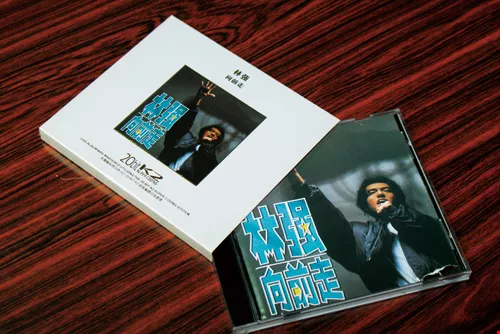
Until the rootsy, vital "Marching Forward" came along, Taiwanese-language music tended to stick to melodramatic themes of romance and hard luck. The song made Lim Giong a star overnight.
Millennium Mambo
Producing electronic music became central to Lim's life. He got together with friends to form Fluid-mix, a studio that made music for commercials and websites. Now he mainly works on his own, covering broader territory including film and documentary soundtracks and working with other multimedia artists.
Though there is not much market for electronic music in Taiwan, Lim has broadened people's minds and opened up a new world here.
In 2001, he produced an electronica record for Magic Rock Records to fulfill his old contract. After listening to it, the record company decided that there was no market for it and sat on it. Little did they expect that later Hou Hsiao-hsien would make the album the soundtrack to his film Millennium Mambo, and that it would win that year's Golden Horse award for best original soundtrack.
As Millennium Mambo found success in Europe, Lim's unique musical style also started to develop an audience.
After the success of the film, the Cannes Festival-one of the four major film festivals in the world-and the French music and film production and distribution company mk2 invited Lim to come to France to present a new work. In 2005, Lim presented a work featuring digital content from the National Palace Museum and videos by other Taiwanese artists at Cannes, where it wowed the international audience and the critics.
mk2 released Lim's album Insects Awaken and debuted it at Cannes. The album's theme is "stereo pictures," and in order to bring out Taiwan's own unique character Lim traveled around collecting environmental sounds such as rainfall, insects, birdsong, conversations, traditional music such as Taiwanese Opera and gongs, and even the clacking of mahjongg tiles and night market hawkers' pitches. He placed them all within percolating and vibrant electronic rhythms and layered the result with his own magnetic voice, bringing the listener into a rich and layered sonic environment.
This well-received album exceeded everyone's expectations and won the 2006 Golden Melody award for best crossover album. The same year he became a spokesman for the National Palace Museum and produced the music for an ad for it entitled "Old is New." The spot won a Muse award for promotion and marketing from the American Association of Museums.
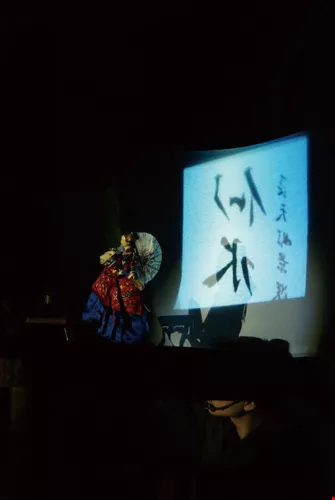
Lim's crossover musical work with multimedia artists and performance troupes is pioneering and much in demand at film festivals and other events. Pictured above is a scene from the 30th Golden Harvest Awards ceremony; below, Lin at work at a crafts fair in Taipei's Hsimenting.
Still marching forward
After having disappeared for nearly ten years, the familiar name "Lim Giong" is popping up again in the mainstream media. But now Lim has a new identity-no longer a manufactured, commercial pop idol, he's a self-confident music producer.
Early this year, the piece he created with other Taiwanese multimedia artists, "Lightening Music Seeds," was displayed at the National Taiwan Museum of Fine Arts in Taichung for four months. He was also invited to perform at an arts festival in Singapore. In January of next year, he will perform at the MIDEM trade show's "Taiwan Night" at Cannes at the invitation of the Government Information Office. The performance will feature puppets, dancing, and electronic music in a multimedia version of Sanlang Sells Tea.
Easygoing and not after fame or profit, Lim Giong has a calm and indifferent attitude while discussing the ups and downs of his long career in music. He says it doesn't matter to him whether or not his works get good reviews or become popular. As long as he can express himself through his creative outlets, he feels an ineffable joy.
He isn't an electronic music master, nor is he a virtuoso artist. He is Lim Giong, still "marching forward" 18 years on.
Intro to Electronic Music
| Electronic music is defined as music that is produced using synthesizers, effects boxes, computer software, drum machines, and other electronic devices. Electronic music can be broken down into categories such as techno, trance, house, and drum and bass. It developed along with nightclub culture and rave parties. DJs play electronic music to create an exciting atmosphere. However, it is just these associations with nightclubs and raves that make many think of electronic music as deafening noise. In actuality, electronic music has a broad range of uses. It can be heard in film scores, music for advertisements, and even pop and rock music-it's just that most people don't notice it. |
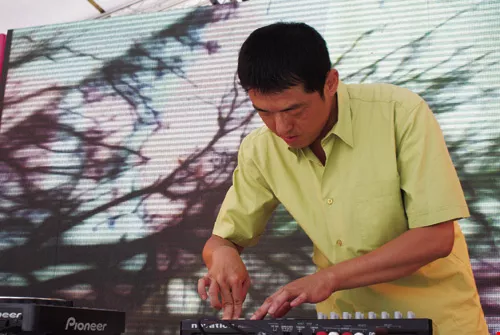
Lim's crossover musical work with multimedia artists and performance troupes is pioneering and much in demand at film festivals and other events. Pictured above is a scene from the 30th Golden Harvest Awards ceremony; below, Lin at work at a crafts fair in Taipei's Hsimenting.


