Han Yu, Hakkas, and Examination Hopefuls Come Together at Changli Temple
Tsai Wen-ting / photos Jimmy Lin / tr. by Bruce Humes
November 2002


With the arrival of examination time, crowds of students preparing to take their exams are bound to pour into Changli Temple in Pingtung's Neipu Rural Township in order to pray to Han Wen Gong-Han Yu, the Tang dynasty's great homme de lettres-for literary excellence and good luck on their exams. Unlike the typical "fortune-oriented" temple, the boisterous celebrations of Han Yu's birthday at this Changli Temple-the only one of its kind in Taiwan-display a rich "literary ambience."
On the ninth day of the ninth lunar month this year (Double Ninth Festival), a mass of devotees crowd into Changli Temple, located in the Liutui of Neipu in Pingtung County. But unlike in a typical temple, senior citizens are outnumbered by children brought by their elders to wish Han Wen Gong a happy birthday. "If you want to come first in the exams," exhort those of the older generation," you must burn incense for Han Wen Gong."
"Then I am going to pray twice so I can score highest on both exams this term," says a fifth-grade young girl surnamed Chung.
Inside the temple, walls on either side are filled with photocopies of Exam Entrance Permits for all sorts of students from all over Taiwan, from middle-schoolers' core curriculum tests to entrance exams for MA and PhD candidates, exams for overseas study, public exams for candidates seeking government posts as prosecutors, law clerks or bailiffs, and even interview notices for job openings are plastered on the wall. Every June and July during the exam season, there are people everywhere you look and moving about in the temple is a real chore.
Changli Temple is the sole temple devoted mainly to the worship of Han Yu (Han Wen Gong), and he is the patron deity of all Taiwan's numerous students. "From olden times, our Neipu has produced lots of successful scholars in the imperial exams," explains temple committee chairperson Chung Cheng-Hsiung, "all thanks to the influence of Han Wen Gong."
Just this year there was a candidate who, to show thanks for passing a special exam, came from far-away Ilan to present a red envelope containing NT$30,000 to Han Wen Gong. On a typical day it is not rare to see people coming to express their gratitude with a golden tablet bearing an inscription. Three women, seniors at Pingtung University of Science and Technology who are preparing for their masters' exams next year, their hands grasping sweet-smelling incense, state their names and ages and chant in sincere prayer to Han Wen Gong: "As the sky is round and the earth is square, wherever I go may I be constant in what I do, may my name appear on the honor roll and bring honor to my ancestors."
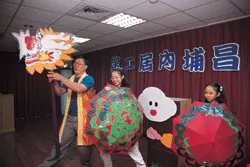
“Dragon’s Breath Transformed into Clouds” turns Han Yu’s story into a lively event for parents and offspring, leading children lightheartedly into the world of Han Yu’s writing.
Han Yu arrives in Taiwan
"Ancient temple, still magical, for good fortune pray at Tienhou Temple, and for success at examinations, pray at Han Gong Temple. For those who burn incense will be protected." So goes a children's folk rhyme in the Neipu area.
Says Chang Kuo-jung, a man of about 40 who lives near Changli Ancestral Temple: "We knew about Han Gong when we were small, but it wasn't until middle school that we knew he was actually Han Yu, the great literary master of the Tang dynasty."
If you want to talk about the relationship between Han Yu and the residents of Neipu, you have to go back to the days of the Tang dynasty emperor Xianzong, in 819 AD. Some 1180 years ago, Xianzong dispatched men to Famen Temple in Shaanxi to bring the Buddha's relics back to the capital city. From the emperor's ministers down to the common man, everyone was competing to pay homage to the Buddha's remains.
Han Yu, 52 years old at the time and serving as a high-ranking official in the Ministry of Punishments (equivalent to a deputy minister in today's Ministry of Justice), found this situation totally irrational. Therefore he penned a Memorial on the Bone-Relic of the Buddha, arguing that the act of accepting the Buddha's relics was harmful to social mores and made the emperor the object of derision, and that many emperors who had accepted the Buddha's remains had died ahead of their time. The emperor was so incensed that he wanted Han Yu's head. Han Yu was pardoned, but only thanks to the strong support of all the ministers, and was exiled to the Chaozhou area of Guangdong, which at the time was still uncivilized and malaria-infested.
Despite being exiled to a backwater, Han Yu worked hard and made many contributions, particularly in terms of promoting moral education and nurturing talent. In the text of the Stele for Chaozhou's Han Wen Gong written by the Song dynasty literary master Su Dongpo, it is recorded that: "After Han Yu, the literati of Chaozhou all became more earnest in their pursuit of literary excellence."
To express their gratitude to the virtuous governance of Han Yu, the people of Chaozhou established a temple to worship him. During the Ming and Qing dynasties, surrounding counties all worshipped Han Yu as a local protective deity. When they emigrated to Taiwan, the ancestors of today's residents of Neipu-as per the traditions of Chaozhou-reverently brought the idol of Han Wen Gong with them to worship.
Inside Changli Temple, besides a place of worship for Han Yu, on either side are statues of Chao De, whom Han Yu invited to come to be responsible for education, and Han Yu's nephew, Han Xiang, known in folk history as Han Xiangzi.
At dawn submitting an epistle to the heavenly court,
At dusk exiled to Chaoyang eight thousand leagues down south.
Desiring only to rid his majesty of things evil,
And willing to sacrifice what remains of my waning years.
Clouds hang menacingly over Qinling ridge, and where lies my home?
Languan Pass packed in with snow, and my horse forward cannot go.
Coming from afar you must have come for a reason,
perhaps to collect my bones from this disease-ridden riverside.
A horizontal inscription hangs high on the walls of the temple, upon which is carved Han Yu's poem attesting to his principled character. And the object of that poem was, in fact the person who had accompanied him to Chaozhou, Han Xiang.
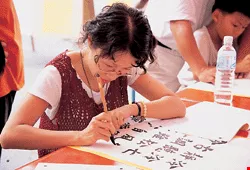
Calm the mind by copying a Tang poem, then recite it before Han Wen Gong himself. . . to win your own calligraphy brush. There’s a rich cultural ambience at the Rites for Han Yu.
A new voice in the lecture hall
There are two variations on how Changli Temple was built. According to one, in 1803 its establishment was sponsored by Chung Lin-chiang, an earlier man of virtue in Neipu. Another version has it that it was built by Li Meng-shu, a practitioner of martial arts. At that time, the nearest Confucian School to Neipu was in Fengshan prefecture some twenty li away, so Neipu's residents engaged a teacher to lecture and cultivate talent. For a time, a learned culture became the trend, producing successful candidates in the imperial examinations for suijinshi (Chiu Kuo-chen), jinshi (Chiang Chang-jung), juren (Chiu Yun-peng, Tseng Chung-li, Tseng Wei-chung, Li Hsiang-jung) and others.
Sponsor Chung Lin-chiang founded the Worship Rites Foundation to help pay costs for the lecturers and their students, and Liutui Keju Foundation to provide funding for candidates taking the county-level exams as well as those traveling to the capital for national exams.
Even after Taiwan was ceded to Japan, Changli Temple still served as the "Chinese" school for local children. "When we were small and before we went to elementary school, we all carried a woven straw bag holding some books such as the Three-Character Classic and Tang dynasty poetry, as well as a small stool, to take to Changli Temple where we studied Chinese." Even today, 60-year-old committee chairman Chung Cheng-hsiung and committee secretary Chiu Hong-chun still recall the sound of what were then perhaps 30 students reading out their texts with their teacher.
In the 1940s as Japan's rule neared its end and China's civil war intensified, except during "exam season," the sound of verse rolling off the tongues of students ceased to be heard, and people seemingly gradually forgot Changli Temple's uniqueness. But last year a number of former students from Neipu born in the 1960s, including Tseng Ta-jen, Liu Hsiao-ming, Li An-chi, Huang Tzu-huan and Chang Wei-cheng, assembled to help re-create the former ambience of the academy where culture was once propagated.
"You can often see young students making an appearance in Changli Temple, which is a sort of 'theme temple' revolving around cultural education," explains Liu Hsiao-ming, chief secretary at Pingtung Community College. "Going to the temple to pray during exams is a shared memory among children in the Neipu area. Building on this, we hoped to re-create the temple's role as a center of cultural learning, and give it the functions of a modern educational foundation."
With Tseng Ta-jen's bookstore as headquarters, a group of young people gathered together and, because Han Yu's birthday was just a month away, each person put forth the resources they had at hand, and then combined those resources with those of Changli Temple. For instance, they worked with the community college's renowned experimental drama troupe to launch an open-air drama based on Han Yu's Funeral Oration for the Crocodile. And woodblock artist Huang Tzu-Huan rendered Han Yu's image as a woodblock, and provided it to the public to print their own honor roll lucky charms.
Fresh with their new concept, the next day the youngsters approached the management committee with their idea. Since the costs need not be borne by the temple, the management committee let the young people give it a try. "Rites for Han Yu" consisted of performances at Crocodile Ode Outdoor Theatre, as well as the printing of honor roll lucky charms, an exhibition of bookplates, batik handkerchiefs and a lecture about old photographs. Just the queue of people who wanted to get a honor roll lucky charm extended outside the temple and then some.
This first ever Rites for Han Yu cost less than NT$100,000, but successfully made a name for Changli Temple while also educating people about the special character of this culture-oriented temple.
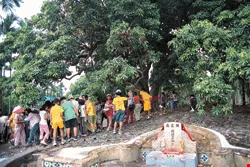
With the Celebration of Cultural Sites replacing the traditional festival parade, Rites for Han Yu succeeds in attracting large numbers of children and adults to the temple. The picture shows Neipu’s foetus-shaped Po Kung and Sacred Tree.
Study Han Yu on the family plan
After the first Rites for Han Yu, the number of people coming from outside counties and towns markedly increased. Said one deeply moved mother: "We've never had any kind of cultural event here in Neipu before. I never expected to see an event like this right in front of our home."
This year for the second annual Rites for Han Yu, the committee gave an even freer hand to young people to do their thing. For three days running, several different, more refined events introduced Han Yu; at the same time, the collaboration with the Hakka communities in Neipu and the rest of Pingtung County was deepened, so that Han Yu has become a source of cultural pride.
Scene: October 14, 2002. The second annual rites at Changli Temple. First to take place is the Han Yu Literature Seminar. Using Han Yu's In Memory of Shi'er Lang as a point of comparison, Pingtung Community College lecturer Kuo Hui-jui discusses how modern education treats the subject of death. Tseng Hsi-cheng, a lecturer at the Department of Social Studies Education of the Taipei Municipal Teachers College, talks on the special relationship between Han Yu and the Hakka people.
Meanwhile, "Parents and Children: Let's Study Han Yu" brings adults and young children even more fully into the world of Han Yu's writing. "Long, long ago, the dragon was just a normal creature crawling upon the earth. One day he discovered he could blow forth beautiful clouds which brought great pleasure to human beings, whereupon he began to put all his strength into spewing mist which formed into a string of lucky clouds. Finally, the dragon rode his clouds into the sky, becoming a powerful and auspicious magic dragon."
This text is based on Han Yu's Essays. By means of a dragon head and several umbrellas painted with fish scales manipulated by the children, Dai Chen-ni, deputy chairperson at Pingtung Community College, allows them to understand that Han Wen Gong intended for children to experience the idea that they too, through their own efforts, can soar like dragons in the sky.
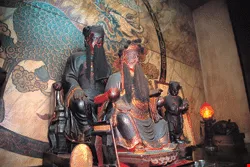
Full-length official dress, scroll in hand: The Tang homme de lettres Han Yu has become the key patron of exam-wracked students in southern Taiwan.
Fearless Han Wen Gong
The events of the first day mobilize the resources of Pingtung Community College's teachers and staff. Hakka Communal-Building Music Rites, performed that night, and the Celebration of Cultural Sites and Hakka Autumn Songs, activities on the second day, are aided by various Hakka bodies including the Pingtung Plains Culture Association, the Community Development Association of Neitian District, the Hakka Charity, and the Association for the Promotion of Dialects.
"We hope to use Rites for Han Yu to promote unity among different groups of Hakka people," explains Chang Wei-chang, a former local representative to the township council and also sponsor of the first annual rites.
Many arrive in chartered vehicles, including students and teachers from many nearby elementary schools. With a map and five "passes" in their hands, one by one they are introduced to Hsitsu Pavilion, where Hakka burn paper upon which words have been written as an offering to deities; visit Po Kung (the Earth God), whose image is similar in shape to the graves used by the Minnan people of Fujian and Taiwan; stop at the Sacred Tree; and watch screen-making. The last "pass" requires copying a Tang dynasty poem with a calligraphy brush and then reciting it before the image of Han Wen Gong. This form of worship, with its profound meaning, leads many older adults on the side to clap their hands in enthusiasm.
While Han Yu's eventual friendship with the Hakka was due to chance, their veneration of him has left a traceable trail. "Han Wen Gong's spirit and our Hakka spirit are very similar," local senior citizen Liu Jui-an explains. "Han Yu dared to advise against providing a home for the Buddha's relics at a time when the court was mesmerized by Buddhism. His fearlessness in the face of the threat of death is what we Hakka call 'hard-headed.'"
That aside, Han Yu's work as a teacher in Chaozhou, and his emphasis on education, are also similar to Hakka values. "In the past when our ancestors came to Taiwan, they made the land farmable but they also promoted learning. Working the fields when the sun shines and studying when the rain falls-that's Hakka tradition," explains temple management committee secretary Chiu Hung-chun. "Even if our parents had to sell their rice paddies, they would do so to get an education for their children."
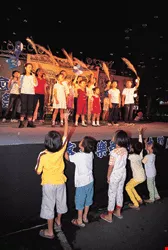
Thanks to the Rites for Han Yu, Pingtung’s Hakka community bodies come together for a wonderful, multifaceted performance at an evening celebration.
Verses roll off the tongue
The third and last day of events-the ninth day of the ninth lunar month-is the anniversary of Han Yu's birth. Early morning, white walls, black tiles. Decorated simply but elegantly, the Changli Temple building, whose architecture is so typical of the Hakka of Neipu, is crowded with incense-burning pilgrims and adoptees.
On the vermilion doors are the words "Gate to Civility" and "Path to Righteousness." At either side of the central courtyard are a whole pig and a whole lamb. When the auspicious moment arrives, a traditional Hakka eight-note suona horn rings out. Cloaked in Tang dynasty ceremonial dress, Deputy County Commissioner Wu Ying-wen and legislator Tsao Chi-hung formally make the three offerings: The flower offering, the fruit offering and the wine offering. Thereafter, the temple management committee members, garbed in long gowns, begin the complicated and solemn rites of worship.
"Disciples are to form into groups, stand at attention and maintain silence, each performing his tasks unceasingly." As the master of ceremonies sings out each step of the rites, the drummers beat three times, the ringers strike their bells nine times, the door-guardians open their doors. . . and just then, the yellow curtain around Han Wen Gong's statue is lifted. With a tome in his left hand, Han Wen Gong formally accepts the good wishes of the public upon his birthday.
The master of ceremonies leads all worshippers out the door where they are ceremonially cleansed with water. With umbrella and fan in hand, the ritual assistant greets the deities, and all the worshippers kneel three times and touch their heads to the floor nine times.
The master of ceremonies kneels and reads the text of worship in praise: "Born after Confucius and Mencius, Han Yu, renowned Confucian scholar of the Tang. . . with his brush he moved the winds and clouds at will, impacting generations to come, and served as a pillar of the dynasty. . . we perform these three offerings, though modest, in the hopes that we and the disciples who follow us shall be protected, culture may flourish and talent be nourished." The entire rites consist of some 12 stages and take more than one hour. No divination is performed, no noisy ritual to win favor from the gods-simply this serious and spare ceremony, which conveys the deep respect in which the Hakka hold Han Wen Gong.
One thousand and one hundred years ago, the exile of a great literary master of the Tang dynasty led to a special relationship with the people of Chaozhou in Guangdong. Even though Han Yu was in Chaozhou only eight months, he earned the love of the common people which has endured for over a millennium, during which incense has been burnt for him and rites conducted unceasingly.
In the main hall, the horizontal inscription "Paragon of Lingnan" hangs high aloft. Young students from Neipu's Futian Elementary School crisply recite Tang poems. The example of Han Wen Gong's spirit has literally come to life among these young children here in Neipu.
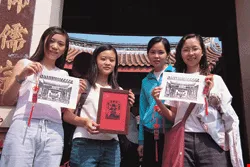
“Preparing” for next year’s exams: A group of Pingtung University of Science and Technology MS candidates making “honor roll lucky charms.”
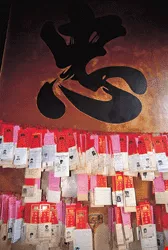
“Han Gong Temple, pray to pass your exams; burn incense, win his protection.” The walls inside Changli Temple are covered with all sorts of Exam Entrance Permits.
@List.JPG?w=522&h=410&mode=crop&format=webp&quality=80)

@List.jpg?w=522&h=410&mode=crop&format=webp&quality=80)


