Grand Mall Seizure! Mega Shopping Center Boom Hits Taipei
Laura Li / photos Jimmy Lin / tr. by Phil Newell
January 2002


For the shopping set, the winter of 2001 really was a season to remember. On October 26, the stores of the Breeze Center complex opened for business. The next day, NEO19, a mini-mall, hit the scene. Soon thereafter, on November 23rd, a mall that bills itself as the largest in all of Asia, one open 24 hours a day year-round, Core Pacific City Living Mall, also entered the fray. And on New Year's Day of 2002, Mitsukoshi opened its second department store (of a planned four) in the toney Hsinyi District.
It is early December in Taipei, and the weather is still warm and sunny. There is no hint of winter chill in the air, which adds fuel to the raging shopping fire. A Ms. Chung, who relates that she hasn't been to a department store for quite some time, has taken her son out searching for "buried treasure." When her ten-year old boy sees the steep escalators seemingly hanging in mid-air in the globe-shaped center of the Core Pacific City "Living Mall," he is thrilled to the bone, jumping up and down and looking all around in amazement. Later, he circles the broad spaces of the mall playing hide-and-seek. Thereafter, mother and son hop on the free Living Mall bus to the Chunghsiao East Road SOGO department store, and then it's on to Breeze Center's second floor open-air coffee shop to bring a close to their happy day. Ms. Chung makes a decision right then and there: In the future, she will loyally return to big complexes to shop, and no longer fritter away her time on "guerilla shopping" in boutiques.
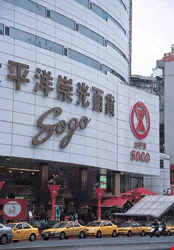
The Chunghsiao commercial district is lively, diverse, and fun-filled. Two lines of the MRT cross here, and Pacific SOGO department store, with its geographic advantages, has consistently been the leader in single-storefront shopping centers in Taipei.
"Taipei should have had an outstanding shopping environment like this long ago." With a mixture of satisfaction and exasperation, Horng Shun-ching, chairman of the Department of Business Administration at National Chengchi University, makes this observation on the rise of new shopping malls. He says that Taiwan's shopping environment has always been rather backward. Despite the high per capita income of the population, downtown Taipei had no shopping centers like the ones open now. Many shoppers went to Hong Kong-the shopper's holy land-drawn there by the bright and colorful consumer complexes lined up one next to the other along the streets.
Taipei still lags behind Hong Kong in terms of selection and price. But from the many tourists and business people from overseas who have organized groups to come to Taiwan explicitly to visit the new shopping centers, you can see that these have made an impact, and they are changing the face of Taipei.
When you look at these new shopping centers in detail, you find that they have a variety of styles and are governed by different concepts.
The Breeze Center, located on Taipei's Fuhsing South Road, calls itself the country's first city-center mall. It is divided into A and B galleries. The A gallery is nine stories tall, and includes a cinema complex, food court, and department store. The B gallery, which is really the main novelty, is a space-consuming two-floor structure, covered in enormous glass plates that block ultra-violet rays while letting the warm sunshine in. It hosts 25 top international brand-name stores, and is great for a leisurely stroll. There is an open air cafe on the second floor where you can rest your tired doggies, from where, if you are lucky, you can also take in a live show in "Victoria Plaza." For ordinary folks who might not be able to afford the designer fashions (which, says one wit, are only distinguishable by that extra zero tacked on to the price tag), you can always look for bargains in the A gallery, where you can find a nice outfit for NT$2000 and go home guilt-free.
Why the differential? "During a recession, consumer spending tends to become polarized," explains Jason M.T. Tsai, special assistant to the chairman in the Breeze Development Group. In Japan, for instance, where the economy has been in a rut for twelve years now, even as there has been continual price-slashing at the low end, there has been steady growth at the top end of the consumer market.
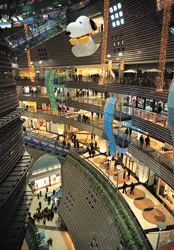
A combination of a sphere and straight lines, mixing high-end fashions with pop culture products, the unique Living Mall concept has kept Core Pacific City bubbling with people even into the wee hours of the morning.
"No matter how the economy is doing, the rich are still very rich," says Tsai. One store imported sable rugs from Denmark that sell for NT$400,000 (over US$ 12,000) each. They are few and far between, and the quota for all of Asia was only ten (six for Taiwan and four for Japan). Yet Breeze sold all six within 25 days of opening, an exhibition of consumer avidity that leaves your tongue hanging out.
Breeze tempts the ordinary urbanite with a combination of a comfortable, leisurely environment with low-priced clothing, which suits the current "Bobo" (Bohemian bourgeoisie) trend. Its polarized pricing strategy has niches where both the "new rich" and the "new poor" of the city can fit. From the fact that Breeze has achieved sales in excess of NT$1 billion in its first month or so, it seems that this strategy is very viable.
But given the exorbitant cost of land in Taipei, isn't it economically irrational to put only two floors of shopping space on a lot? Jason Tsai says confidently, "If you want to change the way shopping centers are run, you have to be willing to give up some space."
Tsai explains that Taipei already has 23 department stores, with everybody trying to maximize "return per square meter." They are all trying to squeeze as many products as they can into the smallest possible space to optimize sales. But in the case of Breeze, the "stockholder" is also the "landlord": Hey-Song Corporation owns the land it built the mall on, so it could afford to give the B gallery an American-style open, spacious feel. Tsai says that once consumers get used to such an environment, they won't want to go back to sardine-can traditional department stores.
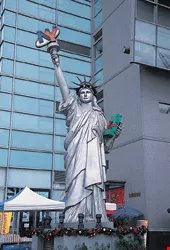
Seemingly oblivious to the chilly economic conditions, several glittering new shopping centers have opened in eastern Taipei to compete with the old established firms. Taipei is looking more and more international all the time.
When you are through at Breeze, you can head over to the Living Mall, only ten minutes away by car. This mall, which claims to have set a world's record with 500,000 visits in a single day, was designed based on the traditional Chinese "two dragons holding a pearl" motif. The centerpiece of the mall is a spherical structure, which also is said to be a global first. The sphere has a diameter of 58 meters, and is held in place by four enormous bases set eighty meters into the ground. There is shopping from the first to ninth floors, with a branch of the Eslite bookstore on 10 and 11. The L shaped area which branches off from the central sphere has hundreds of counters. Putting the two pieces together, the mall offers more than 130,000 square meters of floor space, staking its claim to be the unrivalled king of shopping centers in Taipei.
Sheen Ching-jing, group chairman of the Core Pacific Group, bristles at even discussing his Core Pacific City project in the same breath with department stores. When this happens, he quickly makes his standpoint clear: "This is not a shopping center, this is Taipei's one-and-only Living Mall!" Sheen's ideal is to have "entertainment-driven consumption" side-by-side with "entertainment-driven education"-realizations of childhood dreams-and not just to create another ho-hum department store.
As part of the emphasis on entertainment, and in an effort to make the maximum impact on visitors, Core Pacific City has spared no expense. Three multi-floor express escalators cut through the air. Visitors who ride them can gaze out over a "Grand Canyon" of lights and sound packed with visitors weaving in and out. You can't help but be impressed.
"Entertainment-driven consumption" is certainly a major trend in retail in the new century. In the Hsinyi District, another high-rent part of eastern Taipei, businesses directly threatened by Core Pacific City got together to spark some Christmas shopping spirit by sponsoring light displays, horse-and-carriage rides, and other activities, in order to keep shoppers in the neighborhood. The opening on January 1 of the second Hsinyi District department store of Mitsukoshi, with its firmly established reputation as the top department store group in Taiwan, should greatly add to the attractiveness of the district to shoppers.
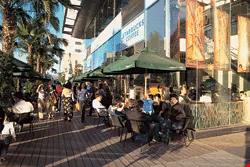
The Hsinyi commercial district has a more European feel. You can catch a movie, stop for coffee, and if you're lucky, while enjoying the afternoon winter sun, catch a glimpse of Tom Cruise crossing the street in front of the Mitsukoshi department store.
"If you look at it from the viewpoint of overall land-use planning, the Hsinyi District offers advantages with which other districts in Taipei just cannot compete," says Shauna Lee, assistant manager for Sales Promotions. The district has been laid out to offer a great deal of open space, broad vistas, and expansive pedestrian areas. To this, Lee adds a list of its other attractions: "If you want to see an exhibition, there's the World Trade Center. If you want to see a performance, there is Novel Hall. You've got Warner Village Theaters for movies, Starbucks for coffee, and NEO19 for dining and workout facilities. New York New York offers shopping for the younger crowd, while the office set can come to Mitsukoshi." In fact, "Except that it's not all under one roof, the Hsinyi District is really a complete mall!"
Lee points out that strolling through the Hsinyi District reminds one of being in Europe or the States: "Customers who come here feel relaxed and comfortable walking around, and they won't just hit a few stores at most, so that every shop in the commercial district can benefit."
The opening of the second Mitsukoshi in the Hsinyi District on January 1 is only the first move in Mitsukoshi's strategy to strengthen its competitiveness. In order to avoid overlap with the neighboring first Mitsukoshi, in the future there will be a clear division between the products of the two branches. The current Mitsukoshi will steadily move toward popular culture, and will include activities, information, and exhibitions, creating a hip contemporary atmosphere. The second building is positioned to have a more elegant, luxurious and mature feel. Three years from now the third Hsinyi-area Mitsukoshi, which will mainly focus on entertainment, will open, and the fourth will have begun to take shape. At that time, Mitsukoshi's blueprint for the Hsinyi District will establish it as the unquestioned department store leader in the district.
Mitsukoshi currently has eight shopping centers in Taiwan, with annual turnover exceeding NT$30 billion. This makes Mitsukoshi the second-largest retailer in Taiwan behind only 7-11. Why have they decided to open new branches at this time, when the economy is at a low ebb and powerful competitors are rising? Shauna Lee points out that the opening of new branches is based on a fixed long-term plan. Naturally it would be better to have the opening when the stock market is over 10,000 points, but from the point of view of long-term management of a department store, there will always be economic ups and downs.
Lee further advises that there's no need to panic in the face of strong competition: "We are our own toughest adversary, always challenging our previous records. We're not concerned with what strategies new competitors will adopt, nor will we try to match what they are doing."
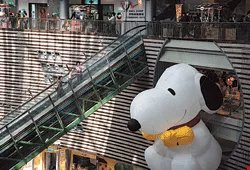
Seemingly oblivious to the chilly economic conditions, several glittering new shopping centers have opened in eastern Taipei to compete with the old established firms. Taipei is looking more and more international all the time.
Its opening 14 years ago created a sensation, and year after year it has been the champion among single-building shopping centers in Taiwan, with annual sales reaching NT$16 billion. What is the mood at the SOGO Chunghsiao East Road department store in the face of all this new competition?
"We're not worried," says K.J. Lee, vice general manager at the headquarters of Pacific SOGO Department Stores Ltd, without a sign of hesitation. Retail services are more than simply renting out floor space, there are also many tricks of the trade, and things that you can only learn through the experience of greeting a constant stream of customers coming through your door every day. Leaving everything else aside, simply maintaining good relations with customers, efficiently bringing in products, and managing the tenants is a whole field of learning in itself.
In particular, as products have ever-shorter life cycles of popularity (witness Portuguese egg tarts, Tamagotchi, and push scooters), shopping centers must constantly come up with something new to satisfy consumers. The skill and vision required to do this quickly, decisively, and accurately are certainly not things that a corporation with no background in department store operations can learn overnight.
As for the enormous space and variety offered by competitors, K.J. Lee argues that department stores are in any case positioned differently from malls. People who come to department stores generally have specific counters they want to hit, and come primarily to shop. At a mall, on the other hand, you can stroll, go to a movie, or watch a performance, and buying is a secondary activity that can easily be dispensed with. "If people go for the entertainment and only shop as a by-product of that, usually the revenues from this kind of shopping are not high," says Lee.
Horng Shun-ching of National Chengchi University notes that shopping centers thrive on crowds, so the three main conditions for success are "location, location, location!" From this point of view, both Breeze and Core Pacific City are a little out of the way, so they must constantly come up with promotional activities to keep stirring up the market and maintain customer loyalty. The one unassailable advantage enjoyed by SOGO is precisely its location: As if its location at the heart of the Chunghsiao-Fuhsing shopping district were not enough, the mass transit system has two lines that stop right at its doorstep. Not only does this solve problems of parking and being stuck in traffic jams, a large crowd of people are changing from line to line all the time. These are the main reasons SOGO has been able to maintain its reputation.
A combination of a sphere and straight lines, mixing high-end fashions with pop culture products, the unique Living Mall concept has kept Core Pacific City bubbling with people even into the wee hours of the morning.
K.J. Lee suggests: "In the future there will a battle to the death among retail districts." Eastern Taipei is the main bastion for department stores, especially the Hsinyi and Chunghsiao-Fuhsing retail areas. The Hsinyi District has a more European, elegant, and spacious feel. But it lacks the vitality and diversity of the Chunghsiao-Fuhsing zone, with its combination of stores selling brand-name fashions side-by-side with hawkers selling clothing right on the street. So long as the mass transit system is up and running, there is a constant flood of people through this area, so, on the logic that a rising tide lifts all boats, SOGO should be able to maintain its exalted status.
So sometimes the logic of boats rising with the water applies, and sometimes the individual canoe can also make its way. Given Taipei's large-scale shopping-center market capacity of approximately NT$70 billion per year, as new shopping centers pop up one after the other, will the result be the spurring of new demand, or merely dividing up the existing pie into smaller pieces?
Crunching the numbers, newly opened Breeze Center estimates annual revenues will be about NT$5 billion per year, while Core Pacific City is shooting for NT$20 billion. Many people doubt that these numbers can be reached.
The Chunghsiao East Road SOGO department store had its anniversary sale shortly after the opening of Breeze Center, and in a brief two weeks scarfed up NT$2.2 billion in revenue, so it seems they haven't been too adversely affected.
Although they do not fear competition, SOGO's K.J. Lee admits that this has been their worst winter ever. Over the past fourteen years, SOGO has maintained annual double-digit growth in sales, but 2001 saw only a 2% rise. Even if you do not include the NT$400 million in losses resulting from the flooding following Typhoon Nari, the growth rate was only 5%. However, even this number will look great if predictions of a drop of 5-7% in estimated total department store revenues prove true.
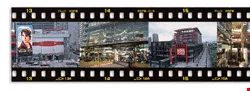
The Hsinyi commercial district has a more European feel. You can catch a movie, stop for coffee, and if you're lucky, while enjoying the afternoon winter sun, catch a glimpse of Tom Cruise crossing the street in front of the Mitsukoshi department store.
For the older stores, a bad winter could prove more fatal than the competition of the newcomers. How does Breeze Center evaluate the future of the market? Jason Tsai says that, with 23 shopping centers in Taipei, the market is about saturated in terms of quantity. But in terms of quality, there's a lot of room for improvement, and that is where Breeze intends to focus its efforts.
Looking at the numbers from overseas, Tsai points out that in the US about 50% of the amount that an average consumer spends goes to large-scale shopping centers (including department stores, malls, and hypermarts). In Japan, the figure is 25-30%, while in Taiwan it is only 11%. This indicates that the possibility exists for expanding the large-scale shopping center pie. So long as all the new shopping centers maintain a certain level of quality, potential consumers will come.
Market competition is getting critical. In order to avoid cutthroat price competition, expensive promotional gimmicks and other vicious cycles, Horng Shun-ching of National Chengchi University says that the best strategy will be for shopping centers to develop unique styles and seek "differentiation."
"In the future, small shopping areas will move in the direction of 'small but specialized' or 'small but beautiful.' For example, Idee department store now sells exclusively women's fashions, while the DMART department store in Neihu and the Takashimaya department store in Tienmu mainly focus on customers in their immediate area. These are both good approaches." As for the larger chains like Mitsukoshi, Far Eastern, and Pacific SOGO, these will try to take advantage of their large numbers of branches to get advantageous conditions from suppliers or tenants, in order to get around the competition posed by new shopping centers.
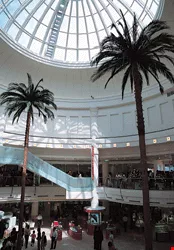
With its bright and well-lit corridors, and frequent shows or celebrity autograph sessions, Breeze Center is the first shopping center in Taiwan to create a leisurely, elegant consumer atmosphere.
"Competition brings progress," says Horng. From the point of view of businesses, the short-term operational pressures will increase. But in the long run, isn't this a motive for businesses to improve their structures and drive themselves to a higher level? In particular, now that Taiwan is in the World Trade Organization, international department store groups will be able to open stores in Taiwan, and the only guarantee against being defeated will be to develop well-rounded competitiveness.
Meanwhile, from the point view of consumers, Taipei is undoubtedly becoming more attractive and closer to the highest international standards. It is perhaps worth reminding consumers, then, in this year of change, to remember the "three principles of shopping": compare prices, don't buy what you don't need, and don't buy anything that's not on sale. That way, you won't be confused by the glitz and glitter of the new shopping centers and find that your money has burned a hole through your pockets!
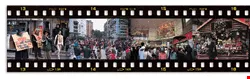
The Chunghsiao commercial district is lively, diverse, and fun-filled. Two lines of the MRT cross here, and Pacific SOGO department store, with its geographic advantages, has consistently been the leader in single-storefront shopping centers in Taipei.
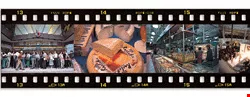
With its bright and well-lit corridors, and frequent shows or celebrity autograph sessions, Breeze Center is the first shopping center in Taiwan to create a leisurely, elegant consumer atmosphere.


