Spreading Their Rice Around--Fuli Township
Vito Lee / photos Jimmy Lin / tr. by Geof Aberhart
April 2005


The days of Japanese immigration to the Huatung Valley area, with its southbound railway track and towering mountains on either side, are long gone, but the attentive visitor will spot a definite Japanese flavor to the placenames on the way to Taitung-names such as Chi-an, Shoufeng, Jueisuei, Chihshang, Kuanshan, and Luyeh, all distinctively Japanese names when written in Chinese characters.
Fuli, sandwiched between these Japanese-sounding places, has long been a sleepy little place. But now the town is earning a big name for its rice, which has recently managed to break into the Japanese market.
Nestled in the narrowest part of the Huatung Valley, this small town was first farmed by Chinese immigrants over 160 years ago, who named the place Guangpu. Sitting at the southernmost end of the narrow county of Hualien, Fuli is neighbored by the township of Yuli to the north and the Taitung County township of Chihshang to the south.
Since its earliest days, the Fuli area has been home to two main townships-Fuli and Tungli-which have both earned reputations for their excellent agricultural produce. They were so successful with their farming that the residents of Fuli took to expanding the name into a nickname phrase-fushu zhi li, or "the populous, productive township."
But for a long time now the population has been falling, taking the township down with it. And the name Fuli doesn't have the illustrious meaning the locals have attached to it. It's simply a name of a state in ancient Japan, rendered in Chinese.
To their good fortune, the farmers of Fuli were able to finally get a foothold in the Japanese market, which had been closed to Taiwanese rice for over 30 years, and as a result the town is once again in the spotlight. The local farmers, so accustomed to living the simple life, are getting rich off their rice, and on top of all this the area is facing a seemingly never-ending stream of tourists to its beautiful scenic spots, including Mt. Liushihtan, which are the pride of Fuli.
All the myriad standouts of Fuli-the acres of fertile farmland, their excellent produce, and their growing reputation-seem to be combining to create a bright future for the township.
In any discussion of Fuli, the area's mountains and rivers naturally play a big part.
The town sits in the narrowest part of the Huatung Valley, towered over on the western side by the Central Mountain Range, which reaches as high as two or three thousand meters, and on the eastern side by the East Coast Range. On maps the latter looks like a relatively minor stretch of mountain at the coast, but when it reaches Fuli it gets truly magnificent. Mt. Hsinkang, Mt. Malao, Mt. Chengkuangao, and Mt. Tachuangyueh tower over the area, all standing around 1000 meters tall. Between these mountains lie stretches of fertile farmland, and amongst these fields lie 13 villages. Here lies the homeland of the children of Fuli.
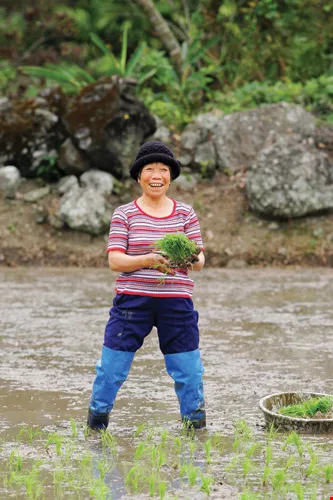
The smiling faces of Fuli: hardworking Amis rice farmer Lin A-mei
Heavenly waters
The pressure at the line where the Philippine and Eurasian tectonic plates meet has led to the creasing and folding that defines eastern Taiwan. Where the folding has been particularly intense, mountains have formed, and as they grew, water began to flow downhill, starting as mere trickles and growing into rivers, attracting people to the area. The history of the area briefly goes thus: first the Amis and Puyuma Aborigines settled the area; by the Qing dynasty it was home to no more than 2000 people, with Han Chinese settlers few and far between. During the Japanese occupation of Taiwan, migration to Fuli was established in a carefully planned fashion, in the interests of developing the farmland and providing for national defense and public security. Japanese outposts were established throughout the area, but at that time Fuli-then known as Kouho in Japanese or Gongpu in Chinese-had yet to gain any notice.
Regardless, the rich red and black soil and hills of the area, so suited to the planting of crops, were able to attract a number of Japanese businessmen to the town.
On top of this, the Japanese government started to put into place policies in the Huatung Valley area which led large numbers of people to move in and start developing Fuli, particularly in terms of transport infrastructure. At the beginning of the 20th century, the Japanese made plans for five narrow-gauge railways; these plans went through a number of revisions and delays, and then in 1926 the Huatung railway was opened, bringing large numbers of Hoklo and Hakka migrants. Gradually the population of the town started to grow, and over time Chinese residents came to outnumber Aborigines, much to the relief of the Japanese, who had had an especially strained relationship with the Aborigines. The railway line stayed active for 56 years, until the Taiwan Railway Administration decided to renovate the line in accordance with their plan for an eastern trunk line in the 1980s. The new line was to largely follow the old, though, and to this day that line and Provincial Highway 9 remain the main transport links to the outside world for the residents of Fuli. Fuli Township, being much longer north-south than it is east-west, is home to three stations along the railway line-Tungli, Tungchu, and Fuli.
During their time there, the Japanese were a major force in the area, and strictly controlled migration into the eastern valley. Later migrants, however, were less likely to come in large numbers, aside from those that arrived in the aftermath of the August 7 Flood of 1959. As our car reaches the famous tourist destination of Mt. Liushihtan, Tseng Chien-ming, who has worked for the Fuli power plant for over 30 years, points to the inscription "Yunmin" on a power pole, a reference to that last wave of migrants to Fuli.
During the early period after Taiwan was ceded by Japan, General Chang Li-jen established the Fuhsing Farm in Fuli, which was staffed by retired officers and servicemen. On August 7 1959, Taiwan faced the most serious flood in its history, in which a large number of farmers on the western plains lost their land and were driven back into the mountainous areas. Most of the migrants were from the Yunlin County township of Hsiluo. On seeing that most of the flat land was already being farmed, they moved on to Mt. Liushihtan, becoming the last group of migrants to the Fuli area.
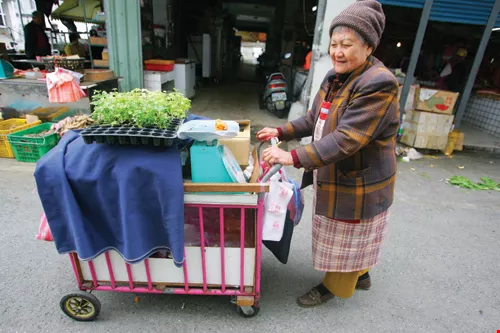
The smiling faces of Fuli:a street vendor pushing her cart after finishing work at the morning market
Longing for entertainment
After night falls, the entire village quickly turns silent. By seven each night, Fuli's central hotspot The Banyan Tree, a pharmacist, a general store and the fruit stands are the only things still going. After eight, the whole township turn their lights off, in preparation for another long day's farming. In the still of night, passing the old Jueiwutan Theatre, silent for nearly 20 years, it's hard to imagine this place was once alive with activity until 10 p.m.
"A lack of nightlife is Fuli's biggest problem," says town mayor Teng Kuo-hsiang, who often receives complaints from tourists who come here for overnight stays.
The population drain has made it hard for the entertainment business to stay afloat here, and the lack of entertainment makes it hard to get the sons and daughters of Fuli to stay in the town for very long.
Work is hard to find, and keeping the youth in their small towns has been the biggest problem for the agricultural industry in Taiwan for 40 years now.
In the 1960s, when Taiwan's economy was changing from agrarian to industrial, large numbers of young people from small rural villages were enticed to leave. Fuli, which boasted a population of 30,000 and a total of five theaters at its peak, has gradually been reduced to just over 12,000 people today.
"In Fuli, the most often heard lament is that 'all the talented people leave'," jokes Teng, "but in recent years the level of migration has leveled off and household numbers are stable."
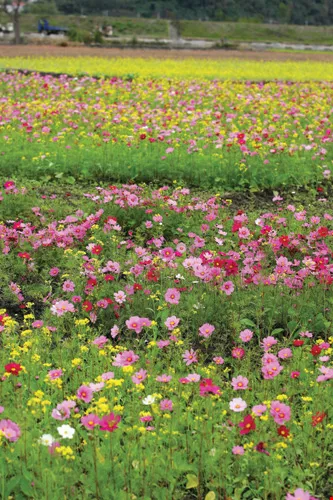
As well as the bright yellow of the rapeseed flower, calliopsis flowers of every hue add color to the early spring scenery of Fuli.
Life's treasures
As Chinese New Year approaches, the rich golden fields of rapeseed flowers that were on display in mid-January have been reduced to a few clumps of yellow. It looks as though virtually every rice paddy is full of transplanted rice seedlings. These 2500 hectares of rice paddies are the lifeblood of Fuli. In recent years, with the successful promotion of Fuli Rice and the long-awaited breakthrough into the Japanese market, the two growing seasons produced rice fetching up to NT$1400 per 60-kilo bag last year. "If this town were a company, we'd have most likely pulled in the highest prices in Taiwan," says Fuli Farmers' Association director Hsu Yi-ming.
For over 20 years Hsu has delivered newspapers by motorcycle while inspecting the local paddies in the early morning, and he emphasizes that "water is of paramount importance to Fuli."
Whether it's the Pieh Creek or the Chiu-an River, which flows down from the volcanic peaks of the Luoshan area, Fuli's rivers and streams all seem to flow north to eventually merge with the upper reaches of the Hsiukuluan River. You could say that Fuli enjoys a bounty of pure water bestowed by the heavens, whether it's used for irrigation or for daily use. As one visitor to the area said, "Even the syrup on the shaved ice was amazing-not a trace of bitterness."
The true major players in Fuli are the mountains and the water. The collision of two major tectonic plates have formed the towering mountain scenery of the area, and this has led to Fuli being constantly under threat of earthquake, as well as to the township's rising higher above sea level by two or three centimeters a year. As for water, in the past the area was frequently hit by flooding, and as TaiPower employee Tseng Chien-ming says, "it was particularly tragic for those who set up their paddies next to the streams, as they would often have their best farmland flooded out."
Thankfully, water conservation projects have been put into place over the past two decades, and this has gradually removed the threat of flooding. Now, the paddies that neighbor the streams which crisscross the township like a spiderweb are no longer victim to the whims of nature, gradually giving the farmers a sense of stability in their lives.
In recent years, both the agricultural and tourism aspects of Fuli have seen vast improvement, and have given the residents hope for their future.
"In the past we used to say that the kids who leave are the gifted ones, the ones who stay are the filial ones," jokes Chang Chih-chao, wh has just finished his term as head of Fuli Farmers' Association. "But if the agricultural and tourism industries can reach a point where people feel that there are opportunities here, we'll probably see more of our kids staying here in future."
Tourism alone draws around 300,000 visitors a year to Mt. Liushihtan, Luoshan's waterfalls and mud geysers, and the Antung Springs. Additionally, the fields of rapeseed flowers after each of the two rice-growing seasons each year and the scenic valley of Hsiaotienhsiang-situated by the Tungfu Highway-are major drawcards. The so-called "three agricultural jewels" of the area-rice, day lilies, and mushrooms-have also earned quite a reputation.
However, "no matter if it's tourism or agriculture, rice is at the heart of it all," says Fuli-born Hualien County councilor Su Hsiao-hsin.
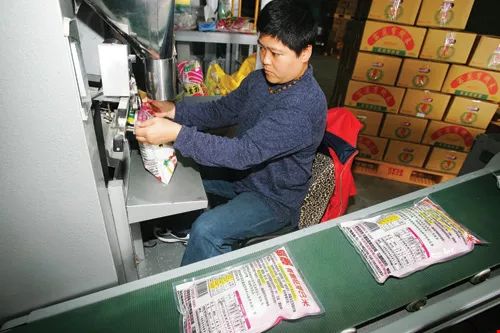
Mechanically sorted by color into three groups, the masses of sorted rice glisten in the light. They then go through the packaging process, ready for the ricebowl. Besides being tasty, the aesthetic appeal of Fuli rice was a crucial factor in its entry into the Japanese market.
Organic opportunities
In recent years more and more ideas have been put forward to help the people of Fuli make the most of their unique situation, such as regional festivals like the Mt. Liushihtan Day Lily Festival and the annual Rapeseed Flower Festival that is held at the beginning of each spring.
"At first the Council of Agriculture provided rapeseed seeds for us to plant around the place; residents of the other villages all laughed at us, but now they're all following our lead, and after the harvests at the end of each rice season, the entire valley glows a brilliant yellow."
"Now that it's so hard to get rooms in lodges on Mt. Liushihtan during holidays, we're hoping that the effects of tourism will spread further afield and let more of the locals enjoy some of the benefits," says Su Hsiao-hsin. With Mt. Liushihtan being the focus of the tourism industry, there's plenty of room for growth. "Whether it's nighttime entertainment or planning package tours to other tourist spots, it could all do with some more work."
"Last year the Minister of Transportation and Communications Lin Ling-san visited Mt. Liushihtan three times to be certain that a cable-car system would be a genuine benefit to tourism," says Su. At the start of this year tenders began being sought for the cable-car system, and public investment of around NT$1.3 billion is forecast. The Ministry of Transportation and Communications has said that in the event that tenders fail, the ministry is willing to undertake construction itself.
Although conservation groups have concerns about the building of a cable-car system, "the locals of Mt. Liushihtan are generally looking forward to its development," according to Chang Chen-yueh, the author of Fuli History.
Separated from Mt. Liushihtan by no more than a stream is the village of Luoshan, known for its waterfalls and mud geysers. The village is hemmed in on three sides by mountains, and has a single water source; not only does this help the village farm using organic methods, it helped make them the focal point for the future development of Fuli township.
Luoshan, which has in recent years been chosen by the Department of Land Administration as a model for the National Farming Renewal Plan, has comprehensive infrastructure plans. These include laying sewage pipes, moving power and phone lines underground, and a boardwalk which will give tourists the chance to experience the area anew.
At the same time, Fuli has been the first place in Taiwan to implement the "Organic Village" plan.
"First we encouraged farmers not to use chemical fertilizers, and to use green fertilizers such as rapeseed to allow the soil to balance out," recalls Chang Chih-chao about the process which Fuli has gone through to promote organic farming over the past decade. "Then that was complemented by a price guarantee system, to ensure that the association buys rice above the government purchase price, which meant we gradually got the cooperation of the farmers."
In the Luoshan Farmers' Association Distribution Center factory, a mass of rice is screened and sorted into categories, which can then be granted the "Fuli Rice" brand and the logo indicating that it has been organically produced in Luoshan. Since making their way into the Japanese market last year, the Fuli Farmers' Association has continued to work steadily, forecasting sales of 208 tons of rice this year. Luoshan Organic Village is scheduled to open in 2007, where they will raise everything from rice to fruit trees organically. This way they will be more able to "pull away from ordinary rice price-wise" and take Fuli Rice to the next level.
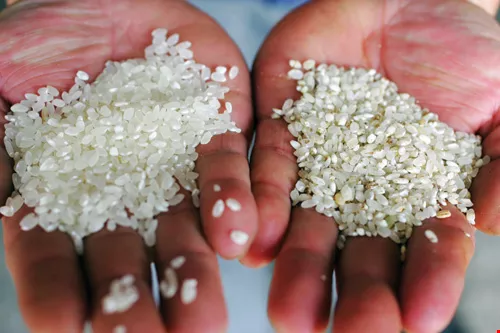
Mechanically sorted by color into three groups, the masses of sorted rice glisten in the light. They then go through the packaging process, ready for the ricebowl. Besides being tasty, the aesthetic appeal of Fuli rice was a crucial factor in its entry into the Japanese market.
Ethnic harmony
Walking onto the campus of any of Fuli's high schools or elementary schools, you can often hear the local children joking around in their own unique variant of Mandarin. "Aside from the Tachuang Incident way back in the past, which led to strained relations between the local Amis Aborigines and the plains Aborigines, there's a pretty even spread of ethnicities in Fuli, and you virtually never hear of any sort of ethnic strife," says Chang Chen-yu.
"The vast proportion of Aborigines, Hakka, and descendants of more recent Chinese immigrants all get along fine with the majority Hoklo residents, and the children here learn at an early age how to live side by side with those of different cultural backgrounds," says a teacher by the name of Lin who has been teaching in Fuli for almost a year. "As a result, people can joke about their respective differences, but those differences are never used in a discriminatory fashion; most people just treat them as ordinary."
The mountain scenery is reflected in the water, and the rice seedlings sway in the wind. Above the heads of the residents of Fuli float fluffy white clouds. The wonderful mountains and excellent water have attracted migrants to this area for over 160 years, and the region has seen the rise and fall of several small towns and villages. Now the residents are feeling a whole new level of pride, which has added another element to the wonderful scenery of Taiwan.
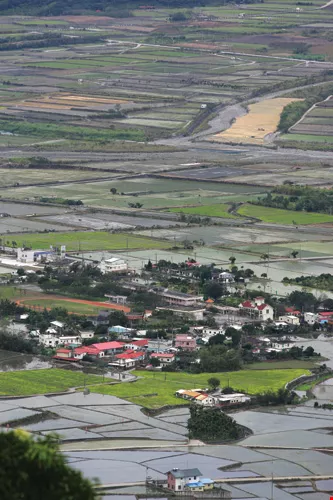
An array of colors, the water and soil working in harmony; Fuli is literally picturesque.
Fuli in Brief
Fuli Township sits in the central part of the Huatung Valley, neighboring the townships of Yuli to the north and Chuohsi to the west. It is bordered on the east by mountains and the Taichung County township of Chengkung, and the Taitung County township of Chihshang in the south. The township covers a total area of 176 square kilometers, and has a population of approximately 12,000 people, spread across 13 villages.
The area's original inhabitants were the Aboriginal Amis and Puyuma peoples. They were later joined by large numbers of plains Aborigines who had traveled north from Pingtung, and later still by settlers from Fujian, and by Hakka and other mainland Chinese. At present, people of Hakka and Fujianese descent each make up 40% of the population of Fuli, with Aborigines and families that migrated to Taiwan after 1949 each making up roughly 10%.
The main agricultural products of Fuli Township are rice, mushrooms, and day lilies. Additionally, the area produces a large number of fruits, particularly pomelos.
Fuli Township Farmers' Association website:
http://www.fulifa.org.tw/
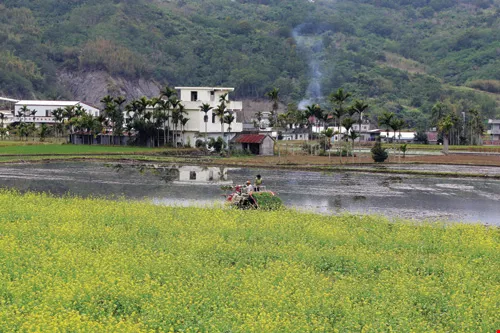
Beside a field of rapeseed, farmers prepare a paddy field for planting out rice seedlings. On fields like these in early spring, there is a definite air of optimism about the place.
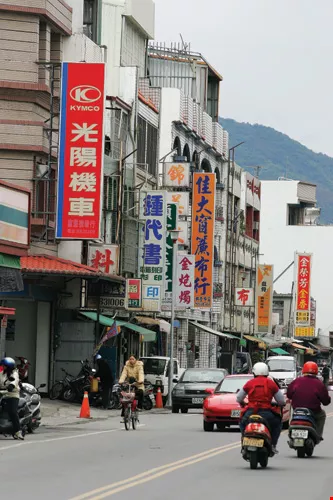
As in numerous other townships, the main road in Fuli is called Chungshan Road, and is packed with stalls and stores.
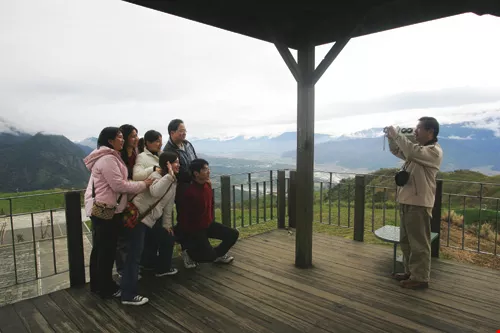
Mt. Liushihtan, known as "Little Switzerland," sits almost 1000 meters above sea level and is home to spectacular mountain scenery.
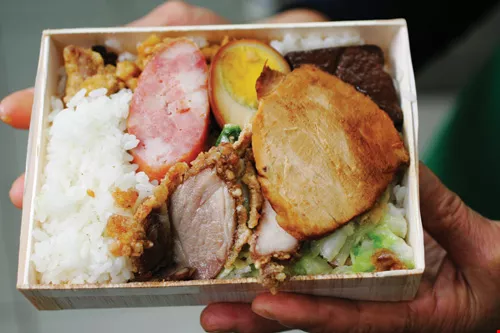
Mechanically sorted by color into three groups, the masses of sorted rice glisten in the light. They then go through the packaging process, ready for the ricebowl. Besides being tasty, the aesthetic appeal of Fuli rice was a crucial factor in its entry into the Japanese market.
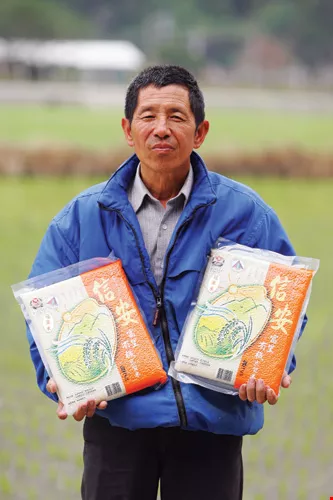
The smiling faces of Fuli:and farmer Chien Ming-chih, carrying two bags of rice sporting the brand name "Hsin An."


@List.jpg?w=522&h=410&mode=crop&format=webp&quality=80)


