

Chou Chun-hsun, winner of the 2007 LG Cup world championship Go tournament, is Taiwan's first locally born and raised world champion Go player. At 27 years old, he has been playing the game for over 20 years, honing his skills to one day reach the top of the Go world. Chou attributes his success to a combination of luck and hard work: "I'm no Go genius, and I don't think anyone really is. So-called genius is built on a foundation of tireless practice, the right opportunities, and the right environment. My winning this tournament is no exception."
A nine-year-old dropout
Walking into Taiwan Chi Yuan, a Go school on Taipei's Roosevelt Road, you'll often see a young man sitting in the corner, silently studying Go games and engaging in matches against players from around the world on the computer. Sometimes, when he's tired, he'll take a break from the high tension of Go matches by immersing himself in the virtual world of the online game World of Warcraft. The right side of his face is covered by a huge red birthmark that stretches from the back of his neck around to the bridge of his nose. When people first see him, the sight of the birthmark often throws them, but the young man seems to have got accustomed to the strange looks and pays it no attention. This young man is none other than the "red-faced Go king," Taiwan's top Go player Chou Chun-hsun.
While today he may be top of the heap, Chou only began studying Go at age seven-in relative terms, hardly an early bloomer. Twenty years ago Chou's father, Chou Yen-shan, was a sixth-dan Go player, his passion for the game making him famous in the Taiwanese Go community as the "Go madman." As a young man, the elder Chou's passion for Go saw him travel around the major clubs looking for challengers. His life's goal was to go pro. But there was only so far his skills could take him, and eventually he put his old goal aside and instead put his hopes on his children.
Unlike his three elder sisters, who had to be forced to play by their father, at around five years old Chou Chun-hsun would sit in front of the Go board calmly dropping down pieces for hours on end, despite having no understanding of the game whatsoever. The elder Chou realized his son was different, and decided to mentor him on his path through the world of Go.
When Chou was in third grade, at age nine, his father took him out of school and out to find masters to teach him the art of Go. First he studied under Chen Chiu-lung of the Chiu-lung Go Academy, and later under renowned professional Go master Tai Chia-shen. To focus entirely on his studies of the game, Chou even moved in with his masters, and he was accepted into the "Child Prodigy" Go classes at the Ing Chang-ki Weichi Educational Foundation, a place dedicated to training the best Go players.
Chou Chun-hsun, winner of the 2007 LG Cup world championship Go tournament, is Taiwan's first locally born and raised world champion Go player. At 27 years old, he has been playing the game for over 20 years, honing his skills to one day reach the top of the Go world. Chou attributes his success to a combination of luck and hard work: "I'm no Go genius, and I don't think anyone really is. So-called genius is built on a foundation of tireless practice, the right opportunities, and the right environment. My winning this tournament is no exception."
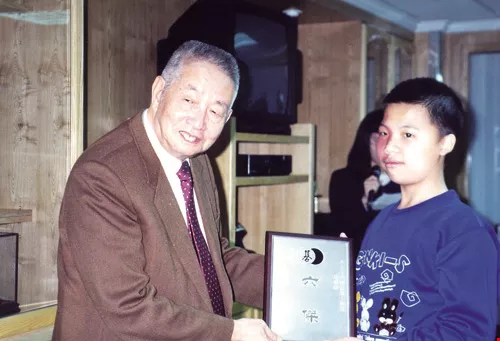
Chou Chun-hsun was taken out of school at the age of nine and quickly became one of Taiwan's top Go players. In this photo, he is being awarded a prize from one of the major tournaments at around age 10. The person giving the award is Ing Chang-ki, one of Taiwan's main promoters of Go at the time.
Learning from the masters
So what did young Chou think of all of this?
"When I was little, every time I went to school I would have to put up with people staring at me and calling me names. Some people yelled, "Monster!" the moment they saw me coming. I hated going to school, so when Dad decided I should quit school and focus on Go, I was over the moon. While a lot of people criticized my parents for deciding my future for me and called it unfair, in the end it was my choice too."
Having left school and the usual childhood behind, and possibly realizing there was no turning back, Chou Chun-hsun dedicated himself to the study of Go. The world of Go is a simple one-you win, or you lose. As the wins stacked up, Chou found a sense of confidence through the game, forgetting his birthmark and the self-consciousness it brought. Go became like a friend to him, with the black and white of the stones the only colors that mattered.
Chou is Taiwan's first 100% homegrown Go champion. Unlike previous champions like Chang Hsu ("Cho U" in Japanese), he notes, he never studied the game in Japan, because his family circumstances just wouldn't allow it. "I was one of five kids, and my Mom left her job as an elementary school teacher for a while to take care of us. My Dad was basically my driver as I grew up, doing little more than drive me around from school to school. Back then, studying for a year in Japan cost at least ¥1 million, and there was no way we could afford that."
While he couldn't travel to Japan to study Go, Chou still found plenty of people in Taiwan willing to help him chase his dream. People like Ing Chang-ki, an industrialist active in both Taiwan and Hong Kong who was Taiwan's preeminent promoter of the game. Chang saw Chou as a rising star in the world of Go, and called on some of the best players in Taiwan-players like seventh-dan Lin Sheng-hsien and Peng Ching-hua-to give Chou and fellow student Lin Chih-han (now eighth dan and ranked second in Taiwan) instruction and a sound foundation in the game.
A star is born
As Chou started to make a name for himself in the Go world, he began to come to the attention of more and more of the top players. When Chou was 11, sixth-dan Liang You recommended him to Chinese player Song Xuelin, number one in Chengdu, ushering in the beginning of Chou's cross-strait Go education. "Go players need to hone their skills by finding the best people to compete against, and the players in Chengdu were outstanding. One false move and the game was over. Where in Taiwan I could win eight out of ten games, over there I was lucky to hit five out of ten," says Chou.
After three months' training in Chengdu, Chou's eyes were open to a new world and his skills were sharper than ever. At the age of 13, he participated in the Chinese national ranking tournament, which serves as the examination for players seeking professional status. He successfully earned his accreditation as a professional Go player. The next year he did the same in Taiwan, and has since won a string of renowned national tournaments.
In the years since, he has regularly returned to China, as well as traveling to South Korea, Japan, and elsewhere to compete at the top levels of the game. Like a wandering swordsman of old, he began traveling the Go world, looking for challengers, honing his skills, and pushing his limits. He continues doing this to this day-even having won the world championship has not sated his appetite for competition.
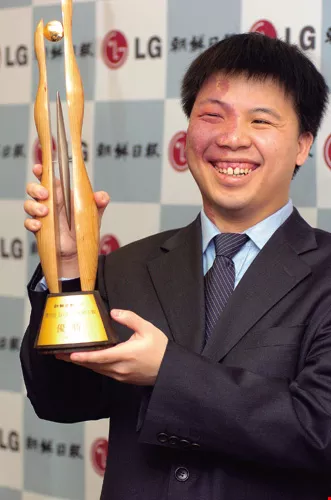
In March 2007, Chou defeated top Chinese player Hu Yaoyu to take the title at the 11th LG Cup World Baduk Championship.
A nine-year-old dropout
Walking into Taiwan Chi Yuan, a Go school on Taipei's Roosevelt Road, you'll often see a young man sitting in the corner, silently studying Go games and engaging in matches against players from around the world on the computer. Sometimes, when he's tired, he'll take a break from the high tension of Go matches by immersing himself in the virtual world of the online game World of Warcraft. The right side of his face is covered by a huge red birthmark that stretches from the back of his neck around to the bridge of his nose. When people first see him, the sight of the birthmark often throws them, but the young man seems to have got accustomed to the strange looks and pays it no attention. This young man is none other than the "red-faced Go king," Taiwan's top Go player Chou Chun-hsun.
While today he may be top of the heap, Chou only began studying Go at age seven-in relative terms, hardly an early bloomer. Twenty years ago Chou's father, Chou Yen-shan, was a sixth-dan Go player, his passion for the game making him famous in the Taiwanese Go community as the "Go madman." As a young man, the elder Chou's passion for Go saw him travel around the major clubs looking for challengers. His life's goal was to go pro. But there was only so far his skills could take him, and eventually he put his old goal aside and instead put his hopes on his children.
Unlike his three elder sisters, who had to be forced to play by their father, at around five years old Chou Chun-hsun would sit in front of the Go board calmly dropping down pieces for hours on end, despite having no understanding of the game whatsoever. The elder Chou realized his son was different, and decided to mentor him on his path through the world of Go.
When Chou was in third grade, at age nine, his father took him out of school and out to find masters to teach him the art of Go. First he studied under Chen Chiu-lung of the Chiu-lung Go Academy, and later under renowned professional Go master Tai Chia-shen. To focus entirely on his studies of the game, Chou even moved in with his masters, and he was accepted into the "Child Prodigy" Go classes at the Ing Chang-ki Weichi Educational Foundation, a place dedicated to training the best Go players.
Practice pays off
In the finals of the 2007 LG Cup, Chou was pitted against China's number-three player, eighth-dan Hu Yaoyu. With much of the Go world agreed that Hu was a better tactical player than Chou, Hu was the favorite to take the title.
"I wasn't nervous before the match, because even I felt I wasn't a match for Hu. In fact, he was under more pressure than I was. I never figured I would take out the first match in the best-of-three contest, so when I did I started to feel there was a chance I could take it. After I lost the second match by half a point, I started crying, but fortunately I pulled myself together and took the final match by half an 'eye.' Even now I feel I really was lucky."
While Chou might call his winning the world championship "luck," his long-time friend and playing partner Lin Chih-han says he's just being modest.
"Of course, in any contest luck is a factor, but no-one could win a world title purely on luck. A-hsun's got a wealth of experience and is amazingly calm while playing-that's what helped him win," is Lin's analysis.
Learning calmness through Go
Chou is known for having an impenetrable poker face while playing Go, making it hard for his opponents to get inside his head or figure out what he's planning. But the moment the contest's over, he's a ball of emotion and is always in a rush to call his newly-wed wife Cheng Shu-ching and tell her how the match went.
Even after all these years of playing, losses still hit Chou hard, and Cheng provides valuable emotional support. "We'll go for two- or three-hour walks, or maybe go see a movie, whatever it takes to turn his mood around-like when he lost the first match of the Wangzuo Tournament and we went and saw The Golden Compass," Cheng laughs. While he was at a low point after losing that match, ultimately he turned it around, winning three of five to successfully defend his title at the tournament for the third time running.
While he may be astoundingly calm while playing, Chou admits that usually he's anything but. "I'm very impulsive by nature, and playing Go has taught me how to keep myself under control. In Go, everything can change in the blink of an eye, and even a single stone can turn the whole game on its head. If you're not calm and you're not seeing the big picture, you're bound to lose."
Learning from the masters
So what did young Chou think of all of this?
"When I was little, every time I went to school I would have to put up with people staring at me and calling me names. Some people yelled, "Monster!" the moment they saw me coming. I hated going to school, so when Dad decided I should quit school and focus on Go, I was over the moon. While a lot of people criticized my parents for deciding my future for me and called it unfair, in the end it was my choice too."
Having left school and the usual childhood behind, and possibly realizing there was no turning back, Chou Chun-hsun dedicated himself to the study of Go. The world of Go is a simple one-you win, or you lose. As the wins stacked up, Chou found a sense of confidence through the game, forgetting his birthmark and the self-consciousness it brought. Go became like a friend to him, with the black and white of the stones the only colors that mattered.
Chou is Taiwan's first 100% homegrown Go champion. Unlike previous champions like Chang Hsu ("Cho U" in Japanese), he notes, he never studied the game in Japan, because his family circumstances just wouldn't allow it. "I was one of five kids, and my Mom left her job as an elementary school teacher for a while to take care of us. My Dad was basically my driver as I grew up, doing little more than drive me around from school to school. Back then, studying for a year in Japan cost at least ¥1 million, and there was no way we could afford that."
While he couldn't travel to Japan to study Go, Chou still found plenty of people in Taiwan willing to help him chase his dream. People like Ing Chang-ki, an industrialist active in both Taiwan and Hong Kong who was Taiwan's preeminent promoter of the game. Chang saw Chou as a rising star in the world of Go, and called on some of the best players in Taiwan-players like seventh-dan Lin Sheng-hsien and Peng Ching-hua-to give Chou and fellow student Lin Chih-han (now eighth dan and ranked second in Taiwan) instruction and a sound foundation in the game.
As for his hopes for the future, Chou says he wants to get more governmental and public support behind Go and to try and improve the standing of the Go community. "But for me personally, well of course my biggest hope is to get a few more world titles!" says Chou with a hearty laugh.A star is born
As Chou started to make a name for himself in the Go world, he began to come to the attention of more and more of the top players. When Chou was 11, sixth-dan Liang You recommended him to Chinese player Song Xuelin, number one in Chengdu, ushering in the beginning of Chou's cross-strait Go education. "Go players need to hone their skills by finding the best people to compete against, and the players in Chengdu were outstanding. One false move and the game was over. Where in Taiwan I could win eight out of ten games, over there I was lucky to hit five out of ten," says Chou.
After three months' training in Chengdu, Chou's eyes were open to a new world and his skills were sharper than ever. At the age of 13, he participated in the Chinese national ranking tournament, which serves as the examination for players seeking professional status. He successfully earned his accreditation as a professional Go player. The next year he did the same in Taiwan, and has since won a string of renowned national tournaments.
In the years since, he has regularly returned to China, as well as traveling to South Korea, Japan, and elsewhere to compete at the top levels of the game. Like a wandering swordsman of old, he began traveling the Go world, looking for challengers, honing his skills, and pushing his limits. He continues doing this to this day-even having won the world championship has not sated his appetite for competition.
Practice pays off
In the finals of the 2007 LG Cup, Chou was pitted against China's number-three player, eighth-dan Hu Yaoyu. With much of the Go world agreed that Hu was a better tactical player than Chou, Hu was the favorite to take the title.
"I wasn't nervous before the match, because even I felt I wasn't a match for Hu. In fact, he was under more pressure than I was. I never figured I would take out the first match in the best-of-three contest, so when I did I started to feel there was a chance I could take it. After I lost the second match by half a point, I started crying, but fortunately I pulled myself together and took the final match by half an 'eye.' Even now I feel I really was lucky."
While Chou might call his winning the world championship "luck," his long-time friend and playing partner Lin Chih-han says he's just being modest.
"Of course, in any contest luck is a factor, but no-one could win a world title purely on luck. A-hsun's got a wealth of experience and is amazingly calm while playing-that's what helped him win," is Lin's analysis.
Learning calmness through Go
Chou is known for having an impenetrable poker face while playing Go, making it hard for his opponents to get inside his head or figure out what he's planning. But the moment the contest's over, he's a ball of emotion and is always in a rush to call his newly-wed wife Cheng Shu-ching and tell her how the match went.
Even after all these years of playing, losses still hit Chou hard, and Cheng provides valuable emotional support. "We'll go for two- or three-hour walks, or maybe go see a movie, whatever it takes to turn his mood around-like when he lost the first match of the Wangzuo Tournament and we went and saw The Golden Compass," Cheng laughs. While he was at a low point after losing that match, ultimately he turned it around, winning three of five to successfully defend his title at the tournament for the third time running.
While he may be astoundingly calm while playing, Chou admits that usually he's anything but. "I'm very impulsive by nature, and playing Go has taught me how to keep myself under control. In Go, everything can change in the blink of an eye, and even a single stone can turn the whole game on its head. If you're not calm and you're not seeing the big picture, you're bound to lose."
As for his hopes for the future, Chou says he wants to get more governmental and public support behind Go and to try and improve the standing of the Go community. "But for me personally, well of course my biggest hope is to get a few more world titles!" says Chou with a hearty laugh.

@List.jpg?w=522&h=410&mode=crop&format=webp&quality=80)


