Golden Oldies!Taiwanese 78-rpm Records
Chen Hsin-yi / photos Chuang Kung-ju / tr. by Phil Newell
January 2009


We are all probably familiar with the trademark Taiwanese folk song "Spring Breeze." It was written in 1933, back in the Japanese occupation era, by the composer Deng Yuxian, and was a big hit everywhere across the island. But you may not know that in 1930s Taiwan, when life was quite comfortable relative to the past, the record industry as a whole was already booming, with each release coming out in at least 3500 copies. In terms of music styles, besides traditional forms like Taiwanese Opera, Nanguan, Beiguan, and Hakka tea-harvesting songs, there was also quite a bit of Taiwanese-language original music with an experimental spirit.
This flowering of musical styles was made possible by the invention of the amazing gramophone. In recent years, thanks to the fact that the collections of the sound-recording culture vultures Lin Liangzhe and Davide Lin have been made available to the public, these old voices that have been stored away for half a century are again making an exciting impact on our lives.
The invention of sound recording at the turn of the 20th century gave humankind the ability to preserve sound for the first time ever. It is fascinating to realize that early gramophones-composed of turntable, needle, resonator, and speaker-were like handicraft items. They needed no electricity, but instead were hand cranked, producing sound by the vibration of the needle as it passed along the grooves of the record. Because the sound was so similar to that of the sound waves received by the human ear, it sounded even more "true-to-life" than current technology.
The records played on these gramophones were very different from the black vinyl platters that later became so familiar. The primary material was instead shellac, made from the secretions of a Southeast Asian insect. Because they turned at a rate of 78 revolutions per minute (rpm), they were also nicknamed "78s."
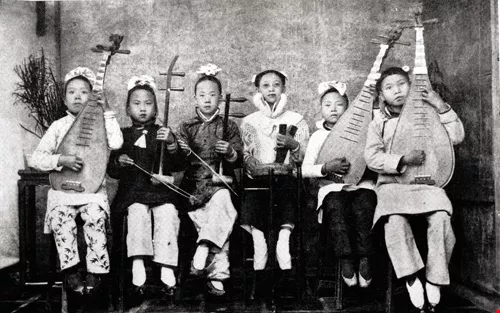
The photo at right reproduces the cover of an American National Geographic Magazine from March, 1920, showing "an orchestra of Chinese 'sing-song' girls," with the caption "The Formosan version of the 'jazz band.'"
Gramophone globalization
In 1948, a 33-rpm vinyl disk was invented that could hold 16 minutes of sound per side; this was later extended to 30 minutes per side. These vinyl records gradually displaced the 78, which was capable of holding only 3.5 minutes of sound per side. In the 1950s, electrical phonographs supplanted gramophones, and by 1962 the production of 78s had come to an end worldwide. Thus the old-style gramophone and the 78 became antiques in hibernation, carrying and encasing the sounds of the first half of the 20th century.
In 2004 the cultural historian Andrew Jones of the US published a book entitled Yellow Music: Media Culture and Colonial Modernity in the Chinese Jazz Age. Taking the popular music of 1930s Shanghai as a case study of hybrid colonial aesthetics, he analyzes the impact of the new medium of the gramophone on musical activities, society, and culture in the non-Western world from the late 19th century to the beginning of World War II.
First off, the spread of the gramophone and of recording as an industry was from the very beginning related to Western colonialism, the economic motivation of seeking new markets, and Western cultural influence. Records were products with an incomparable characteristic: through them, music could rapidly cross distances and become widely distributed. Not only did this bring the voice of the West to remote China, but the addition of new elements made Chinese music more lively and diverse and a great deal of hybrid music appeared. For example, the music produced prolifically in the 1930s by "the father of Chinese popular music" Li Jinhui blended elements of Western jazz, local folk melodies, and Hollywood movie tunes.
Another important fact is that the linking up of the new cultural media of recording, broadcasting, and the "talkies" (films with sound) nurtured new listening habits, musical tastes, and audience aggregations. The gramophone and the record became treasured symbols of the "modernization" of the urban middle classes. Even more, they were employed as competitive weapons in the battle for status among the professional and cultural elite.
An incredible performance
Getting back to Taiwan, the Japanese occupation era (1895-1945) was a period of transition from old to new. Through a variety of channels-including mass media, Western-style education imported by the Japanese regime, cross-strait and Taiwan-Japan trade, and overseas travel-Taiwanese came into contact with the dazzling outside world, nurturing complex and pluralized cultural thinking. At the same time, new leisure activities and venues entered the market, such as movies, theaters, photography, dance halls, and department stores, sending shockwaves through people's sensory experiences and lifestyles.
The early history of recording in Taiwan was embedded in the just-described currents of cultural globalization. It also overlapped with the period of Japanese colonial rule. Given the intermixture of diverse cultures, the result was a flourishing of creativity and productivity, with the whole process of development from first receiving records from abroad to the ability to mass-produce 78s domestically taking less than 30 years.
In 1898 a young man from Guangdong with his hair in a queue and wearing a traditional Chinese jacket showed up in the teahouses of Dadaocheng, Taipei's cultural center of the day, and claimed to be able to give his audience an entire Chinese opera by himself, even including the band for accompaniment. He collected one jiao of silver money from each curious bystander, and "played" an "invisible" Cantonese opera. This was the first time Taiwanese had ever come into contact with recorded sound, even earning a story in the Chinese-language edition of the then Taiwan Daily News headlined "An Incredible Performance!"
Japan, which was anxious to Westernize following the Meiji Restoration, imported gramophones for sale not long after they first appeared. In 1907, a Japanese company entered into a joint venture with a US firm to establish Japan's first gramophone and record manufacturer, the Nipponophone Company. Three years later a branch was set up in Taipei, on what is today Hengyang Road. Before long there were about ten or so shops under contract, and advertisements were regularly popping up in newspapers and magazines. In those days gramophones and records were luxury items owned mostly by the rich and powerful, or else by drinking establishments and clubs. Platters in circulation were mostly in the genres of Western classical and Japanese traditional music, or traditional songs from the Chinese mainland.
The birth of an industry
By 1925, Japan had developed small records, using thick paper as the foundation, which could be produced and sold relatively cheaply. Starting in 1927, recording technology advanced from mechanical to electrical, thereby increasing quality and efficiency. With falling prices for gramophones also becoming a factor, record companies formed in rapid succession.
Driven by the desire to expand markets, companies began to record all kinds of traditional music that had come to Taiwan in the Qing Dynasty and which were still vibrant among the ordinary people of Taiwan. These included Beiguan, Nanguan, folk tunes, and tea-picking songs, though the most recorded and tops in sales among "native" forms was Taiwanese Opera (Gezaixi), which had developed the most recently of all of them.
Xu Lisha and Lin Liangzhe, authors of Looking at Taiwanese Opera through Japanese-Era Recordings, point out that Gezaixi lyrics were easy to understand and the melodies could be picked up quickly, making it naturally more accessible to ordinary people than the tongue twisters of Beiguan or the elegance of Nanguan. The writers also discovered that recorded Gezaixi of that period gave a big boost to all aspects of this new operatic form that was still in the process of developing, such as vocal techniques, rhyming, and so on, and also provided a market for a large number of new scripts and themes that were more in tune with the social conditions and emotional states of the times.
Burst of creativity
Another of the boons that poured from recordings was new original music with Taiwanese lyrics.
The origins of Taiwanese-language songs can be traced back to the period of "unarmed resistance against Japan" in the 1920s. One example is a song written to back the petition to establish an assembly to govern Taiwan. The first verse-which goes "A new era of world peace / Western thinking spreads in waves / Freedom, equality, and human rights / Ringing the bells to overthrow tyranny"-was invariably sung whenever activities of the assembly-petition movement were held. A number of songs were also written on behalf of the Taiwan Cultural Association, formed by great pioneers of democratic activism such as Jiang Weishui and Cai Peihuo. These songs, which included "Labor Day Song" and "Our Taiwan," were disseminated through concerts and cultural performances and were also recorded and sold. However, it was only in the 1930s that Taiwanese-language music came out that would become genuinely popular in every street and back alley.
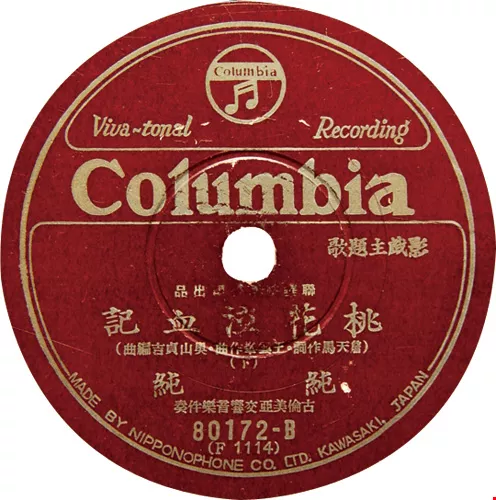
In 1932, a silent film from Shanghai called Story of a Blood-Weeping Peach Blossom (a tragedy about a struggle for free choice in marriage starring Ruan Lingyu as the heroine) came to Taiwan theaters. In order to connect to potential viewers, the Taiwan agent commissioned Zhan Tianma (then Dadaocheng's reigning silent-film live narrator) to write lyrics, and Wang Yunfeng to do the music, for a promotional song of the same name as the film. This Taiwanese-language tune, based on the qizidiao (seven-character melody) form of traditional Gezaixi, was soon known throughout Taiwan as a result of its association with the hit movie.
At that time the Taiwan director for Nippon Columbia (formerly Nipponophone, later taken over by Columbia Records of the US), realized the commercial opportunity and hired Liu Qingxiang (stage name Chun Chun), then the most popular player of young female roles in Taiwanese Opera, to make a recording of Story of a Blood-Weeping Peach Blossom. As expected, it was a huge hit. Thereafter Nippon Columbia aggressively developed the market for Taiwanese-language records, and hired musicians such as Chen Junyu, Li Linqiu, Zhou Tianwang and Deng Yuxian to write lyrics and music. This was when iconic songs like "Spring Breeze," "Moonlight Night Melancholy" and "Rainy Night Flower" came onto the market.
In 1935, the Lin Benyuan clan of Banqiao near Taipei became the Taiwan sales agent for Victor Records, a US company. The Lins then hired Zhang Fuxing, the first Taiwanese musician to study in Japan, to head up the arts and culture department, which turned out Taiwanese pop songs in great quantity and great quality, including such classics as "White Peony," "Farm Village Melody," and "Bitter Feelings," pushing the firm up into the same rank as Nippon Columbia.
The late musicologist Xu Changhui once explained the flowering of Taiwanese songs in the 1930s as a combination of several factors. Musically, there were contributions from artists deeply rooted in folk culture, musicians from Western church groups, and scholars versed in various Western schools. In terms of lyrics, participants included people active in the New Literature Movement.
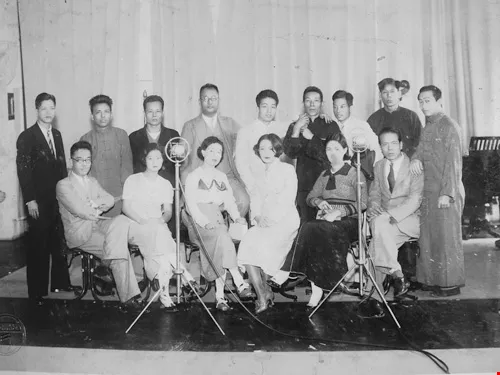
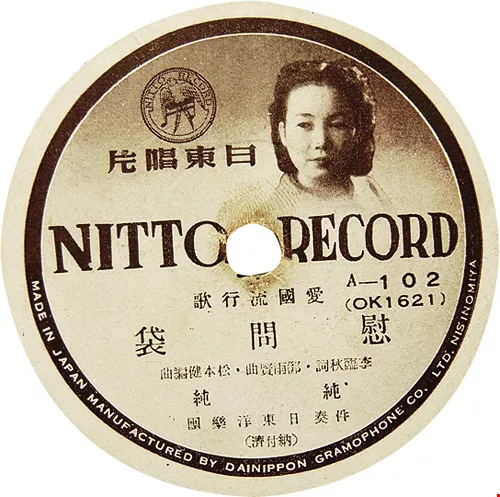
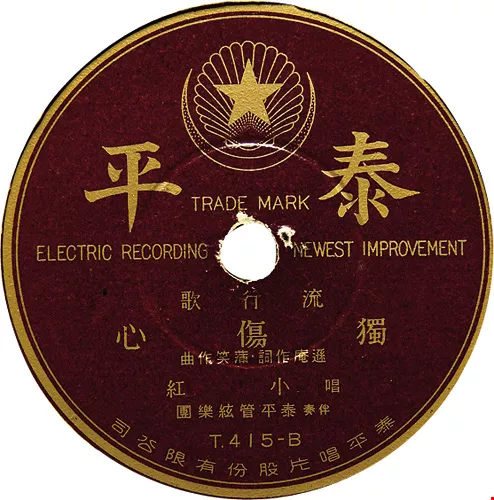
(record labels courtesy of Davide Lin)
Fade out
With the outbreak of the Sino-Japanese War in 1937 and the forced "Japanization" of Taiwan, many Taiwanese songs were reworked by the regime to convey political messages and instructions. In 1945 the Taipei branch of Columbia, which had produced more than 330 popular songs and issued at least 1000 native Taiwanese records, was destroyed in an air raid, heralding the end of the era of 78s.
Although the company was gone, however, 78-rpm technology had become firmly established in Taiwan. Beginning in the mid-1950s, many record companies, seeking fast and cheap products in an era when copyright was less rigorously enforced than under Japanese rule, began covering Japanese songs rewritten with Taiwanese lyrics, a form known to scholars today as "new hybrid music." Under pressure of market saturation, many Taiwanese songwriters gave up tunesmithing and switched to other lines of work. Later, the ROC government implemented a policy of compulsory use of Mandarin Chinese, and channels for the transmission of Taiwanese music were sharply limited. Taiwanese Opera, then still full of creativity and vitality, was excluded from various media such as outdoor theater, television, and film.
In the mid-1950s, Taiwanese record companies launched 33-rpm vinyl records that could hold 12 minutes of sound per side. Although 78s survived side by side with 33s for a while, they were ultimately squeezed out of the market.
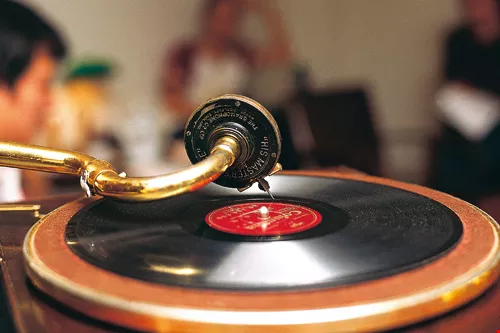
78-rpm records and gramophones were treasures to music-lovers in the pre-vinyl era. Storing the voices of three-quarters of a century ago, they wait for contemporary cognoscenti to set them spinning again. Modern people are surprised that each 78 had a limit of three-and-a-half minutes of sound, that the gramophone had to be wound by hand, and that the needles had to be changed for each play. Nonetheless, people would listen to each precious record thousands of times.
Retroactivity
From the point of view of popular culture, music is a more infectious and penetrative media than literature, yet there have always been a lot more gaps in research about music in the Japanese era than about literature. This is because the printed word is easily preserved, but many sounds disappear forever.
Fortunately, beginning in the 1990s, many voices that had only survived in documents but had never been heard by anyone began to be "unearthed" thanks to the efforts of several collectors. Of these, Li Kuncheng introduces old records through radio and lectures, Lin Liangzhe collects and researches various musical genres, and Davide Lin has a blog focused on old Taiwanese popular songs. They have revitalized the old voice boxes.
In 2000, the Preparatory Office of the National Headquarters of Taiwan Traditional Arts issued a book-plus-CD set called Hearing the Sounds of Taiwanese History. This set reproduces 100 old records in nine major categories-such as Nanguan, Beiguan, Peking Opera tunes, Taiwanese Opera, Hakka songs, and humorous tunes-greatly aiding research by scholars into songs, opera, musicians, and schools of music. Nonetheless, as Professor Wang Ying-fen, head of the Graduate Instutute of Musicology at National Taiwan University, points out, so far most research interest has centered on individual musical categories, and there has been little exploration from the perspectives of sociology of music or of the record industry. Perhaps, as she firmly believes, these 78s are just the historical "records" we need to gain fresh perspective on the long-debated subjects of historical continuity and cultural identity in Taiwan.
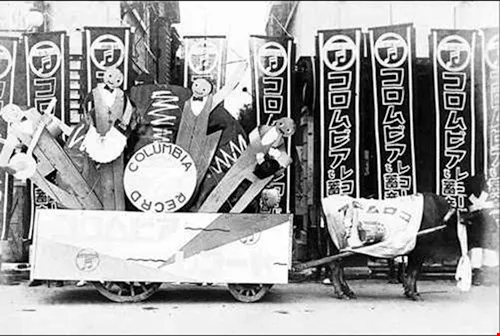
(left) Advertising for early records: A band on a cart pulled by a cow, complete with banjo and concertina. This was part of a marketing campaign by the Columbia record company in the 1930s.
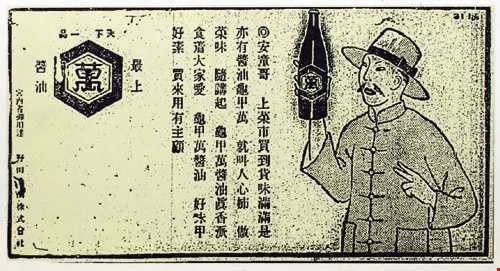
An advertisement for soy sauce from 1931; the text is a variation on lyrics from the traditional Taiwanese chant "Antong Goes to Market," while the image is that of Brother Antong as portrayed in the song.
The photo at right reproduces the cover of an American National Geographic Magazine from March, 1920, showing "an orchestra of Chinese 'sing-song' girls," with the caption "The Formosan version of the 'jazz band.'"


@List.jpg?w=522&h=410&mode=crop&format=webp&quality=80)


