

In both the art world and the art market, 90-year-old Wang Pan-yuan's name carries tremendous clout. There is a timelessness to his unique style, and his simple compositions powerfully suggest the fundamental loneliness of the human condition. Wang's works are often compared with those of Charng Yuh, who left for France at age 20 in 1920 and spent his career doing paintings rather similar in theme to Wang's. Critics generally agree, in fact, that the sense of loneliness in Wang's works is even deeper than in Charng Yuh's because Wang's loneliness comes from the bitterness of life itself, and is not just something cooked up by the artist for the sake of his art.
Wang has been holed up for the past half century in Ilan City. A man of misanthropic tendencies, Wang is not one to suffer fools gladly, and people generally find him very unapproachable. He often keeps his best paintings at home, but a collection of his work went on display in late May at the National Museum of History. The show, scheduled to continue through late June, will be a rare chance to get a look at the world of Wang Pan-yuan.
One day Wang Pan-yuan's grandchild asked him: "Why don't you have any friends?" Pointing to the books and paintings all around his room, Wang answered: "All of these are my friends." One gets a feel for Wang's world just by looking at his double bed; one side is obviously where he sleeps, while the other half is covered with books and dozens of his personal journals. Elsewhere the room is cluttered with unframed oil paintings, and scrolls of ink-wash paintings and calligraphy.
I pick up a notebook and come across something he wrote in 1970: "Reading, writing, loving, and painting. Go without any one of these, and there's not much point in living." It pretty much sums up his 90 years.
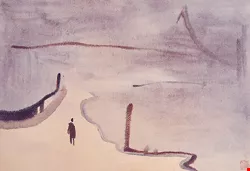
A small figure makes its way across a big, fuzzy landscape in Distant Road. Wang Pan-yuan knows much of loneliness, having lost his father at age three and his mother just ten years later. Watercolor, 39 x 26.5cm, 1962.
Wang was born in rural northern Jiangsu Province. His family was quite wealthy and lived on a huge estate with palatial architecture.
Although Wang got off to a good start in life as the second son of the clan's eldest heir, things took a turn for the worse when his father suddenly died. Wang was only three at the time. Amidst the consuming rivalries and contention within the clan, there was little his mother could do to protect her sons from being bullied. "My mother said I always cried out in my sleep at night. When I was nine years old I had a premonition that someone was going to do something bad to me. I never felt secure." Wang's mother died when he was 13.
After Wang's father died, Wang Pan-yuan stood second in line behind his elder brother as the next heir to the clan's wealth, but because they were still very young, the household was run in their stead by Wang's uncle. Wary of the day when his nephews might seek to assert their prerogatives, the uncle used every excuse he could think of to deny Wang an education. That didn't prevent him from graduating from high school, however, or enrolling in an art academy in Shanghai, where he studied Western painting. Wang's uncle, seizing on the fact that students at the academy sketched nude models, cut off all financial support. Wang nevertheless managed to graduate from the academy with the support of his friends and some concerned servants.
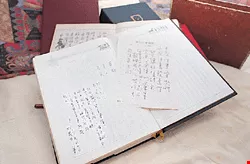
Wang keeps dozens of his personal journals beneath his bed. An enduring theme is his first love, who was swept out his life amidst the chaos of war. (Pu Hua-chih)
During his last semester at the art academy, Wang asked for a loan from a rich distant relative, who demanded that Wang hand over his winter coat as collateral. Although the temperature was well below freezing at the time, Wang did not hesitate to take off the coat in exchange for the money to pay his tuition. He then walked for two days through the freezing cold to get back to school only to collapse in delirium soon thereafter in class. He was taken to a hospital, which sent a telegram informing the Wang clan that Wang Pan-yuan was in serious condition, but the letter went unanswered. The hospital sent out a second telegram designed to ensure a response. Claiming that Wang had already died, they asked for someone to come and deal with the "corpse." Still no answer came, and everyone at the hospital was shocked at the family's callous attitude.
It was just at that point when Chi Chu-chun, a student at a music conservatory, came to the hospital to visit a friend and was seized with compassion when she heard of Wang's circumstances. Chi agreed to pay Wang's medical expenses, and stayed by Wang's side the whole time he was in the hospital.
Wang still remembers lying in a foggy state and hearing Chu-chun say: "I've come here to save you, and I'm going to stay with you forever. If you die, then I'm going to die too, and be buried by your side." Thanks to Chi's attentive care, Wang managed to survive, and all of a sudden he was deeply happy for the first time in his 25 years. He and Chu-chun eventually agreed that together they would accompany Wang's teacher, Pan Yu-liang, to France to continue their studies.
To get the money, however, he had to make a trip back home to ask for another loan, but was refused. The Marco Polo Bridge Incident happened soon thereafter, marking the beginning of war with Japan. Amidst the ensuing chaos, Wang lost contact with Chu-chun, and though he would try to find her later, he was never to see her again. He often reminisces about the love that got away-rowing a boat at West Lake, sitting under the eaves and listening to the falling rain, Chu-chun's favorite red jacket... It was the most unforgettable time in his life, and his greatest heartache.
The name of Chi Chu-chun threads its way persistently through the journals that Wang has kept for the past 50 or 60 years. Wang writes: "Men need to be elevated by something, and that something is love for a good woman." In this and other passages, one can see that beneath the gruff exterior beats the heart of a romantic.
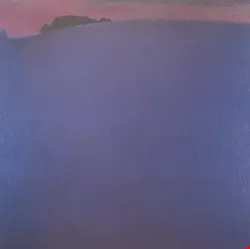
Having spent better than half his life in Ilan, Turtle Mountain Island has become a key feature of Wang Pan-yuan's mental landscape. Oil, 90 x 90 cm, 1962.
In his paintings, Wang creates a misty, dream-like world. On most of the canvases he places a fuzzy subject in one corner-a running dog, someone kneeling in prayer, an abandoned fort, or a low-flying bird, for example. Art critic Hsieh Li-fa opines: "Wang's brushwork is in some places very dense, while in others it is just the opposite, and the interplay between the two gives the subjects of his paintings a certain mobility; it creates a simple complexity and a complex simplicity at the same time. Through subtle use of colors, he achieves a feeling of elegance and space that goes beyond anything that can be done in regular printed materials. You have to see the paintings in person to have any feel for the world of Wang Pan-yuan."
According to Wang Che-hsiung, an art professor at National Taiwan Normal University, "Wang Pan-yuan's paintings feature a very modern structure, and manage to be both concrete and abstract at the same time. The paintings appear quite simple, but Wang's technique is actually very sophisticated." And in spite of the lonely sense of impermanence in his works, lurking inside the loneliness is a latent passion that surprises with its power.
Wang's timeless style has remained unchanged ever since his days at the art academy in Shanghai. Some say it's because he's lazy, and some regard him with contempt. He is often misunderstood, to the point where someone once argued that a red sun in one of his paintings was a sneaky hint of pro-communist leanings. Wang has his own thoughts on the matter of style: "The style of a genius painter changes in response to creative urges; you don't change for the sake of change." He often warns young painters not to slavishly follow conventions.
Noting that countless artists have painted suns, birds, and horses before him, Wang says: "Mine are different only because they express my emotional response to the surrounding world. Take away this emotional element, and a painting is nothing more than plagiary. I've had a very painful life, and I use painting to express the pain I feel inside."
The dog that appears in so many of his paintings was his only childhood friend. The girl in red is Chu-chun. The moody bitterness in his works is not just an artist's mental construction, but a real, searing memory.
Having lived through the tumult of 20th-century China, Wang knows all too well just how little a single individual's existence can mean. And the blue moods that recur without rhyme or reason over the course of a lifetime are his home turf, for he excels at converting these on canvas into visual imagery laden with a Zen-like poetry.
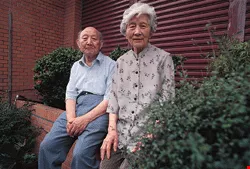
As the wife of a struggling artist, Ni Yueh-ching has seen many hard times. At one time or another she has had to make a home of an abandoned shack, and skip meals, and even scrounge for leftovers, but she has never uttered a word of complaint. (Pu Hua-chih)
When Japan invaded China, Wang returned to the "safety" of his hometown, but his relatives had it in for him. They helped bring about his capture by Japanese soldiers, who gave him a choice between serving in the Japanese Imperial Army or being executed. Much to his surprise, someone showed up in the middle of the night with bolt cutters and set him free. Fully awake to the treacherous intentions of his relatives, Wang decided to head for southern China and make a life there together with Yueh-ching, the sweet and innocent daughter of a tenant farmer. The two married, and warfare continued. The surrender of the Japanese was followed by the resumption of civil war between the Kuomintang (KMT) and the communists. With the communists driving the KMT steadily southward, Wang and Yueh-ching, accompanied by Wang's cousin, eventually boarded a ship bound for Taiwan.
After arriving in Kaohsiung, the family found a stack of hay and went to sleep. Wang became a day laborer at the docks, where he had to struggle fiercely for three years just to keep food on the table. Sometimes he would go several days in a row without being offered any work, and worries weighed heavily on his mind. There was a baby at home to be fed. Would Yueh-ching have to ask for leftovers again at the army post?
In 1952, recommended by a cousin, Wang was hired to teach at Lotung Middle School in Ilan County. There he earned a monthly salary of NT$300, hardly sufficient to support a family of six. They moved into an abandoned shack. A typhoon soon rendered this uninhabitable, however, and they had to take refuge in a dilapidated, windowless structure. But the roof leaked, which was disastrous in rainy Ilan. The children slept under umbrellas.
The painter Huang Yu-cheng, a former student of Wang's at Lotung Middle School, remembers that Wang spoke little in class. He would just write instructions on the chalkboard ("sketch," "do water colors," etc.) and let the students do whatever they wanted. For the sake of his growing children, Wang would seldom eat lunch, and he and his wife both had serious gastric ailments. But in spite of the hardships, Wang, by now in his 40s, still wrote in his journal: "You are a painter. No matter what your circumstances, you're still a painter."
He would do sketches late at night by the light of a kerosene lamp. Without an easel or even a table, he used wooden crates for small sketches, and the floor for large ones. It became a habit with him, and even now he will do his art absolutely anywhere. He lays canvases on the bed, or hangs them on the back of a chair or a wall, and gets right to work. He has spent so much time bent over canvases that his back is now permanently hunched. He has also earned himself the sobriquet "the best painter who never used an easel."
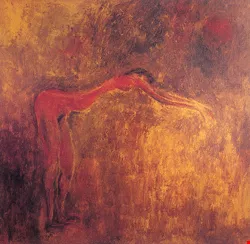
82 x 86 cm, 1962.
In 1964 the painters Li Teh, Liu Chi-wei, and Hu Chia put on an exhibition of their works in Ilan, and there they came to know Wang Pan-yuan. Impressed by his paintings, they eventually persuaded him to do a show in Taipei in 1966. All 32 of the paintings at the show were snapped up by a Hollywood film crew that was in town doing some location shots for The Sand Pebbles. While pleased at the positive reception, Wang also felt a sense of loss, and wished that he might have kept some for himself. This attachment to his paintings, and a sense of insecurity born of wartime chaos, have never left Wang. Ever since that first show, he has been reluctant to exhibit or sell his works.
Wang is well known for his attachment to his paintings. He keeps them in different rooms throughout his house, always under lock and key. Many of his favorites have never been shown in public, and in fact he hasn't even shown them to his wife or kids. And when he does put his works on display, about a half to two-thirds of the items are not for sale. Wang often exhorts Chen Yin-hui, Liao Teh-cheng, and other artist friends not to pander to common tastes just to make their work more marketable, which he regards as "selling one's soul." Although his friends all agree with him in principle, they can't help shaking their heads and chuckling: "He just can't be poor enough to please himself!"
In 1987, Wang put on a one-man show at Taipei's Crown Center. A collector made plans to buy seven or eight of the works, but one of them, Nude Woman, was not for sale. The collector was adamant, and said he would buy all of the paintings or none at all. Wang Pan-yuan, in debt up to his ears, nevertheless stuck to his guns: "I said it's not for sale, and that's final. I'd starve to death first." It was only later that he related the story behind the painting. A model had returned to Taiwan from overseas and taken a liking to Wang's paintings. The two hit it off immediately, and she shed her clothing to let him do a painting of her. Says Wang, "You can't take a gift from a friend and sell it." He did two very similar paintings of the model, and has never parted with either one. Says Celia Huang, manager of Metaphysical Art Gallery: "Wang is extremely stubborn. You've gotta love him for it. And people respect him for it too."
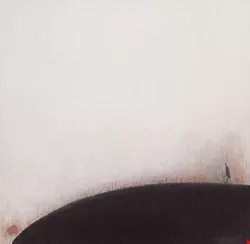
A warm, distant sun often appears in Wang Pan-yuan's paintings, symbolizing his longing for warm affection. Remembering a Friend, oil, 91 x 91 cm, 1988.
Wang's life changed dramatically after he reached his 70s. After completing the show at Crown Center, he put on one-man shows at Hsiung Shih Gallery and the National Museum of History. The following year he took part in a big exhibition to mark the opening of the Taiwan Museum of Art. For nearly 80 years, Wang's life path had managed to steer clear of money and fame. Indeed, Wang seemed to be steering away from it consciously. But now, all of a sudden, his artistic genius was coming to light even though he himself was hiding away in Ilan City, slightly off the beaten track for a cultural figure of his stature.
After a lifetime out of the public eye, Wang has not changed his ways now that the media and noted personages have started knocking on his door. If a visitor rubs him the wrong way, he won't give them the time of day. Celia Huang clearly recalls the first time she visited Wang at his home. Wang kept right on with his sketching, barely saying a word to his guest. As Huang admired the paintings and chatted away, Wang asked her three times to "step through the door," a veiled request for her to go back home. But Huang was young, and didn't catch the hint. Taking him at his word, Huang stepped through the door and waited for Wang. It turned out to the beginning of a long-running collaboration. Wang laughs: "Some people aren't worth my time. I just tune them out." Another line of defense is Wang's heavy Xuzhou accent. A lot of people can't tune in to Wang!
Wang truly doesn't care a whit about the fame that has come in his later years. If anything, he would like to take refuge deep in the mountains. He feels that fame achieved during one's lifetime is meaningless, and that a truly fair appraisal of a person's works can only come after the artist himself has died. Pointing to a recently completed painting of a swimming fish, Wang explains: "The farther off into the corner you put the fish, the more clearly you can see the spaciousness of the sea."
Although reluctant to show or sell his paintings, Wang once donated a dozen or more works to Ilan Culture Center. The center had budgeted NT$1 million to purchase art, and inquired about the possibility of buying some of Wang's paintings. But Wang said he wasn't selling. The administrators at the culture center changed tack and asked whether he would sell them some watercolors. Wang responded: "I'm not selling. I'm donating." The total value of the donated paintings was around NT$10 million (about US$300,000). The donation was made upon the condition that the center would spend their budget on efforts to encourage young artists. When the center said it was going to hold a press conference to thank Wang for his donation, Wang was adamantly opposed, and threatened to cancel his donation. He was afraid that people would think he had only made the donation for the sake of the publicity. According to his good friend Li Kui-chung: "He says what he means and means what he says. That's what we admire most about him."
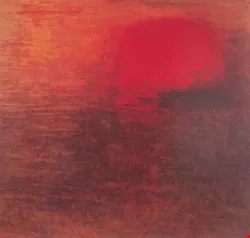
Concrete, yet abstract. Wang Pan-yuan's simple canvases support tremendous philosophical depth. This is the most distinctive characteristic of his work. Sunset, oil, 77 x 77 cm, 1953.
Although at age 90 his physical capacity is on the decline, Wang still works on big life-size paintings. A friend recently suggested that he ought to take it easy at his age and play mahjong to while away the time, but Wang gets indignant at the very thought: "What a ridiculous idea, telling me to play mahjong! Being old just gives me that much more reason to make good use of my time." Not only does he continue to paint, he feels that the older he gets, the better his paintings ought to be.
In recent years the Ilan cultural community has come to view Wang as something of a symbol of Ilan County, putting him just practically on a par with that Ilan talisman par excellence, Turtle Mountain Island. There can be no greater honor than to have him show up at one's event, and he has been much more obliging in this regard than he once was, because he is concerned about the need to encourage young artists. "But the thing I most admire him for," says Li Kui-chung: "is that in spite of his immense reputation, he has never established a following or a school here in Ilan."
Says his wife Yueh-ching: "He's become a lot more easygoing in his old age." After a lifetime of hard knocks, it has been quite an achievement for Wang to enjoy a degree of comfort in his waning years. The colors in his paintings have become noticeably brighter in recent years, and the lone sailing junks plying the empty waters in so many of his past works now sometimes come in pairs. A note of happiness seems to be taking the edge off the old feeling of heartache that has long been his signature.
It has been a fun interview, and Wang has been animated in recounting his life story. As the conversation draws to a close, he says with a note of a sigh: "I've really enjoyed talking with you, but I wonder when we'll meet again?" Perhaps his rootless existence has made Wang especially sensitive to the beginnings and ends of friendships. In that one little sigh, I thought I heard Wang expressing the feelings of an entire generation uprooted by war.

@List.jpg?w=522&h=410&mode=crop&format=webp&quality=80)


