New Year Traditions and the Married Woman
Lin Hsin-ching / photos Hsueh Chi-kuang / tr. by Phil Newell
February 2011


A hospital invited a well-known psychological counselor to conduct a hypnotism class. He hypnotized a number of volunteers and, hoping to create a good atmosphere by evoking people's happy memories, asked them to talk about Chinese New Year.
It didn't work out that well, as more than half of the subjects showed unhappiness or anger, or even broke down in tears. It turns out that for a lot of people, the family gathering for Chinese New Year's Eve is not as happy as it ideally should be. "Indeed, for many it is a source of anxiety and stress," says Shieh Wen-yi, chairman of the Department of Social Work at Shih Chien University, who revealed the hypnotist anecdote to us.
What kind of people say "I feel annoyed whenever I even think about the New Year holiday"? The answer shouldn't be that hard to guess.
Mention the Chinese New Year, and 54-year-old Shu-zhen (a pseudonym) gets a bellyful of bad memories.
Thirty years ago, then only 24, Shu-zhen married into a large clan based in a remote rural part of northern Taiwan. Though her husband was only the third-eldest son, he was the first to marry, so she naturally took on the role and duties that come with being "eldest daughter-in-law."
At that time, factories had not yet begun moving into the area around the clan's ancestral home. It was still all farmland, and Shu-zhen's in-laws, like all the neighbors, spent long hours in the fields on most days. This meant that whenever the Lunar New Year holidays came around, everything-cleaning, decorating, shopping, cooking, preparing offerings-fell on the shoulders of the new daughter-in-law.
Every year, for Shuzhen, who was a civil servant, the stress would set in at least a month before the holiday even arrived. Every weekend or day off during that month, she would get the earliest train she could out of Tai-pei back to the clan's traditional san-he-yuan (three-sided family compound), where she would get to work giving the whole place-where dozens of people lived-a thorough cleaning. One of the most onerous tasks involved hand-washing countless thick bedspreads, starching them, and drying them outdoors so that they could be available for other relatives returning to the san-he-yuan for the holiday.
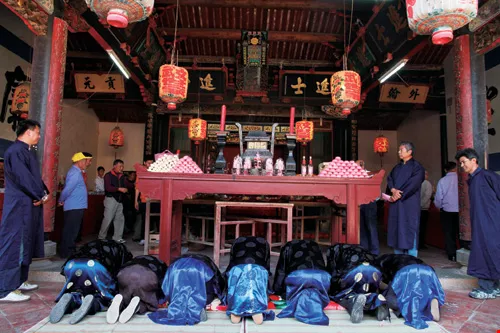
Numerous traditional values and rituals are embedded in the Chinese New Year. One of the most unsatisfactory things to many women is that while they do all the housework, cooking, and preparations, men take the lead roles at key moments like paying respects to ancestors and formally opening the family feast. The photo shows a ceremony being held at the Tsai clan shrine in Kinmen.
Then, a few days before New Year's Eve, she would take leave from work and go back to her in-laws' home, where-because her mother-in-law would only take responsibility for the rice cakes-she had to do all the food shopping and cooking.
Because the sanheyuan was near a fishing harbor, besides the whole array of foods that are de rigueur for a Taiwanese family's New Year's dinner, the meal could not be without plenty of fresh seafood as well. Shu-zhen, who had never entered the kitchen in her life before getting married, was forced by cir-cum-stan-ces to master all kinds of dishes, partly by asking her elders and partly from reci-pes, until she could lay out a restaurant-quality feast. And it was not just quality that was demanded, but quantity as well-over the years, as more of the clan offspring married, the number of people coming home for New Year's Eve dinner grew from one table to three.
"Maybe I just got used to it because I was so young when I started, so I guess I was better able to deal with the pressure," says Shu-zhen, who recalls that when she had surgery and the clan's second daughter-in-law had to take over preparing the New Year food, the latter actually became clinically depressed from the stress of it all. "After that, if I wasn't available, the whole family preferred to cough up the money for a restaurant banquet."
Besides the general pressure of family duties over the years, Shuzhen had an especially unhappy time during her second year after getting married. Her sister-in-law, who was not married, decided to invite all her co-workers to a big meal the second day of the New Year holiday. The sister-in-law asked Shu-zhen to stay and make it, meaning that Shu-zhen would have to give up returning to her own family home, which is the traditional, most common, and most required thing for any married woman in Taiwan to do on that day. The sister-in-law even went so far as to "kidnap" Shu-zhen's recently born baby boy to ensure that she wouldn't sneak off back home.
Angry and aggrieved, Shu-zhen originally planned to have it out with her sister-in-law. But when she considered that this would be a real downer for the family's congenial holiday atmosphere, she decided just to give in and put up with it.
Shuzhen says that perhaps independent-minded young modern women won't think too highly of her choices. But making compromises has not been without its payoffs. Her husband's family fully recognizes how much she has done for them over the past three decades, and she has gotten unstinting support from her spouse when it comes to taking care of her own family. For example, when her father was on his deathbed several years ago, Shu-zhen's husband took a regular shift helping care for the old man at the hospital, and handled many of the details that followed his death, all without a single complaint.
She has also been complimented many times by her mother-in-law, who says she is the most reliable daughter-in-law in the whole clan. That is why this year, as she has done so often in the past, she will return again to her in-laws' home to clean and cook. It's just that she has a completely different attitude about it now in contrast to the anger she felt when she was younger.
Shuzhen explains that her mother-in-law in fact went through all the same things when she first married into the clan, so Shuzhen-though having no intention of putting any of her own daughters-in-law through the same stress-says she can understand why her mother-in-law used the old traditional standards to make demands on her. "Anyway, you don't have much time with older relatives. My father-in-law has passed away, and my mother-in-law recently had surgery for cancer and is now recuperating. Since being there for the New Year will help her relax and put her mind at ease, I'll spend as much time back there as I can."
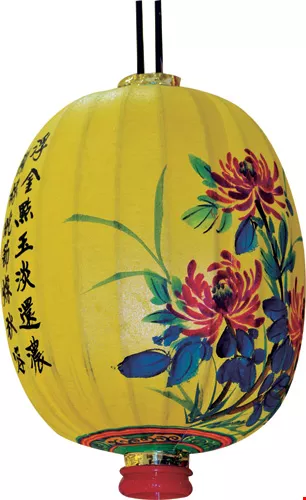
Holiday stress is by no means limited to middle-aged women who have come of age against more traditional backgrounds. Today there are many married women in their 30s and 40s for whom the Chinese New Year is always a minefield, a time when rough edges with relatives have to be smoothed over.
Skimming through the "Marriage" board of Taiwan's most popular BBS site PTT for a month before this year's Lunar New Year, one sees that the holiday is indeed the top priority. Countless conundrums are posed on the site: How can I persuade my mother-in-law (or mother) to buy ready-made store-bought New Year's food for the family dinner? How can I deal with the insistent questions from friends and relatives about when we will have a baby? Should I and my husband give joint red envelopes to each of our two families, or should we each give individual envelopes? (Red envelopes are traditionally used to wrap gifts of cash given at the Lunar New Year.) What kind of allocation of vacation time between the husband's family and the wife's family should be considered "fair"? How can a married woman get her in-laws' permission to spend Chinese New Year's Eve with her own family?
There's no question that such issues can cause aggravation for married -women. Ms. Xie, a teacher whose in-laws live in a traditional Hakka village in Ping-tung County, says that in the 13 years since she got married, whenever the winter school holidays come around, she always packs her schedule with as much classwork as possible, otherwise she will be urgently "recalled" to Ping-tung by her mother-in-law. And although her mother-in-law always handles all the food preparation for every holiday-Mid-Autumn Festival, Dragon Boat Festival, New Year's Eve, you name it-the menu is always the same: heavy loads of pork, fish, and poultry, known in Chinese as san-sheng ("the three animals of sacrificial slaughter"). This is because before holiday food is eaten, it is symbolically offered to the deities, and Xie's mother-in-law always chooses the food she thinks shows the greatest respect to the gods, without which it just wouldn't really feel like the holiday season. After the offering ceremony, the meat is all thrown into a big pot with wok-fried sweet potato leaves, and that's the family dinner. The trouble is that by now Ms. Xie feels sick to her stomach just thinking about eating such a meal.
One year Ms. Xie tried to add a little variety by making a hotpot, but got the evil eye from her mother-in-law for her troubles, because her mother-in-law insisted that unless everybody followed the traditional beliefs, it just wouldn't be a proper Chinese New Year. Xie is even more unhappy that she has to stay in her in-laws' house after the family dinner and stay up with everyone until midnight to see the New Year in, whereas her married sister-in-law, whose in-laws live very close, can split time between her husband's family and her own.
"My mother-in-law has a double standard: The daughters-in-law have to follow tradition, but the daughters aren't under any restrictions from customs," she says, clearly dissatisfied.
Last year around the Lunar New Year, having put up with her mother-in-law for enough years, she finally proposed to her husband that they spend New Year's Eve with her family in Taichung. Her husband reluctantly agreed. But when they finally went to her mother-in-law's home on the second day of the New Year, they found out that all of his brothers had followed their example, leaving her mother-in-law alone at home. Naturally, she got the blame.
"My mother-in-law was very angry, and she considered me to be the provocateur who ruined the annual harmonious gathering of the extended family, so this year I have no choice but to be obedient and go back to her house. In fact, I wanted to suggest that we all go out to a restaurant for a banquet, but my husband just responded, 'Is that some kind of a joke?'" Xie says that her ideal holiday would be for her husband and her to go separately back to their own families, "But the way things are going, that doesn't look likely to ever happen."
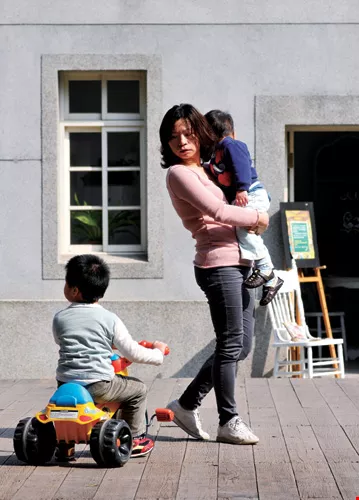
Besides having all the chores to do, a married woman also has to cope with her in-laws and young kids throughout the long holiday-trying to satisfy everyone's demands is like burning a candle at both ends and in the middle at the same time! No wonder so many married women feel aggravated just thinking about the holiday.
Even if a woman gets along with her in-laws, the family gatherings over the New Year holiday can easily turn into difficult periods in which salt gets poured into old wounds. Ms. Huang, who was married for seven years before giving birth to a daughter, recalls that she dreaded Chinese New Year during those years when she had no children. Although she had achieved more academically and professionally than any of the other women of her generation in the family, because she had no kids she was treated like a "second-class citizen" over the Lunar New Year. Not only did her sisters-in-law ask her to prepare food for all her nephews and nieces, but once the family feast was over, she got stuck with washing up all the dishes and pots and pans. Why? "You haven't got any children, so you must have time on your hands."
This unequal treatment continued right up until she had a child. "But since then I have been an equal with everyone else."
The minor aggravations that accumulate over the extended Chinese New Year vacation (which can be as long as seven or eight days depending on where New Year's Eve falls in the week) may seem trivial, but they can widen existing fault lines in marriages. Chen Mei-yi of the Awakening Foundation notes that her organization receives twice as many calls for divorce advice just after the holiday than at normal times during the year.
"Its not that husbands and wives get divorced just because they had some kind of big argument over the Chinese New Year, but in cases where the marriage is already in trouble, the behaviors that are required by custom and the frequent family gatherings can become "the straw that breaks the camel's back," says Chen.
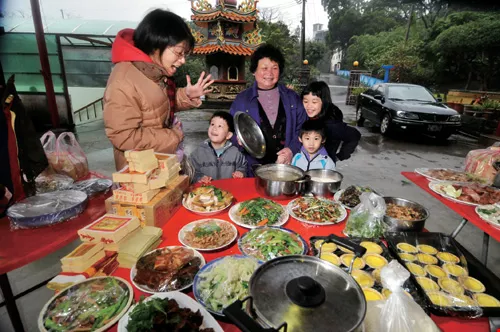
In these modern times, so long as both mother-in-law and daughter-in-law are considerate and communicate with mutual respect, their relationship can be as close as mother and daughter. The photo shows a mother- and daughter-in-law from Caijia Village working side by side to prepare a holiday meal.
Another potential problem for married women is the long-established custom of married women returning to their own parents' home on the second day of the New Year.
Liu Huan-yueh, a scholar of folk customs, says that New Year's customs can be traced as far back as the Zhou Dynasty (1046-256 BCE). Among traditionally minded Han Chinese society, women who marry are thereafter considered to be part of the husband's family. This means that they must spend New Year's Eve and the first day of the New Year taking care of cooking and cleaning chores, and also participating in ceremonies to pay respects to clan ancestors, at their in-laws' house. Only on day two of the New Year, when things settle down a bit at the in-laws', do they have a chance to go back to their own parents' home. However, even then they do so "as a guest," and usually must bring some kind of gift expressing that everything is going well in their own marriages and households.
"This is a custom which exists to confirm the change in status," explains Liu Huan-yueh. In order to ensure that customs like these are largely self-enforced, traditional cultures create taboos so that the restrictions don't need to be imposed from outside. The widespread belief that "going home on New Year's Eve or the first day of the New Year will bring bad luck" means that few married women are going to depart from tradition unless they have a very serious reason to do so.
But is there no room in these modern times to change these cultural rules? Tsai Li-ling, an associate professor at the Graduate Institute of Gender Education at National Kaohsiung Normal University, isn't the least impressed by the old taboos. "They are just a kind of deterrence discourse, no more sensible than the idea of putting a curse on someone."
Tsai points to the case of a friend of hers, whose husband has a large extended family but whose own parents have no one but her. Saddened at seeing her parents forced to spend every New Year's Eve by themselves, she resolved that she would one day ask permission from her husband's family to have New Year's Eve dinner with her own parents.Little did she expect that a few days before the holiday arrived, her own mother would call her up and tell her not to come home for New Year's Eve. It turns out that her mother's neighbors had pulled out that old taboo about the married daughter bringing bad luck to her own family if she returned home before day two of the New Year.
Tsai concludes: "Times have changed, and we should steadily break through the paternalistic discourse of traditional customs. In particular, given that single-child families are already common and will remain common in the future, there is no reason to persist with the custom of married women only returning home on the second day of the New Year."
Let's go back now to a subject we talked about earlier, New Year holiday relations between married women and their mothers-in-law, but this time look less at people who just don't get along and more at the cultural roles these two women are called upon to play.
One reason relations between daughter- and mother-in-law can be so strained over the holidays is that the relationship approximates one of "foreman" and "workman" in the overall family scheme. From a certain point of view however, the two women are, ironically, actually on the same side: they are both "outsiders" who have married into their husbands' families, and both are relatively disadvantaged compared to the insiders.
Unfortunately, "the weak often compete for resources," says Tsai, "and even strongly implement the rules and values of collective culture as a way of confirming their own relative status within the system." When a new daughter-in-law enters the family, the mother-in-law will often be the most vociferous in "tutoring" the newcomer in the rules and values that she will have to follow, because the mother-in-law herself had to run the same gauntlet.
Ironically, both women are sidelined when it comes to the main holiday rituals, such as paying respects to ancestors or the formal opening of the family feast, in all of which men play the leading roles, while the "servers" are strictly in the background.
"Unfortunately, older mothers-in-law and mothers who have been repressed to the point where they can barely breathe consider this kind of unreasonable treatment to be completely natural," Tsai relates. "This is how many customs that are unfriendly to married women get passed down from generation to generation, and form a cycle of repression that can't be escaped."
Creative solutionsAlthough it is difficult for married women to make a sharp break with long-established customs, as times and society have changed, there has been increased flexibility.
Lily Lin, president of the National Alliance of Taiwan Women's Associations, says that the latest generation of in-laws have generally been exposed to higher education, and are open to new ideas. "Modern women don't have to accept any pre-established position and get locked into some framework of traditional daughter-in-law and mother-in-law relations. As long as both parties are open-minded and thoughtful, it shouldn't be hard to find an approach that both can accept."
"Xiao Jing" (a pseudonym) has been through this type of experience. Her father-in-law died quite long ago, and her mother-in-law has lived with her and her husband. During her first few years of marriage, she worked alongside her mother-in-law cleaning house and preparing "enough food to feed an army" for the New Year's feast. It even happened that by the first day of the New Year they had exhausted themselves to the point where they got sick and had to go to the emergency room!
Beginning roughly seven years ago, Xiao Jing decided she was going to change things, so she said to her mother-in-law, "Mom, you work hard enough the rest of the year, so when New Year's Eve comes we'll go out to eat. We'll have Japanese food, your favorite, and it will be my treat." This soft approach proved successful, and since then the family's New Year's Eve dinner has always been at a restaurant.
She also knows that her mother-in-law loves being out and about where there is a lot going on, though she doesn't really like to spend money, so every Lunar New Year holiday, Xiao Jing carefully chooses domestic group tours that fit the bill and will be safe, which means that from the first day of the New Year onward, her mother-in-law will be all dressed up every day and going out with friends as they visit different places in Taiwan. This allows Xiao Jing to spend the rest of the holiday at home with her own family, where she and her husband and children can relax, or be free to plan a trip of their own.
Ms. Lin, who has been married for three years, offers yet another option. Because her husband is an only son, they have no reason that can justify not spending New Year's Eve with her in-laws. But her family only has two daughters, and since her marriage her parents and remaining sister have been left even more on their own. Therefore, in her second year of marriage, just before the arrival of Chinese New Year, she boldly proposed inviting her parents and sister to come and join the New Year's Eve feast at her in-laws, an idea which, much to her surprise, was strongly endorsed by her father- and mother-in-law.
Not only do her parents and sister now share their New Year's Eve dinner with her in-laws, when the second day of the New Year arrives and it is time for Ms. Lin to return to her parental home, her father- and mother-in-law happily go along. This arrangement makes things a lot easier and more relaxed for her and her husband, who are not caught up in having to "choose sides" when it comes to who spends what day with whom.
As Tolstoy told us, "Happy families are all alike; every unhappy family is unhappy in its own way." Yet perhaps most women can find a solution to the problems posed by the Lunar New Year holiday by being creative, kind, and considerate, and communicating in a sincere and thoughtful way. This is perhaps the best way that modern women can break the bonds of tradition and have a genuinely happy New Year.

@List.jpg?w=522&h=410&mode=crop&format=webp&quality=80)


