3D Film Craze--Passing Fad, or the Next Big Thing?
Lin Hsin-ching / photos Chuang Kung-ju / tr. by David Smith
September 2010


Many have had the startlingly novel experience as kids of seeing 3D movies at the planetarium or the science museum. All you had to do was put on a pair of special glasses to go zipping through the cosmos and explore the secrets of the heavens. Time traveling was another option-ah, the delights of roaming through a Jurassic-period forest!
This mind-boggling type of cinema has now broken out of the museums and into commercial theaters where, for a slightly higher price (admission to a 3D movie in the US costs about US$12-20, while in Taiwan it runs around NT$340-400), moviegoers can experience the thrill of movies made to blow your socks off!
In Hollywood alone, 12 different 3D movies will be released this year, and another 28 are on tap for next year. 3D movies may have been born in Hollywood, but moviemakers in Taiwan, Hong Kong, mainland China, Japan, and South Korea are licking their chops over future prospects. The formula for success, as they see it, is simple: "3D" means "excitement," and that means "box-office success." They are now gearing up for 3D productions of their own in hopes of luring to the theaters a generation of audiences that have gotten used to holing up at home to watch TV or download movies from the Internet.
The popularity of 3D movies is on a tear. Will they become, as some experts predict, "the new normal" that replaces the current 2D movies? Will the current 3D craze be any different from the 3D craze of 50 years ago? Could 3D perhaps be derailed? And how do moviemakers strike a proper balance between artistic creation and technical innovation?
From about two o'clock on the afternoon of July 24, 2010, a stream of cars begins to clog the streets of downtown Taichung City. Before long, an unexpected rainstorm adds to the misery, and the gridlock tightens. Sweat, rain, and the sounds of cursing define the ambiance until at last, at four o'clock, the police impose traffic control and the knotted mass of autos and humanity unravels ever so slowly. People finally begin making their way to Taichung Stadium.
A crowd of 40,000 has suddenly surged into the normally somnolent city of Taichung to attend a concert being put on this evening by Mayday, Taiwan's most popular rock band. This will be the final show in the band's DNA Encore world tour. Faithful fans wanting to get a glimpse of their heroes and enjoy the special stage effects have packed the stadium full. Due to the chaos, however, the eight-o'clock event has been delayed for a full hour.
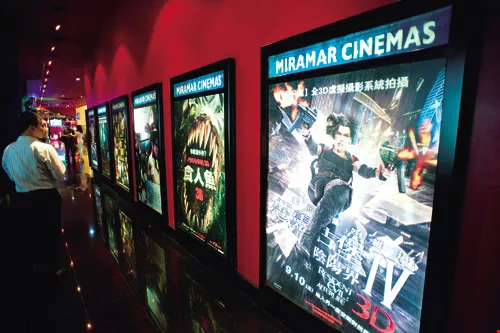
Quite a few of the movies showing at theaters these days are 3D. Hollywood studios clearly see 3D as a goose that lays golden eggs.
Needless to say, when Mayday members Ashin, Monster, Stone, Masa, and Guan You finally make their entrance in cool black army gear and belt out such monster hits as "The Scream of Spring," "Racing Car," and "Viva Love," the long-suffering crowd goes wild. With glow sticks waving, pyrotechnics blasting, and ribbons exploding through the air, those in the crowd completely forget that just minutes before they were angrily chanting, "Give us our money back!"
The high point comes midway into the concert when two Gundam robots rumble out on the stage just as Ashin is singing the new hit song "DNA": "Who has wormed their way into my brain? Who has tied my hands and feet? Is my DNA against me? Or am I just too timid to control my own fate?" Nine meters tall and weighing in at three tons apiece, the black and yellow robotic monsters act as bidden by Mayday and another band called Magic Power, which is playing the part of a Mayday impostor. The mecha-monsters fight it out, good against evil, shooting laser beams and belching fireworks. For the audience, it feels for all the world as if a sci-fi thriller is unfolding before their very eyes. This is entertainment at its best!
Though their stage appearance lasts just 10 minutes, the yellow and black robots have eaten up NT$8 million in production expenses. Even so, they are not the concert's biggest novelty. The really creative stuff is going on at the sidelines, largely unnoticed by the audience.
Unlike the "one camera per angle" approach usually employed by filmmakers, the producers at the rock concert have adopted stereo photography (i.e. with two cameras shooting from each angle). Especially observant concertgoers may have noticed pairs of camera lenses pointing at the action from five different angles. Some of the pairs are in an over/under setup, while others are arranged left/right, looking upon the scenery much like a pair of eyes, simultaneously gazing upon and recording the movements of the band members.
This laborious filming method has been adopted as part of plans to release a 3D movie of the concert in Taiwan, Hong Kong, and mainland China during the 2011 lunar new year holidays. The movie may even be released throughout all of Asia. Which will turn out to be more entertaining? Will it be the 3D movie or the live concert? The best judges of that would be the 40,000 people at the concert.
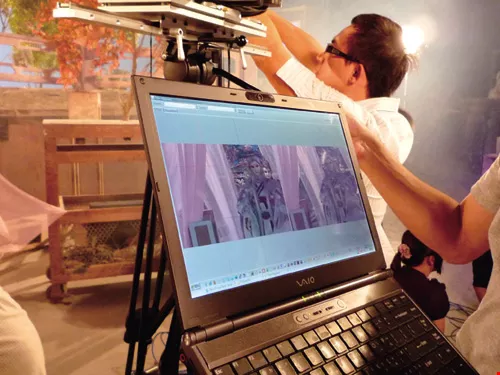
In order to promote 3D stereoscopic imaging, personnel from the National Center for High-Performance Computing (NCHC) recently visited the headquarters of Pili International Multimedia, a puppet theater hotbed in southern Taiwan, to collaborate on experimental 3D filming of a puppet theater performance. They spent 12 hours filming a four-minute short. During the filming, camera angles and 3D effects were continually tinkered with, offering some hint of how technically tricky 3D cinematography is.
There's nothing new about filming a concert in 3D. Back in 2008, Walt Disney Pictures made a 3D film of the Hannah Montana/Miley Cyrus: Best of Both Worlds Concert, featuring the American teen idol Miley Cyrus. The film grossed an impressive US$65 million (roughly NT$2.08 billion) in North America.
Before that, when the Irish rock group U2 played seven venues in the South-American leg of its Vertigo Tour in 2006, the concerts were filmed as a 3D movie called U2 3D, which gave people who couldn't make it to the concert a chance to get a life-like feel for what it would have been like to be there.
As the cameras glide from one focal point to the next, they afford an array of changing views. Now it's an up-close shot of a U2 player singing his heart out, now a soulful look into the eyes of lead singer Bono, now the viewer becomes a member of the audience, caught up in a maelstrom of raving passions and waving glow sticks. If the movie could just replicate the smell of sweat and beer, it would feel almost exactly like being there in person.
Hannah Montana and U2 3D both scored critical and box-office success, to be sure, but the market for 3D movies wasn't yet primed at that time to take off, so there was no follow-up until 2009 when the worldwide buzzed sparked by Avatar led to a revival of interest in 3D concert films. In addition to Mayday 3DNA, Japanese diva Ayumi Hamasaki and South Korean boy group Super Junior are both gearing up to ride the wave of excitement. Hamasaki has been the quickest off the mark, as her ~Arena Tour 2009 A~Next Level~ will be hitting theaters at the end of August, the first Asian 3D concert film to do so.
Wolf Chen is head of production at Double Edge Entertainment, the firm that will be releasing Mayday 3DNA. In his view, concerts are a perfect trial balloon for the early-stage development of 3D movies because popular singers or bands come with a solid base of diehard fans, which means that the moviemakers need not worry that they won't recoup the big bucks it takes to make such a film.
Another important reason why rock concerts are a good launch pad for 3D movies is that the special effects-fireworks, exploding ribbons, and assorted pyrotechnics-provide a vertiginous mix of motion and sound that is perfect for 3D presentation. Moviemakers in Taiwan and elsewhere in Asia have other reasons for filming rock concerts in their initial foray into 3D movies-such films pose no scriptwriting burden, and good ticket sales are assured.
According to Chen: "3DNA was shot in Taiwan, Singapore, and Beijing at a cost of NT$100 million, which is hugely expensive by Taiwan standards. But the project has generated considerable buzz, and Mayday is extremely popular throughout the Chinese-speaking world, so we're very confident that we can recoup our investment."
Chen reveals that his company is also preparing to film a movie version of Black and White, and that director Tsai Yueh Hsun had originally wanted to do it in 3D but decided against it because he wasn't 100% certain he had the necessary filming and post-production skills.
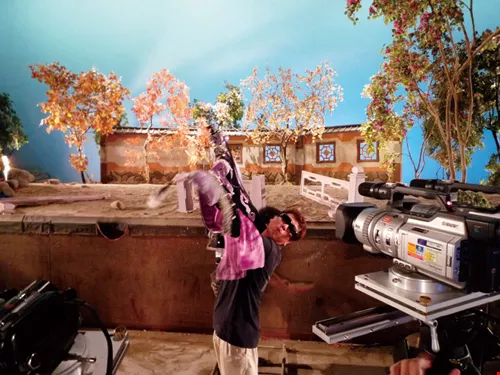
In order to promote 3D stereoscopic imaging, personnel from the National Center for High-Performance Computing (NCHC) recently visited the headquarters of Pili International Multimedia, a puppet theater hotbed in southern Taiwan, to collaborate on experimental 3D filming of a puppet theater performance. They spent 12 hours filming a four-minute short. During the filming, camera angles and 3D effects were continually tinkered with, offering some hint of how technically tricky 3D cinematography is.
Quite a few film studios are optimistic about the prospects for 3D movies. In Hollywood, which has been dubbed "the world's film studio," competition is already fierce. In the second half of this year alone, filming will start on 17 different 3D movies. Animated 3D films are on tap at DreamWorks (How to Train Your Dragon), Disney (Shrek Forever After), Pixar (Toy Story 3), and Universal Studios (Despicable Me), for example. The idea is to build for the future by cultivating a 3D audience among the very youngest of moviegoers.
In addition to animated flicks, a good number of recently released 3D live-action films, including Clash of the Titans (a remake of a 1981 film of the same name) and StreetDance 3D, have done very well at the box office. Alice in Wonderland, in particular, grossed US$1.02 billion worldwide (roughly NT$32.7 billion), placing it among the top five earners in the history of cinema and making it the second monster 3D hit in a row, following in the wake of Avatar.
Even sequels already expected to score big with audiences, such as Resident Evil: Afterlife (scheduled to hit theaters at year-end) and Harry Potter and the Deathly Hallows (the final movie in the Harry Potter series), are jumping on the 3D bandwagon in a bid to ramp up ticket sales.
Outside of Hollywood, Asia is another major 3D cinema battleground. In addition to the trial-balloon rock concert films coming out in countries throughout the region, dramas are also becoming a big item. Japanese director Takashi Shimizu, who excels at suspense thrillers and is best known for The Grudge, this past March became the first in Japan to film a live-action 3D horror film, The Shock Labyrinth 3D. Korea, in the meantime, is going with romance flicks, which have long been a surefire success in Korean TV series. Noted actor Lee Sung-Jae plays the leading man in a 3D romance called Natali. The film has done very well at the box office since hitting the theaters in August, thus putting to rest criticisms that filming a love story in 3D would be overkill.
In mainland China, where filmmakers cater to the second-largest movie market in the world, huge investments and big casts are employed to whip up enthusiasm among moviegoers. Don Quixote, adapted from the 17th-century Spanish novel by Cervantes and produced at a cost of RMB75 million (roughly NT$360 million), is scheduled for release this October. In the meantime, The Monkey King carries a price tag of a cool RMB210 million (roughly NT$1 billion) and will feature in the role of Sun Wukong the martial arts star Donnie Yen, who rocketed to Asia-wide stardom in Ip Man. The Monkey King is being targeted at Western audiences.
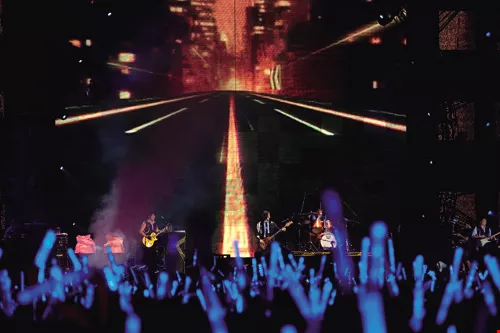
Smoke blows, laser lights flash, and psyched-up fans wave their glow sticks. Such are the scenes we've all come to expect at a rock concert, and in the future, thanks to 3D cinema, we'll be able to experience it up close and personal-in the comfortable surroundings of a movie theater, no less!-even when we can't actually make it to a concert. Shown here are Mayday performing during their DNA Encore world tour.
Taiwan's film industry is not by any means watching the 3D hullabaloo from the sidelines. In addition to Mayday 3DNA, which is currently being filmed, the 3D live-action feature Clownfish was already released this past April (but unfortunately grossed less than NT$2 million due to insufficient publicity). Also, Pili International Multimedia recently announced it was collaborating with the National Center for High-Performance Computing, a division of the National Applied Research Laboratories, to make the world's first 3D film of a puppet theater performance.
In addition, veteran film director Hsu Chin-liang, who was known in the 1970s as the master of the student movie genre, is planning to make a "live action + animation" 3D film to match the sound and fury of Avatar at a projected cost of NT$1 billion. To be released in 2012 at the earliest, the story line would be based on the tale of the Third Prince Nezha, a character in the Ming-Dynasty Daoist epic Canonization of the Gods. For the project, Hsu has recruited the services of outstanding Taiwanese cinema professionals working in Hollywood, such as Daniel Chen, who was part of the post-production team for Avatar.
So it would seem that the 3D spark is about to light a prairie fire, but veterans in the industry haven't forgotten that 3D cinema already has a past, and it has involved no few false starts. During 130 years of cinematic history, the first 3D experiment took place in 1890 when William Friese-Greene showed stereoscopic movies by projecting identical images simultaneously side by side on the screen. He had audiences wear special anaglyph glasses with complementary red- and green-tinted lenses, and relied on the mind's natural image processing to synthesize the two images into one.
The first commercial 3D cinematic effort came in 1922 with The Power of Love, and there were spates of 3D film releases in the 1950s and the 1970s. The peak years were from 1953 to 1955, when Hollywood turned out over 50 3D films. The 1970s saw the release of 36.
The Stewardess, which played in theaters in 1969-70, was produced for a mere US$100,000 yet raked in a whopping US$27 million. Prior to the release of Avatar in 2009, The Stewardess boasted the highest profit margin in the history of 3D movies.
Taiwan's first 3D film, Super Dragon, was a martial arts flick made in 1977 by noted director Chang Mei-chun. Many older moviegoers vividly recall how the daggers and flying guillotines seemed to come right at the audience. The fresh new visual experience made the film a huge hit.
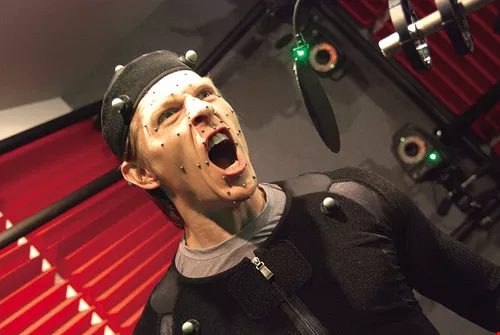
"Motion capture" is a technique whereby a person's movements are recorded and translated into animation using computer software. This technique makes it possible to produced animated characters with movements and facial expressions that are every bit as subtle as those of a human actor. Shown here is Reuben Langdon, the stunt man who stood in as Jake in Avatar. In this photo, Langdon is doing a motion-capture scene for the popular video game Resident Evil 5. His face is blanketed with sensors in order to capture all the subtleties of human facial expressions.
What we are seeing in 2010 is thus the third 3D movie craze following earlier surges of popularity in the 1950s and 70s. Will it be just another flash in the pan? Or will 3D this time around become mainstream?
Optimists in the industry argue that "this ain't your granddaddy's 3D," and claim that today's digital technology is a game changer. In the analog era, producing a 3D film was an extremely laborious process, because two cameras had to shoot every scene simultaneously, and movie theaters had to haul out not just one bulky reel, but two, and if they weren't synchronized perfectly, the lag between the left and right images defeated the whole purpose of 3D.
Now that everything is digitized, and computer-controlled stereoscopic filming software is easily available, it is a simple matter to simultaneously record video and audio, and to reproduce, edit, and save it to memory. The time required for producing a 3D movie, and the associated risks, have been dramatically reduced. And on top of that are advances in projection equipment. High-quality polarized and shutter projection technology and newly developed 3D movie glasses (see side article on "3D TV Explained") have replaced the red-green anaglyph technology of the past. The new methods provide audiences with 3D images that are both realistic and easy on the eyes. Many different factors have thus combined to create a much stronger survival niche for the current wave of 3D movies.
The 3D feature films Don Quixote and The Monkey King are the handiwork of noted mainland Chinese director Ah Gan (real name: Liu Xiaoguang), who says that 3D films are attractive to studios because they are pirate-proof. In China, where pirating is rampant, this is no small consideration. There was virtually nothing filmmakers could do before about piracy, but moviegoers wanting the full effect of 3D have no other choice than to go to a theater and pony up a premium of at least one-third over the normal ticket price. In some cases, the price is twice that of an ordinary movie! That explains why 3D screens are being installed throughout China at the rate of 1.5 per day. By the time Don Quixote is released in October, there should be over 2,000 3D movie theaters in China. Says Ah Gan: "Prospects are looking good!"
Tu Ming is Greater China managing director for Twentieth Century Fox International, the distributor of Avatar. During a forum on 3D cinema at the Taipei Film Festival in July, he stated that 3D images will become something you just expect in movies as a matter of course, just like Dolby Sensurround.
Says Tu: "A car shopper out looking at a car doesn't ask whether it has air conditioning. Well, it's the same with movies, which have gone in the past from silent film to talkies, and from black and white to color. This is the inevitable result of technological progress. Now we're going from 2D to 3D."
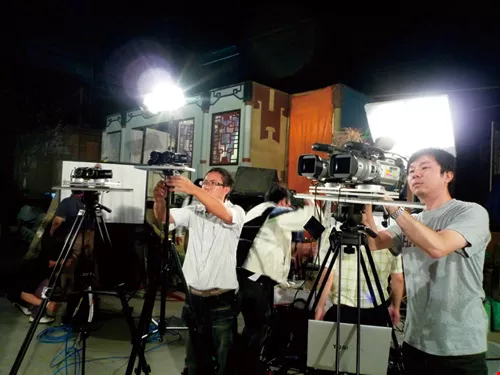
In order to promote 3D stereoscopic imaging, personnel from the National Center for High-Performance Computing (NCHC) recently visited the headquarters of Pili International Multimedia, a puppet theater hotbed in southern Taiwan, to collaborate on experimental 3D filming of a puppet theater performance. They spent 12 hours filming a four-minute short. During the filming, camera angles and 3D effects were continually tinkered with, offering some hint of how technically tricky 3D cinematography is.
Not everyone sees a bright future for 3D, of course. The well known Chicago-based movie critic Roger Ebert published an article entitled "Why I Hate 3-D" in Newsweek magazine this past April and set out nine reasons why he opposes the 3D craze. He argues, for example, it is a "waste of a dimension" (because "when you look at a 2-D movie, it's already in 3-D as far as your mind is concerned"), "it adds nothing to the experience," "can be a distraction," is inappropriate for "a serious drama," increases production costs, "theaters slap on a surcharge," "it can create nausea and headaches," and "whenever Hollywood has felt threatened, it has turned to technology: widescreen, stereophonic sound, and now 3-D."
Ebert's complaints are shared by most of those with reservations about the current 3D trend.
Robert Chen, a professor of film theory in the Department of Radio and Television at National Chengchi University, strongly agrees that the latest 3D craze is just a sign that Hollywood has exhausted its bag of tricks. He points out that 3D was not the only fad to sweep Hollywood in the 1950s and 60s. Olfactory cinema was also popular in Hollywood for a time. The idea was that "whatever appears in the movie, its smell ought to reach the viewers." They even distributed scratch-and-sniff cards to audiences!
Says Chen: "Olfactory cinema is the progenitor of what today we call 4D cinema (3D + other sensory stimuli), but while movies that put excessive emphasis on packaging can whip up enthusiasm among audiences for a time simply on the strength of novelty, in the long run people will get sated and stop coming."
In Chen's view, now that audiences have had their appetites whetted by Avatar, a carefully crafted film that was years in gestation, the industry is setting itself up for a big fall if other 3D movies fail to provide a sensory thrill or storyline to equal what people got with Avatar. Once the novelty wears off, 3D really won't have anything going for it.
Crayon Yao got his start in cinema by making 3D movies for museums. Now working as the creative director at YAOX Edutainment, which gained lots of attention recently for its contributions to the World Expo in Shanghai, Yao considers 3D cinema a passing fad. 3D movies are pretty cool, to be sure, but he points out that you have to wear special glasses to watch them, which isn't a very comfortable or natural way to watch a movie.
"It's okay to see a 15-minute 3D film once or twice a year at a museum or theme park, but it's quite impossible to imagine people wanting to see unnatural 3D images every single time they go to the theater. And it's even harder to think that people will accept being forced to watch 3D in their own homes." Based on his many years in the industry, Yao sees 3D becoming one among many types of cinema, but feels there is no way that it could replace 2D, or that it will ensure better box-office success over the long term.
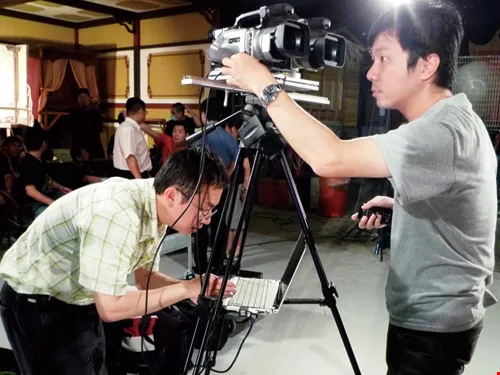
In order to promote 3D stereoscopic imaging, personnel from the National Center for High-Performance Computing (NCHC) recently visited the headquarters of Pili International Multimedia, a puppet theater hotbed in southern Taiwan, to collaborate on experimental 3D filming of a puppet theater performance. They spent 12 hours filming a four-minute short. During the filming, camera angles and 3D effects were continually tinkered with, offering some hint of how technically tricky 3D cinematography is.
Both fans and detractors of 3D cinema agree, in any case, that 3D is just one form for the presentation of images, and that good scripts and artful storytelling are the most important determinants of a movie's success with audiences.
Lee Daw-ming, chair of the Graduate Institute of Filmmaking at Taipei National University of the Arts, notes that 3D movies in the past generally featured projectiles continually shooting off the screen, or horrific creatures. The idea was to ambush and startle viewers, and it was not uncommon to work unnecessary scenes into the movie just for the 3D effect. "In time," says Lee, "people naturally got tired of that."
Avatar was successful because director James Cameron was basically telling an entertaining tale, and used 3D simply to accentuate the spatial element of the film and help create a beautiful alien world. That is the only way to achieve enduring success with 3D.
Lee states: "A lot of folks think that 3D is more appropriate for certain genres, such as horror movies, fantasy flicks, and animation, but I think the most important thing is not the type of movie. I think we need to get back to fundamentals. We need to focus on the spatial depth of a story, aesthetic style, and storytelling techniques."
In Lee's view, as long as the 3D format helps a movie tell a tale more powerfully, then its use is worth considering. For example, he feels that if Island Etude, which follows the travels of a young man around Taiwan on his bike and sparked a wave of interest in bicycling in Taiwan, had been filmed in 3D, audiences would have gotten a much more compelling look at the beauty of Taiwan.
"Of course, even without 3D, Island Etude is a gorgeous film. So my point is, when you've got a good script and the right kind of movie, then 3D very clearly makes for a better film. Absent those conditions, however, 3D is simply superfluous."
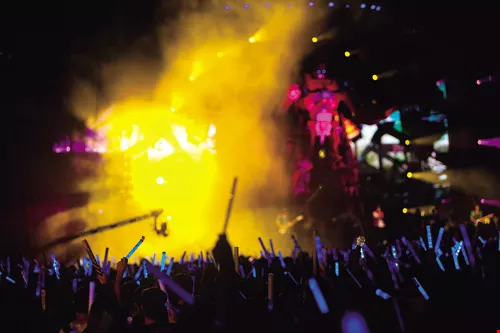
Smoke blows, laser lights flash, and psyched-up fans wave their glow sticks. Such are the scenes we've all come to expect at a rock concert, and in the future, thanks to 3D cinema, we'll be able to experience it up close and personal-in the comfortable surroundings of a movie theater, no less!-even when we can't actually make it to a concert. Shown here are Mayday performing during their DNA Encore world tour.
It's hard to say whether 3D cinema will fare as well as the industry expects, but Lee feels that even if Taiwan's film industry remains for the most part in the doldrums, there is still no reason for local filmmakers to get down on themselves. They shouldn't tell themselves that finding any work at all is a major accomplishment, and for that reason shrink away from 3D, nor should they indulge in Luddite opposition to all things new, or simply hurl the accusation that 3D is "just a bunch of special effects meant to gyp audiences," and use that as an excuse for turning their backs on new technologies.
After attending the forum on 3D cinema at the Taipei Film Festival, where there were only a few local directors and producers present, Lee said with frustration: "Even Hollywood is still taking its first baby steps where digital stereoscopic cinema is concerned. Taiwan is not far behind other countries in this area, and we can look to Taiwan's high-powered manufacturers of 3D display panels and other display technologies for support. If our moviemakers do not seize the opportunities afforded by today's new trends, it would really be a shame."
Is today's 3D movie craze just a brief dalliance, or is it the beginning of something big? The answer to that is not clear, but perhaps the observation of famed Chinese director Zhang Yimou provides the most constructive suggestion we've heard for those active in the film industry: "Don't everybody just go jumping on the bandwagon for its own sake. If you're going to do it, do it in style." Bold experimentation, careful forethought, and the use of unique new perspectives to create better movies-surely those are the points that will get people excited about 3D films.
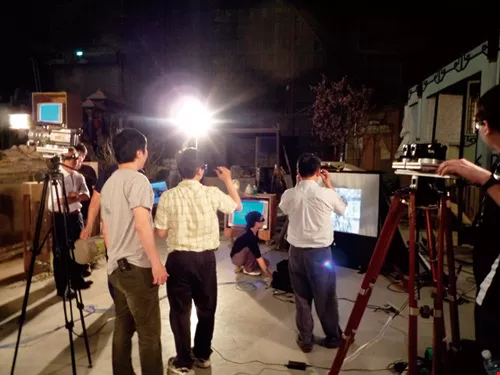
In order to promote 3D stereoscopic imaging, personnel from the National Center for High-Performance Computing (NCHC) recently visited the headquarters of Pili International Multimedia, a puppet theater hotbed in southern Taiwan, to collaborate on experimental 3D filming of a puppet theater performance. They spent 12 hours filming a four-minute short. During the filming, camera angles and 3D effects were continually tinkered with, offering some hint of how technically tricky 3D cinematography is.
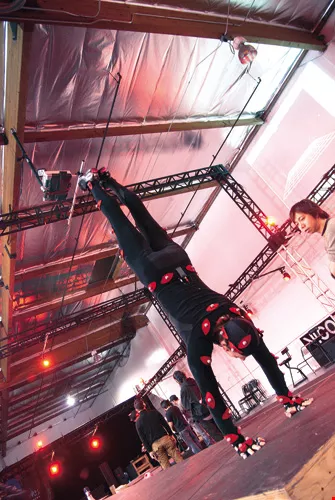
"Motion capture" is a technique whereby a person's movements are recorded and translated into animation using computer software. This technique makes it possible to produced animated characters with movements and facial expressions that are every bit as subtle as those of a human actor. Shown here is Reuben Langdon, the stunt man who stood in as Jake in Avatar. In this photo, Langdon is doing a motion-capture scene for the popular video game Resident Evil 5. His face is blanketed with sensors in order to capture all the subtleties of human facial expressions.
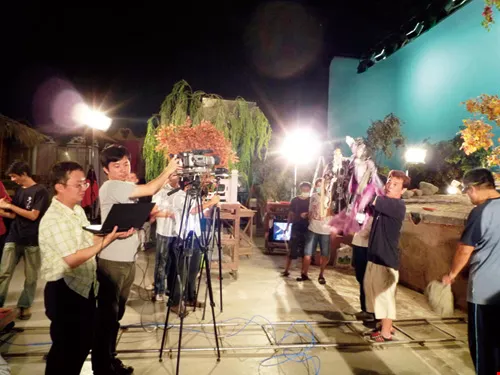
In order to promote 3D stereoscopic imaging, personnel from the National Center for High-Performance Computing (NCHC) recently visited the headquarters of Pili International Multimedia, a puppet theater hotbed in southern Taiwan, to collaborate on experimental 3D filming of a puppet theater performance. They spent 12 hours filming a four-minute short. During the filming, camera angles and 3D effects were continually tinkered with, offering some hint of how technically tricky 3D cinematography is.
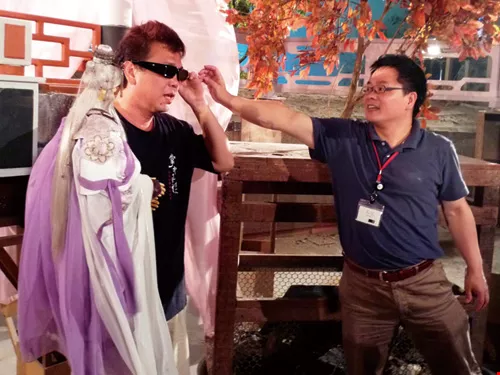
In order to promote 3D stereoscopic imaging, personnel from the National Center for High-Performance Computing (NCHC) recently visited the headquarters of Pili International Multimedia, a puppet theater hotbed in southern Taiwan, to collaborate on experimental 3D filming of a puppet theater performance. They spent 12 hours filming a four-minute short. During the filming, camera angles and 3D effects were continually tinkered with, offering some hint of how technically tricky 3D cinematography is.
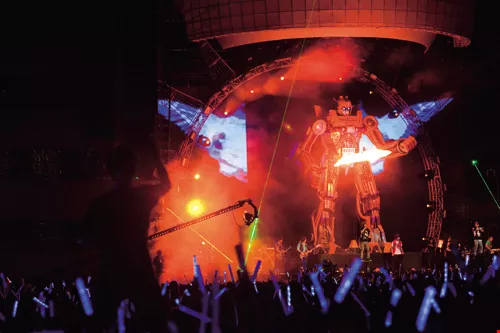
The organizers of Mayday's DNA Encore world tour arranged for a pair of fire-belching Gundam robots-one black, the other yellow-to fight it out on the stage during the concert. Hidden in the filming rigs were two pairs of stereoscopic cameras, standard equipment for the making of 3D movies.
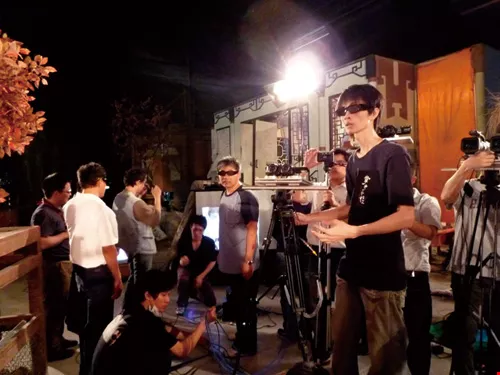
In order to promote 3D stereoscopic imaging, personnel from the National Center for High-Performance Computing (NCHC) recently visited the headquarters of Pili International Multimedia, a puppet theater hotbed in southern Taiwan, to collaborate on experimental 3D filming of a puppet theater performance. They spent 12 hours filming a four-minute short. During the filming, camera angles and 3D effects were continually tinkered with, offering some hint of how technically tricky 3D cinematography is.

Avatar, which sparked a global 3D craze, will be re-released in theaters in late August in a special version that is eight minutes longer than the original.
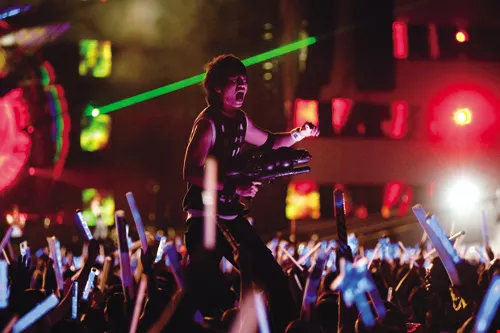
Smoke blows, laser lights flash, and psyched-up fans wave their glow sticks. Such are the scenes we've all come to expect at a rock concert, and in the future, thanks to 3D cinema, we'll be able to experience it up close and personal-in the comfortable surroundings of a movie theater, no less!-even when we can't actually make it to a concert. Shown here are Mayday performing during their DNA Encore world tour.

The film Don Quixote goes long on big scenes and big productions to translate Western chivalric literature into a Chinese context. This highly creative effort will be the first 3D live-action flick to be made in China.


@List.jpg?w=522&h=410&mode=crop&format=webp&quality=80)


