Street Urchins--The Collared Bush Robin
Chang Chin-ju / photos Kuo Chih-yung / tr. by Robert Taylor
December 2001


When the weather in Taiwan's low-lands begins to gradually turn cool, in the island's high mountains the mercury is already plummeting, and all kinds of living things are getting ready for their winter rest. But despite the cold, high up on Mt. Hehuan, Yushan, Mt. Ali and elsewhere one can often see a unique Taiwanese bird species-the collared bush robin-hopping busily along the ground alone in search of food, like a solitary little knight-errant.
Long isolation in Taiwan's high mountains has allowed the collared bush robin to evolve into a unique endemic species. As well as being adapted to the cold of the high altitude environment, thanks to its resilience and vitality the robin has also followed closely in the footsteps of human activity, to become one of the most commonly seen birds along Taiwan's mountain highways.
Elevation: 3000 meters above sea level.
The first rays of the morning sun break over the dark, distant ridges of Mt. Chilai, then draw ever nearer, awakening one by one the peaks of Mt. Nanhu, Central Range Point, and finally Mt. Hehuan. Swathes of arrow bamboo glisten green in the dawn light, and a boundless sea of white clouds swirls through the dark valleys. . . .
Shadows of the road
In early October, at a weekend in the low season for tourism along the Central Cross-Island Highway, despite the perfect blue sky and sea of clouds at the top of Mt. Hehuan, staff and students from Kaohsiung's Shu-Te University keep their eyes trained on their traffic recording instruments, until the answer is revealed: in the space of 24 hours, 1350 cars, coaches and trucks have gone roaring by on this stretch of Provincial Highway 14A running through Taroko National Park. The noise of the traffic continually pierces the expansive silence of Taiwan's high mountains.
For Assistant Professor Lo Liu-chih of Shu-Te University's Department of Leisure, Recreation and Tourism Management, the purpose of this trip is to investigate the relationship between traffic levels and the breeding behavior of collared bush robins. As visitors hurry by on their way from one scenic spot to the next, on the steep slopes they see the patches of Japanese knotweed, stonecrop and spiraea, with little flowers blossoming shyly in all shades of yellow and red; the dense, short arrow bamboo; and the Yushan roses heavy with rose hips. But only Lo Liu-chih knows that at little more than arm's length, the tangled vegetation hides many nests laboriously built by a bird found only in Taiwan.
The collared bush robin, which grows to around 13 centimeters long, is a member of the subfamily Turdinae-the thrushes. This subfamily numbers over 300 species worldwide, distributed from Europe to Siberia and East Asia. In tropical Taiwan the bush robin, a temperate-zone bird, is found in mountain valleys at elevations from 2000 meters to 3700 meters.
A dandy in a red cravat
The majority of bird species live in trees, but many members of the subfamily Turdinae are active on the ground. Unable to fly far, they have a very small range, and due to long periods of isolation without genetic exchange they have evolved into endemic species in many areas. Taiwan alone boasts 23 recorded Turdinae species. Among them, a number are unique to Taiwan, including the plumbeous water redstart, which lives by rivers, the sizeable Taiwan whistling thrush, and the collared bush robin, which is found only in Taiwan's high mountains.
The collared bush robin is a pretty little bird. The male has a coat of black feathers, a white line across each brow, and a bright band of orange around its neck that makes it look like a dandy wearing a flashy cravat. By comparison, the female appears much drabber in her olive plumage mottled with yellow and brown. But these camouflage colors give the female robin the best possible protection when she is building her nest and raising her young in holes in rock faces or on slopes of broken rock.
Many mountain birds tend to gather in noisy flocks, but collared bush robins prefer to pace the mountain roads alone like itinerant Taoist monks, looking for insects on the ground to fill their bellies.
Unlike Taiwan's endemic mikado pheasant and Swinhoe's pheasant, whose populations are dangerously small, the lively bush robins can be quickly spotted by experienced birdwatchers, and many amateur ornithologists have had the experience of watching them on mountain roads. But what prompts the robins, which normally live in dense vegetation on steep mountain slopes, to build their nests next to highways? This has long been a puzzle.
Mountain love-nests
"Around dawn in April or May, if you walk along the road you can hear them calling 'peep! peep! peep! peep!' in the darkness, and then you see them looking for food on the road, or picking up dry twigs for their nests," says professional nature photographer Kuo Chih-yung.
In late March, as Mt. Hehuan's cap of white snow melts away, the rich red Oldham rhododendrons burst into blossom. Visitors come streaming into the mountains to enjoy the spring colors, and the collared bush robins also begins their breeding season. Running the risk of being squashed flat, they take advantage of breaks in the stream of traffic to busily build their little nests on the mountainside.
To escape unwelcome gazes, the energetic robins dart in and out of their nests at lightning speed, and to avoid disturbance they mainly choose to build them in spots covered by vegetation up to 50 centimeters tall, or in hollows in areas of fallen rock.
The monogamous bush robin pairs divvy up the "housework" between them: the female builds the nest and incubates the eggs, while the male is responsible for standing guard, and shares in finding food and feeding the hatchlings. Once the female robin has sized up the local fengshui and chosen a suitable nesting site, the two birds first use their little feet to prepare the ground, then hack out a small hole the size of a rice bowl in the fragile shale mountainside. Once they have successfully dug the hole the birds do not rest, but continue their efforts by carrying back in their beaks soft materials such as fallen leaves, dry twigs, moss and even bits of nylon string, to pad out a soft, warm nest.
Macho recklessness
"You see them start work in the morning, picking up a few fallen leaves, and by the afternoon they've laid out a thick layer of moss, and the nest is already finished," says Lo Liu-chih, who marvels at the quick, deft, and confident movements of the future parent robins. Once the nest is finished, the female spends another two to three days familiarizing herself with the surroundings, before finally settling down to lay her eggs. A couple of days later, a clutch of two to four pale greenish-blue eggs just two-and-a-half centimeters long are lying safely together inside the nest.
After the eggs hatch a fortnight later, one can see the diligent parent birds efficiently carrying beakful after beakful of insects home to feed to the nestlings. "The female birds are very cautious. They always stop at the barrier on the other side of the road, or on a lone fir tree, look all around, and wait until the cars are at a safe distance before they zip into their nests. But the males just rashly fly straight home." Lo Liu-chih says that observers prefer to watch the less cautious male birds, for that way they can more easily track down the nests.
When the chicks emerge from the eggs, their plumage is a duplicate of their mother's. Eighteen days later the fledglings begin to leave the nest to live independently, and their parents also fly away from the road and back into the forest. From mid-August on, temperatures in the high mountains begin to fall, and the breeding season comes to an end. Many birds move down to medium elevations above 2000 meters to spend the winter there. The number of collared bush robins along the highways decreases, and we will have to wait till next spring to see them converge on the roads once again.
The long and winding roads
Three years ago, when Lo Liu-chih began making surveys along the Central Cross-Island Highway, he discovered that along some stretches of the road above the 2000 meter mark, on the side toward the mountain there was a collared bush robin nest about every 50 meters. The robins are fiercely territorial, and 50 meters is the distance they like to keep between each other. "Between Kuanyuan at 2400 meters and Kunyang at 3000 meters, over ten kilometers away, this spring we found at least 40 nests." On recording the nests' positions, Lo discovered that more than 80% of them were within seven meters of the road, and many were on the steep slopes directly adjacent to the road. Further away from the highway there were fewer nests, and on trekking deep into the woods the surveyors also found that robin nests were less numerous there than along the roadsides.
"The proximity of nest sites to the road, their height above the road surface, and the depth of the nest hole, showed significant positive correlation with breeding success," writes Lo Liu-chih in his report.
Taiwan's high mountains stand peak after peak, and roads wind through them seemingly without end. The highways that strike deep into the heart of the wilderness are often seen as destroyers of nature, carving up habitats and threatening wild creatures' survival. So why do the roads not scare away the collared bush robins? What makes these little birds willing to ignore the noise and vibration, endure the black, noxious exhaust fumes, and become street urchins, building their nests and raising their young along narrow mountain roads where pedestrians fear to tread and their lives appear constantly in danger?
Lo Liu-chih points out that the collared bush robins that live on the ground in the forest understory mainly nest on grassy slopes, where as well as being exposed to major airborne predators such as raptors and crows, they are also apt to attract the attention of land animals such as weasels and rock monkeys. "Large creatures like weasels, birds of prey or nutcrackers may be more sensitive to traffic, and more easily frightened by human activity," says Lo Liu-chih. He speculates that the robins have discovered that traffic drives away their predators, and this is why they choose the lesser of two evils, putting up with the pollution in exchange for the traffic's protection.
To confirm that collared bush robins really are deliberately choosing to live by the roads, apart from surveying the Central Cross-Island Highway Lo Liu-chih also decided to carry out surveys along the New Central Cross-Island Highway (the Yushan/Mt. Ali route) and the Southern Cross-Island Highway, both of which cross Taiwan's mountains at heights over 3000 meters, in the hope of better understanding the relationship between traffic levels and the birds' survival rates. Although no final conclusions have yet been reached, "one thing that is common to each of the highways is that both sides of the road have become meccas for nesting bush robins." So says Shu-Te University student Chou Ming-hung, who over the last two years has spent much time plodding the Southern and New Central Cross-Island Highways to observe the birds.
Many other animals become roadkill, but the more fortunate collared bush robin has passed its "road test" and survives all the better in this harsh environment.
A high price
However, apart from the numbers of robins along the roads, it is also necessary to examine their overall survival in the wild. Increasing human encroachment into mountain areas has drastically reduced bush robin habitats, and not only is their breeding disturbed by humans' own activities, but the dogs that come with people also destroy the birds' nests and eat their eggs and young. Away from the roads, how do conditions for collared bush robins' survival compare with the past? How have their populations changed? These questions require in-depth surveys. As the bush robins have grown used to life on the road, how has it affected their biology and ecology? And while the robins have built their nests along the roadsides and taken up residence there, what other animals have disappeared because of the roads? These are all unsolved mysteries.
In fact, whether the bush robins' choice of the roads is a good or a bad one still remains to be seen. The birds' proximity to people and traffic makes it easy for bird catchers to get to know their habits. "The greedy hunters who are in the mountains every day know more about the birds' behavior than we do. Of the 40-plus nests we recorded along the Central Cross-Island Highway this year, a quarter were taken away, birds and all." Lo Liu-chih says that even within the national park area, the massive demand for rare bird species from bird shops in the lowlands pushes bird catchers to risk flouting the law, and they have carried off almost all the nests in easy reach.
Nature is dynamic and changing, and perhaps when the pressure from hunters is too great, or when tourists' behavior goes beyond what the birds can bear, the collared bush robins may, after a careful reappraisal, make a new choice and move house again. But what is more worrying is that, threatened wherever they turn, in the end the birds may have no choices left and nowhere else to go.
Valiant little warriors
Collared bush robins are beautiful shadows of Taiwan's high mountains. Despite the chaotic hubbub of tourists on the roads, every spring and summer the industrious parent birds constantly hop about and call and sing, reminding many visitors that these bright, clear seasons belong to them too.
For modern people, even leisure is a busy affair. The next time you cross the high mountains, will you notice the indomitable little birds that struggle each year to raise their young beside the busy roads?
p.102
White clouds smile from a blue sky, fir trees stretch out their branches. A young collared bush robin looks into the distance, getting ready to spread its wings and leave the nest.
p.102
The Collared Bush Robin
p.104
Along Provincial Highway 14A on Mt. Hehuan, assistant professor Lo Liu-chih of Shu-Te University discovered many hidden nesting holes in which collared bush robins raise their young. (photo by Hsueh Chi-kuang)
p.104
The Collared Bush Robin
p.105
Collared bush robins are often active in the forest understory. In the shade of the trees, the male bird (left) in his red cravat and the female (right) in her mottled yellow-and-brown plumage give birdwatchers something to feast their eyes on.
p.106
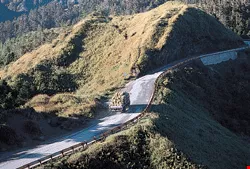
Winding mountain highways cut through nature at random, changing birds* ecology. (photo by Hsueh Chi-kuang). (facing page:) Just what impact does this have on the birds* life? This is something researchers need to study in depth, and all of us need to wake up to.
p.106
The Collared Bush Robin


@List.jpg?w=522&h=410&mode=crop&format=webp&quality=80)
@List.jpg?w=522&h=410&mode=crop&format=webp&quality=80)
