Premium vs. Mass-Market: A Taiwanese Tea Industry Dilemma
Sam Ju / photos Jimmy Lin / tr. by Scott Williams
March 2012


Nowadays, it’s almost obligatory for visitors to Taiwan to pick up some tea as a gift for friends back home. Tea is a distinctive part of the local culture, and thus an ideal souvenir.
In contrast, three or four decades ago tealeaves were an important export item and a major source of foreign exchange. In those days, the tea business was practically synonymous with profit.
The two business models are emblematic of how Taiwan’s tea industry has changed.
Signs of human habitation grow few and far between as you make your way towards Hsinchu on Provincial Highway 3. It’s hard to believe that the road was originally built to support industrial development.
In recent years, there hasn’t been so much as a hint of industry in the area, but 40 years ago the road was packed with pedicab drivers and shoulder-pole-carrying workers, all vying to deliver fresh-picked tea flushes to local processing plants and hoping for a good price when they got there.
It was a golden age for Taiwanese tea exports. With endless baskets of fresh leaves to process, tea factory workers had no time for breaks. They labored day and night to ensure that their teas were loaded on time onto the ships that would bear them to buyers in North Africa and the Middle East.
In 1972, Chiang Ching-kuo made a trip to Hengshan Township, Hsinchu County, just after assuming the premiership. His purpose was to visit the Sha Keng Tea Manufactory, then the largest tea processor and exporter in Taiwan.
In those days, the law required tea processors to obtain a tea factory construction permit and a factory registration before beginning operations. While visiting the Sha Keng facility, Chiang suggested that Taiwanese manufacturers expand into the bagged tea business so popular abroad.
Norman Shu, the present-day chairman of the Taiwan Tea Manufacturers’ Association and CEO of the Sha Keng Tea Manufactory, was just an elementary-school student at the time. He says that in the old days, when southern Taiwan was known for sugar and northern Taiwan for tea, tea production was concentrated in the foothills of Taoyuan, Hsinchu, and Miaoli Counties. “In those days, growing and processing were generally agreed to be separate businesses. International demand for tea was strong, which fostered the growth of Taiwan’s tea export business.”
In fact, tea exports hit a record high of 23,000 metric tons in 1973, a record that stands to this day.
Shu says the factories used to run three shifts round the clock, and that a single processing plant could support the 3–400 farmers growing within a 10-kilometer radius.
Jackson Huang, chairman of ABC Tea, says that in those days Taiwan’s biggest export markets were Algeria, Morocco, Libya, and Tunisia—almost all former customers of a Shanghai tea company.
In 1949, the civil war compelled the Shanghai company to relocate to Taiwan where it passed on its green tea roasting techniques and international sales tactics—and ultimately its international clients—to local producers.
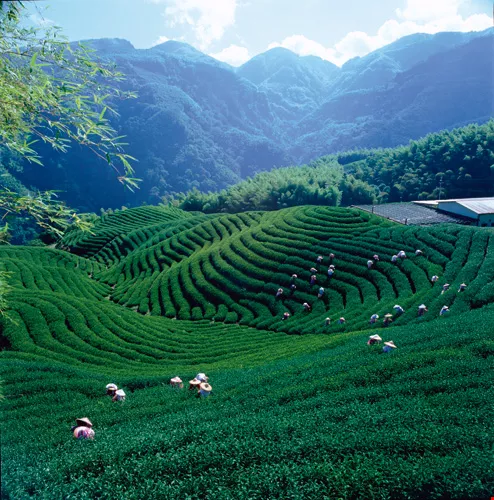
Taiwan’s tea industry began transforming in the mid 1970s. With exports falling and domestic consumption rising, the major centers of cultivation moved south from Taoyuan, Hsinchu, and Miaoli Counties to Nantou and Chiayi Counties. The photo shows a Nantou tea plantation.
Huang went abroad to negotiate an order for the first time at the age of 26. “Taiwan’s economic miracle was all about toting samples and luggage” all over the world to open up new markets. Huang himself ultimately visited more than 60 countries and territories.
But Taiwan’s export tea business collapsed in 1974, when exports began falling by 1–2,000 tons per year. They fell below 10,000 tons in 1987, and dropped to just 4,800 tons in 2010.
Taiwan began importing tea in 1985. While imports started small—just 3-400 tons in the first two years—they expanded rapidly, reaching 30,000 tons in 2010.
There were multiple reasons for the turnaround. When Taiwan’s economy took off in the 1970s, labor costs soared and urban job opportunities attracted many workers from rural areas. The NT dollar also appreciated. That made our tea less cost-competitive on the export market, bankrupting many local producers.
Drinking fine teas had not yet become fashionable, so there was little domestic demand to take up the slack. As a result, the number of tea growers and of acres planted in tea began to shrink in the north.
The government’s elimination of the Regulations Governing Tea Production in Taiwan Province in 1982, permitting farmers to produce, process and sell their tea themselves, was another issue. The move benefited the farmers, but removed tea processors and brokers from the production chain.
In the old days, the mountains of central and southern Taiwan were not important tea-growing regions despite having a climate very well suited to tea. But as incomes rose across the island, consumer interest in quality teas from the mountains grew. Farmers cultivated increasing numbers of tea bushes, and plantations began to sprout at ever higher elevations.
But even with domestic demand increasing and unit prices rising, acreage in cultivation and output declined. Moreover, high production costs made Taiwanese teas relatively uncompetitive in the export market, and made it virtually impossible for even those processors who wanted to remain in the export business to do so.
When Huang buys tea from local farmers, they often ask him why he wants to sell it abroad when “there isn’t enough to meet domestic demand.”
“Taiwan’s tea output accounts for less than 1% of global production. Our tea farmers ignore international prices. They set their prices so high, there’s no way for me to sell it.” He complains, “Back in the old days, we produced and sold whatever tea the global market demanded. Now, that’s been turned on its head. The farmers decide what tea to grow. They ignore what the international market has to say about varieties and prices.”
Different streamsGiven that the old days of separate growers and processors aren’t coming back, how do we bring back the glory days of Taiwanese tea exports?
Huang recommends that the government establish an export-processing zone for tea as a base for licensed tea processors and registered factories. They want the government to permit tariff-free imports of cheaper Southeast Asian and mainland Chinese teas that could be processed and blended in this zone, then re-exported.
Huang stresses that the government would be able to protect the rights of local growers and consumers by keeping tea processed in the zone out of the domestic market. It could also levy a tax on beverage makers that used leaves from the zone to make their beverages. In other words, it could employ separate systems to advise and regulate producers of commercial and premium teas.
Responding to their suggestion, Shi Qiongyue, a technical consultant with the Council of Agriculture’s Department of International Affairs, says that tea processors first need to reach a consensus on whether to establish such a zone before the COA can approach the Ministry of Finance and the Ministry of Economic Affairs about the feasibility of a tax measure.
Tea growers, tea brokers, and the government are going to have to put their heads together and pool their resources if Taiwan is going to again produce tea for both the domestic and international markets.

@List.jpg?w=522&h=410&mode=crop&format=webp&quality=80)
@List.jpg?w=522&h=410&mode=crop&format=webp&quality=80)


