Investing in the Health of 1.3 Billion
Teng Sue-feng / photos Jimmy Lin / tr. by Chris Taylor
November 2005


The expression "health care is good business" is being understoodand put into practice on both sides of the Taiwan Strait much quicker than most people realize. Eyeing China's 1.3 billion population, which has the potential to become a RMB640-billion-a-year industry, many countries want a slice of the cake--including Taiwan.
But even if the allure of the China market seems to know no bounds, when Taiwan's business godfather Wang Yung-ching headed west with his superior Chang Gung Memorial Hospital banner unfurled, he still met with obstacles. Yet the ranks of those looking for a way forward continue to swell. What are the difficulties for hospitals investing in China? Is China's health care environment mature?
After six months of preparation, in June this year Taipei's Federation Clinic, famed for its six-hour senility-prevention check-up, opened an RMB50 million five-star health center on Shanghai's Dapu Road. The clinic aims to bring new concepts of luxury and comfort to the city's health care.
"When the problems of food, clothing, housing, transportation, education and finances of Taiwanese businesspeople in China are resolved, what remains is the issue of less than satisfactory health care," says Chu Heng-yi, director of the new Shanghai clinic, which is called the Jingkang Health Center. They are using a three-in-one, one-stop combination of the latest anti-aging, preventive medicine and medical imaging methods, and through precision instruments detecting disease lurking in organs that are not yet diseased. Excellent follow-up service is provided for patients, such as contact with medical schools, referrals to specialist doctors, and comprehensive nursing care, in order that patients can return to full health as soon as possible. At present, many Taiwanese enterprises that have invested in the Shanghai region are using the service through a membership system, allowing staff to undergo periodic health check-ups.
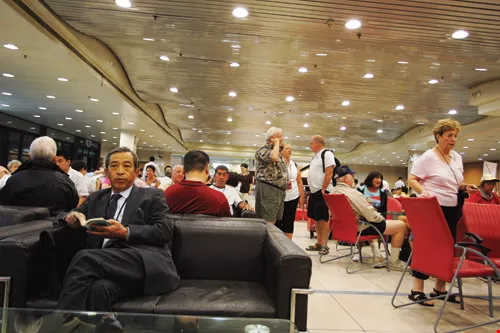
There are approximately 400,000 Taiwanese and many foreign busi-nesspeople living in Shanghai, and these are the high-spending target market of Taiwan-China joint-venture hospitals.
Plans in limbo
The last decade has seen a mass influx of Taiwanese industry into China, and now the health care industry has joined it. Federation Clinic is just one example.
Since China's reforms of the 80s, and its steps towards a market economy, more and more foreign organizations and individuals have had the idea of establishing hospitals there, and all kinds of joint-venture-operated hospitals, check-up centers and clinics have come into being.
Formosa Plastics Group chairman Wang Yung-ching has long had a deep interest in establishing hospitals in China. More than ten years ago, while leading a group on a visit to China, he met with Ministry of Health officials, bringing up his notion of opening a chain of local hospitals. In 2001 Formosa Plastics was planning to invest in three hospitals in Beijing, Fuzhou and Xiamen. But after all these years the project remains a pipe dream.
The reason is that for many years China's health care centers were subsidized by the government and foreign investment was not allowed. But in 2000, for the first time the MOH released its "Interim Measures on the Administration of Chinese-foreign Equity and Contractual Joint Venture Medical Institutions" and made a commitment that following its entry into the World Trade Organization, China would open up its health care market to foreign investment. However, there were many restrictions, such as a minimum Chinese holding of 30% in joint-venture hospitals and a 20-year limit on the period of joint ownership.
According to media reports, Formosa Plastics' march on China has been thwarted because it wants to be a sole investor. Secondly, Formosa Plastics has chosen the seat of power in China, Beijing, to build a hospital, possibly offending the vested interests of many local hospitals.
Chang Gung Memorial Hospital Administration Center director Gong Wen-hua says that there has been no response since the plan for a hospital in Beijing has been brought up, and now they have decided to "give up the game." This is because as incorporated non-profit organizations, Taiwan's private hospitals are required to reinvest their profits in health care services and research, and cannot distribute them to shareholders. However, China currently has no laws governing non-profit corporations, and only government-subsidized public-sector hospitals that care for the health of the general public are recognized as non-profit organizations. Formosa Plastics' experience has been that it started out using Taiwanese thinking to understand China, only to discover how great the gulf is between the systems on either side of the Taiwan Strait. But grounds for cheer can be found in the fact that Formosa Plastics' Xiamen hospital has been approved and the groundbreaking for construction should take place soon.

The spacious and comfortable Jingkang Health care Center offers five-star service on a membership basis, including genetic cancer and nuclear magnetic resonance check-ups at a cost of RMB30,000, or ten times more than the average.
Latecomer takes all
The unfortunate apprenticeship of the Formosa Plastics Group has not scared off those following in its wake.
The WantWant Group, which established itself in the food industry, received permission to build a hospital in April 2002. It chose the same location as WantWant's mainland headquarters, Changsha in Hunan Province, where it invested nearly RMB700 million in a 1,200-bed Level III, Class A hospital.
After investing RMB900 million in the Nanjing BenQ Medical Center in September 2002, in August last year IT products manufacturer BenQ began constructing a medical center in Suzhou, its mainland base camp. The location chosen for the Suzhou Medical Center is by the Suzhou New District Hi-Tech Industrial Park.
Apparently the westward advance of Taiwan's health care industry is well under way, but how long will it be before hospitals can start operating?
This year there were reports of good news. WantWant Hospital in Hunan completed construction in May, formally going into operation in September. The effects of this Taiwanese-operated hospital on local health care centers and the behavior of consumers will be worth observing.
WantWant Group chairman Tsai Yen-ming once said that every time he goes to a hospital in China he feels nervous and helpless. He hopes his own hospital will allow patients to feel reassured and well looked after. WantWant Hospital's website records every tiny step of the hospital's construction, from the ground-breaking to the arrival of Siemens health-care apparatus to the recruitment of nursing staff, making it clear that there were challenges every step of the way in putting together this huge project.
Unlike WantWant and BenQ, which have invested in hospitals to return something to the community, the march of Taiwan's private hospitals into China has more to do with the transformation of Taiwan's domestic health care environment.
In 1995, Taiwan implemented National Health Insurance, but in recent years the heavy costs of implementing the system have not been matched by insurance premium inputs, resulting in a situation in which the more patients hospitals see, the less effective treatment can become. Faced with this systemic assault, many hospitals have found their profits squeezed and, as they search for new markets, the march overseas has become an inevitable trend.
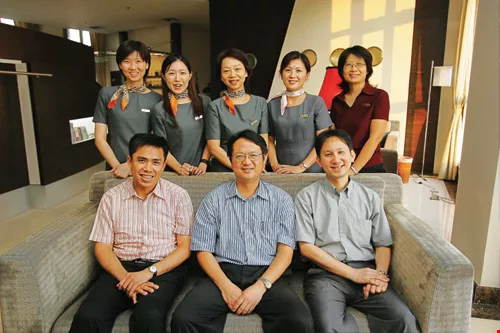
Shanghai's Chen Xin Hospital, which is majority backed by Taoyuan's Li Shin Hospital, will invest in establishing a sophisticated hospital in Shanghai, to be completed in two years.
Exporting medical superiority
But the westward migration of the health care industry is not entirely due to a deteriorating domestic environment: Taiwan's medical management definitely has export power.
Associate Professor Richard Chien of the Institute of Hospital Administration and Public Health Care at National Yang Ming University points out that in terms of Taiwan's service industries the most superior is health care, comparing favorably with Japan and Singapore, and leading Malaysia and China by at least ten years.
Chien says that after China, as a planned economy, opened up a small part of its health care market, many hospitals run according to the Western model were introduced, but afterwards the Chinese discovered that the Taiwanese model suited them better. Apart from the Taiwanese speaking the same language, even more important is that Taiwan's health care skills and technology are equal to any other country. For example, Taiwan's hepatitis B research, Chang Gung's plastic surgery and Veterans General Hospital's cardiac surgery are all very strong.
A similarity between Taiwan and China is that doctors are a closed community attached to the hospital system. This is unlike North America, where doctors operate their own businesses, only resorting to the facilities and equipment of large-scale hospitals in the event of serious illnesses.
"The number-one issue in hospital management is managing doctors," says Richard Chien, who also notes that doctors' distinguishing feature is that they are "loyal to their profession, not their institution." The hospital systems and cultures established at Veterans General and Taiwan National University Hospital have been developed over ten years, and they are very experienced. Apart from this, competition is stiff in Taiwan's health care, and every tactic and strategy was tried out long ago for suitability. Health care in Taiwan is an industry that has been fast-tracked to maturity. For example, Chang Gung Memorial Hospital brought in case payment and case mix index (CMI) measures very early, a move that even influenced subsequent public service pension reforms.
Other examples such as consultation first, pay later, and X-rays that can be directly displayed on computer screens are gradually achieving the aim of paperless case histories. These and control of in-hospital infections are all unique strengths of Taiwan's health care industry.
Medical personnel who come and go across the Taiwan Strait all agree that the quality and skills of China's doctors are not bad. Chu Heng-yi gives the example of gastroscopy, noting that Chinese doctors' case histories in this field alone could already stretch once around the world. Currently the only major difference between mainland and Taiwanese doctors is their use of different drug names and medical terms. But China's hospital environments are bad, and medical personnel lack the service concept of seeing patients as family, leaving a lot of room for improvement.
In recent years, income levels in China have been gradually rising, and there has been a growing trend in demands for accompanying improvements in health care services. China has also been gradually liberalizing its health care market, and that market includes the huge number of foreign entreprises and their employees, so that investing in hospitals that pay their own way should be fully viable.
But if China's health care industry looks like fertile soil, there are still pitfalls.
"The health care industry is mainland China's future number-five star performer, and number one in terms of stability. Demand will continue to grow, but who knows when it will be possible to take a profit," says Chen Xin Hospital director Chang Huan-chen, who admits he does not know if it is the best time to enter the market, but one must first stake out a place.
Federation Clinic and the future BenQ Medical Center both target the top end of the market, but, warns Richard Chien: "In the entire world there are no more than 20 hospitals that have been able to move with the diversifying market economy and maintain their first-class position."
In 1976, when Chang Gung Memorial Hospital began operating in Taiwan, it also wanted to take the high road, but after many years was still not making money. It was only after someone suggested offering Labor Insurance treatment that they turned from loss to profit. Even Taipei's high-class Chung Shan Hospital also has to treat National Health Insurance patients. "Rich people don't get sick every day. The only reliable operating method is to maintain stable business volume and control costs to achieve basic profits," says Chien.
In terms of the superiority of Taiwanese hospital management, there are huge systemic and cultural differences across the Taiwan Strait. "The methods used in Taiwan for managing a hospital can't necessarily be transposed directly to China. If you're not prepared for three or four years of hardship, how can you take the leap?" says Chang Huan-chen. Chen Xin Hospital has been striving for four years and has accumulated a wealth of local experience, training Shanghainese medical cadres and health care management staff, before formally going operational.
Unless you go to China, it is hard to know what a vast, highly populated place it is. China is not a unitary market: regional differences are huge. Richard Chien suggests that with the many pitfalls to investing there it is essential to first understand national and local laws. Furthermore, it is necessary to get used to Chinese traditional behavior--even a mighty dragon cannot defeat a snake in its own lair. Establishing a culture and sense of identification is more important than making money.
For example, Taiwanese hospitals are very good at calculating costs for single events, but when they get to China it is possible their joint-venture partner does not want to tell them everything. For lack of room to maneuver, at this time you must adapt your pace to the local culture.
China's health care market is perhaps still a diamond in the rough, and Taiwanese investment in hospitals already has a winning foothold. With complementary advantages for both sides, they can go forward hand in hand, marking a new start in health care exchange across the Taiwan Strait.
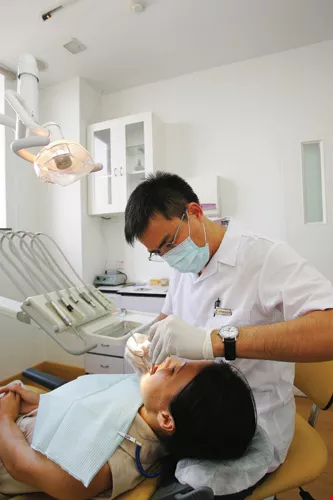
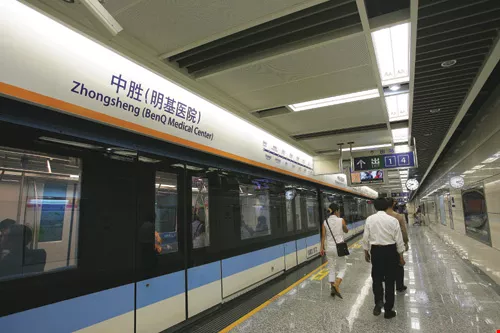
The BenQ Nanjing Medical Center has not formally started operations yet but it is already well known, with one of the Nanjing subway's stations taking its name from the hospital.

@List.jpg?w=522&h=410&mode=crop&format=webp&quality=80)


