

"Passing through the winter of history / Traveling along rugged, windswept, rain-drenched roads / Standing on the mountains where heaven and earth meet / Our hearts are like lilies in bloom / Marching towards Taiwan's spring / Leaving days of toil behind / Lily, lily, a new people / A new kind of love as broad as the very ocean."
Whenever election time arrives, Lee Min-yung's poem "Song of the Lily," set to music by Tyzen Hsiao, sweeps through Taiwan's streets and alleys. Cherishing Taiwan through music is what defines Hsiao, Taiwan's poet of the piano.
The sole musical event to exclusively feature the work of a domestic composer, the Tyzen Hsiao Music Festival, was held on October 15 of this year as part of the series commemorating the 15th anniversary of the opening of the National Theater and National Concert Hall. In the concert's grand finale of "Yushan Hymn" the flutes began to stir, the reeds and strings started to converse with one another, and the choir burst into song: "Leaving tragedy behind / Aspiring to create a new era / Ah, Jade Mountain! Ah, Jade Mountain! / The new Taiwan / The mark of her glory!" Then the entire audience reached an emotional boiling point, with many moved to tears.
Expressing homeward yearnings in notes and giving breath to the national imagination through melody, the music of Tyzen Hsiao has touched the hearts of countless Taiwanese both at home and abroad for nearly 20 years. Known as the Rachmaninoff of Taiwan, he returned from America in a frail state induced by an illness from which he had just recovered, because he didn't want to miss the chance to hear his works performed at the National Concert Hall, nor was he willing to forgo the opportunity to express in music his love for his homeland.
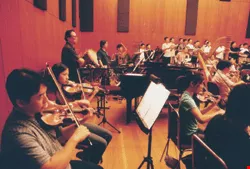
In a rehearsal room in the National Concert Hall, Tyzen Hsiao listens attentively, seeking to present only the most breathtaking music for his countrymen.
Music and the soul
Upon seeing Tyzen Hsiao, one might notice that there seems to be a subtle streak of melancholy amidst his understated urbanity. He is unable to put strain on his vocal chords as a result of injury sustained during a heart operation; as a result, he speaks in dampened tones in a voice that is a bit hoarse. When going up or down a flight of stairs he occasionally clutches the railing, stroking his chest and panting lightly. Despite all this, when receiving guests from afar he enthusiastically leads them up to the roof for a glimpse of Tamsui's beautiful Mount Kuanyin. When the conversation turns to music, especially music imbued with the love of his homeland, his eyes light up. As he often says, "I have no money-all I have is my music, and it is dedicated to Taiwan."
Looking back on Hsiao's life, one can see that his romantic, sincere, and devout qualities crystallized in his childhood days. Hsiao was born on January 1, 1938 in Kaohsiung. His grandfather was a senior preacher in a Presbyterian church, his father was a highly regarded dentist who had studied in Japan and was also a senior church member, and his mother had studied piano in Japan early on. He spent his youth immersed in a world of religion and music, which gave him a bookish demeanor that never faded, even under the stress of his later peripatetic existence.
Reflecting on his childhood, Hsiao remembered that back in the days when all of Kaohsiung only had two pianos, he used to sit on the piano bench at home watching his mother practice church music, hymns, European classical music, and Japanese folk songs, all of which served as handy teaching materials for the young boy. That piano was the envy of the community, and came as part of the dowry of Hsiao's mother, a woman of high pedigree.
In 1959 Hsiao entered the music department at National Taiwan Normal University. As a doctor's son, joining the music profession was accompanied by some personal struggle. He ultimately overcame his misgivings, thanks to the involvement of the principal of his alma mater, Tainan Chang Jung Senior High School.
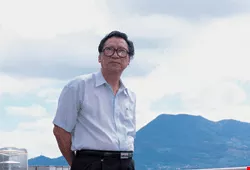
When he returns to Taiwan, Hsiao enjoys relaxing atop the roof of the flat that he rents in Tamsui, sipping coffee as he tranquilly takes in the lovely scenery.
Austrian inspiration
Hsiao majored in piano during his four years at NTNU, and also studied composition with Hsu Chang-huei. At that time Hsu had just returned from studying in Paris, introducing contemporary Western music techniques to Taiwan. Hsu's contribution helped initiate a new wave in Taiwanese music. Recognizing Hsiao's talent, Hsu took him in gratis as a private student. Not long after graduation, Hsiao ventured off to Japan for further study at Musashino Academia Musicae. While in Japan, in addition to studying under famous composer Hideo Fujimoto, he also continued to major in piano.
Hsiao returned to Taiwan in 1967. He taught at Kaohsiung Teacher's College, Tainan Theological College and Seminary, and other schools, amusing himself all the while by writing choral works and small piano pieces. Later on, he was hired by the music department at NNTU, his alma mater. While back at NTNU, he connected with renowned Austrian composer Dr. Robert Scholz. The two men maintained a relationship that was part friendship and part student-teacher, while at the same time reminiscent of father-son-like affection.
The inspiration that the great Scholz provided greatly enriched Hsiao's musical vision, extending the scope of his compositional efforts to include instrumental and chamber works. In 1975 a Tyzen Hsiao Musical Exposition was held at Taipei's Chungshan Hall; such an event was a rare honor for a local composer in those days, and Hsiao specially composed a work for two pianos, "Fantasia Waltz," to express his gratitude to his benefactor, maestro Scholz.
The charismatic Hsiao's talent was flowering, as he bounded back and forth between teaching, performance, and composition. He had married a girl who typified Taiwan's gentry class. With everything seemingly going his way, who could have possibly imagined that the cruel winds of fate would stir, forcing him to leave his homeland behind to embark on an inexorable journey of infirmity, penury, and homesickness?
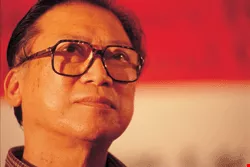
Rotten luck has never diminished Hsiao's spirit. Not only is he Taiwan's musical poet, he is one of the world's truly valiant people. (photo by Yang Chien)
A journey of debt
1977 was the turning point in Hsiao's life. Owing to the fact that his wife had been cheated in business, the Hsiao family finances were hit hard. In an attempt to pick up the pieces, Hsiao relocated to the American city of Atlanta to live with his only younger sister. However, Hsiao's wife couldn't speak English and couldn't make the transition into American life. In the end, they decided that Hsiao's wife would remain in Taiwan, and Hsiao would bring his young children-three sons and a daughter-with him to America. From that point on, the couple has lived apart, each doing their part to earn money to repay their debt.
Tyzen Hsiao handled the misfortune with equanimity. He recalled that his first move to Japan at the tender age of four was also because his father had been cheated. After his two year-old sister had died tragically, Hsiao's parents, brokenhearted by the ordeal, had decided to temporarily abandon everything and go to Japan to recuperate emotionally. After living in the US for 25 years, he still acquires debts one after the other in what seems to be an interminable cycle.
"There's nothing I can do about it. My wife is too goodhearted, so people are always taking advantage of her," sighs Hsiao. In a recent letter to his wife-now living in Guangzhou in the mainland-Hsiao wrote poignantly, "I hope that we may treasure each moment of each day." He hopes that his wife can quickly resolve her financial struggles so that they can be together again.
Hardly cut out for business, Hsiao's original purpose in going to America was just to carve out a basic living.
Not long after immigrating to America, Hsiao's business failed as well. He then accepted the invitation of an expatriate friend, Hsu Pi-lung, to join him on the west coast in Los Angeles. With his friend's monetary assistance, Hsiao set up a gift store that sold the small, decorative items and handicraft works that his wife shipped to him from Taiwan.
He ran the store for more than a year. But although he worked earnestly, he was basically an unassuming kind of guy who didn't have the necessary chutzpah or business savvy to go about attracting customers. At the end of the day, he was just able to make ends meet by running the store. Whenever he had the time, he would play piano for his own amusement. On one occasion, three elderly female customers were browsing through his store when the sound of Hsiao's piano playing caused them to stop dead in their tracks. One of the women then turned to him saying, "Young man, whatever are you doing HERE?"
Hearing the old woman's words was like awakening fresh from a dream. He asked himself, "What am I doing here wasting time like this?" Could it be that the pressures of reality had caused his gift and zeal for music to ebb away? Was it really God's will for him to be a smalltime shop owner? He closed his store not long afterwards and returned to music with renewed determination.
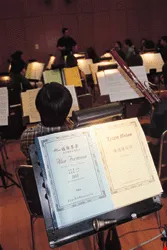
"I hope that Taiwanese composers can gain the appreciation and understanding of their fellow countrymen." Knowing that his work is valued brings Hsiao untold comfort. (photo by Yang Chien)
The "Cultural Golden Age"
Pursuing a career in musical performance in America is no piece of cake for a solitary Chinese without the benefit of a teacher or a network of connections. When Tyzen Hsiao had just arrived in California, he taught many overseas Chinese students, eventually producing some fine piano players like Chen Yu-hsiang, who went on to win numerous accolades in high-profile competitions. After closing the gift store, Hsiao immersed himself in the burgeoning Southern California Chinese music scene.
In October of 1982, an organization that Hsiao co-ran with friend Hsu Pi-lung, the Taiwanese Folk Music Association, sponsored a Concert of Thanksgiving that featured entirely works by Taiwan composers. With the assistance and cooperation of ten church groups, the event was held at Orange County's Crystal Cathedral. The concert overflowed with homeland sentiment and Taiwan folksongs, elevating the 3000 audience members to a rhapsodic state. This type of large-scale event was the first of its kind for overseas Taiwanese, as it differed entirely with the traditional emphasis on Peking Opera in overseas Chinese communities. As a result, it was heralded as the beginning of a "Cultural Golden Age" for Taiwan overseas residents.
Lin Heng-che, an attending physician in the pediatrics department at Mennonite Christian Hospital as well as the founder of Wangtsunfeng Cultural Enterprise Company, had once collaborated with Tyzen Hsiao while living in Los Angeles. He notes that for two consecutive years the Concert of Thanksgiving concluded with the thunderous ovations of the nostalgia-filled audience. Not only did the concerts present the opportunity for communal bonding amongst overseas Taiwanese, but further served notice of Taiwan culture "going mainstream" in overseas Chinese communities.
When Hsiao's orchestral adaptations of the Taiwanese folksongs "Sorrow" and "Broken Nets" were performed, the audience members swelled with pride as the music forged a bond among the hearts of all who heard-"I never knew Taiwanese folksongs were so beautiful and stately!"
A few years down the road, Hsiao led a group of young Taiwanese musicians residing in America on a continental tour that included performances in ten major cities. At the last concert in San Francisco, the performers realized that they had hit the final stretch of the tour, and that the next day they would all be obliged to resume their lives independently. As they dug into Hsiao's piece of homeward yearning, "The Outsider," they couldn't hold back the tears. The performers onstage wept as they played, and the audience offstage, choked with emotion, sang along, the melody articulating the pining for home and the feelings of loneliness that one experiences in a foreign land.
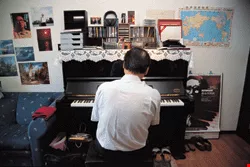
Despite undergoing a major operation a year ago, Hsiao is still able to compose and play piano. He is firmly committed to his personal credo of "Live to compose."
Miraculous beginnings
In 1986 the 48-year-old Hsiao began pursuing a master's degree in contemporary composition at UCLA under the Korean-American composer who went on to compose the music for the Seoul Olympics, B.K. Kim. His daughter, Hsiao Ya-hsin, and her husband were also classmates in the music department.
Hsiao's musical style has always been on the conservative side, so why would he even consider studying modern composition? Hsiao explains that he wanted to appreciate the perspective of 21st century composers. After all, changing times produce changes in aesthetic values, and people's conception of what constitutes beautiful melody differs from era to era. However, Professor Kim was well aware of Hsiao's romantic temperament and tender nature; his works have always abounded with vivid color and layer upon layer of beautiful, unforgettable melody. As a result, Kim reminded Hsiao that he needn't be a slave to modern music and its jarring dissonances, encouraging him instead to follow his own musical path.
It was during this period of study that Hsiao uncovered his personal style, using Taiwanese folksongs as his core material, and adding to it musical techniques from the Classical, Romantic, Impressionist, and Modern style periods. Not long after completing his MA, with solid encouragement from his friend Lin Heng-che, he composed his impressive violin concerto.
Hsiao worked like a fiend to produce the first violin concerto in Taiwanese musical history.
"My father had just passed away and my mother was bedridden by illness. My wife's business was experiencing difficulties," he recalls. He, his mother, and his children were all squeezed into a one-bedroom apartment, the children sleeping in one room, and Hsiao and his ailing mother in the other. In order to keep watch over his mother at night, Hsiao would compose practically every night into the wee hours, working on average about 16 hours every day.
In low spirits and living in the midst of poverty and illness, Hsiao suddenly felt a surge of inspiration driving him to finish this composition, which was of a larger magnitude than anything he had previously attempted. Even today, Hsiao describes its completion as "a miracle."
Going international
At first, Hsiao's concerto for violin could only be performed in a somewhat abridged format-violin with piano accompaniment. Nevertheless, when the plaintive violin slowly began to play the Taiwanese folk song "Plowing Song," the theme in the piece's section of thematic variations, audiences were invariably moved to tears. Then in 1990, Hsiao chanced to meet with a celebrated violinist who also hailed from southern Taiwan, Lin Chao-liang. Lin agreed to perform the world premiere of Hsiao's concerto.
Two years later, Hsiao's "Violin Concerto in D Major" was premiered by the San Diego Symphony under the baton of Japanese-American conductor Heiichiro Oyama with Lin Chao-feng as the featured soloist. The event marked the first time for a large, reputable American orchestra to perform the work of a Taiwanese composer. Not surprisingly, this historical performance was well received by the critics, not only propelling Hsiao to international status as a composer, but also helping to facilitate the internationalization of Taiwanese music.
Reflecting back on that performance, Hsiao is still unable to suppress his excitement. "At that concert, my work was sandwiched between pieces by Brahms and Dvorak-I was afraid that my work would be crushed beneath the weight of these two masters!" However, that night demonstrated that Hsiao's work, rich in late-Romantic flavor, was capable of rivaling the compositions of these late masters. To date, the piece has retained most-popular status within the Hsiao oeuvre.
In 1990 Hsiao additionally became the first Taiwanese to publish a cello concerto, which followed in the wake of the astonishing success of his violin concerto. Incidentally, the violin concerto was frequently performed in the San Diego Symphony's 1995 season. Hsiao's "Piano Concerto in C Minor" emerged in 1992. The piece ingeniously makes use of the Taiwanese folksong "Sorrow." At first the folksong is heard repeatedly as a low hum. Then the mood builds through melodic twists and turns, becoming more impassioned at each interval, until finally exploding into triumphant song that symbolizes Taiwan finally achieving freedom and dignity.
Live to compose
In a mere five years Hsiao had published three concertos. But in the midst of his hectic musical schedule, he was stricken with illness. On Christmas Eve in 1993 Hsiao was rushed to the hospital with a ruptured aneurysm. His condition was grave, and to make matters worse, without any medical coverage he was forced to pay a deposit fee of US$50,000. Hardly any hospital was willing to treat him. Fortunately for him, some of his Taiwanese compatriots moved quickly to raise money for his medical expenses, and arranged for the expert Japanese-American surgeon Dr. Yokoyama to perform the necessary operation. Only after a ten-hour procedure were they able to deliver Hsiao from Death's thorny grip.
When illness reared its ugly ahead, Hsiao was in the midst of composing his "1947 Overture" to memorialize the February 28 Incident. As the pain flared up in his chest, he could only think, "Please Lord, let me finish my work."After receiving treatment, he saw to it that no single day went unproductive. In 1995 his "1947 Overture" debuted in Oakland, California. Once again, his work featured Taiwanese folksongs, transforming their melodies through phases of poignant beauty, passion, and stateliness, achieving tremendous effect throughout.
In recent years, though in less then optimal physical condition, Hsiao, driven by the motto "live to compose," has continued to write, producing such works as "Yushan Hymn," "Ah, Formosa!" and "The Prodigal Son." He is in constant demand as a composer and performer. For a sincere chap like Hsiao, the only way to respond is with unflagging discipline. In October last year, he underwent an emergency operation to have a blood vessel removed. The procedure rendered it impossible to detect a pulse in his left wrist.
He remembers that after leaving the hospital, the first thing he did was to try to play the piano. He discovered that while his right hand was not wanting for sensitivity and strength, his left hand was completely numb. He was only able to regain the use of his left hand after a half-year of physical therapy.
Facing the music
Despite having undergone two surgical procedures, Hsiao's body still contains a number of aneurysms that are like time bombs waiting to explode. But Hsiao learned long ago how to keep an even keel about him. At present, he is living with his son, and though he is as poor as before, at least the cultural foundation that his friends at home and abroad cooperatively established provides him with a monthly stipend of NT$50,000 for his living expenses. He still makes it back to Taiwan on occasion, residing in the quiet flat he rents in Tamsui.
Chuang Chuan-hsien, who for many years has helped Hsiao enter his musical scores into a computer (and also happens to inhabit the same building that Hsiao resides in when back in Taiwan), always takes painstaking care of the composer whenever he returns to Taiwan. Chuang says wistfully that composers in other countries, such as the Scandinavian composer Sibelius, were considered to be national treasures. Accordingly, their material needs were provided for by their governments so as to allow them to concentrate on their work. Hsiao, on the other hand, has spent a lifetime toiling away to make ends meet. In recent years, Hsiao has contemplated returning to Taiwan, but has no permanent residence. And although NTNU has expressed interest in hiring him as a professor, Hsiao is unable to accept the position on account of his inability to climb stairs.
Moreover, Hsiao's fragile feet are no match for the wind in Tamsui, which can be quite heavy. Once while rushing to catch a bus to Taipei to handle some business matters, he very nearly toppled over. The exorbitant cost of printing music scores similarly hampers the circulation of Hsiao's compositions. In fact, all of the scores at the music festival held this last October at the National Concert Hall were cheaply copied and bound together in a makeshift fashion. For Chuang Chuan-hsien, as someone who reveres Hsiao-both the music and the man-the situation is difficult to bear.
After the music festival wrapped up, Hsiao made his way back to the US, his mind preoccupied with his promise to compose a piece, "Song of the Love River," for his hometown of Kaohsiung. Taiwan's foremost contemporary composer will continue to compose unabatedly, expressing in music the deep love he harbors for Taiwan.


@List.jpg?w=522&h=410&mode=crop&format=webp&quality=80)


