Monsters, Inc. on Campus--The Robot Museum
Teng Sue-feng / photos courtesy of the Robot Museum / tr. by Scott Williams
September 2007
Did you know that the Technology and Science Institute of Northern Taiwan (formerly the Kuang Wu Institute of Technology) was home to the world's first robot museum? Located on TSINT's campus at Kuantu in Taipei's Peitou District, it opened in November 2005, nearly a year before its better-known Japanese cousin, the Nagoya Robot Museum.
The museum, a "joint venture" between faculty and students, houses more than 1000 robots of more than 200 humanoid and insectoid types. Nicknamed Monsters Inc., it has been visited by more than 10,000 middle- and elementary-school students since it opened its doors. Have you ever wondered about the influence of robots on human history? How they are affecting its present? What their role will be in its future? The museum can help you find the answers.
The sun is blazing down on a TSINT campus slumbering through summer vacation. The Electrical Engineering Department is a notable exception to the general somnolence. The department is hosting a July robotics camp, and the young campers are whooping it up in its Robotics Museum.
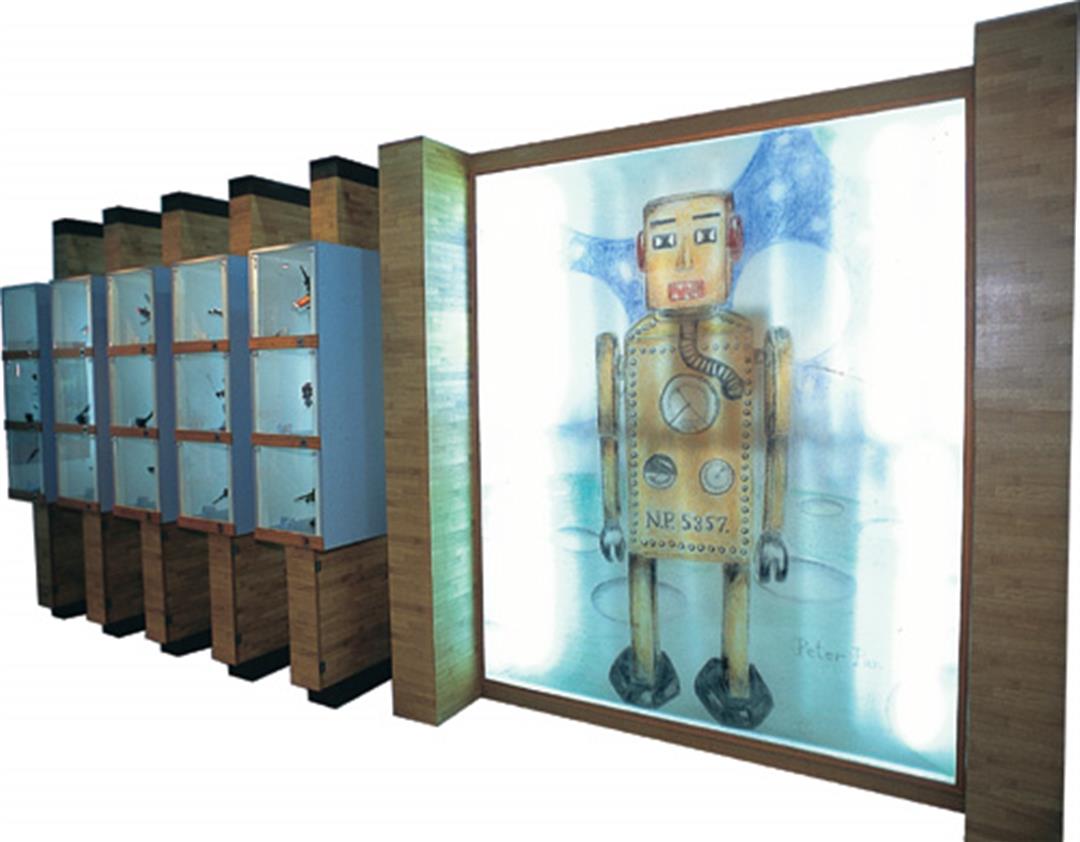
The museum occupies about 2,800 square feet on the fourth floor of the Electrical Engineering building. Its entryway is guarded by a replica of the Zaku-series mobile suit from the Japanese Gundam cartoons. The pink, life-sized figure, armed with a rocket launcher, immediately draws the eyes of the kids, who whip out their cameras to take pictures.
Inside the museum, visitors can press buttons to move the robots in the display cases. These exhibits are arranged so that visitors can watch the robots' "guts" as they move, providing them with an understanding of their machinery, their electronics and the underlying principles used in their design. For example, where early robots used motors to turn gears, modern ones have microcomputer-managed control systems and sensors, and can follow their "masters'" instructions.
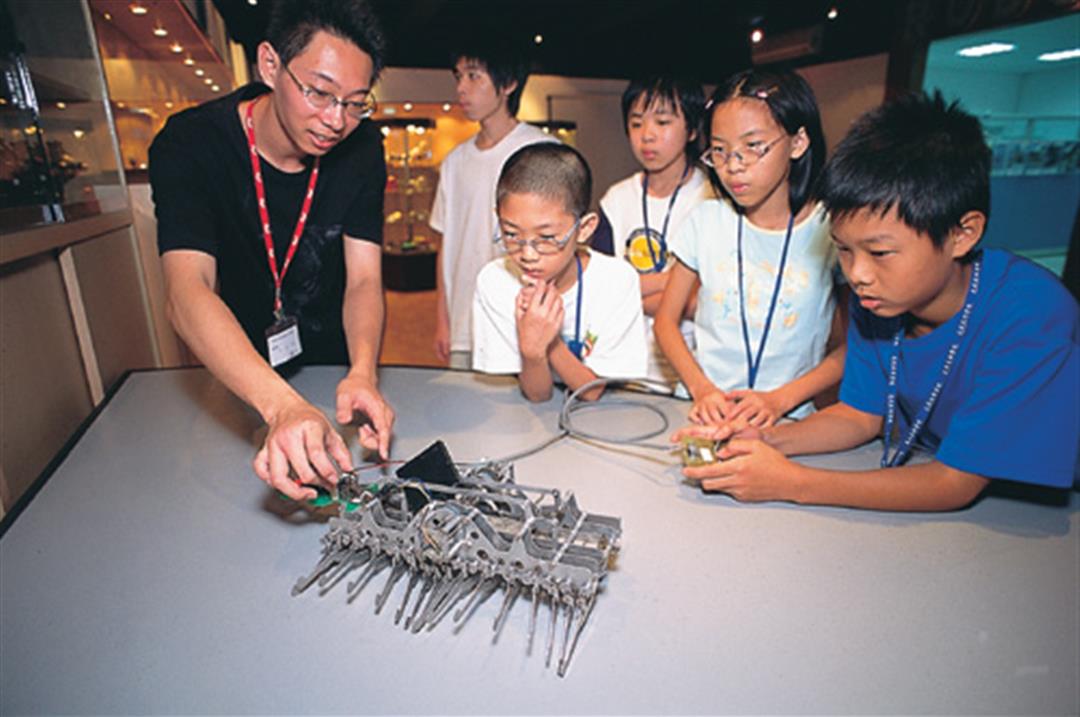
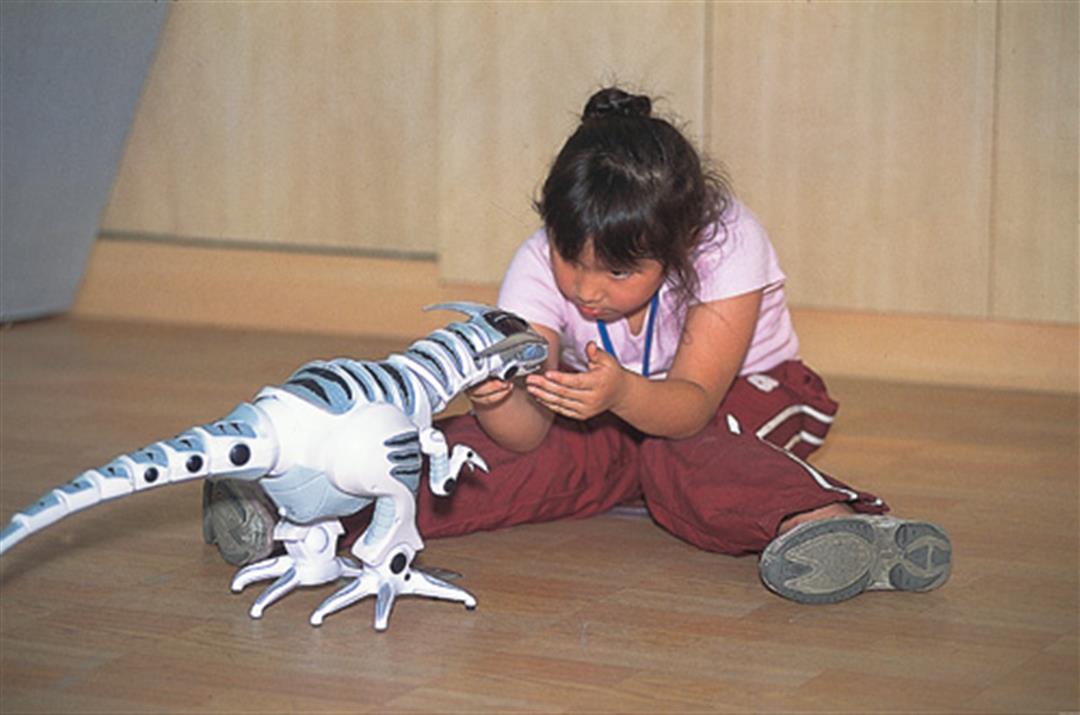
A collection of 20-some RoboRaptors and a 32-legged, dual-motored centipede sit on a stage off to one side waiting for children to play and do battle with them. Docents in this area seek to educate while entertaining, making a Doraemon robot talk and sing as other intelligent robots perform difficult front flips, high kicks and push-ups.

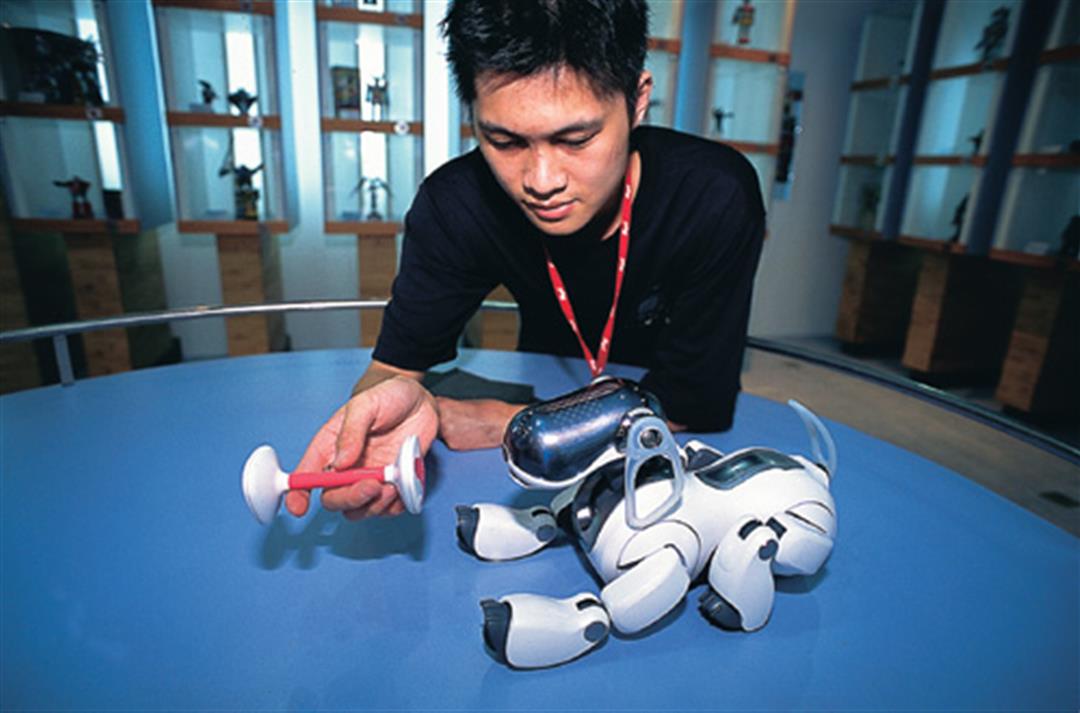
The fifth generation of Sony's AIBO robotic dog makes a playful companion. The longer you keep one, the more it learns to do.
Science's grown-up Peter Pan
Pan Ton-tai, the associate professor in the TSINT Electrical Engineering Department who dreamed up the mini-museum, overcame many difficulties to get the project off the ground. He succeeded in creating a different kind of exhibition space that features docents drawn from his department's faculty and students.
Pan, who shares his surname with J.M. Barrie's "child who never grew up," calls himself the "grown-up Peter Pan of science." He did his graduate work in Feng Chia University's Institute of Automatic Control Engineering and received his PhD in 1985 under Shyu Jia-ming, who had done his own graduate work in Germany. Encouraged by the young inventors' award he received from the Ministry of Education (MOE) for his dissertation on the design of visual systems for robots, Pan decided to make robotics his life work. He has now been "playing" with robots for more than 20 years.
After completing his degree, he went to work for the Institute for Information Industry's Mechanical Industry Research Laboratory, where he developed industrial robots. His work there aided Taiwan's automotive industry in automating its welding and painting processes, thereby helping rejuvenate Taiwan's machine tools industry. Pan then took a position with the Chung-Shan Institute of Science and Technology developing industrial equipment with national defense applications, such as guided missiles and missile boats.
After working in industry for many years, Pan moved into education in 1992. "So few people understand technology," he explains. "I felt that I should be doing something to benefit society. Opening a museum and holding exhibitions was the best way for me to disseminate scientific knowledge and reach the larger public."
Pan set to work on realizing his dream. He scoured toy and department stores whenever he went abroad, buying up whatever robots he found. He got his friends involved, too, tasking them with making the same kinds of purchases. He also began digging into the history of robotics, tracking down earlier generations of robots and persuading their owners to sell them to him.
In addition, he led teams of students to every robotics and microcomputer system design competition the MOE organized, earning hundreds of thousands of NT dollars in prize money that he put toward the purchase of still more robots. He also won grants from the National Science Council to support his robotics research.

A docent takes a robot centipede for a walk to show children the principles underlying robotic movement.
An expert exhibitor
The Robot Museum opened in November 2005 and has earned an excellent reputation for itself for its exhibitions and its popularization of robotics science education. It also helped the China Times organize the Super Robot 2006: Robot Dream Exposition Taiwan. The museum took charge of shuffling exhibits between Taipei, Taoyuan, Taichung and Kaohsiung for the 130-day event, which ultimately attracted 500,000 visitors.
"Robot exhibitions are different from fossil exhibitions," says Pan. "You have to give the public a chance to interact with the robots. And when the jaw falls off a RoboRaptor while the kids are playing with it, you have to fix it immediately. The pressure's enormous."
Pan's co-sponsorship of exhibitions has allowed him to get acquainted with many people who share his interest in robots. Now that businesses know the museum exists, they often donate robots they've used in their exhibitions. Kuei Jung Exhibitions, for example, has donated a number of expensive robots, including a 120-centimeter-tall, NT$2.5-million security robot; a Gigantor that is hugely popular with fans of the Japanese comic and cartoon; and a Nuvo--one of 2005's best inventions according to Time magazine--manufactured by ZMP.
Gigantor, a bipedal robot with a small head and thick body, was originally the eponymous star of a 1956 Japanese manga created by Mitsuteru Yokoyama. Production of toy Gigantors was limited to 200 individually numbered units in Japan. Decked out in blue plastic, he exudes an energy that fans of the comic find utterly charming.
Nuvo, the first bipedal robot to enter the homes of ordinary people, is a star in its own right. It may be only 39 centimeters tall, but Nuvo--a homophone of the French word for "new" or "special"--is multitalented. It can walk, dance, speak, play music, give the time, and shake hands, and is also equipped with a wireless receiver that lets its owner use it to monitor what's going on around the house.
Many, many people contributed to the establishment of the Robot Museum, but the founders didn't have to start entirely from scratch. After all, Pan is himself a robotics researcher.
Pan began researching insectoid robots as early as 1999, and had soon started work on a six-legged robotic beetle. He designed mechanical structures, installed servomotors, developed motor controllers, put in microcontrollers and infrared sensors.... "The hard part was figuring out how to program the motor controllers in such a way that the robot would walk like a real bug," he recalls.
To that end, he made frequent excursions outside the lab to watch six-legged insects walk. The beetle he ultimately built could walk forwards and backwards, and make turns. It could also detect and avoid objects in its vicinity. With the addition of a radio controller and a camera to track a target, it could potentially carry out missions assigned to it by an operator.
"The Chinese translation of 'robot' is literally 'mechanical person," says Pan. "This inaccuracy is often misleading. The earliest industrial applications were simply mechanical arms that bore no resemblance to people." Pan says that people like humanoid robots because they're showy and can be made to perform. But bipedal robots aren't stable and often fall down on rough ground. Six-legged insectoid robots are far more stable and are therefore useful for a broader array of applications--for example, emergency relief work in the mountains or in the wake of an earthquake.
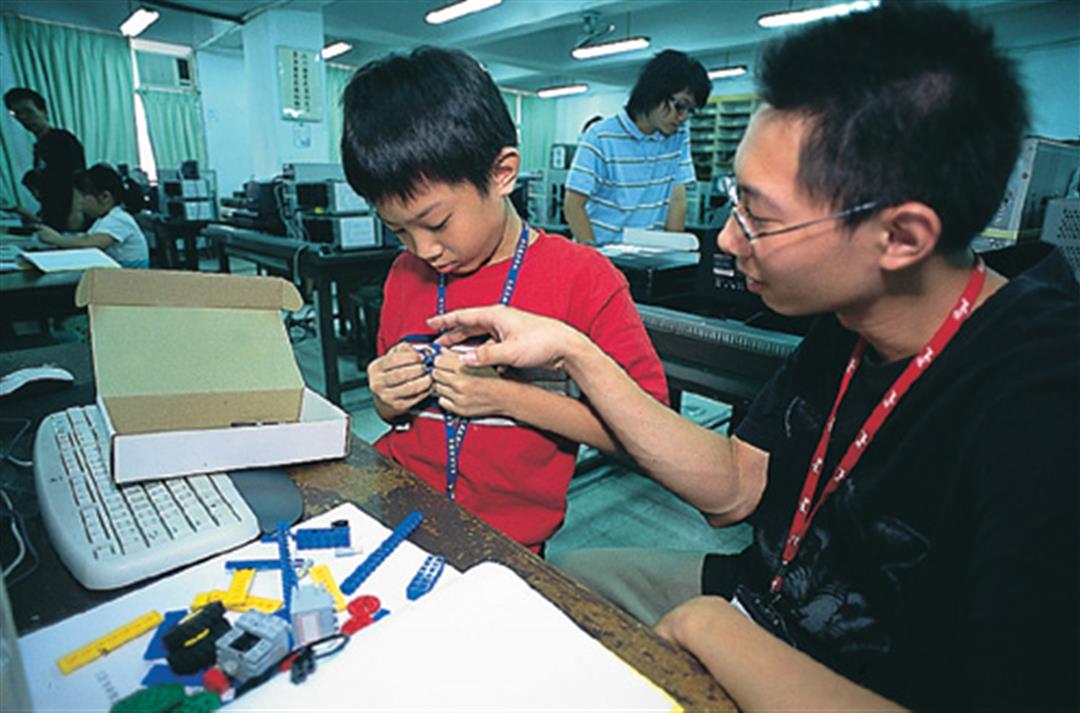
At a robotics study camp, children assemble simple robots themselves.

A good friend
For the last four years, Pan and his students have promoted robotics education by touring Taiwan's elementary schools with several famous robots. They've also run more than 100 robotics research camps. Pan has logged all these miles because he believes that robots are the best friends humanity has.
Robots have been around for more than 300 years, since an Italian named Giovanni Battista Braccelli sketched the first one in 1624. His robot, a blocky device with arms and legs that he modeled on the human figure, had a profound impact on the robot designs of later generations.
When the Czech playwright Karel Capek introduced the word "robot," from the Czech robota "forced labor," in 1920, it gave rise to endless fantasies of building animate mechanical replacements for humans.
The Austrian expressionist director Fritz Lang released Metropolis in 1927. The film is set in a future society in which capitalism has developed too far--the systems of production have been completely mechanized and the populace has been split into two distinct rival classes. Against this backdrop, Freder, the son of the city's plutocratic ruler, falls in love with Maria, the leader of the workers. Concerned that Maria will spark an uprising among the workers, Freder's father orders her captured. He then uses a robot made to look like her to spread disorder among the workers with the goal of creating a pretext for an attack against them.
Those wishing to understand the evolution of robots should spend a little time in the Robot Museum's history section. The robots housed here include the first steel-skinned robot produced by Japan's KT Corporation in 1939; a RoboSapien that can dance, tumble, and offer greetings; and seven of Sony's AIBO robotic dogs, including representatives of all five production generations.
The AIBOs, which cost more than NT$100,000 each, are a great example of the advances in robotics technology. The second generation had 18 motors that allowed all four limbs to move independently and the head to rotate 180 degrees. It also had visual, auditory and tactile sensors, understood commands from its owner, "liked" to have its head petted and paw shaken, and showed its mood with its eyes--they shone green when it was happy and red when it was angry. The fifth generation was even more amazing. The longer it is kept, the more its "thinking" and behavior come to resemble that of a real pet.
"The AIBO generates its emotional responses in its internal non-volatile memory," says Pan. "Even when the power goes off, it retains a record of the good feelings created by the last time its owner patted its head. Its tactile sense relies on microswitches in its paws, head and back that react to being touched. It hears with a microphone. Its ability to come in response to clapping and to understand words and complete sentences is a testament to the skill of its programmers."
The American writer Isaac Asimov gave us the Three Laws of Robotics half a century ago in his short story collection, I, Robot: First, a robot may not injure a human being or, through inaction, allow a human being to come to harm. Second, a robot must obey orders given to it by human beings except where such orders would conflict with the First Law. Third, a robot must protect its own existence as long as such protection does not conflict with the First or Second Law.

The kids can't wait to get a close look at a RoboRaptor.
Technological integration
In 1977, the first of the Star Wars films introduced audiences to the charming, multilingual C-3PO and R2-D2, a three-legged repair unit, who travel the stars in the company of humans. In 1984, The Terminator frightened audiences with a killer robot. Human thinking on robots is forever oscillating between two poles--joy at the creation of another self and the fear of being attacked by our creations.
Philosophy's ultimate question may not yet have an answer, but we can already see many examples of robots functioning as the kinds of helpers of humanity popularized in fiction and film.
Pan notes that robots have been working quietly for humanity for more than 40 years, ever since the American automotive industry first began using robotic arms to paint cars in the 1960s. Most are engaged in dirty, dangerous, difficult or dull work, such as handling nuclear waste or tightening screws. Some work in environments where humans cannot, taking on tasks such as deep-sea exploration or space-station maintenance.
"The machine tools industry is very important to a nation's industrial development," says Pan. "Its technologies integrate a variety of fields including IT, optoelectronics, materials, and mechatronics." Pan argues that government policy tends to overlook the field, with the result that machine tools technology cycles into and out of fashion. This brings us to the importance of his museum: It provides the public with an ongoing connection, via robotics, to the machine tools industry, helping moderate the industry's ups and downs, and ensuring that Taiwan doesn't fall too far behind the rest of the world.
The Robot Museum embodies the hopes and dreams of the students and faculty of TSINT. Through it, they hope to foster greater public understanding of robotics technologies.
Address: 4F, Department of Electrical Engineering, Technology and Science Institute of Northern Taiwan 2 Hsuehyuan Road Peitou District, Taipei City
Hours: 10 a.m. to 5 p.m., Monday-Friday,
Tickets: NT$30 per person
Online: www.tsint.edu.tw/museum