An Epic Tale in the Making: An Interview with Gao Xingjian
interview by Sun Sung-tang / photos Hsueh Chi-kuang / tr. by Phil Newell
October 2002


It is the afternoon of September 25, and Gao Xingjian, winner of the Nobel Prize for Literature, who is staying in Taiwan for three months for rehearsals for Snow in August, is running all the students of the Peking Opera department in the Fu Hsing Dramatic Arts Academy through rehearsals in the large lecture hall. Gao, dressed in a black turtleneck sweater, intently listens to the dialogue between the actor playing the role of the Sixth Patriarch Huineng and the actress playing the Buddhist nun Wujinzang. He is patiently working to help these Peking Opera performers change their vocal techniques from the high-pitched and exaggerated (and virtually unintelligible) pronunciation used in that medium.
"Project more. . . can you project your voice a bit more? You have to cut through the orchestra! Can you people in the back row hear clearly?" They might spend a whole day on just a few lines. But slowly the enunciation becomes clearer, and the simple rehearsal hall takes on a new grandeur. Listeners hold their breath as they hear Huineng declaim: "I am Huineng, born with the surname Lu, in the 12th year of the Zhenguan reign period of the Tang dynasty. . . ." It seems to take us back to the days of the early Tang, and proves once again the extraordinary power of theater.
Snow in August is already garnering world-wide attention, but what kind of production will it be? How will Gao Xing-jian, who crosses the boundaries between theater, literature and the visual arts, and has a unique feel for drama, create a new dramatic form out of the best of East and West, building on Peking Opera, that art form most rich in tradition? What type of impact is it intended to have on the audience? Though it would not be incorrect to say that everyone is still groping their way right now, Gao has long had a definite vision in mind, as he explains in this exclusive interview with Sinorama:
Q: Can you talk a little bit about your connection with theater?
A: I've loved the stage since I was a child. This is related to my family background. My mother was an actress in plays, and when I was five years old I acted with her in something that she wrote herself. We often put on little vignettes at home, with my father being the only audience. My father loved Peking Opera, so when I was small I went with him to see that, and to see plays with my mother, so naturally I became a fan of theater.
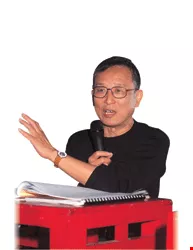
As the year-end opening of Snow in August draws nearer each day, Gao Xingjian grows both more excited and more anxious.
A broad new way
Q: Snow in August combines Peking Opera with Western opera. How would you classify it?
A: In terms of the academic study of drama, it is an entirely new creation, and it is difficult to put a label on it. We have adopted a provisional name for it-"holistic theater." We want to train a group of performers and develop their potential so that they can become "holistic actors" who can sing, dance, act, and deliver dialogue, and we will even have a few traditional acrobats.
Nonetheless, from the musical perspective, this is an opera. Those aspects that define opera, such as having an orchestra and a large choir, are all present in Snow in August.
Most of the actors will be Peking Opera players. We will have to get them to sing a type of opera that they've never come in contact with before, to dispense with the traditional gestures of Peking Opera, and to start from scratch. There is no area in which there will not be innovation, so I can say "it includes everything, but is not any one thing."
Q: Since Snow in August is a Western-style opera, why did you decide to recruit Peking Opera players rather then stage actors or vocalists?
A: Frankly speaking, it's almost impossible to find the kinds of performers I need. But Peking Opera actors fit my needs most closely. They have a great feel for the stage, as well as training in gestures and voice. Building on this technical foundation, we want to train them to bring their potential fully into play, and to accept new things. But not only this-we also want to stimulate and inspire their creativity.
The biggest advantage of Peking Opera performers is also the biggest problem. That is to say, they have a traditional framework with every gesture and step mapped out. If you want them to perform in an improvisational way, they literally do not know how to even take the first step. That is why I asked Lin Hsiu-wei to teach them some modern dance, and I provide some explanations myself, so that the performers can break completely free of restraints.
Q: Does this approach overturn tradition?
A: I have never rejected tradition, and I myself come out of tradition. I respect the traditions of Western opera and I respect the traditions of Peking Opera. I believe that there is no point in toppling or destroying art, because without tradition many things wouldn't exist at all.
Although I am not following the beaten track, I do not deny that we come from a cultural tradition with certain techniques and background. Of course I also do not reject Western cultural traditions. What is important is to try to unbind them to make a totally new creation. This is certainly an attempt at a new form of theater. When I first related my plan to [Council for Cultural Affairs] Chairwoman Tchen Yu-chiou, she immediately understood and offered full support, and mustered outside assistance to provide me with this opportunity to realize a new form of theater in practice.
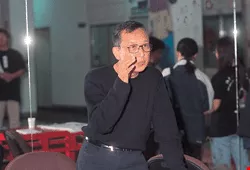
(facing page) Gao Xingjian says that he has never rejected tradition, and that there is no point in destroying artistic tradition. After all, without tradition a lot of things wouldn't exist at all.
The pinnacle of the palace of arts
Q: So you also like Western opera?
A: I definitely love Western opera. Opera is the crystallization of various forms of art. It brings together drama and music, and also places great emphasis on lighting, scenery, and the other fine arts of the stage. You could say that it is the pinnacle in the palace of arts, and the cream of Western culture can be found in opera. Through opera we can appreciate symphonic music, voice, visual arts, drama, and costume. Moreover, Western opera houses are like exquisite imperial palaces which leave you gasping in amazement.
There has thus far not been a Chinese work performed in Western opera houses. There have been a few works adapted from Peking Opera performed in opera houses, but these have not reached the level of real innovation, and performances have not been very impressive. I hope to have a large-scale innovative work that can be performed in opera houses, so that international audiences can see something a little different.
Moreover, the story of Huineng is of epic proportions, on a par with any drama from the pen of Shakespeare. In fact, Snow in August melds Eastern and Western cultures. The form is like that of Shakespearian or Greek tragedy, but the spirit can only have come from the wisdom of the East.
I see Huineng as a thinker, and not simply a religious leader as in the eyes of most people. He is a significant figure in the history of thought in China. First, he broke through the obsession with material objects. He didn't even want the traditional cassock and bowl [which were passed from master to disciple as a symbol of transmitted knowledge] but preferred to just try to achieve a spiritual connection or tacit understanding between master and acolyte. This was a major freeing up of religion, and transcended the problem of transmission of knowledge from teacher to student. This was an enormous breakthrough, and after all only a true thinker could have penetrated to this level.
Secondly, Huineng was unwilling to play the role of a messiah. He only guided people and inspired them to realize their own natures. You could say there has never been any other figure so outstanding in the history of traditional Buddhist thinking. He has an even more modern image than Jesus Christ. Christ sacrificed himself to save others, but the thought of Huineng is even more modern-the point is not who will save who, but to go out and save yourselves!
Q: There is a great deal of Chan thinking in Snow in August, but it lacks those elements like family relationships and love with which audience members can most easily identify, and there is also no female lead. Do you think this will affect the drawing power of this drama?
A: In fact there is a female lead in Snow in August-Wujincang. She is mentioned in The Biography of Huineng, and undoubtedly really existed. In addition, in the background I've also created the role of the courtesan. She helps fill out the female role that Wujincang represents.
Where lies the appeal of Snow in August? There are two questions here that need to be discussed. One is whether Chan can be made into a stage drama. The moral tales of Chinese Buddhism, in which good is rewarded and evil punished, have appeared in play form. But there has never been any integration of Chan into Chinese drama. I believe that since Huineng was a thinker, he can be expressed through theater. If the play were just to publicize a religion it would be insignificant.
Secondly, even today many people think that Chan is modern Japanese-style Zen. They have modernized and commercialized the performance of Chan. You cannot say that this is bad, but Japanese place too much emphasis on formal ritual. At its inception Chan rejected formal ritual, and only in that way can you see the real profound significance of Chan.
In the book Wu Deng Hui Yuan there is a clear listing of 1800 koans [Chan riddles], demonstrating all kinds of ways in which one can "become a Buddha by recognizing the essence." You could say that there is Chan in every person, and everyone can become a bodhisattva. It just depends on whether or not you achieve realization.
Since Chan is so closely connected to human nature, why can't it be the subject of a theater production? The ultimate goal of theater is to express human nature. I have as much as possible integrated the enlightening approach of these 1800 koans into the play, so naturally I had to look for a corresponding dramatic form that would express this approach. This play should have a spiritual impact on people; it will be a jolt to the innermost mind, so it requires a powerful theatrical form. So long as you grasp the essence of Chan, you can move the audience.
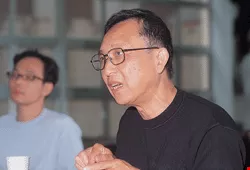
(facing page) Gao Xingjian says that he has never rejected tradition, and that there is no point in destroying artistic tradition. After all, without tradition a lot of things wouldn't exist at all.
Practice is the sole criterion
Q: This work combines the two most beautiful traditional theater forms from East and West in an unprecedented way. How can this be done without leaving scars? How can you avoid producing something that is "neither Chinese nor Western" or merely a "hodgepodge of Chinese and Western"?
A: The discussion of Chinese versus Western is an old topic, going back at least as far as the May 4 Movement [which began in 1919] and even earlier. I don't think this is a problem for discussion, but one for practice. In the process of actually doing something, you can choose what you want and the things you find acceptable, and through these choices create something new. If you do this well, then the problem of Chinese versus Western will dissolve in the process. Discussion can never create a new art form; art is what you do within a specific artistic realm, so I would prefer to do, not talk.
Q: If Snow in August is successful, it will become a new form of theater. Will this open up new opportunities for Peking Opera?
A: I think it will be a stimulus for creativity in Peking Opera, and a positive force. A lot of work has gone into the reform of Peking Opera for a long time now. Taiwan's Wu Hsing-kuo is one of those strongly promoting reform of Peking Opera, and there are many similar efforts going on in China. But they start from a precondition, and that is to make Peking Opera. I'm different from them in that I don't care whether what I come out with is Peking Opera or not.
If Snow in August is successful, it can provide food for thought: It turns out Peking Opera can be carried quite far, and we have this tremendous resource, how should we bring out its full potential in the future? Perhaps it can be combined with symphonic music, with composers asked to write new pieces, rather than merely using the same old traditional melodies over and over. It can have large-scale production, escape from its original confines and go onto the world stage.
Q: What is the greatest source of pressure at the current phase? Does it come from yourself?
A: The greatest source of pressure is not myself, but the fact that there is no established structure and no established format to follow. There are many complex problems, and it is not like overseas where there is the institution of the opera house, so the director merely has to worry about the play and nothing else. As a result, from applying for funding to getting materials and people to signing contracts, its not clear who should be telling who what to do, and without a single institution which has overall authority, doing this by myself is really exhausting.
Fortunately I have strong support from Tchen Yu-chiou at the Council for Cultural Affairs and from Minister of Education Huang Jung-tsun, cooperation from the National Concert Hall and National Theater, and hard work from all the various groups involved. I want to take this opportunity to specially thank them all, because without them this would never have gotten off the ground.
Q: With so much to do, based on current progress will three months of rehearsal be enough?
A: We're doing something no one has ever done before, so how can it not be difficult? No one dares to say that they have experience; if they have experience it is at Peking Opera or traditional drama. I've directed many performances, and worked with actors from many countries, but I too have no experience doing this kind of theater. When you make this kind of choice, you'll run across difficulties. We can say that "nothing is easy," but that we "go forward despite knowing the difficulties." Since starting rehearsals, everyone has been getting more familiar and working more closely together. I believe that there are no problems we cannot overco me.
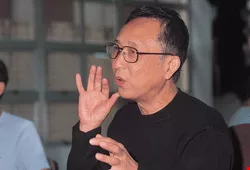
(facing page) Gao Xingjian says that he has never rejected tradition, and that there is no point in destroying artistic tradition. After all, without tradition a lot of things wouldn't exist at all.
Gao Xingjian wants his actors to set aside all the structures, movements, and fixed modes of Peking Opera and stresses: "Even if you can't set them aside, you must set them aside!"

@List.jpg?w=522&h=410&mode=crop&format=webp&quality=80)


