Wu San-lien-- Speaking Out for the Taiwanese
Elaine Chen / photos courtesy of Wu San-lien Memorial Hall / tr. by Robert Taylor
November 1994


In capitalist society, there is nothing special at all about a company changing hands. But the sale of the Independence newspapers in August this year unexpectedly aroused a storm of protest.
Not only did the Independence staff protest vehemently against the takeover, holding demonstrations, throwing eggs and leaving the front page blank; a campaign to "save the Independence" also spread throughout society. During this campaign the "Wu San-lien spirit" was often invoked, and his rotund bronze bust was even carried to the main entrance of the Independence building.
Wu San-lien, known to the older generation of Taiwanese as the "old angel," gradually returned from the Japanese occupation and the martial law era, into peoples' memories...
Do you know who Wu San-lien was?
The "new youth" say: "Dunno. Who cares?"
Journalists are a bit better informed. They say: "He set up the Independence newspapers, didn't he."
Business people may say: "He was the patriarch of the Tainan Faction, and sometime president of the Tainan Spinning Group and the Universal Cement Corporation."
But people in political circles will tell you: "He was a National Assembly member, mayor of Taipei City and a provincial assemblyman, and under martial law it was through him that the Kuomintang and opposition groups communicated."
People in the literary and arts world will tell you: "I once got his 'Wu San-lien Award.' The annual Salt Belt Arts Festivals are put on with his support."
So who's right? In fact they all are. But don't be too quick to mock the "new youth" as young and ignorant, for actually precious few people are aware that under the Japanese occupation, Wu San-lien was a prestigious member of the anti-Japanese resistance movement. For twenty years, through his lectures, lobbying and leading articles, he stood up against the Japanese for the rights of the people of Taiwan. If we look back across his life, although he did so many different things, the common thread we find running through all of them is "speaking out for the Taiwanese people."
The first time Wu San-lien made his voice heard was in 1920, at a reception for students studying in Japan put on by the director-general of the Taiwan governor's office.
That day, Wu San-lien stood up to lambaste the "assimilation policy" by which the Japanese were attempting to eradicate Taiwanese culture. He openly attacked "Law 63," under which Taiwan was treated differently from the Japanese motherland, and the high-handed arrogance of the police.
After that, Wu San-lien was accepted as a member of the resistance movement among Taiwan's intellectuals. Later, in Lin Hsien-tang's petition campaign for the establishment of a Taiwan parliament, the young Wu San-lien was sent to such places as Tokyo and Osaka to collect signatures. In his memoirs, Wu wrote: "I was so immersed in my mission that I would forget to eat or sleep."

On 16 August this year the Independence Morning Post left its front pageblank to protest at the new owners' refusal to sign an "editorial agreement" guaranteeing the editorial freedom of the news departments. (photo by Vincent Chang)
Why the model pupil rebelled
Wu San-lien was born in Tainan County, in the village of Toukang in Hsuehchia Rural Township. His family was poor and the men all went away to work in other places. His mother too would drive the family's pigs to forage on wasteland outside the village. Most days she would take a handful of slices of dried sweet potato and ask the neighbors to boil them for her son along with their rice. Sometimes there wouldn't even be any sweet potato, and with an empty stomach Wu San-lien would stand all afternoon in the biting north wind, waiting anxiously for his mother to return home.
But the poverty of his surroundings only spurred his ambition to succeed. At the age of 12 he began attending a public school set up by the Japanese. In those days the pupils were still all wearing pigtails, and the school authorities encouraged them to get them cut off. Wu San-lien was one of the first to be "de-tailed," and the school presented him with an abacus as a prize.
Who would have guessed that this model pupil, who had been rewarded in this way by the Japanese colonial government and who after finishing school went to study in Japan with a scholarship from the wealthy Lin family of Panchiao, would later go on to resist the Japanese?
Wu San-lien himself describes this turnabout very clearly in his memoirs. At that time World War I was just over, and the Paris Peace Conference had passed its resolution on national self-determination, upholding the right of all peoples to decide their own fate. This marked the start of an international movement in which one after another many a small and weak nation gained its independence.
At the same time a new democratic movement emerged within Japan, and popular protests demanding the right to participate in political life spread throughout the country.
"Taiwanese students studying in Japan in those heady days gradually formed their own national consciousness; ... students from Taiwan no longer simply buried themselves in their books. The spark of resistance against the Japanese began to burst forth," wrote Wu San-lien in his memoirs.

(above) A photograph of Wu San-lien and his colleagues when he was a newspaper reporter. (below) A family photograph taken in August 1938, before Wu San-lien's fourth son Chun-min and fifth son Shu-min were born.
Blacklisted
The second time Wu spoke out was during a cultural lecture tour of Taiwan which he led during the Summer vacation.
The tour was very much in the style of public rallies today. Everywhere the lecture group went it attracted large numbers of ordinary people, and naturally also aroused the close attention of the Japanese authorities. Japanese police wearing swords attended every lecture to "observe." Whenever words were spoken which displeased them, they would immediately issue the warning "let the speaker beware," and in more serious cases they would stop the lecture.
As can be imagined, this "political baptism" greatly stiffened Wu San-lien's resolve to resist the Japanese. Inevitably his name found its way onto the Japanese police's blacklist, and from then on he was constantly followed. More seriously, this almost resulted in the funds which enabled him to study in Japan being cut off.
One day the Lin family's steward Hsu Ping called to see Wu San-lien, and told him in a roundabout way that his master, in his business dealings, had to call on the government for assistance from time to time. As Wu was receiving a scholarship from his master, it was really not appropriate for him to be acting in opposition to the government....
Naturally Wu San-lien realized that in view of his personal debt of gratitude to the Lin family, he ought to heed their advice and stop his activities. But from the standpoint of the interests of the Taiwanese people, he could not leave off. Fortunately Hsu Ping did not press the point any further, and even when the Lins' business was going badly Hsu continued to send Wu his scholarship whenever he could, so that by hook or by crook Wu managed to finish his studies.
Although Wu San-lien had studied business, after graduating he did not go for a well-paid job in one of the large trading companies, but instead chose to become a reporter, joining the Osaka Mainichi Shimbun.
"As a reporter, he saw things more clearly than most people," says Chu Chao-yang, founder of Taipei's Yenping Middle School. Chu is one of the very few people still alive today who knew Wu San-lien well under the Japanese occupation.
Indeed, seeing and reporting on the constant political and diplomatic clashes between China and Japan before war broke out between them, and the Chinese people's boycott and burning of Japanese goods, threw Wu San-lien's feelings into turmoil.
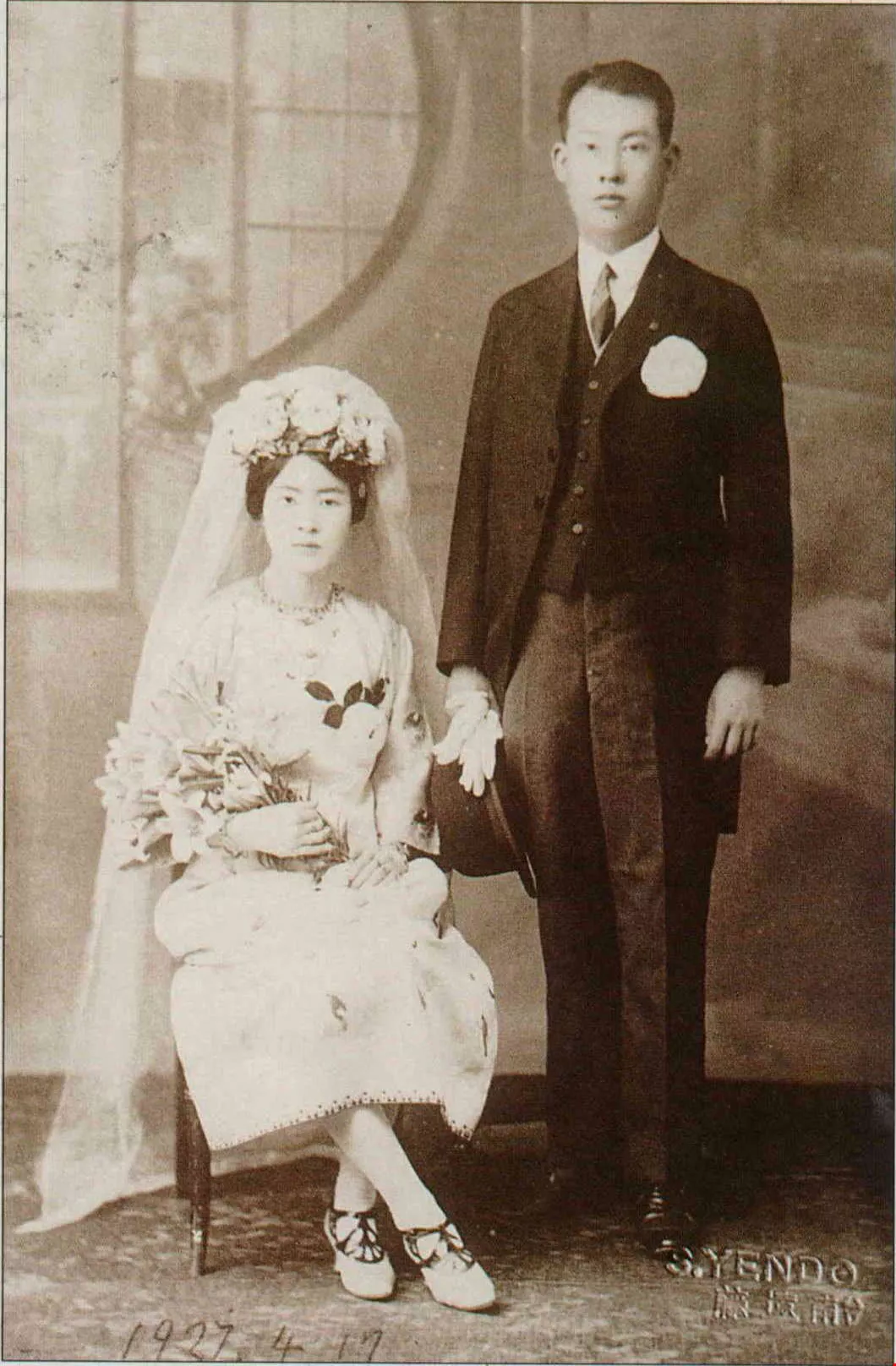
In 1927 Wu San-lien married Li Ling in Tainan. Although Wu jokingly called it a match between a princess and a pauper, their marriage was a very happy one.
Taiwan's first "Bomb"
Naturally the paper could not express sympathy for the Chinese, and the only way in which Wu San-lien could voice the mood of Taiwan's people and his own concern and hopes for China was in the names he gave to his five sons.
Wu wrote: "My eldest I called Yi-min. 'Yi' means both 'outstanding' and 'wandering.' ['Min' means 'the people.'] At that time we were living in Tokyo. We Taiwanese were ahead of the Japanese, but because the Ching government had ceded Taiwan to Japan, the Taiwanese were like a people without a country. When Te-min ['win the people'] was born, the nationalist movement was in full spate. 'Those who win the heart of the people will prosper' was my reaction to a colonial rule which did not accord with the wishes of Taiwan's people. When Kai-min ['bring victory to the people'] was born, China's Northern Expedition had just succeeded, and national unity was in sight. I longed for China to grow strong enough to overcome Japan and allow Taiwan to return victoriously to China. I hoped that if China could defeat Japan, from then on the people of Taiwan could enjoy a better education and work hard to contribute to society. So I called my fourth son Chun-min ['talented people'] and my fifth son Shu-min ['build up the people']."
Later Wu San-lien was invited back to Taiwan to help found the Taiwan Hsin Min Pao newspaper, where at last he could express the feelings of Taiwanese people once again. He wrote a column in the paper called "The Bomb," a title which reveals just what a firebrand he was in those days.
Although the way the Independence Morning Post staff protested against the newspaper's sale by leaving the front page blank was rather overblown, perhaps the inspiration really did come from Wu San-lien.
When the Japanese began to invade China, the Taiwan Hsin Min Pao closely followed the international situation and reported on it as fully as it could. But because the press was censored, the paper had to present its printing Plates for inspection before publication. The Japanese officials would cut any reports and commentaries they did not like, and the newspaper would deliberately leave the cut sections blank to let their Taiwanese compatriots realize the lack of free speech under foreign rule, and arouse their sense of hatred for the common enemy.

(above) In 1949 President Chiang Kai-shek called Wu San-lien to see him and asked him to become mayor of Taipei City. Wu had got wind of the appointment and to try and avoid it, had gone to stay at Kuantsuling hot springs for a few days. But he could not hide out for ever, and in the end had no choice but to accept. (below) After completing his terms as mayor, Wu stood for election to the Taiwan Provincial Assembly.
Taiwan's rice under pressure
Eighteen months later, the paper sent Wu San-lien to set up an office in Tokyo. As office chief he again spoke out vigorously for the rights of Taiwanese people by opposing the rice control regime.
In 1936 the Japanese governor's office in Taiwan drafted regulations controlling the export of rice from Taiwan. Rice to be sent from Taiwan to Japan was compulsorily purchased by the colonial government at a low price, and then sold in Japan at the current market price. The reason was that Taiwan was expected to produce large quantities of cane sugar (which could be used to produce ethanol, an important strategic commodity), and only by depressing the price of rice in Taiwan could the farmers be induced to go over to growing sugar cane.
But the Taiwanese opposed this with all their might, for when the price of rice was forced down farmers suffered heavy losses, and if too many switched to growing sugar cane, this would also drive down the price of cane. This policy struck at the very foundations of Taiwan's farming communities.
"I not only wasn't a large landowner, I was a proletarian without so much as an inch of land, and so the rice regime had almost no impact whatsoever on me as an individual. But for the sake of our national honor and of my suffering Taiwanese compatriots, I once again rose up without hesitation." In his memoirs Wu wrote that this was the most significant event in his life. This time he not only protested with his pen, writing many critical pamphlets and articles, but also lobbied Japanese members of parliament who were sympathetic to the Taiwanese standpoint. But unfortunately the power of the military in Japan was too great, and the rise of the extreme right suppressed liberal elements, so all Wu San-lien's efforts came to nothing. Later, because of two friends' involvement in resistance activities, Wu San-lien was taken into custody for three weeks by the Japanese police.
Wu San-lien's eldest son Wu Yi-min remembers how his father suddenly lost contact with the family. His mother didn't know what to do, and he often saw her shedding tears. After his release Wu San-lien decided to flee to Tianjin and sit out the war as a small trader.
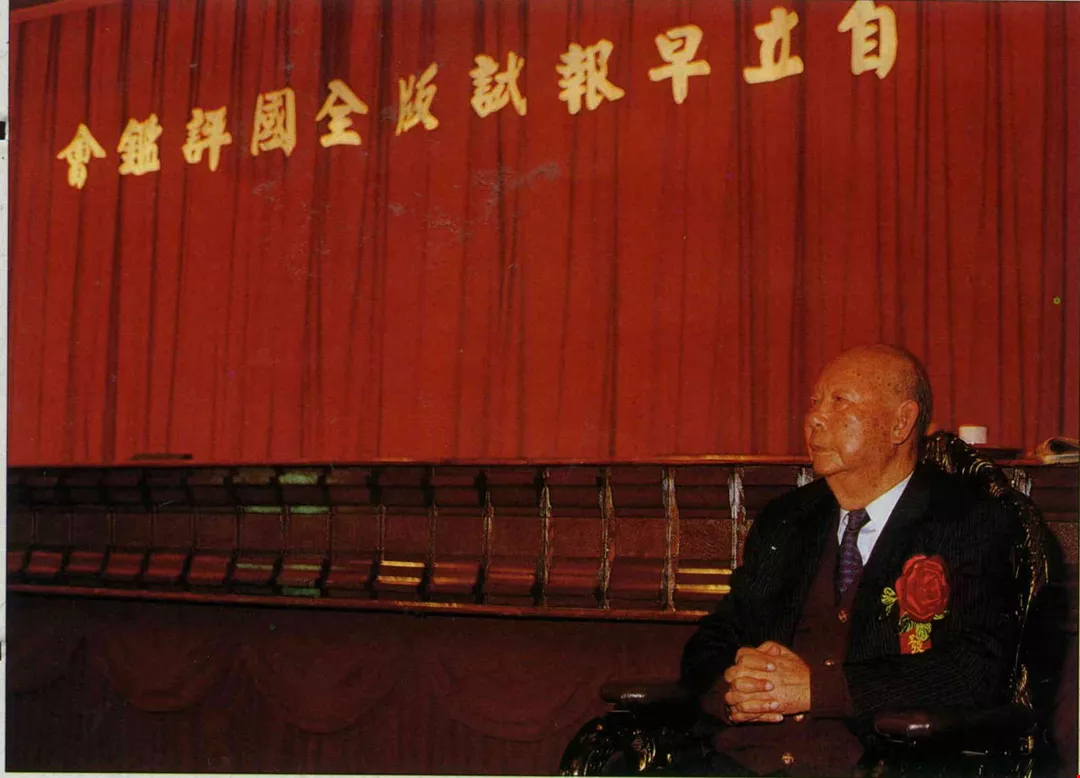
In January 1988, after restrictions on new newspapers were lifted, Wu San-lien founded the Independence Morning Post. (photo by Vincent Chang)
Clearing the Taiwanese' name
The war finally ended with Japan's defeat and unconditional surrender. Wu San-lien would have liked to hurry back to Taiwan to see the Japanese flag come down from the governor's office with his own eyes. But in order to speak up for the Taiwanese once again, he stayed on the mainland.
At that time the many Taiwanese who during the war had been officials of the "puppet regime" or who had traded with the colonial government were all branded collaborators and profiteers. They were not only thrown into prison, but had all their assets confiscated too.
In Wu San-lien's view this was a great injustice. He believed that as the Taiwanese had not become Japanese citizens by their own choice but through the tragedy of the times, they should not be made to bear the blame. Thus he vigorously appealed to the central government to help them. At the same time there were 3000 Taiwanese living in North China when the war ended who could not get hold of boat tickets to return to Taiwan, and Wu San-lien arranged bookings, food and accommodation for them. This great task took him over a year to complete.
While Wu San-lien was working so hard looking after others, he could not attend to the needs of his own family, and he sent his wife and children back to Taiwan before him. "Things were really tough then," recalls Wu Chun-min, now general manager of Universal Cement Corporation. "He had arranged for one of our relatives to come and meet us, but the Keelung coolies wouldn't let our relative help us with our luggage, so Mother and we children had to shift it ourselves."
On returning to Taiwan, Wu San-lien did a little business, but was not successful, and decided to go into politics. At his first try he was elected into the first National Assembly with the highest number of votes of any candidate throughout China. Later he was twice appointed mayor of Taipei City, and elected twice to the Taiwan Provincial Assembly.

(above) In 1982 the Wu San-lien Awards Foundation invited Alexander Solzhenitsyn to Taiwan. (below) Wu San-lien died in October 1988. At his funeral, Li Kuo-ting, Lin Yang-kang and others draped the ROC flag over his coffin, and President Lee burned incense in his honor.
Spokesman for the Taiwanese
To get elected into the Taiwan Provincial Assembly, Wu actually resigned his seat in the National Assembly, so that he could speak for the people of Taiwan. On a members' question paper which has survived from a meeting of the Provisional Taiwan Provincial Assembly, Wu set out with logic and clarity the outline of his questions:
1) Which department is responsible for controlling prices? In the Central Government it is the Ministry of Economic Affairs; in the Provincial Government, is it or is it not the Department of Finance?
2) Responsibility for the high rate of inflation lies with the government.
3) But the government is trying to shift the blame onto hoarders and profiteers.
4) Wouldn't restricting the money supply solve the problem?
5) If inflation causes difficulties for ordinary wage and salary earners, does the government intend to increase their pay?
We have no film of that question and answer session, but from the assured and forceful tone of the content we can guess that Wu would not be outclassed by any of today's legislators.
At the end of his second term in the provincial assembly, Wu San-lien felt that with the growth of election bribery, electoral standards were going from bad to worse, and he decided not to stand again. But this did not mean that he stopped speaking out, for he returned to his "old job" of running a newspaper, in order to continue expressing his concern for Taiwan. On the occasion of major political incidents such as the "Chungli incident," the "Kaohsiung incident," the murder of Lin Yi-hsiang's family or the death of Professor Chen Wen-cheng, the Independence Evening Post always had something to say.
The recent "Save the Independence" declaration issued by professors and other academics said: "After Wu San-lien took over the Independence Evening Post in 1959, he set unique standards in upholding democracy and courageously resisting the abuse of power. Under a regime which claimed a monopoly on truth, he held open a small window to keep freedom of speech alive."
"I am Taiwanese, and I think that today the voice of the Taiwanese has become too loud. But in those days, for him to persist in speaking up for the Taiwanese required unusual moral courage," says Hsieh Kuo-hsing, an assistant research fellow at Academia Sinica's Institute of Modern History.

In the Wu San-lien Memorial Hall, the old man's hat, wallet and pipe, and even the bell he used to call people, are all on display. (photo by Vincent Chang)
Money runs faster than people
The money for Wu San-lien to run his newspapers actually came from the businessmen of the Tainan Faction. Because Wu San-lien's nephews Wu Hsiu-chi, Wu Tsun-hsien and others wanted to set up a textile factory, Wu San-lien used his political connections to help them get authorization, and with everyone's support he became president of the company. But he really didn't have much money, and when the company was established he didn't even have NT$10,000 to put up as capital, and had to borrow it.
After so many terms as mayor and as an assemblyman, why were his finances so strapped? Firstly it was because he was always honest and upright in office, and secondly because he so often dug deep into his own pockets to help others in need.
Because he had received financial support from Lin Pen-yuan's family as a student, later in Wu San-lien's life whenever anyone approached him for assistance he would always do his best to help them. Wu Chun-min reveals that his father helped at least 40 or 50 young people who wanted to study overseas. "He would always deal with such matters himself, so no one knew about them except perhaps his secretary. It was only later, when the students returned, that during our evening meal at home he might mention that such and such a person had come to see him." Wu Chun-min says that his father was a very earnest man and did not usually speak much at mealtimes, so for him to volunteer such information unprompted showed that he was very pleased indeed.
Having to wear shoes with holes in them because his father was constantly helping others out with money, as a small child Wu Shu-min always thought he was very poor.
"The Tainan Faction and Wu San-lien really complemented each other," says Hsieh Kuo-hsing, who has been researching the Tainan Faction for many years. With the Tainan Faction's financial support, Wu San-lien could do many of the things he wanted to, and as an upright and respected figure, he in turn was the best advertisement for the Tainan Faction.
As well as providing the backing for Wu to run the Independence Evening Post, the Tainan Faction and Wu's children donated the funds to set up the Wu San-lien Awards Foundation as a gift for his 80th birthday, for they agreed with his idea that a special characteristic of literature and art is that they cannot be defeated by might. As the expression of a nation's soul and thinking, they are eternal and indomitable.
Harsh words for the president
Wu San-lien spoke out for the people of Taiwan all his life. The last time was after the "Kaohsiung incident." He hurriedly consulted with national policy advisor Tao Pai-chuan as to how to deal with the situation, saying that he hoped that it would not develop into a second February 28th Incident.
Wu San-lien not only frequently visited the detainees in prison, he also did his utmost to console the victims' families. In protest against her husband Yao Chia-wen's arrest, Chou Ching-yu went on hunger strike outside the prison, fully prepared to die. When she was rushed to hospital in a serious condition, the old and respected Wu San-lien went to visit her several times and earnestly entreated her to end her fast. He also sent his sons and daughters-in-law to bring her food. Recalling the events of that time, Chou Ching-yu is still moved to tears. She says that opposition groups placed great hopes in Wu San-lien and thought he should have said and done even more. "But old Mr. Wu came from a different age and had his own role. He once told us that the democracy movement mustn't be like a fireworks display which is over after a few bangs. In the end he exerted himself so much for us young people that he made himself ill. I feel very deeply that we are in his debt," says Chou Ching-yu, unable to hold back a sob.
In the heat of the summer of 1986 old Mr. Wu visited prisons and hospitals many times to take care of the victims of political repression and their families. But the effort was too much for him and he suffered a stroke. Two years later, he died of complicated influenza.
In Wu San-lien's memoirs, the only period not covered is that of the "Kaohsiung incident." He never told anyone what he did, and never answered the opposition groups' criticism that he should have done more. But among the bulging files in his memorial hall, we discovered a draft of a letter to President Chiang Ching-kuo in which Wu San-lien urged the authorities to be big enough to show tolerance. He wrote very bluntly: "The whole affair gives the impression of being a case of arresting people first and looking for evidence later. The charges are contradictory, suspicious and far-fetched in the extreme. It is neither satisfactory nor convincing."
To address the president so harshly in the days of martial law took more than just moral courage.
Trying to follow their father's example
Standing in the Wu San-lien Memorial Hall inside the Wu San-lien Foundation for Taiwan Historical Materials, seeing how well the materials documenting Wu's life are preserved, one cannot help noting that some people devote their life's efforts to making money, but when their time comes, they can take none of it with them; whereas Wu San-lien, who devoted all his life to others, has left behind such rich historical materials and the traces of his efforts have not been washed away.
So what did he leave behind for his sons? He left no shares and no real estate, and this year when the Tainan Faction decided to sell the Independence newspapers because of their amassed losses of over NT$700 million, none of Wu San-lien's children were in a position to buy the newspapers, which were their father's most treasured life's work.
His only legacy was a spiritual one. Wu Chun-min has discovered that just like his father in earlier years, he very rarely attends sumptuous wedding banquets, but feels compelled to go to funerals where others need warmth and consolation.
Ten years ago Wu Shu-min, who was in medical practice in the USA, began trying to persuade his father to let him return to Taiwan to take over the newspapers. When he did return in 1988 he too visited the political prisoners of the time in gaol. Today, although he is not able to realize his ideals by running a newspaper, he is very active in the Medical Professionals' Alliance in Taiwan, and is director of the Salt Belt Arts Festival. Listening to him reminisce about his father and talk about himself, one is suddenly struck by how much the curves of his face resemble his father's!
[Picture Caption]
p.101
On 16 August this year the Independence Morning Post left its front page blank to protest at the new owners' refusal to sign an "editorial agreement" guaranteeing the editorial freedom of the news departments. (photo by Vincent Chang)
p.102
(above) A photograph of Wu San-lien and his colleagues when he was a newspaper reporter. (below) A family photograph taken in August 1938, before Wu San-lien's fourth son Chun-min and fifth son Shu-min were born.
p.103
In 1927 Wu San-lien married Li Ling in Tainan. Although Wu jokingly called it a match between a princess and a pauper, their marriage was a very happy one.
p.104
(above) In 1949 President Chiang Kai-shek called Wu San-lien to see him and asked him to become mayor of Taipei City. Wu had got wind of the appointment and to try and avoid it, had gone to stay at Kuantsuling hot springs for a few days. But he could not hide out for ever, and in the end had no choice but to accept. (below) After completing his terms as mayor, Wu stood for election to the Taiwan Provincial Assembly.
p.105
In January 1988, after restrictions on new newspapers were lifted, Wu San-lien founded the Independence Morning Post. (photo by Vincent Chang)
p.106
(above) In 1982 the Wu San-lien Awards Foundation invited Alexander Solzhenitsyn to Taiwan. (below) Wu San-lien died in October 1988. At his funeral, Li Kuo-ting, Lin Yang-kang and others draped the ROC flag over his coffin, and President Lee burned incense in his honor.
p.107
In the Wu San-lien Memorial Hall, the old man's hat, wallet and pipe, and even the bell he used to call people, are all on display. (photo by Vincent Chang)


@List.jpg?w=522&h=410&mode=crop&format=webp&quality=80)


