"You Cannot Shape an Implement Without Pounding"--Is Chinese Tradition to Blame?
Teng Sue-fen / tr. by Phil Newell
April 2000


In days gone by in China, the educational system consisted mainly of privately run, very small-scale academies. Teachers kept wood implements with which to strike students' heads, doing it so often that a Cantonese slang expression for these academies was "Thwack Studios." (rephotographed from Goodbye to Another Kind of Childhood, published by the Commercial Press)
In Chinese, there are such sayings as "You cannot shape an implement without pounding" and "A filial child emerges from under the stick." Can we conclude from these that corporal punishment is an integral part of Chinese traditional culture?
Three thousand years ago, the great Chinese sage Mencius ran away from school when he was only a small child. But when he got home, his mother did not strike him. Instead, she simply cut up a cloth that she was in the middle of painstakingly weaving, and told her son that if he did not continue his education he would end up like the cloth-unfinished and useless.
Yet here in the 21st century, the sounds of corporal punishment still resonate through middle and primary schoolyards in Taiwan. From where and when does the educational philosophy of corporal punishment come? Is it really the fault of traditional culture?
In the United States, a Chinese father was arrested by a policeman for slapping his daughter. It became headline news.
In May of 1998, the Chicago Tribune published an extensive report on an immigrant couple from the PRC who were being brought up on charges for mistreatment of their child. According to the report, a Mr. Li from mainland China was angry at his daughter for losing a ring that he had given her for her eighth birthday, and he slapped her. Then he took her to the park near their house to look for the lost ring. A policeman on patrol noticed the girl, whose tears had not yet dried and whose face still bore a red mark from the slap. The patrolman immediately took her to a hospital, and arrested the father.
After the incident, Chinese community groups in Chicago reminded Chinese immigrants to the United States that they should not physically punish their children in public places. These groups advised Chinese parents to adapt their child-rearing methods to the Western respect for basic human rights. The idea that "you cannot shape an implement without pounding," they concluded, is definitely not suited to contemporary American society.
Striking similarities
Perhaps the striking of children is not suited to contemporary American society, but it has certainly not been a monopoly of Chinese society. You can find references to corporal punishment all the way back to the Old Testament. And in English there is the common saying "spare the rod and spoil the child."
Up until the Renaissance, corporal punishment was a universally accepted element in European education. The 16th century French thinker Montaigne described in his Essays how schoolchildren were beaten with willow switches until they bled.
As he described it, a school was "a real house of correction of imprisoned youth. They are made debauched by being punished before they are so. Do but come in when they are about their lesson, and you shall hear naught but the outcries of boys under punishment, and the thundering noise of their pedagogues drunk with fury. A very pretty way this, to tempt these tender and timorous souls to love their book, with a furious countenance and a rod in hand!"
But this educational philosophy, based on religious thought, began to be challenged by humanism in the Renaissance. Later, during the Enlightenment, educational thinking that centered on the individual gained further ground. However, the idea that corporal punishment should never be used has only recently really come into its own.
In 1959, the United Nations issued its Declaration on the Rights of Children and 1979 was declared International Year of the Child. The happiness and welfare of children has become a global ambition, and the impact of this idea has been far-reaching. In 1987, educational authorities in Britain declared that teachers in state schools could not use corporal punishment on students. In 1997, the Danish parliament went farther, passing legislation forbidding parents from striking their children.
Keeping parents in the right
Over two millennia, educational philosophy in the West has gradually moved toward respect for basic human rights. What has been the situation in Chinese society?
In the Analects of Confucius, there is a parable about the attitude of the ancient philosopher-king Shun toward punishment: "If your parents beat you lightly, you must accept it, but if they beat you too severely, there is nothing unfilial in running away." Indeed, by running away for a while a child would save his parents from committing a potentially terrible misdeed against the tenets of righteousness (killing their own child) while in a fit of rage.
Confucius always advocated that a teacher could best exercise a restraining influence on students with benevolence and by setting a good example. He declared that he never got tired of learning or of teaching, and he hoped that students would naturally be guided by his dedication to seeking the correct path.
From the works of Confucius and Mencius, it is clear that corporal punishment was not part of classical thought. So who has been advocating the beating of children all this time?
This question also aroused the curiosity of Wendy Lin, an associate professor of psychology at Fu Jen Catholic University. She decided to record everything she could find on household instruction and family rules in the Chinese classics and in works by pre-Qin authors. After reading more than 200 books and essays, and analyzing their views on human nature and education, she reached the following conclusion about their impact on Chinese pedagogy: "Rather than saying traditional educational philosophy was Confucian, it would be more accurate to say it derived from beliefs on well-ordered family life."
Perhaps the earliest comment of note is in the Spring and Autumn Annals of Lu. It reads: "If there is no bamboo switch in the home, a child will readily fall into error." It seems that the bamboo cane was an essential convenience around the home, right at hand so that a child could be immediately punished for any infraction. The Historical Records agrees, saying: "The instructional bamboo cane is indispensable." The Yan Family Norms of the Northern Qi dynasty contains a similar admonition.
By the time of the Song, Ming, and Qing dynasties, sets of family rules were being recorded and widely circulated. Take for example this entry from the Yuan Family Regulations of the Song dynasty: "A family domicile should be like an official's residence-there must be discipline."
In the Qing-dynasty novel Dream of the Red Chamber, the hero Jia Baoyu was whipped so severely by his father for failing to study hard that he was unable to sit down for several days.
Wendy Lin suggests one explanation for why parents in ancient times felt that they were right to beat their children for mistakes. They considered the goal of education to be satisfying the needs of the clan. From ancient times, family rules incessantly reminded people to protect the family, to make the family secure, to prevent the family honor from being tarnished, and to seek the extension of the family line. Clearly people in former times cared very much about whether their children's education would successfully bring honor to the household. Because this was the purpose of education, there was no consideration that children had any independent character or rights.
No pain, no gain?
What kind of impact did this outlook have on the authority of teachers?
Wendy Lin notes that in traditional Chinese society teachers always had a very elevated status. The dignity of a teaching career was mainly built on the socio-ethical norm of hierarchy. The Three Character Classic, compiled during the Song dynasty, includes phrases like "You cannot make a curio without cutting the jade," or "If instruction is not strict, the teacher must be lazy." There is no doubt such ideas encouraged teachers to set themselves up-and be accepted by others-as awe-inspiring authority figures.
As times have changed, the pedestals on which teachers were formerly placed have been steadily knocked down. The concept of equal rights has replaced that of hierarchy. Wendy Lin says that as the ethical basis of traditional education has evaporated, teachers have found that they have needed to buttress their fading authority by inflicting pain physically and verbally.
In the early Republican era, virtually everyone who studied in the small private academies that were the typical schools of that age had the experience of being beaten. The Hong Kong author Zhang Qingyi has compiled a book, entitled Goodbye to Another Kind of Childhood, from the childhood reminiscences contained in the autobiographies of famous early 20th-century literati. One chapter is devoted to corporal punishment, and it describes the treatment most students received in their academies.
The chapter is entitled "Thwack," because corporal punishment was so frequent in these academies that Cantonese people nicknamed them "Thwack Studios." The main reasons for corporal punishment were misbehaving or failure to learn the lessons properly.
The authors Shen Congwen and Guo Moruo have both described what it was like in those days. When Shen was a boy, he much preferred being outside in the colorful real world than stuck in the classroom every day memorizing text. So he often cut class, and if he was caught, he got a beating at school and another one at home. At school he had to move his chair in front of the tablet dedicated to Confucius, and lay across the chair to allow himself to be beaten. After the punishment, he had to then bow respectfully to Confucius' icon to show his remorse. He was often sentenced to kneeling there for the length of time it took a stick of incense to burn down.
Li Zongren, who served briefly as acting president of the ROC at the end of the Civil War between the Nationalists and the Communists, recorded in his memoirs: "Teachers invariably had on their desks a rectangular piece of wood, which we called the 'admonition block.' If students did not follow the rules, or could not recite their lessons by heart, the teacher would strike them in the head or the palm of the hand. It was common for youths to be beaten until the skin broke or swelled up with severe bruising. Some teachers even kept a long bamboo stave by their desks to strike students in the head. Given the small size of the classrooms, with a long stave the teacher could reach every student in the class from his desk."
The beat doesn't go on
Of course, some children were not beaten.
The linguistic scholar Zhao Yuanren was beaten once. But Zhao's grandfather told the teacher: "A teacher who can really teach doesn't need to hit." After that Zhao was never struck again.
If parents had their own ideas about education, and talked with the teacher, the student was likely to get better treatment. That is why Hu Shih was never beaten; his mother had considerable influence.
The Chinese philosophy of education was based on the principle of "severity." Strict teachers produce outstanding students, it was said, and students only respect strict teachers. Most Chinese took this idea for granted in all places and times, but in early modern China, teachers increasingly began to feel that beating students was not really appropriate.
Guo Moruo has described the transformation of one teacher. "At first he beat us very severely indeed. But that was not because he was cruel or had bad intentions. It was because that was the way education was done in those days. But he was able to abruptly change direction, and thereafter he never again used heavy sticks to beat us."
"Severity" among Chinese educators was a result of the habits of teachers and the demands of parents. But "severity" is not equivalent to "beating." Teachers who use corporal punishment on their students may simply be grabbing at the cultural tradition that they find most convenient. Today traditional authority is crumbling, and corporal punishment is not a workable solution. Perhaps it is once again time to extol the humanistic tradition that we find in the early Confucian classics.
p.94
In days gone by in China, the educational system consisted mainly of privately run, very small-scale academies. Teachers kept wood implements with which to strike students' heads, doing it so often that a Cantonese slang expression for these academies was "Thwack Studios." (rephotographed from Goodbye to Another Kind of Childhood, published by the Commercial Press)
p.97
In 1981, eight students from the Tungmen Primary School in Taipei petitioned the Ministry of Education over a teacher who beat them and forced them to put in long after-school hours of extra study. The incident rocked the education community, and drew attention to the long-standing evils of cramming and corporal punishment. (courtesy of the China Times Data Center)
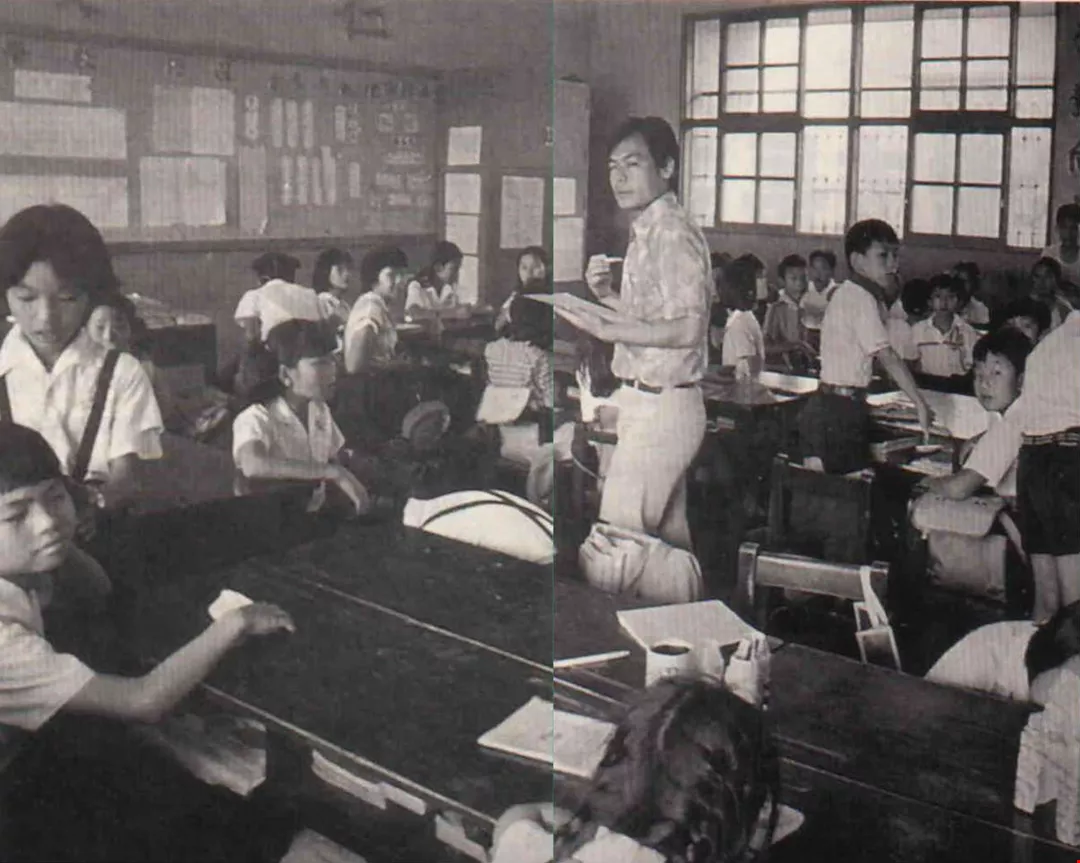
In 1981, eight students from the Tungmen Primary School in Taipei petitioned the Ministry of Education over a teacher who beat them and forced them to put in long after-school hours of extra study. The incident rocked the education community, and drew attention to the long-standing evils of cramming and corporal punishment. (courtesy of the China Times Data Center)


@List.jpg?w=522&h=410&mode=crop&format=webp&quality=80)


@List.jpg?w=522&h=410&mode=crop&format=webp&quality=80)
