Shining the Stage Lights on Oral History--The Uhan Shii Theater Group
Chen Hui-yin / tr. by Jonathan Barnard
January 2009


During an international art festi-val performance in March of 1998, Wu Wencheng, an old Taiwanese man, performed The Story of Taiwanese Men, imitating a Taiwanese man cleaning himself with a wet towel. From taking off a bamboo-leaf field hat, to wetting the towel with water from a showerhead, to wringing it out, he didn't speak a word, and no explanatory text was projected on screen. Yet those five minutes of silent performance brought the crowd to tears. Afterwards, Greeks, Germans, Dutchmen and Englishmen hugged him and blubbered: "You did it just like my father!"
Not a professional actor, Wu simply demonstrates with great passion what he has experienced in life. He is a member of a group of older Taiwanese who, though lacking backgrounds in dramatic arts, now perform interpretations of their own life experiences. Some have proven so determined as to continue even after contracting cancer, performing through their chemotherapy to the very end of their lives. They are members of the Uhan Shii Theater Group, Asia's only theater company that is devoted to performing stories drawn from oral history and composed entirely of amateurs who are over 60 years of age.
The driving force behind the Uhan Shii Theater Group is its director Peng Yaling.

Echoes of Taiwan II: The Black Dog Brother and Black Cat Sister Touring in Taiwan (1996) This show took the life of zhentou troupe master performer Wu Tienlo (the elderly man in the photo) as its blueprint, revisiting the period from the 1950s to the 1970s when the Wu family travelled the island as street performers and medicine salesmen.
Redefining performance
Peng Yaling, who founded the Square and Round Theater 27 years ago, was a member of a generation of pioneers who were pushing the boundaries of the performing arts in Taiwan's small theaters. Absorbing the experimental creativity of Western avant-garde theater, she tried every "ism" in drama theory and every performance space configuration, but she never quite felt that she was achieving what she was aiming for. Hearts and souls weren't being moved enough. Then she went abroad to study drama in London, the world's theater capital.
She was the only foreigner in her class. Expressing pleasant surprise, her teacher said, "You're from Taiwan, that's great!" To Peng, the comment sounded patronizing, as if the teacher were pampering a special ed. student. It angered her. She also hated the way her classmates treated her as some kind of exotic curiosity, and so at the end of each class Peng would slip out the door in a flash to avoid them. One day, the dean of the school told her that "performance" and "culture" were inextricably intertwined, and that in Britain she could elect to do design or conduct research, but "performance" would be impossible. Under similar pressure, almost all of the school's foreign students would leave after only three months.
Yet Peng stayed for the full three years. Her plump physique, oriental facial features and unusual way of moving never ceased to attract people's curiosity.
For instance, in one silent drama all Peng did was pull out a single grey hair with great precision to the accompaniment of the sound "Ah..." She became much discussed and imitated by the audience at the pub. Her teacher even complimented her on her "excellent Chinese kungfu!" It turned out that they were truly charmed by the Taiwanese qualities of her performance.
"One's performance should connect to one's emotions." She finally understood what the dean had meant. And so she decided to "re-educate herself" and learn how her own body could generate emotion.

Gao Sha Guen (2008) Uhan's latest production is about the proprietress of Gao Sha Guen, an inn near Keelung's harbor. She obsessively longs for her lover to return from Manchuria where he went for work. (far left:) The young Ah-xiu (played by Shi Biyu) folds paper sailboats to release her longing. (left:) After 60 years, the elderly Ah-xiu (played by Li Xiu) still fondles a sailboat, waiting for her fiance to return.
Seniors' stories
Even when she was young, Peng loved to hear old people tell stories. And as an adult, when she travelled to more than ten European nations or to mainland China before ROC residents were officially permitted to go there, she paid little attention to relics and historic sites, but took great pleasure in following seniors and listening to their stories. This unusual proclivity of hers led her to conduct fieldwork and collect oral histories from the elderly all over Taiwan, particularly Taiwanese Opera singers. She then embarked on a long journey of taking seniors' life stories and putting them on stage.
When she returned to Taiwan, Peng taught some classes at a theater, where the actors would laugh that she was teaching "foreign performance" because she lacked any understanding of Taiwanese Opera, zhentou street troupe performance, or hand puppet theater. For Peng, who had received training in Western performing arts since she was very young, it was a wake-up call.
In the Wanhua District of Taipei one day, she came across the Min'an Taiwanese Opera Troupe performing in front of a shrine for a local earth god. As the Taiwanese Opera star Xu Yuan-or "Black Cat Cloud" as she was commonly called-agilely shifted between playing an old man, a female clown, and a male clown, Peng looked on open-mouthed with astonishment At that very moment she knew that she wanted to have Black Cat Cloud perform modern drama if an opportunity ever presented itself.
Three years later, she visited Xu who was already an old woman by then and needed a wheelchair or a walker to get around. Of Hakka ethnicity, Peng used standard Mandarin to express how she wanted to combine Taiwanese Opera and modern drama, and Black Cat Cloud, said in Taiwanese, "I don't understand. Stop talking...." Undeterred, Peng pressed on, gesturing as she spoke. At that point, Black Cat Cloud said, "You're really horrible-worse than an extra...."
To help convince Xu to perform, Peng found an emissary in Xie Yuexia, a Taiwanese Opera performer who was likewise regarded as a national treasure. Xie brought gifts of alcohol, small treats and cigarettes, and Peng had to bite the bullet and drink with Xu to obtain her agreement to perform.
Next Peng visited Wu Tienlo, who had been singing with zhentou performance troupes for 60 years. In a remote district Wu was playing the moon-shaped yueqin lute by himself for a friend who had passed away. With great curiosity, Peng crouched under a banyan tree and observed him as he sang for two hours. The whole scene-what with the plaintive sound of the yueqin mixed with the rumbling of nearby excavators and the ringing of the hand bell by an old peddler selling tapioca pearls-gave her a sense of being moved by the life of the common people.
Then Peng thought about trying to find the traditional nakasi performance that she remembered from her youth. She went to a teahouse in Danshui and found the blind music teacher Li Binghui, and sensed how happy he was with his lot in life. Whenever Peng visited, she asked him to dine with her. Bashfully, Li always said: "My one little desire is to go to a noodle stand and have some simple qiezai noodles, with some NT$5 sliced dried tofu and extra hot sauce. That would totally satisfy me...."

Echoes of Taiwan-Fifty Years in Taiwan (1995) The elderly Black Cat Cloud (Xu Yuan) sits in a wheelchair, singing in the style of Taiwanese Opera to recall life during the Japanese era. The projected image in the background is a photo of the actor Li Xiu when she was young.
Bringing tears to foreign eyes
In 1995, Black Cat Cloud, Wu Tienlo and Li Binghui-three performing arts masters and national treasures-along with several amateur actors-went on tour to Britain. So as to celebrate the group's first experience with "citizens' diplomacy," they performed Uhan Shii's first drama: Echoes of Taiwan-Fifty Years in Taiwan.
On the night they landed in Britain the festival sponsor had prepared a spread of smoked salmon and raw vegetables and uncorked some champagne. Just as members of performance groups from many different nations were raising their glasses in a toast, Xu Yuan blurted out, "Wait a minute!" Then, with the rough confidence of a xiaosheng (a young male character in Taiwanese Opera), she said, "What a poor show of sincerity! The fish is raw, the vegetables haven't been cooked and we're raising our glasses with soda pop! Bring on something stronger!" It caused quite an uproar, and Peng was embarrassed no end.
Yet, at show time, Xu's performance moved and astonished people. Ignoring her injured legs, she pulled herself up with her two arms, using all her might to leave her wheelchair. As she sang with great power, the eyes of audience members welled with tears. And they offered thunderous applause-well deserved acclaim for "Taiwan's greatest opera star."
While in Britain, Wu Tienlo stayed true to form, improvising songs about the newfangled hotel. Li Binghui, too, remained his old self. When they all went to a department store to eat, he pulled Peng over: "Yaling, same as always-qiezai noodles with NT$5 dried tofu and a little extra hot sauce...."
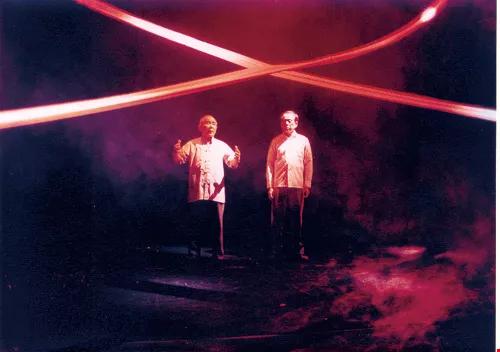
Echoes of Taiwan III: The Story of Taiwanese Men (1997) Actors Cai Yishan (left) and Wu Wencheng together revisit the "white terror" period of political oppression in Taiwan. The fog on stage serves to convey the cold atmosphere.
Staring down disease
Apart from putting stories from old performers' lives on stage, the Uhan Shii Theater Group also recruits amateurs over the age of 60. Weaving together the particulars of personal history with the general background of the era, Uhan has produced the excellent "Echoes of Taiwan" series of dramatic performances.
One of these, Fifty Years in Taiwan conveyed what life was like before and after World War II; The Black Dog Brother and Black Cat Sister Touring in Taiwan described the legendary life of the zhentou performance artist Wu Tienlo. If You Had Called Me explored the vicissitudes of fate experienced by the old Nationalist soldiers who fled the mainland to make their lives in Taiwan. We Are Here explained the sentiments of Taiwan's Hakkas, whose proud sense of uniqueness has dimmed as their communities have moved to big cities and dispersed. Salt and MSG conveyed the conflicting emotions of a husband and wife who quarrel constantly but nonetheless can't live without each other. These elderly ladies and gents came up with their own methods to write and perform their scripts, and some went on performing to the very end of their lives. Their 15 plays bring to life the sorrows and joys of life in Taiwan.
Cai Yishan was already 65 when he joined the group. In 1995 he went on a tour of the island, performing Fifty Years in Taiwan. During breaks, people discovered that he never took a sip of water no matter how thirsty. It turned out he was undergoing chemotherapy for bladder cancer. A shocked Peng Yaling blurted out: "Cai Yishan, you can't die; you're the leading man in our next show!"
Peng asked Cai to spend some time every day writing his own life story. Determined that he would not let his condition stop him from performing, Cai said to Peng: "Teacher, don't worry, I'm going to keep fighting!" Several times after chemotherapy treatments, Cai would squat as he held a public phone and called Peng to say: "Teacher, say it again: I'm your leading man." Peng would loudly respond: "Cai Yishan, you cannot die; you're my leading man!"
Miraculously, the tumor was brought into check and, after a tour through various counties and cities in Taiwan, The Story of Taiwanese Men went to Europe and America, where the cast earned standing ovations, stomping of the audience's feet, shouts of "bravo," and blown kisses. After a year, Cai Yishan passed away, saying goodbye without regret to the performance group that was a big part of an outstanding period in his life.
Painful memories
Peng emphasizes that the process of oral history must touch upon memories of suffering. But you've got to hang out with old people for a long time before you can uncover their pain. Even now, telling stories of the past dredges up indescribable pain. Numerous times, when driving home after hearing one of these tales, Peng has been unable to keep herself from sobbing and crying out wildly. Consequently, when interviewing seniors and during rehearsals, she has taken the prudent and considerate measure of having a consulting psychologist present.
One woman recalled that when she was young her grandfather took her up to the mountains and then threatened to give her away. He put her down and started running away. Although she was in her sixties and blessed with many children and grandchildren, she still felt unwanted. The terrifying feeling wasn't dissipated until she recalled a warm moment when her father returned home after leaving their village for work and lifted her up onto his shoulders.
One grandmother was a mainlander who originally hailed from Shantou in Guangdong Province. In If You Had Called Me, four leading women characters are supposed to talk about their childhood hometowns in their native dialects, but this one grandmother refused for four years to go on stage and say in the Shantou dialect: "I am [so-and-so]. I was 17 when I fled Shanghai for Taiwan." Attending one rehearsal after another finally broke down her resistance to delve into that black hole in her memory, a place that she had avoided for decades. After bawling, she put down her guard and finally spoke those lines that Peng had waited four years to hear.
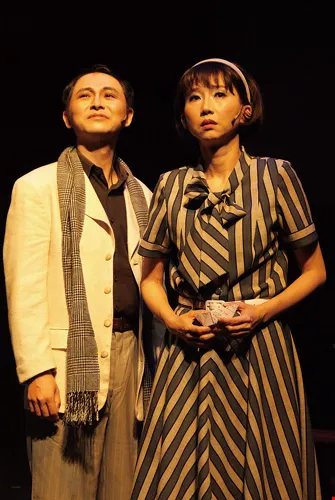
Gao Sha Guen (2008) Uhan's latest production is about the proprietress of Gao Sha Guen, an inn near Keelung's harbor. She obsessively longs for her lover to return from Manchuria where he went for work. (far left:) The young Ah-xiu (played by Shi Biyu) folds paper sailboats to release her longing. (left:) After 60 years, the elderly Ah-xiu (played by Li Xiu) still fondles a sailboat, waiting for her fiance to return.
Changing one's final act
Everyone has a different reason for participating in the performance group. Some people get dragged in by their children because they seem too bored at home. Others are simply curious or do it for fun. When the Reverend Wu Ming joined he was already 80. He heard about the theater group during a stay in the hospital, and he decided to live out the remainder of his life in an entirely different manner. When he joined and discovered that the warm-up exercises included playing children's games such as "the hawk grabs a chicken" and singing children's songs, he said very seriously: "The way I was raised doesn't permit this!" When all the others were on their bellies stretching their spines, his back was "as stiff as a turtle's shell." Much to his surprise, his physical condition made great strides over the course of a few years, and despite being in his eighties, he was able to spread out his arms as if to fly.
When the group went to perform in Germany, a fan hugged Wu and said "Papa, Papa." From originally being quite serious, Wu Ming grew more jovial. Then, because there weren't any suitable roles and he wasn't feeling well, he didn't appear in any Uhan shows for five years. But he would often grab his cane and return to Uhan, declaring to Peng Yaling: "I could come back one more time!" Finally, on the night before a new show he was going to open-after the promotional stills had already been taken-the 90-year-old Wu Ming passed away, bidding adieu to this theater troupe that had changed his life.
When he was 78, Yi Jintang, an old soldier, planned to return to mainland China to pass his old age. Then, almost accidentally, he joined Uhan. At first, he couldn't even lie down straight, but he grew comfortable with turning his body and he performed scenes of when he was 12 and participated in both his parents' funerals, as well as his later circuitous journey to Taiwan.
Unfortunately, before he was to act, Yi injured himself in a fall. Nevertheless, he was determined to get back on stage and refused a substitute. Removing all the medical tubes that were attached to him, he said, "I am going on stage myself. This old man isn't go to die from an illness or a fall...." Performing while ill, he went off script to forcefully shout: "I hate war! I hate war!" Later, this old man, who lived by himself in the Guang Ci Care Home, finally passed away.
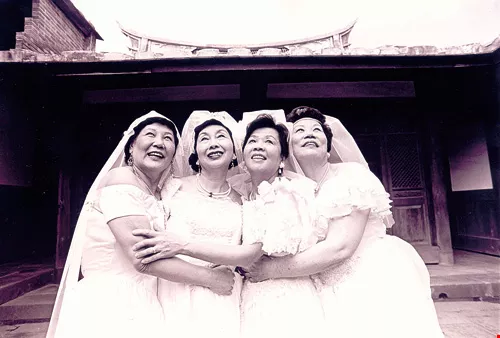
Echoes of Taiwan IV: If You Had Called Me (1998) This drama shows what unfolded on one day in 1949 when citizens were fleeing with the Nationalist government from the mainland to Taiwan. Four women who turned 20 that year experience their individual, but alike moving, stories.
Treasure in a time capsule
So as to unearth stories that are "simple and true," Peng Yaling has, in addition to conducting oral history fieldwork, also set herself up in various fixed locations in Taiwan, where she has invited old people to put memorabilia related to unforgettable experiences of their own lives into time capsules. The goal is to preserve some special memories of their eras in these wooden boxes.
In a remote village in Chiayi, Peng is preparing to interview a 70-year-old man, but neighbors crowd around to say: "He's a lonely old man; he doesn't have any stories!"
This old man was a laborer his whole life. When he was young he had to carry more than 7000 bricks to earn just NT$12 a month. In that same era, Peng's mother earned NT$600 a month as a nurse. Everyone thought that the old man "ought to be forgotten," but tears came to Peng's eyes when he pulled out his son's wedding photograph: someone that everyone regarded as a lonely old man was the patriarch of a family of 50.
Peng also discovered that for the elderly who came from the mainland, the most unforgettable life experiences were those involving war and escape. Take, for instance, the story of Mei Lizhi.
When he was ten years old, the village chief gathered everyone together and issued papers on which was written "refugee so-and-so, from Tuanshan Township, Xuancheng County." Everyone was supposed to pin them on the clothing over their chests and leave. Amid the confusion, Mei Lizhi's father walked first, with a supply of rice tied to one end of his carrying pole and quilts on the other. Next came Mei's mother, who had clothing on one end of her pole and pots and pans on the other. Then came little Lizhi himself, carrying a chicken, and finally his little sister, who clutched a doll. When they reached the river, it was already dark, and there were only two places on the last boat crossing. Their father was insistent that Lizhi and his mother take the seats, but they refused. Finally, their father decided to enter the water holding his little sister, while clutching onto one of the boat's ropes. It was very dark, there was a strong wind, and the river water was very rapid. It was more turbulent than expected out in the middle of the river. To make certain that his father was maintaining his strength, his mother repeatedly called to him and he replied. It went on like that back and forth until they got to the middle of the river and his father's voice disappeared in the wind.
Peng Yaling laments that over the course of 70 or 80 years each of these old men and women who had experienced war adopted a common survival strategy of forgetting what had pained them. Some people trembled as they exposed their experiences of humiliation or imprisonment during the era of "white terror." Unable to bear the psychological and spiritual pressure, some announced that they were leaving and then "disappeared," no longer willing to accept interviews. Others, because their family members had told them "not to bring all that up," kept their mouths closed. Peng found it hard to conceal her regret about the uncompleted time capsules, and she felt worse about the seniors who had buried painful memories deep in their minds and were unable to talk about them and thereby release the pain.
After the time capsules were completed, Peng brought some of the old folks to schools and cultural centers for exhibitions and talks. When these regular people suddenly became sought after for interviews and important focuses of students' school work, they lit up.
After the major earthquake of September 21, 1999, Peng spent eight months in the temporary housing set up for quake victims, listening to the stories of old people who, despite the sad and fearful atmosphere in Taiwan back then, would nonetheless pass their days chatting and laughing and not lose themselves in self-pity and regret. Social workers calling in on them were moved to tears.
Yet Peng discovered that these optimistic grandmothers would nonetheless cry and shout out in their sleep. It turns out that they were women who would make jokes while suffering greatly.
On one occasion, when a time capsule performance was being given at an elementary school in Taipei, one of the children said, "The house collapsed and Grandmother died...." Most everyone thought he was making up a story, but his homeroom teacher began to sob. It turned out that the boy was originally from the earthquake zone and had refused to speak to his classmates before. The treasure box unlocked his memories, and comforted his hurts.
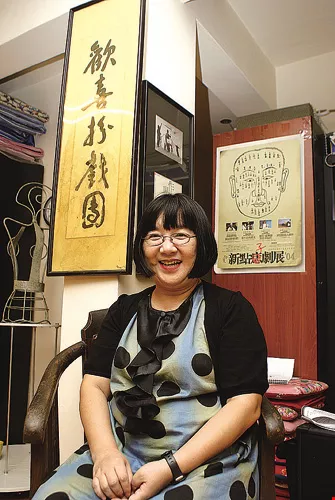
Not your typical theater company, Uhan Shii presents stories from the lives of Taiwan's older generation. Peng Yaling collects stories from the elderly and turns them into moving stage performances. In the process she changes the lives of many of her performers.
Putting life experiences on stage
For the seniors who had no previous acting experience, the biggest obstacles were physical frailty and various inhibitions. As they sat in chairs and told stories, some would doze off or lie down half asleep, and others would speak and speak until they got headaches from high blood pressure. Furthermore, the women would stay on one side of the room and the men on the other. Because they wouldn't mix, it became necessary to come up with special training methods. For instance, if you first got the men to put on makeup and wear women's clothes, and got the women to play men by putting on fake beards, then you could begin to free them from the conditioned responses they had developed over a lifetime, and eventually they could "return to their true selves." Peng says that these seniors have a tremendous amount of practical life experience: they've run for shelter at the sound of air-raid alarms and avoided Japanese police patrols while carrying contraband pork. Their movements on stage are very vivid. Their performances "have so much flavor that they don't need salt."
The inexorable march of time has taken Xu Yuan, Wu Tienlo, Cai Yishan, Wu Ming.... Whenever a member of the company passes away, it makes Peng want to speak on behalf of old people even more, in the hope that young people can learn to treasure the old people nearby, so that they can escape loneliness and do more with their old age than simply wait in silence for death.
"Old people really need friends. It's unfortunate that too few people are willing to listen to them." Peng recalls that Uncle Tienlo was unable to go with the company to America because of a traffic accident. At the same time he was battling the terminal stages of lung cancer. Nevertheless, he held on for a month-until Peng had returned to Taiwan and paid him a visit-before passing away. Peng really relied on Tienlo. Even now, when she encounters difficulties, she will look heavenward and pray for his help.
Having helped seniors put on theater for more than ten years, Peng has seen all sides of life, and she's quite sincere when she says: "I only hope that behind each story, every person can"-here she inserts some English-" 'say yes' to every side of life."
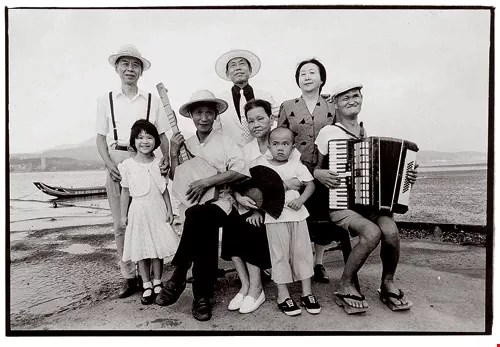
Echoes of Taiwan-Fifty Years in Taiwan (1995) On the 50th anniversary of World War II's conclusion, each person separately recalls how the war changed their lives. This show was put on together with a European performance group. Front row, from left to right : Li Wenyu, Wu Tienlo, Black Cat Cloud, Du Yijin, Li Binghui. Back row, from left to right: Tsai Jinxing, Wu Wencheng, Li Xiu.

Echoes of Taiwan VI: We Are Here (2000) This drama about Hakkas in Taiwan describes how they have seen their unique ethnic identity-whether intentionally or not-become subsumed by greater Taiwan society over time. Whenever Uhan Shii puts on dramas about the Hakkas, Peng Yaling takes the members of her company back to traditional Hakka settlements amid the paddy fields. These trips evoke memories of hard farming lives.

@List.jpg?w=522&h=410&mode=crop&format=webp&quality=80)


