2014 Nobel Peace Prize Winner Kailash Satyarthi:Freedom to the Children
Kobe Chen / photos Jimmy Lin / tr. by Geoff Hegarty and Sophia Chen
February 2015


Indian-born Kailash Satyarthi has rescued nearly 85,000 children from factories and brothels over the past 35 years, and was awarded the 2014 Nobel Peace Prize for his work. At the ceremony, he outlined his dream: to build a world without child labor, to relegate child labor to history.
In January 2015, the Ministry of Foreign Affairs invited Satyarthi to visit Taiwan to tell his stories and share his humanity with Taiwan society, and also to enhance the relationship between Taiwan and India.
Outside a factory on the outskirts of New Delhi, Kailash Satyarthi sat quietly in a small truck waiting for the armed guards at the factory gate to hand over to a new shift. Making the most of the dark, Satyarthi slipped through the gate and found a small metal hut in the factory grounds where around a dozen children were just going to sleep. The children were amazed to see a stranger slip quietly into their little home.
“Follow me,” he whispered to the children. He carried a nine-year-old girl and led the other children quickly to his little truck. In less than 20 minutes, they were all safely in his truck fleeing the factory area.
Gunshots rang out behind them, but the children remained silent, staring blankly out of the windows.
Satyarthi pointed to a bag of bananas and said: “Eat if you’re hungry.” Surprisingly, the children started to chat about the fruits. “What are they? Some kind of potato? No, I reckon they’re carrots.” Listening to the children talking, his main feeling was one of relief knowing that they were all OK. “They’re not potatoes or carrots. They’re bananas, and sweet and tasty ones too.” A little girl picked up a banana and looked at it for a long time. Then she asked Satyarthi: “What does sweet taste like?”
Satyarthi burst into tears, but managed to answer the little girl: “Ha. Sweet is the taste of freedom!”
He shared tales like this one when he visited charity organization Wake—movie stories for most of us, but everyday occurrences for Satyarthi. For that little girl, rescue was the beginning of a rebirth, and a decade on she fulfilled her dream of studying at a local university.
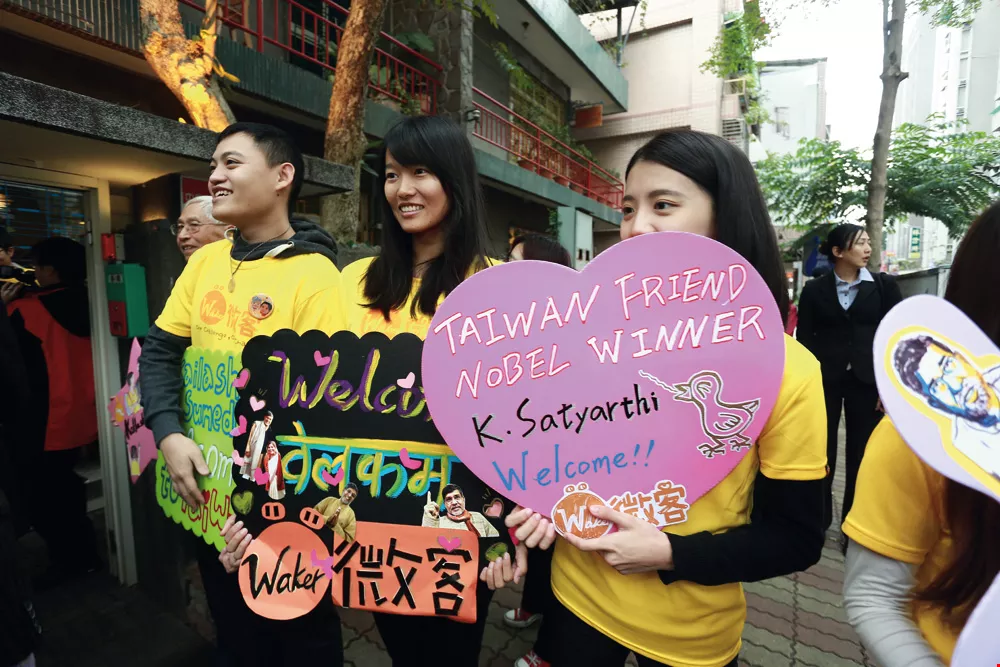
Charity organization Wake sends around 100 Taiwanese volunteers to India every year to assist in rescuing working children. On this visit to Taiwan, Satyarthi expressed his appreciation to volunteers on behalf of freed Indian children.
Satyarthi was born in 1954, and at age 60, along with the young Pakistani girl Malala Yousafzai, was last year awarded the Nobel Peace Prize for their struggle against oppression of the young. Satyarthi first became involved in rescuing children as a result of an experience that occurred 54 years ago.
On the first day of primary school, Satyarthi saw a bootblack the same age as himself working outside the school gate polishing people’s shoes. Satyarthi was puzzled: why couldn’t he go to school like the other children? He asked his teachers, his parents, other grown-ups, and even the boy’s father, but didn’t get a satisfactory answer. The image of this boy remained in his mind over the next two decades, inspiring him to learn about child labor and slavery.
At age 26, Satyarthi gave up a prestigious teaching post to join the Indian movement Bonded Labour Liberation Front, and in 1980 he founded Bachpan Bachao Andolan (BBA), Hindi for “Save the Childhood.” Since then, with his wife Sumedha, Satyarthi has become a leading advocate of children’s rights.
In addition to working at the front line rescuing children, Satyarthi has also launched a number of large-scale events to focus the attention of governments and consumers worldwide on the issue of child labor. These have included the famous RugMark label, which helps customers to identify ethical manufacturers who don’t use child labor. And in 1998 he launched the Global March Against Child Labor, a worldwide movement to rescue working children that attracted the participation of 7.2 million people in 103 countries.
In 2009, Satyarthi promoted new legislation in India: The Right of Children to Free and Compulsory Education Act, giving children the opportunity to turn their fortunes around and lift themselves out of poverty.
With the efforts of Satyarthi and his colleagues, statistics for child labor in India dropped from 12 million in early 2000 to 4.3 million in 2011.
The Nobel Committee said that Satyarthi has inherited the spirit of Mahatma Gandhi, by which he has led various forms of protests and demonstrations over the past 35 years, all peaceful, and achieved a number of significant goals. Since 2000, the efforts of Satyarthi, Yousafzai and like-minded people have helped to reduce worldwide child labor figures by something around 78 million, bringing the goal of eliminating child labor ever nearer. But Satyarthi isn’t satisfied. After winning the Nobel Peace Prize, the media wanted to know what his next step would be. He had only one answer: “To rescue more children.”
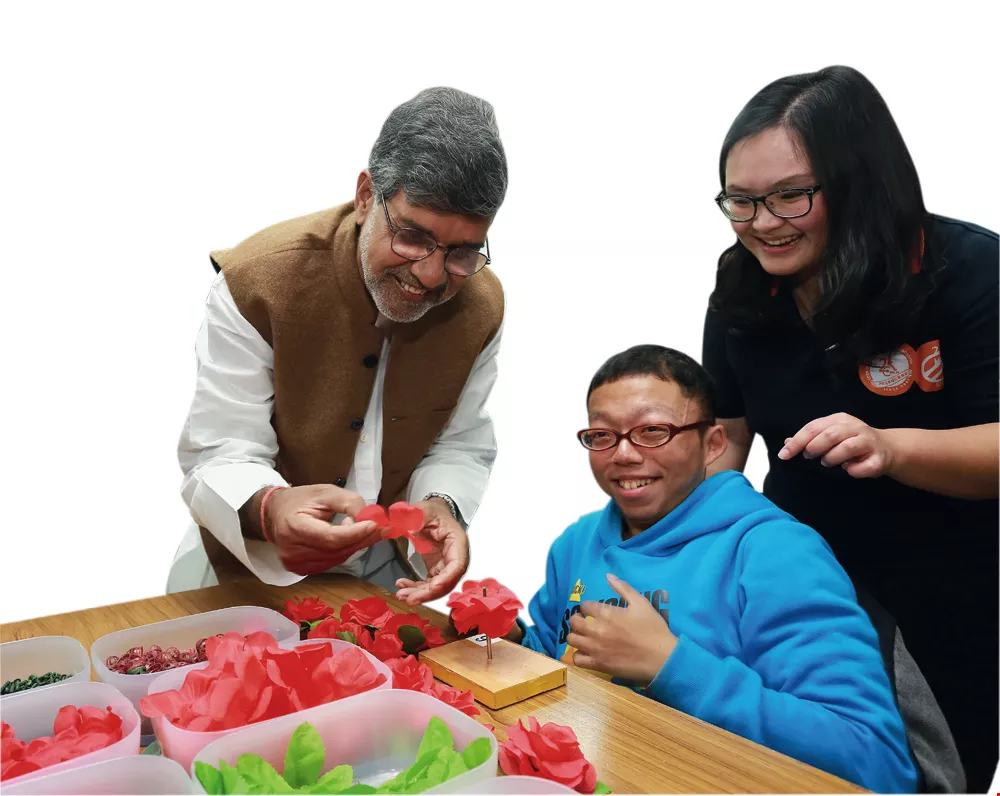
Satyarthi visited the Eden Social Welfare Foundation and saw disabled children making brooches from artificial flowers.
Since the Nobel Peace Prize has brought him to the attention of the world, Satyarthi has been invited to speak in many countries. Taiwan was the second country in his itinerary, after Nepal: “Because I love Taiwan and its people, visiting Taiwan has been my dream for many years.”
Child labor has been virtually eliminated in Taiwan, but every year more than 100 young Taiwanese volunteers travel to India to work with Satyarthi’s team, providing care and education for rescued children. Satyarthi is impressed by these volunteers’ passion and empathy, and has long cherished a desire to visit their country.
One of the main concerns for the Taiwanese volunteers after arriving in India is their proficiency (or lack of it) in the local language. But Satyarthi encourages them with the advice that “language is not the only channel for communication. Having a heart willing to listen to others is more important.” As long as people open their hearts, they can communicate. And sometimes body language is more effective than words.
In Satyarthi’s eyes, there’s no difference between a nine-year-old Indian child and a 20-year-old Taiwanese. As long as they maintain a pure heart and an open mind, they are all his children.
During this trip to Taiwan, Satyarthi visited the Eden Social Welfare Foundation and the charity organization Wake, both of which have a long history of cooperation with BBA. And wherever he travelled, he was embraced by enthusiastic young Taiwanese like a rock star.
Satyarthi and his wife opened their arms to give young people big hugs whenever they met—just as had happened several years ago when the Taiwanese volunteers arrived in India, the couple openly offered their warmth in welcome.
In his speech, Satyarthi mentioned the dramatic development in Taiwan’s economy over the past few decades, but also noted that Taiwan had been able to maintain a critical balance between economics, and humanity and family values. Economic growth doesn’t necessarily imply the deprivation of childhood. “Every year, Taiwan has more than 10,000 volunteers serving overseas, which shows the empathy of this land and its people.” Satyarthi recognized the passion and sparkle in the eyes of those Taiwanese volunteers. “With young people of this stature, Taiwan’s future is definitely full of hope.”
Refusing childhood dreamsSince winning the Nobel Peace Prize, because Satyarthi regularly has many media interviews to deal with, he no longer always has the time he would like to be with his children (not his own, but the children he has rescued—and the volunteers who have assisted).
He says with humor that after winning the prize, his wife has taken to reminding him of the need to maintain a peaceful relationship; so no quarrels. Satyarthi also has to watch his words “as anything I say is likely to become a news headline or find a place in someone’s book.”
With a Nobel Prize, he is feeling the weight of greater responsibility on his shoulders—but he is also aware of a greater capability to recruit people to join in the task of rescuing children. After all, the battle is not over.
“As I speak, there are still 5.5 million children without freedom, and 85 million child slaves, child prostitutes, and child soldiers living in harsh conditions. And 150 million children are unable to complete a basic primary school education. “These children don’t cry, don’t laugh, don’t know how to communicate; few of them survive to 16 years of age.”
To eradicate child labor completely, Satyarthi is planning to lobby the governments of major countries (including the US and the UK) to set up a global parliamentary forum, integrating the powers and resources of a range of nations to together eliminate child labor forever.
“This goal cannot be achieved by a single person, organization or even country. But if all nations can work hand in hand, in my lifetime we will have the privilege to witness the relegation of child labor to history,” says Satyarthi. If the leaders of every country in the world could come to India to work as volunteers, even war could become history.
The aura and glory of the Nobel Peace Prize have made Satyarthi a highly respected figure admired by people worldwide. But it has in fact made him even more humble. On this journey, he repeats time and again: “This prize does not belong to me. It belongs to everyone who has participated in this battle, who has helped our children, and who wants to make the world a better place.”

@List.jpg?w=522&h=410&mode=crop&format=webp&quality=80)
@List.jpg?w=522&h=410&mode=crop&format=webp&quality=80)


