Nature's Dancers, Garbed in RainbowsThe Butterfly Dreams of Tsai Bae-chun
Kuo Li-chuan / photos courtesy of Tsai Bae-chun / tr. by Julius Tsai
January 2006


When I first sighted the high-land red-belly swallowtail butterfly in the forests of Mt. Taiping, I thought I must be dreaming. When it emerged, its peach-colored form like a dream amidst the forest green, I beheld a sight that must not be missed among all of the spectacles that the world of Taiwanese insects has to offer."--Japanese naturalist Tadao Kano
When butterflies grace the urban landscape with their sudden appearance, they cause wonder and delight. By contrast, however, trying to photograph their elusive forms while deep amidst mountains and ravines is no easy feat.
Tsai Bae-chun, who has been pursuing the traces of butterflies for 26 years, has sought to document the habitats of Taiwanese butterflies through his photographs. To accomplish this task, he has traveled to the island's various corners, capturing the manifold movements of these dancers of nature. He has immersed himself in the bone-chilling waters of an early spring creek in March, clambered up perilous tree branches to reach butterflies delighting in their treetop lingering, and has even exhausted his life savings to pursue his passion. Through it all, however, Tsai has never regretted his chosen path, which is to live out the rustic butterfly dreams of the Taiwanese people.
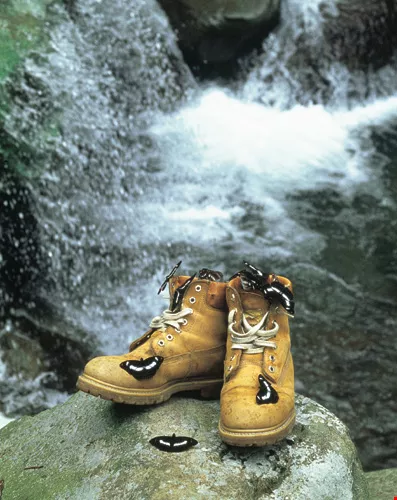
One summer while walking along a creekbed to photograph the creatures there, Tsai discovered that even the residual salt on his boots was enough to attract butterflies in search of provender. Pictured here are Tacoraea cama zoroastes.
Between movement and stillness
Tsai, who is also known as "Mr. Butterfly," displays his photos to visiting guests in his studio: "The large purple fritillary [Sasakia charonda] is one of the characteristic species to be found on Mt. Lala; Euthalia formosana is unique to Taiwan, and loves to sip the juice of overripe fruit; the club silverline [Spindasis syama] has specially shaped rear wings that tremble just like its head does when it is sipping nectar. This protects it from life-threatening attacks. This butterfly is a master of deception...."
Twenty-some years of proximity to the butterflies and their secrets have caused Tsai to reflect on life's lessons.
"From egg, to caterpillar, to chrysalis, to butterfly, each stage is a complete life metamorphosis. The chrysalis may look completely still, but radical transformations are occurring within, in which the outer and inner structure of the creature is being destroyed and rebuilt. This is a most mysterious process that has taught me much about when to act and when to be still in my own life."
Even though Tsai has learned from the butterfly how to navigate between movement and stillness, his own development as a young man was an unpredictable one. A spartan education unexpectedly set him on a path towards the woods and the wilds.
Tsai Bae-chun, originally named Tsai Kuo-yang, was born in Changhua in 1950. When he was three his family moved to Kaohsiung. After graduating from elementary school he earned a spot in Kaohsiung Third Middle School (now Shihchia Middle School). At that school were many teachers who had come to Taiwan with the Nationalists; they spoke with thick mainland Chinese accents and had spartan ways of maintaining order. If one student made one mistake, the whole class would be punished, with each student being struck on the thigh with canes as thick as water pipes. Tsai was often beaten for others' mistakes, which left him with little sense of self-worth. Good at drawing, Tsai closed the door on school learning, using his drawing pencil to proclaim his dissatisfaction with the educational system.
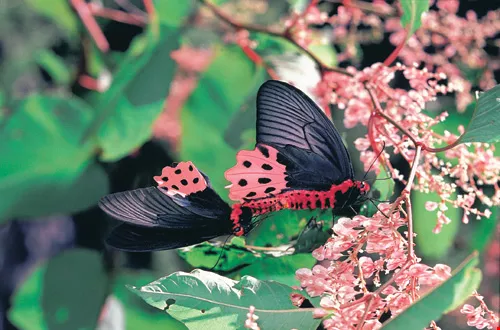
The highland red-belly swallowtail (Atrophaneura horishana) glides about slowly. Appearing between June and November, it can only be seen at intermediate altitudes in the mountainous regions of Taiwan. Many appear around Mt. Li in the summertime.
Art dreams
After graduating from middle school, Tsai came to Taipei with a classmate to seek his fortune. His classmate was put to work delivering goods for a paper factory. As the paper factory had business dealings with a comic book publisher, Tsai made use of the connection and began to draft up illustrations for the comics.
"During those days you only got paid NT$4 per A4 sheet of illustrations. To have a quiet environment for working at the illustrations, and also to save on food expenses, I would draw through the night and then sleep until almost noon. Sometimes I would only eat one meal a day," says Tsai. With his meager salary and his night-owl schedule, the idealistic young Tsai soon began to experience the hardships of being a comic-book artist. After working for a bit over a year, he decided to return to Kaohsiung to continue his education, and passed the entrance exam for Sanhsin Vocational High School.
Bored with his business classes, Tsai once more shut the door on formal education. He joined an art club and used the library as his classroom, reading all kinds of books on art. Outside of class, he would roam the used bookstores on Liuhe Street looking for discarded magazines from the news operations of the American Institute in Taipei. Among these, he came across the American magazine Life, which often featured articles and photographs dealing with the natural world. "Once," Tsai reminisces, "I saw a picture of a dewy spider web and started wondering, 'How much time would it take to try and render all of these drops of dew by drawing them by hand?'" That photo of the spider web inspired him to pursue photography.
In 1969, he borrowed his brother-in-law's twin-lens reflex camera and began experimenting with it. He continued to diligently seek out photography books in the used bookstalls. After completing his military service, Tsai zealously acquired needed equipment and engaged in portrait photography. He later expanded his areas of specialty and began to shoot landscapes. However, with the steady increase in the popularity of cameras and their increasing technological sophistication, both portraits and landscapes became very commonplace photographic themes. Just when Tsai was considering switching to photographing animals in the wild, he took a trip to Hualien, and there began to forge his bond with butterflies, a bond that is as close as the way shadows follow form.
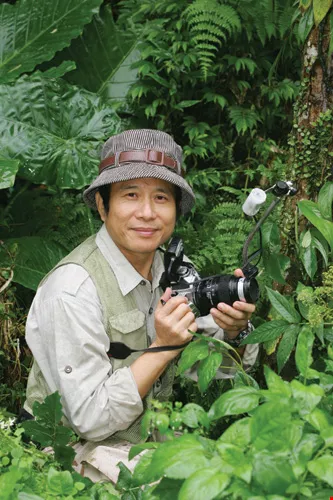
Having photographed butterflies for 26 years, "Mr. Butterfly"--Tsai Bae-chun--has delved deeply into the mountains and forests of Taiwan. In the process, he has amazed the world with his documentation of these winged creatures.
Beyond Shirozu Takahashi
Tsai's younger brother, who was working for a friend in a mountain village in Hualien, invited him for a visit in 1979. In those days Hualien had two professional dance troupes, one of them belonging to his brother's friend Chang Ching-po. The troupe was called Red Leaf Mountain Village Aboriginal Dance Troupe, and its Aboriginal dances attracted many tourists from Japan. To enhance the spectacle, Chang had planted many of the grasses that caterpillars enjoy eating, at the same time going out and capturing female butterflies to have them lay their eggs and reproduce in his garden.
Tsai, who had grown up in an industrialized section of Kaohsiung, was captivated by Hualien's pristine beauty. Each day he traveled with friends by motorcycle, going deep into canyons and ravines to capture butterflies. They would refer to Butterflies of Formosa in Colour (1960), authored by Shirozu Takahashi, a professor at Kyushu University in Japan. While Shirozu's work rendered the butterflies to scale and in their exact colorings, similar Taiwanese works proved far inferior, a fact that gave Tsai some intimations into differences between the two cultures.
Tsai thought to himself, "Why did it have to take a Japanese scholar to complete these butterfly illustrations? In order to surpass Shirozu's work, which relied on taxidermic specimens, the Taiwanese would need to create their own illustrated work of butterflies relying on photos of live butterflies." With such thoughts, Tsai began to focus his lens on butterflies, and started shooting away.
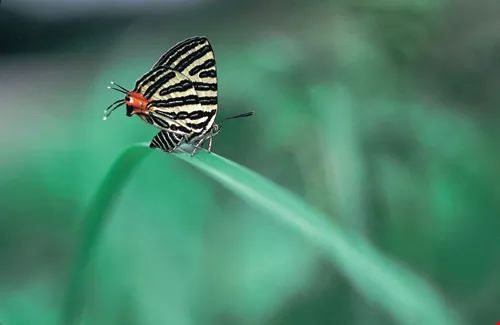
This long-banded silverline (Spindasis lohita formosana) must have studied the deceptive stratagems of the ancient general Zhuge Liang. It shakes its brilliant rear wings to create an attention-diverting decoy of its head, allowing this slippery butterfly to survive the attacks of predators.
Regrets of close encounters
Unlike photographing portraits or landscapes, butterflies never follow instructions. While it is easy to capture a butterfly in one's net, it takes a lot of effort to make it sit still for a photo. Tsai's first challenge was that of inadequate equipment. He started out with a Nikon F2 AS, which was fully manual in its operation. This meant that he had to set up the flash and set the aperture and shutter speed. Furthermore, the flash was not adjustable, but could only fire at full brightness. When Tsai discovered the presence of butterflies, he would pay attention to their every movement and consider how to draw near without frightening them.
"Sometimes I would discover a rare specimen, but with my attention on the butterfly I would not be able to adjust my camera. If on the other hand I dropped my guard and adjusted my camera settings, the butterfly might just disappear without a trace in the blink of an eye. Sometimes when I had just missed a butterfly or lost a good opportunity, it might be many years, or never, before I might have that chance again," says Tsai.
The most dramatic example of such close encounters was when he engaged in a game of hide-and-seek with the prized broad-tailed swallowtail butterfly (Agehana maraho).
The broad-tailed swallowtail is unique among butterflies, and as a caterpillar eats only the leaves of the Taiwanese sassafras. However, the tree's natural habitat is very scarce and it may be found in scattered locales in the forests of the Central Mountain Range, at about 900-1200 meters altitude. Thus, the broad-tailed swallowtail is a rarely seen creature. The Forestry Bureau later planted a stand of sassafras trees on Mt. Taiping in Ilan in order to give the butterflies a safe, secluded breeding ground.
Tsai spent ten years trying to capture these "dream lovers" on film. There were many close calls. Once, a friend had taken him to Chihtuan, the highest point of the Northern Cross-Island Highway. Workers were in the process of laying asphalt when he suddenly saw a single broad-tailed swallowtail, hovering over the surface of the road, perhaps attracted by the scent of the asphalt. His friend immediately hit the brakes and Tsai rushed out of the vehicle with his camera. He took off the lens cap and stepped gingerly forward. With only a few meters' distance to cover, however, the butterfly flew straight up and away.
In March 1983, in early spring, Tsai traveled to Chiayang on Mt. Li to await the butterflies, but found that he had arrived too early, for the sassafras trees had not yet budded. However, three months later, when the trees were green, the broad-tailed swallowtails were nowhere to be seen. In early June of that year, Tsai went to Mt. Taiping in Ilan to try his luck there but due to some heavy rain soon returned to Mt. Li. Only when he examined the sassafras trees' leaves did he discover that during the two days that he had been away, broad-tailed swallowtails had just laid their eggs! Although he had missed the adults, there was still a chance that he could see the caterpillars grow up and undergo their metamorphosis. All he could do was wait.
The eggs hatched in about a week, but by September all traces of the creatures had disappeared. It turned out that the caterpillars would select dried wood or grass upon which to pupate. They would spend the winter as chrysalises and turn into butterflies the following April to June. Tsai would have to wait until the next year for that to happen. In 1995, Tsai waited an agonizing 14 days and nights, finally obtaining the photographs he desired of these "dream lovers."
Tsai has mixed feelings when talking about the twists and turns of those events: "The process of searching out the broad-tailed swallowtail enabled me to photograph over 300 other butterfly species. It was as if I was being secretly led into an appreciation of the butterflies' colorful world."
In his first few years of photographing butterflies, Tsai captured and bred butterflies to support himself financially. A Japanese student who once saw him photograph a butterfly and then capture it with a net, exclaimed in astonishment, "Isn't it a bit of a contradiction to photograph a butterfly and then capture it?" Tsai could only respond with an awkward silence.
Some time afterwards, Tsai captured a golden birdwing butterfly (Troides aeacus) in the mountains near Hualien. He put the butterfly into a paper bag. On returning home, however, he discovered that this female had been near the time of delivery, and had laid her eggs in the paper bag. Tsai felt ashamed to have sacrificed the lives of these butterflies to satisfy his own personal needs.
"I was forced to choose between pho-tographing butterflies and capturing them. I thought that if I were able to photograph all of the butterflies in Taiwan, and do that well, I might be able to make my living that way." Thus, Tsai gave up capturing butterflies, spending summers photographing them and winters in the city, where he worked as a street vendor with his brother-in-law in order to make a living.
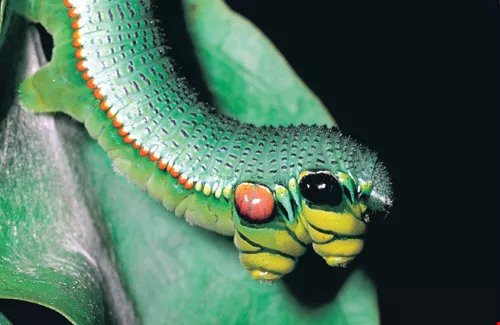
Most butterfly caterpillars have no means of defending themselves, but rely on disguising or concealing themselves from enemies. Here, what appears to be a small green snake about to strike is actually the caterpillar of the great orange tip butterfly (Hebomoia glaucippe formosana).
How to photograph a butterfly
With many years' experience photographing butterflies in the wild, Tsai has developed swiftness, aggressiveness, and accuracy in his work. He has high expectations of himself: his photos must clearly depict the movements and habits of the butterflies, their motions must be natural and fluid, their colors need to be accurate and sharp, and the photos must be well composed. Seeking perfection, Tsai has also customized his photographic gear, fashioning an extension for his flash in order to gain more control over the lighting and angle of his shots. In this way, he's been able to achieve ideal lighting conditions in the great outdoors.
"Know yourself and know others" is Tsai's photographic secret. The first step is to gain the trust of the butterflies. Tsai will first spend some time in the general environs, making exaggerated arm motions so that the butterflies become acclimated to his presence and see him as simply part of the environment. At the same time, Tsai closely observes the butterflies' movements.
"Even though we don't share a common language with butterflies, we can understand their moods through the movements of their antennae and wings. If a butterfly's wings move more quickly it means that it senses a threat. In that case you would need to slow down so that the butterfly would not flee the scene entirely," says Tsai.
When he has minimized the distance between himself and a butterfly, Tsai then begins to imitate a chameleon's walk: his legs first step forward, and then his upper body follows. While moving, he must consider the angle of his shots and any obstacles that might present themselves. Slowly drawing forward to an ideal distance of 50 centimeters, Tsai will sometimes even have to stop breathing in order to vividly and clearly capture the butterflies through his lens. Since butterflies are often active in wet grassy areas on the banks of creeks, Tsai will often proceed on all fours to match the height of the butterflies, which may be at knee level.
Some butterflies love to linger at treetop level. To capture these creatures, Tsai has cultivated formidable tree-climbing skills, often gripping the tree trunk with both legs to leave his hands free to operate his camera. His body is often sore after such exertions. In early spring, to capture the wondrous sight of butterflies drinking creekside, Tsai has often immersed himself in the piercing cold of a high mountain spring fed by the melting snows. Each of these bone-chilling episodes has been etched into his memory.
While pursuing his photographic work, Tsai has been stung by wasps, set upon by leeches and threatened by rockslides, all potentially fatal hazards. When he was young and full of energy, Tsai would often ride his motorcycle into the mountains in search of butterflies. Often, he would catch a glimpse of a butterfly as it flashed by him. He would identify it and then store that information into his memory. If he caught sight of a long sought-after species, he would train his eye on it and even forget sometimes that he was still on his motorcycle, resulting in crashes into mountain faces and down into ditches. And in the desolate mountains, where could he find a repair shop if a tire had been punctured by a sharp stone? After several unpleasant experiences in the mountains awaiting rescue, Tsai began not only to bring along tools with him, but learned how to fix flats as well.
Decline of the "butterfly kingdom"
Having photographed butterflies for 26 years, Tsai is concerned not only with how the creatures appear in his photos, but also with the health of their habitats. According to Tsai, Taiwan once had a reputation as a "butterfly kingdom," possessing 11 of the 12 major genera of butterflies on the planet. 380 butterfly species may be found in Taiwan, with the number increasing to 400 if one includes the outer islands. But with large-scale hunting and habitat destruction, the days are long gone when one could catch the sight of butterflies filling the Formosan skies.
In the early days, Taiwan's butterfly industry was a flourishing one, with colorful butterflies rendered into artistic creations that sold all over the world. Professionals could capture up to a record 60 million butterflies a year. But with the rise in labor costs, the butterfly industry declined. Tsai maintains, "While people really detest those who capture butterflies, it's rather the destruction of their habitat that has truly caused their decline."
"The monarch butterfly [Danaus plexippus] and the large crow butterfly [Euploea phaenareta juvia] both reside in the flatlands, but these areas have all been overdeveloped. The monarch butterfly is headed towards extinction, and the disappearance of the large crow butterfly is still a mystery," notes Tsai sadly.
Another butterfly, the Lanyu birdwing (Troides magellanus sonani), is found only on Lanyu and boasts golden rear wings that shimmer in reds, greens, blues and purples under the sunlight. But the butterfly's coat of many colors has also endangered it. Tsai worries that there may be rare, undiscovered species that may suffer the fate of the large crow butterfly. Even those butterflies that can still be sighted may one day suffer the tragic fate of being labeled "extinct in Taiwan."
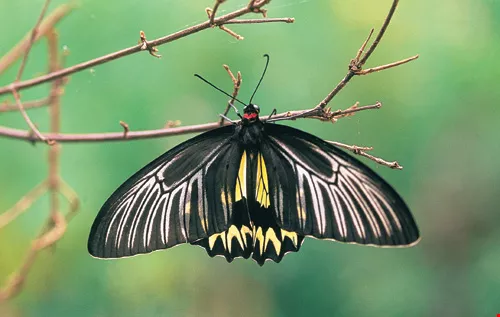
The Lanyu birdwing is garbed in dazzling colors. This huge birdwing butterfly is only found on the island of Lanyu. Its survival has been threatened by overdevelopment.
Butterfly musings
Tsai has created a precious photographic record of the butterflies of Taiwan. Following the establishment of the national parks, Tsai became sought after as a compiler of butterfly ecology guides and field guides. Tsai has published many books, among them The World of the Butterfly in Taiwan. In 1990, Tsai was the first photographer to receive the National Literature and Art Achievement Award. His indefatigable spirit and achievements in photography have also caused his story to be selected as material for elementary school textbooks.
"When encountering the natural world, humans should not and indeed cannot suppose that they are at the top of the heap. Nature possesses unimaginable majesty and mystery that need to be respected by humans," says Tsai. He offers as an example the chrysalis of the swallowtail butterfly (Papilio machaon sylvina). Even though diminutive, the chrysalis has the amazing ability to withstand temperatures down to -196oC--the temperature of liquid nitrogen--without perishing.
"No matter whether undergoing metamorphoses or facing moments of crisis, butterflies are always trying, within their limited lifespans, to see through the next generation. People are the same. Life is limited, so you have to accomplish what you need to in the time that you have." To date, Tsai has photographed 350 species of butterflies, but those that he has yet to capture on film include the diminutive Malayan butterfly (Megisba malaya sikkima), Euaspa tayal, which dwells only in ravines on Ilan's Mt. Fu, and the silver-washed fritillary (Argynnis paphia formosicola), which lives in ancient redwood forests in Taroko National Park.
Tsai has tens of thousands of slides in a temperature-controlled facility in his home in Kaohsiung. Each slide exquisitely captures the characteristics of butterflies: the tailed jay (Graphium agamemnon) that moves so swiftly; the green and black Euthalia malatana, which once commanded a price of NT$1 million each; the large tree nymph (Idea leuconoe clara) with its ten-centimeter wingspan, the largest of Taiwan's butterflies, that looks like a warrior carrying two swords; or Minois nagasawae, the butterfly that survives at the highest elevations in Taiwan.
To Tsai Bae-chun, butterflies are like shy young maidens. In his many years photographing them, he has cultivated the art of patience, knowing how to work discreetly around them, never interfering with them. This attitude of respect is exactly the kind of relationship that humans should have in their communion with nature.
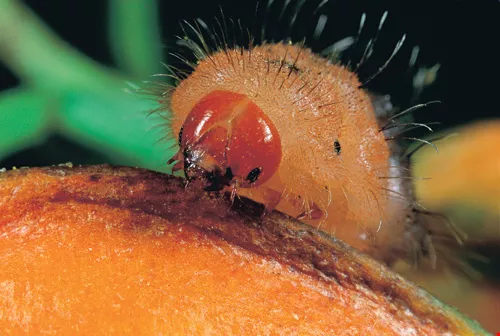
The plump caterpillars of Deudorix eryx horiella resemble moth larvae. Tsai was misled by their appearance for many years.
For a photographer of butterflies, "butterfly valleys" are treasure houses to be frequently visited. These valleys may be divided into three categories: "migratory pathways," "habitats," and "wintering sites."
Migratory pathways: The butterflies active in these areas are passing through and do not permanently reside in the valley.
Habitats: Such valley formations must be able to provide sufficient grass and nectar-producing plants. They must also be free from fierce predators, and be places where the butterflies may spend their entire lives. During the period of Japanese rule, due to the needs of the military and industry, the Japanese deforested the Meinung and Liukui areas of Kaohsiung. In the place of the original trees they planted Siamese cassia trees intended for making rifle butts. It turns out that the Siamese cassia provides food for the caterpillars of lemon emigrant (Catopsilia pomona pomona) and common emigrant (Catopsilia crocale crocale) butterflies. These butterflies gradually became a dominant presence in the mountain valley. The valley became famous for the Catopsilia butterflies, whose density was unmatched anywhere else in the world. In the spring, around the time of the Dragon Boat Festival, the air would be filled with myriad dancing butterflies in their mating season, and it would seem as if heavenly maidens were showering down petals from the sky.
Wintering sites: Adult butterflies may head towards certain valleys to pass the winter. This is a practice particularly seen among the milkweed butterflies of tropical Asia. Currently, such wintering valleys of varying sizes may be found in southern Taiwan in Liukui, Tachin, Laiyi, Maolin, Chialeshui and Machia, as well as Chihpen in Taitung County.
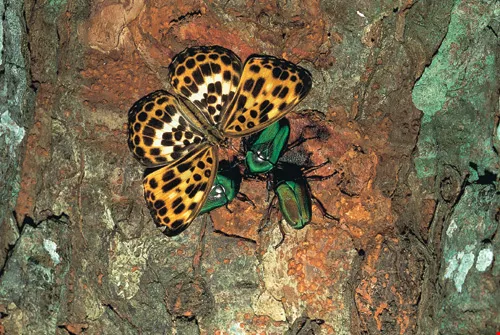
Timelaea maculata formosana and some beetles vie for the sap of the goldenrain tree (Koelreuteria henryi), which grows in the tropical forests of Kenting.
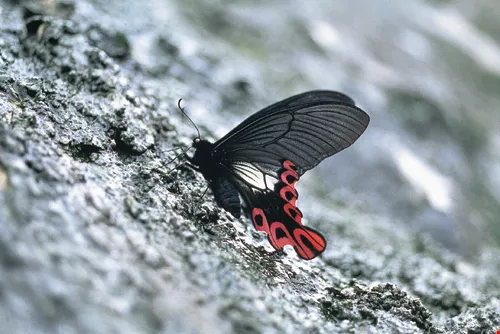
Tsai's quest to photograph the beautiful broad-tailed swallowtail butterfly, a veritable Taiwanese treasure, took a full ten years.
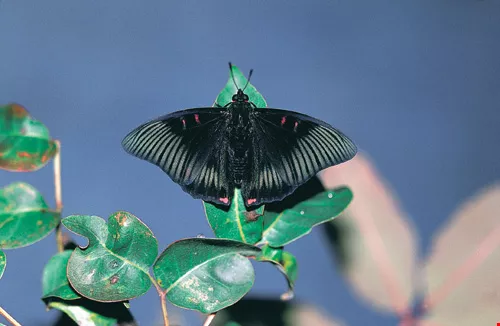
Euthalia irrubescens fulguralis is a swift, elusive creature. The butterfly, with its quick reflexes, is not easily approached. It keeps a safe distance as it observes the activities of human beings.


@List.jpg?w=522&h=410&mode=crop&format=webp&quality=80)


