In the era of "conscious capitalism" businesses are expected to do good works, to operate morally, and shareholders or investors are able to use the stock they own to "reward good and punish evil."
Trend watcher Patricia Aburdene sees the "imminent rise of socially responsible investing" and her new book Megatrends 2010: The Rise of Conscious Capitalism foresees future investors who, while continuing to seek profits, will want to maintain their own values and will take pains to assist those in distress. Whoever can satisfy these dual goals will be the winner in the future capital marketplace.
"The concept of socially responsible investment" (SRI), or "moral investment," is still rather alien to Taiwan investors but in recent years it has been very much the fashion in both the US and Europe, and an approach that is going to become part of the mainstream marketplace.
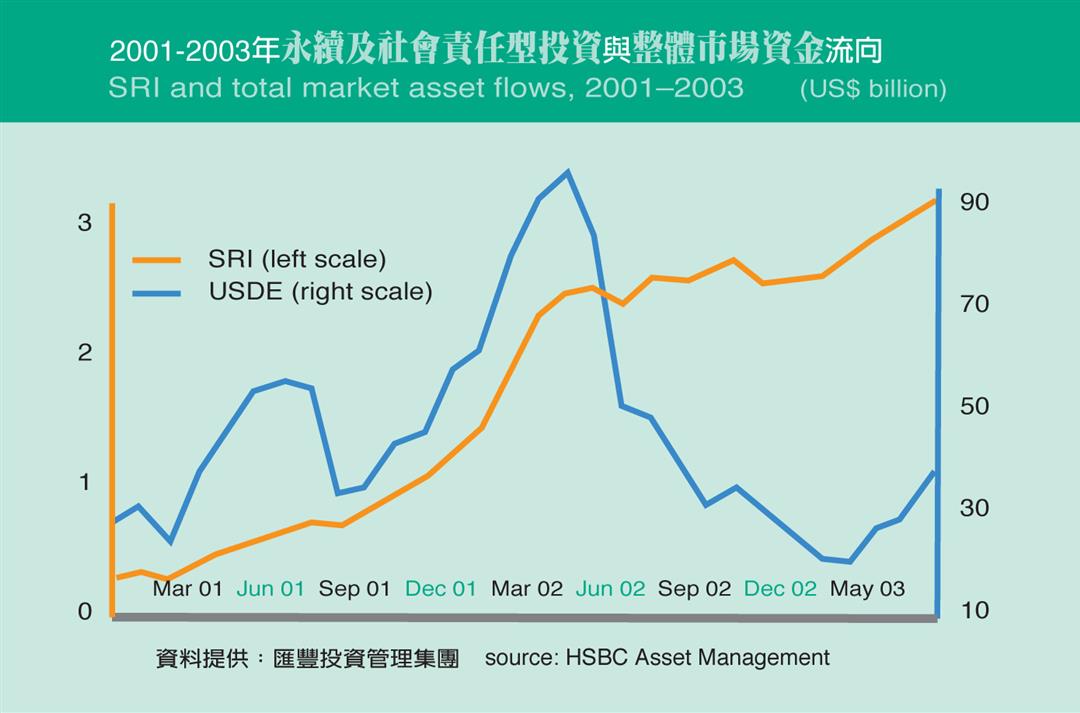
"Between 1995 and 2003 SRI grew more than 40% faster than all other fund categories," says Aburdene. She confidentially predicts that SRI, which has already reached a capital level of US$2.16 trillion in the USA, will become a major trend.
The capital asset value of SRI funds in US financial markets is currently 13% of total value. In the late 1990s British financial markets continuously offered new "moral funds," and similar offerings in Australia and Germany showed high growth. It was particularly the entry of major institutional investors with huge capital assets into the market that caused people look more favorably on SRI.
What is socially responsible investment? As the Association for Sustainable and Responsible Investment in Asia explains it, when the SRI investor evaluates investment opportunities, "corporate social responsibility" is a criterion for screening investment targets. Right off the bat businesses involved in tobacco, alcohol, sex, gambling, and arms are eliminated. Next, consideration is given to an individual company's impact on the environment and society. Thus businesses that destroy the environment, ignore human rights, exploit workers, defraud consumers or engage in abusive animal testing are excluded from selection.

A puritan creation?
SRI, in fact, already existed in the 1970s. The original guiding idea was to avoid investment in "war-related" businesses, but after many years this concept has come to be regarded by the mainstream market as a product of puritans who don't understand business, or of an outdated hippy era. The reason the concept bore fruit later in the 1990s was due to long years of indefatigable effort by people like Amy Domini who "believed the conscience of the investor can change corporate behavior."
Domini, who in her early years had worked for an investment firm, one day had a revelation. Why drum up enthusiasm among clients to buy stocks of arms contracting companies, "to invest in machines that kill people, in a company that spends money to 'make things happen' or gives bribes to get defense department contracts?" Thus she began to research how to go about moral investing and published her book Ethical Investing. For the last ten years and more she has been actively traveling and promoting this alternative concept of investing. Earlier she also integrated "socially responsible investors" with human rights organizations, churches and student groups and succeeded in getting major corporations like GM, GE and Mobil Oil who were invested in South Africa to sign the "Sullivan Principles" to resist apartheid, a truly wonderful achievement.
In 1990 Amy Domini sought out 400 companies with a record of treating employees, customers, the community and the environment well to create the "Domini 400 Social Index," and thus began to compile a stock index for SRI investors. A year later she set up an SRI fund and issued stock. In the five years following 1995 the fund's value grew at an average 30% per year, a dazzling performance that attracted even more capital.

Getting new respect
During the same period European and US financial markets also gradually developed various SRI financial instruments and indexes leading to the lively development of SRI. For example, the US Dow Jones stock market came out with the "Dow Jones Sustainability Index," the Nasdaq has its "Social Index," while in Great Britain there is the "FTSE4Good Index Series." Studies show that businesses included in these indexes have a high rate of return on stock investment.
Daniel C. Y. Chu, senior executive vice president of the GreTai Securities Market, explains that companies included in such indexes, because of their responsible behavior toward society and the environment, earn acceptance by society and win the loyal support of customers. Internally, this encourages hard work among employees and suppliers, creating a virtuous circle of "good" and "profit." Although initially it seems like a lot of investment with high capital costs, in the long term this approach definitely increases profits. Taiwan Semiconductor, for example, has been selected for the Dow Jones Sustainability Index for several years running and its stock price has performed brilliantly.
In California is located the world's largest retirement fund, CalPERS, valued at US$150 billion. In 2002 it announced its "SRI criteria." "In addition to investing in corporations with superior 'company management,' CalPERS announces every year the ten leading companies it deems in need of improvement," says Daniel Chu. Because these announcements might influence other funds to avoid investing in these companies with their poor reputation, the companies cannot avoid changing their behavior. This carrot-and-stick SRI mechanism has caused European and US industry to pay attention to this force behind the scenes for social responsibility.

Changing industry
There are, in fact, many examples of businesses that have changed as a result of investor pressure. The shareholders alliance that includes Domini persuaded Coca Cola and Pepsi Cola to use recycled raw materials to manufacture their plastic bottles. Another shareholders' group persuaded Proctor and Gamble to sell coffee with a fair trade certification. Domini has also focused on the topic of global labor and has urged McDonald's and Disney to increase oversight of their suppliers.
Aside from its ability to oversee businesses and pressure them to "mend their ways," SRI more importantly creates an incentive mechanism. Professor Kang Jung-pao of the Department of Accounting at National Chengchi University says that with SRI, the better a corporation meets its social responsibilities, the more investors and investment dollars it will attract. This "reward" naturally leads corporations to actively reform their practices. Moreover, in the hope of being listed in SRI indexes, businesses will "voluntarily" make relevant information available to specialized companies for drawing up classifications.
"The SRI market mechanism is extremely important," explains Professor Kang. Although the regulatory authorities in Taiwan have in place a certain number of review standards for listed and OTC companies with regard to environmental pollution and labor/capital disputes, these do not constitute a "market mechanism." It is only SRI that is able to elicit the full attention of investors and induce corporations to exchange good acts for company profits, to move forward to high standards "on their own initiative" and not just to achieve the basic minimum by being "forced" to do so by laws and regulations.
SRI has gradually matured in Europe and the US. How is it that today in Taiwan there are neither SRI instruments nor any related investor indexes?
"The basic problem is with those participating in the market--whether it's the financial sector, investors, businesses--none has a full concept of 'corporate social responsibility,'" says Daniel Chu. Only with the development of a CSR culture plus a coordinated body of laws can this concept be pushed forward. Otherwise even if financial authorities encourage the financial sector to develop the related financial instruments, it's like trying to clap with one hand
"Shareholder activism" has taken Europe and the US by storm and together with consumer, environmental and labor groups, has led to the formation of an enormous force demanding corporations "do good." Consumer power and environmental consciousness in Taiwan have become an important part of the landscape, but investor consciousness is still in a deep sleep. If shareholders and investors are able to wake up and realize that they hold all the chips needed to change industry behavior, just as was true for Domini and other champions of SRI in the past, making SRI into a groundswell in Taiwan will be the final tip of the scales that will lead major Taiwanese industrialists to think seriously about corporate social responsibility.


Recent performance of oldest sustainability and social responsibility investment fundPax World Balanced FundLaunched 10 October 1971Year Fund ROR S&P500 Index ROR1995 29.19% 37.58%1996 10.36% 22.96%1997 25.12% 33.36%1998 24.62% 28.58%1999 17.23% 21.04%2000 5.66% -9.11%2001 -9.09% -11.89%2002 -8.86% -22.10%2003 17.27% 28.68%2004 13.39% 10.88%2005 4.87% 2.77%source: HSBC Asset Management