On the Road to Happiness--Interview with Kaohsiung County Magistrate Yang Chiu-hsing
interview by Vito Lee / photos courtesy of Kaohsiung County Goverment / tr. by Christopher J. Findler
October 2005


"Invest in happiness. Nothing is more important." Yang Chiu-hsing's constant mantra has been directed at county government workers since he was elected Kaohsiung County magistrate over three years ago.
Having witnessed the hardships his parents' endured as farmers while he was growing up, Yang decided to return to his hometown to build his own career after pursuing his education in northern Taiwan. He encourages residents to seek happiness through the creation of job opportunities and urban beautification, twin policies that have kept his popularity around 80 percent.
One of the least urbanized of Taiwan's 25 administrative districts (which includes counties and municipalities), however, Kaohsiung County watched as manufacturers left and its agricultural sector ran into challenges posed by Taiwan's entrance into the WTO. These factors caused the unemployment rate to linger above the national average for several years in a row. Yang's goal of happiness through new job opportunities seemed all the more pie in the sky.
Yet, this little giant from the south remained undaunted. Yang, who holds a master's degree in civil engineering from National Taiwan University, started his career with a private company and became an associate technical specialist with the Kaohsiung County Government in 1986. He grew familiar with local affairs through numerous visits to towns and villages. His experience in politics as a parliamentarian at both the local and the national levels turned out to be valuable political capital for him. While gentle in speech, Yang is very strict with both his subordinates and himself. Diagnosed with colon cancer on the eve of the last county magistrate election, he was again putting in 15-hour workdays soon after surgery.
Yang candidly shared with us experiences gained while serving in the county government and working for the welfare of the people--more than three years marked by struggle and achievement. Below are excerpts from the interview.
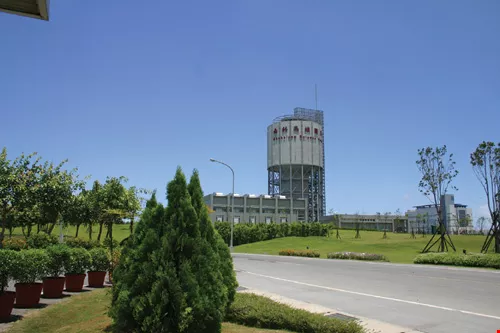
Following in the wake of the Telecommunications Technology Center, photo optics giant Chi Mei announced that it would build its second 7.5-generation factory in Kaohsiung Technology Park--a milestone for the park.
Q: Which statistics in county administration are most important to you?
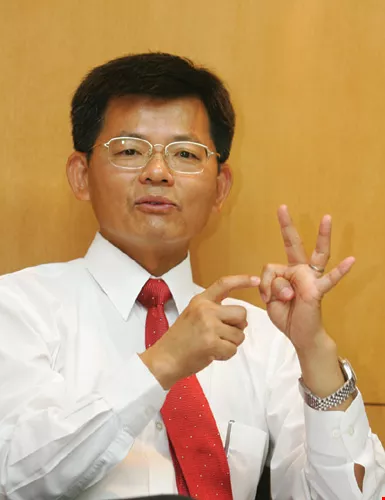
Kaohsiung County has transformed itself from an industrial and agricultural stronghold to a high-tech center complemented by the tourist industry. The little giant of the south, Yang Chiu-hsing, grew up on a farm. Yang has clear economic policies for invigorating Kaohsiung County.
A: I look at the unemployment rate and per capita income, because that's what people care about. Just after assuming office, I remember how startled I was when I learn how low the annual per household disposable income was in Kaohsiung County. It was below NT$700,000, nearly NT$300,000 lower than that of Kaohsiung City. We are located right next to each other.... Why the big difference?
I think people from the south have lower incomes because northern Taiwan received the lion's share of resources for such a long time. The three years I was in office for example, we were allocated a mere NT$80 million in disaster preparedness funds, while the central government had a budget of NT$250 billion. The south clearly receives fewer resources. Both population and development are concentrated in the north, so when disaster strikes, funds earmarked for the north get kicked up a notch. This is reality, but it doesn't mean it's fair.
Q: How are you doing in the recruitment of private businesses?
A: Before the Medical Technology Park is launched, the Kaohsiung Technology Park and the environmental science and technology park located in Kangshan's Benchou Industrial Zone will remain the focus of our recruitment efforts.
The park has chalked up some impressive achievements. The first Japanese company has been approved. It will build an electronic solvent recycling plant that will begin operating early next year. We have also succeeded in bringing in World Resources Company (WRC) of the USA.
Internationally renowned for its record on the environment, WRC's main focus is recycling metals and putting them back into the manufacturing process. It produces electroplating residue, nonferrous, and precious metal recovery equipment used in more than 20 countries. WRC plans to invest NT$120 million this September in a factory that will go online next year.
Q: In addition to high-tech industries, tourism has been a focus in the county's political development. Do you have concrete results to report?
A: Yes. We converted Hsingta Harbor, traditionally a deep sea fishing port, into a tourist attraction--Lovers' Pier; construction on the Eye of Kaohsiung Ocean Theatre will be finished this year; and we will host the National Day fireworks display. Plans are in the pipeline to hold international water sports competitions and yacht exhibitions to draw enthusiasts from around the world and to open up new opportunities to develop tourism and transform industry.
Tourism in Pingtung has had a good showing in recent years, but Kaohsiung County's mountains and seaside also have a lot to offer--forests, rafting, the Southern Cross-Island Highway, hot springs, and fruit. We've noticed that tourists rarely spend the night in Kaohsiung County, opting for Kaohsiung City instead. We are looking forward to the completion of a number of five-star hotels to encourage people to remain. Four hotels, mostly located near hot springs and wooded areas will soon to be opening their doors. I am proud of the fact that the investments were all brought in using BOT.
Q: Local political leaders have been emphasizing coordination between Kaohsiung City, Kaohsiung County, and Pingtung in recent years. Will this help balance north-south development?
A: Taiwan's administrative districts should have been redrawn immediately after the abolishment of the provincial government. A while back, I proposed partitioning Taiwan into six regions. We hope someday to merge Kaohsiung City and Kaohsiung County. Kaohsiung County is 19 times larger in area and has 250,000 fewer people than Kaohsiung City. But Kaohsiung City's annual budget is nearly NT$90 billion, while ours is only a smidgeon over NT$30 billion. Kaohsiung City has money but lacks space. The city and county, however, could complement each other in their quests for development. The environmental science and technology parks in Kaohsiung County are just a couple examples of matching the city's fortes in business and service with those of the county, manufacturing and tourism.
Q: In addition to your efforts to transform the high-tech and tourism industries, does your family's background in farming make you especially concerned about agriculture?
A: My understanding is that many young people from southern Taiwan have no choice but to work up north because of the lack of local jobs. This makes life harder and makes it difficult for them to take care of their parents. My goal is to create job opportunities for the young to enable them to remain in their hometowns and contribute through their hard work there.
Q: But you seemed to have had some reservations about the "China fever" among southern fruit farmers a while back.
A: The first summer after I took office, I went to Singapore to promote our fruit. I brought along representatives from the Farmers' Association to broaden their horizons, so to speak. Upon our return, they immediately founded the Chingkuo Marketing and Transportation Company, which started turning a profit this year.
In Japan, a papaya from Taiwan costs about NT$400. We are the county in Taiwan with the largest variety of fruit and we have been exporting guavas and jujubes to Hong Kong, Singapore, and Shanghai for a long time. Shanghai is not our biggest market. That distinction belongs to Japan and Korea, especially Japan. Because of its high standards of quality and strict safety standards regarding the use of pesticides, breaking into the Japanese market was a milestone in our goal of spearheading the world market. This is the market our fruit farmers should be focusing on over the long run.


@List.jpg?w=522&h=410&mode=crop&format=webp&quality=80)


