Songs from the Soil--Lin Sheng-xiang
Lin Hsin-ching / photos Chuang Kung-ju / tr. by Scott Gregory
October 2007


When Lin Sheng-xiang won the Golden Melody awards for Best Hakka-language Album and Best Hakka Singer, he made the unprecedented move of refusing to accept. He was protesting the Golden Melodies' categorization of music by race and language. He had around 100 supporters in the audience who had come up from the primarily Hakka town Meinung. They held up banners reading "Support Taiwan's agricultural industries" out of support for Lin and to draw the government's attention to issues affecting farmers.
This is how Lin is: ever since his former band, Labor Exchange, started using music to show their opposition to a controversial Meinung dam project, he's dedicated himself to acting as the voice of the powerless farmer and worker. He's proven himself able to dig up, highlight, and even create issues. Though his lyrics are in Hakka, that hasn't stopped him from winning non-Hakka fans in Taiwan and abroad.
It's early morning in Pingtung County's Yenpu Township, and a light rain is falling through the muggy August air. An elderly couple and their thirtysomething son arrive at this pig farm hidden away off a small country road.
The bespectacled young man is dressed simply in a T-shirt and shorts, yet he gives off a bookish air. He considerately finds a place to the side for his parents to rest, then he expertly grabs a piglet from one pen and herds it into a larger one. The startled pigs scurry about, grunting and spraying waste. The young man is patient, and soon he's moved around 100 pigs.
"We're too old to move pigs--it's a good thing he's around to help," says his mother with a smile.

Though Meinung was originally known for its tobacco, less is grown there now due to lower demand from the Taiwan Tobacco and Liquor Corporation. Farmers now make a living planting other crops such as papayas and bananas, but the young continue to leave for the cities. Pictured is the Meinung countryside at dusk.
Breaking linguistic barriers
Feeding and catching pigs and cleaning their pens are common chores, but the young man tending to the pigs here is no ordinary farmer. He's Taiwan's most famous Hakka musician, Lin Sheng-xiang. He was once the leader of Labor Exchange, the acclaimed band known as "the farmers' mouthpiece." His music covers many styles, blending together traditional instruments, Hakka mountain songs and "eight-sound" music, folk, Western-style rock, and even Okinawan sanshin. His lyrics take as their backdrop life in Meinung, Kaohsiung County. He's been speaking out on behalf of disenfranchised farmers and laborers for years.
In October of last year, Lin released his album Planting Trees. The authoritative British folk and world music magazine fRoots featured it as a special recommendation, and the single "Planting Trees" was included on the free CD that comes with the magazine. In recent years, Lin has brought his music to the Czech Republic, Belgium, France, Germany, America, and Norway, and earned fans around the world. In 2005, he played Germany's largest folk and world music festival, TFF Rudolstadt, and 10,000 fans went wild for his Hakka songs. The endless calls for an encore made organizers bend the format for him and allow him to play two more songs.
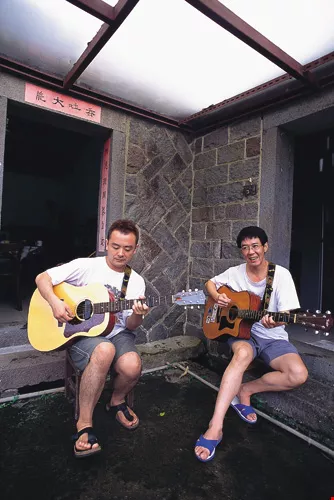
Ken Ohtake is currently Lin's most frequent collaborator. Even a typhoon couldn't stop them from practicing together.
Documentary style
How does his music cross linguistic and cultural divides to move the hearts of audiences?
"Sheng-xiang is an artist who is always in the moment. He's always sincere and dedicated in his personality, in his life, and in his music," says Chung Shefong, Lin's friend of many years and head of record company Trees Music and Art.
Professor Ho Tung-hung of Fu Jen Catholic University's Department of Psychology, who studies the sociology of popular music, says that Lin is one of the few Taiwanese musicians whose works have an air of realism. "Realist music or literature is often geared to a specific group, depicting their lives, environment, and desires, and the pressures they face."
Ho points out that most of the pop songs in the Top 40 stick to fragmented themes of personal emotion like "I'm heartbroken," "I want," or "I love you" and can at best help people express themselves while singing karaoke. Lin's music, on the other hand, is inspired by his own life experiences and social observations, and that's why it can fire the imaginations of listeners. "Listening to his music is like watching a documentary," Ho says.
Discovering music
Lin, born in 1971 in a village called Chutouchiao in Kaohsiung County's Meinung Township, is a classic farm boy--his family runs a pig farm and grows bananas, papayas, and other fruits commonly grown in southern Taiwan.
In 1988 he left Meinung for Tainan to attend high school. Influenced by a friend, he began playing the guitar during the summer break after his freshman year. He ended up performing regularly at a restaurant. While studying traffic management at Tamkang University, he honed his musical talents. In 1992, while only a university freshman, Lin entered his song "Guanyin's Hometown," which describes the views of Tanshui and Mt. Kuanyin, in a university song contest. He won first prize and a prize for best lyrics. He then formed a well-received band with some other students. Among them were future Labor Exchange members Chen Kuan-yu and Chung Cheng-ta, as well as famed producer Chung
Cheng-hu.
Can't go home again
Lin jokingly calls his time with the band his "rock'n'roll youth." Their mix of Mandarin, Taiwanese, and Hakka lyrics with rock styles was a hit with students. From 1994 to 1996, they played concerts on campus every May and attracted standing-room-only crowds every time.
Although Lin was gaining some recognition for his music, it wasn't until he returned to Meinung in 1998 to perform in a celebration of the Hakka god King of the Three Mountains that he realized that his music was basically Western-style rock despite the Hakka elements in it. No matter how much attention he got elsewhere, he couldn't win over the people in his hometown.
"Usually for the King of the Three Mountains festival they invite traditional musicians, or Taiwanese puppet theater or opera troupes," he says. "That year, one of the temple's leaders was planning on running for ward chief and invited us to play. The supporters of the other candidate ended up getting upset about it and there were arguments outside. Some people even said, 'What's with the rock'n'roll? Our Lord doesn't want to listen to that stuff!'" Lin smiles as he recounts the story.
It was a big shock for Lin to discover that as a rocker he couldn't go home again. But protests against a proposed dam in Meinung were reaching a peak at that time, and he decided to take the suggestion of Meinung People's Association chief Zhong Yongfeng to return and make music there.

Lin has long been concerned with workers' and farmers' issues, and draws inspiration from what he sees. Even though he has found fame, he hasn't forgotten his roots on the farm.
Labor Exchange
After returning to Meining, Lin began to think about writing for traditional instruments instead of Western-style ones. He and Zhong visited Hakka eight-sound musicians in Meinung and folk musicians in Hengchun, Pingtung County to better understand the rhythmic and tonal qualities of traditional instruments such as gongs, the suona, the huqin, the yueqin, and the pipa. In 1999, he also formed the band Labor Exchange with Zhong, Chen Kuan-yu, Chung Cheng-ta, and newcomer Kuo Chin-tsai.
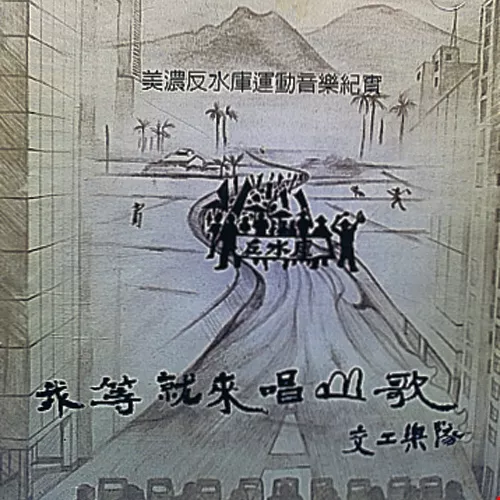
Set against the backdrop of the Meinung dam protests, Labor Exchange's first album, Let Us Sing Mountain Songs, received much attention. The first track, "Traveling Down the Tanshui River Writing the History of Our People," opens in mythical fashion:
"In the time of our great-grandmothers' great-great-grandmothers, / Our ancestors roamed / And came to Meinung, beneath the mountains."
The epic-style song tells the story of how the first settlers in Meinung toiled on the land. The songs that follow, such as "Let Us Sing Mountain Songs," "If the Dam Is Buildable, Shit Is Edible," and "Everyone, Oppose the Dam," describe how the people of Meinung worked to protect their local environment and how they opposed the dam. Listening to the entire album is a stirring experience.
How can a social movement be transformed into music? Lin's inspiration comes from Hakka music. He explains that Hakka music typically makes many sudden changes, jumping between high and low notes, particularly eighths and fifths. The song "Traveling Down the Tanshui River Writing the History of Our People," which describes the founding of Meinung, was a perfect match for this sound. He also incorporated some common Hakka rhythmic elements into the song "Let Us Sing Mountain Songs" to express the emotions of a Meinung farmer singing in protest outside of the Legislative Yuan.
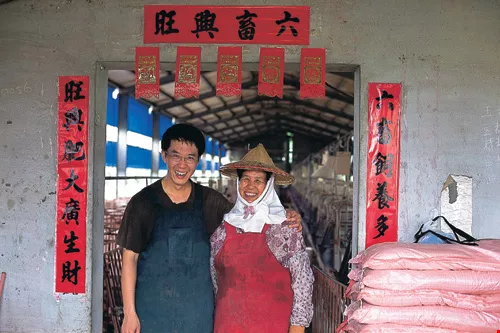
Lin Sheng-xiang's parents' pig farm in Yenpu, Pingtung County, has over 700 pigs. When Lin has free time he comes down to lend a hand. Here he is pictured with his mother in the doorway of a pig shed.
The peak
In 2001, Labor Exchange released their second album, The Night March of the Chrysanthemums, which tells the story of a farmer named A-cheng, and the complex emotions he experiences on deciding to return to the fields after spending ten years working unsuccessfully in the city, and on marrying a foreign bride.
Lin says he wanted Chrysanthemums to be cinematic, so the band recorded ploughs, whistles, and processed ambient sounds for use on the record. They also recorded the voices of people whose backgrounds were similar to those of the characters in the songs. For example, for the song "God of Wind 125," Lin asked his own mother to play the part of A-cheng's mother and read the lines: "A-cheng, you've got to work hard, / If others drive BMWs, / We just have to keep at it with our plough, / Little by little, we can make our days better." It makes for a vivid scene.
For the song "With Time, Away Becomes Home," he had a Vietnamese woman sing lead backed by her classmates from a Chinese language class for Meinung-area foreign brides. Their slightly shaky and soft yet resigned voices sing out: "The heavens are vast, the earth is vast, / Without family I rely on my Taiwanese husband, / The moon is bright, my heart in a flurry, / Home is far away...." Their sense of homesickness is palpable.
The highly topical The Night March of the Chrysanthemums sold more than 10,000 copies--a rare success for a non-mainstream act in Taiwan. Labor Exchange were at their peak, receiving an invitation to play in a world music tour in Europe and selling out shows around Taiwan.
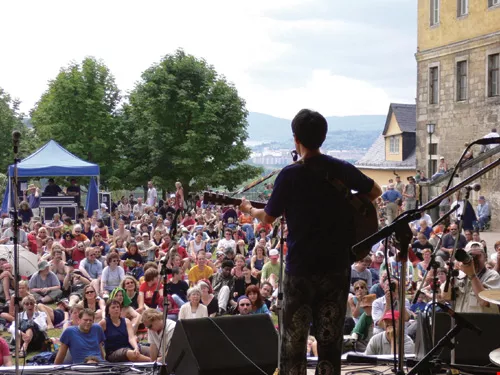
all nationalities in 2005 at Germany's largest folk and world music festival, TFF Rudolstadt. (courtesy of Trees Music and Art).
Hitting bottom
Though Labor Exchange were quite popular, the members were beginning to have different ideas about the future of the band and how it should operate. In 2003, they announced that the band was breaking up, much to the dismay of their fans.
After Labor Exchange broke up, Lin and Zhong Yongfeng continued to collaborate while the other members went on to form the Hohak Band.
Lin describes the feeling at the time: "It felt like being unemployed. For more than a year, I couldn't write anything at all and was always worried. I fell into a bit of a depression." To pick up his mood, he started playing table tennis again. Paying attention to his movements helped him get back into the rhythm of writing songs.
"At that time, the public television station was about to show the Hakka-language drama Cold Night, and they asked me to write a closing theme for it. I kept changing it around but couldn't get it right. I wasted time until the series was right about to air. Then I got it together and finished the piece. That's when I finally broke my writer's block," Lin says with a smile.

Lin Sheng-xiang's parents' pig farm in Yenpu, Pingtung County, has over 700 pigs. When Lin has free time he comes down to lend a hand. Here he is pictured with his mother in the doorway of a pig shed.
The introspective Getting Dark
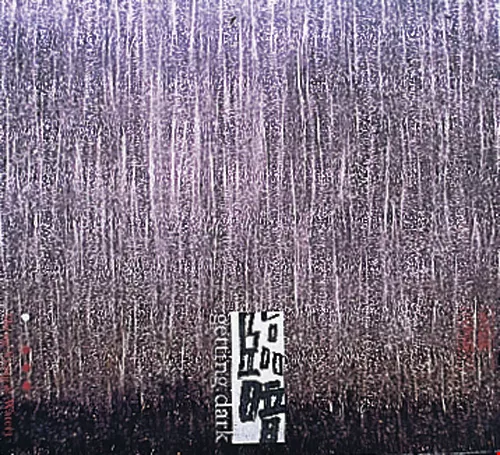
After making it through the tough times, in 2004 Lin, his writing partner Zhong, and three other musicians formed a new band called Sheng Xiang and Water 3. That year, they also released their album Getting Dark, which concerns the lives of laborers in the city.
Lin and Zhong are not as familiar with the plight of city laborers as they are with that of farmers, so while writing Getting Dark, Zhong--who is currently the head of the Chiayi County Cultural Affairs Bureau--made a trip to Carrefour in Tainan to observe and interview workers there. He wanted to discover for himself their workspace, views of love, and hardships. In the song "Job," Zhong writes: "Working first to deliver goods, then changing to an office job / Changing jobs so often is like being a human meatball." In "More Despicable" he writes: "I want to go after a girl / But I'm not qualified / I don't have a house or a car / My work isn't steady." The songs are vivid depictions of the pressures menial laborers face, their unfulfilled emotional lives and their sense of frustration.
Lin set to work writing and arranging the music and working out the vocal styles. In contrast to the passionate style he used in Labor Exchange's protesting days, he avoided rock-style percussion and used the bass to keep the rhythm. The melodies were carried by instruments with more subtle sounds such as the yueqin, sanshin, pipa, and harmonica He also employed a lower-key singing style than the soaring one he used with Labor Exchange so as to capture the emotions of the menial laborers depicted.
Getting Dark is a calm, introspective album. It is a bit moody, but its direct style of dealing with emotions represents a breakthrough for Lin. "I feel I have more possibilities in my music than I did before," he says.

Lin's wife, Sung Chang-ching, is a member of the Meinung People's Association. The couple met during the anti-dam protests. Here Lin plays guitar while Sung and her brother's child listen intently.
Atmospheric music--Planting Trees
"Plant them for those who have left the village, / Plant them for roads that are too wide, / Plant them for feeling you can't going home again...."
These are lyrics from "Planting Trees," a song from the album of the same name that was released in October of last year. For the album, Lin went back to Meinung to find inspiration. He also collaborated with two Japanese musicians, the renowned Okinawan sanshin master Takashi Hirayasu and the guitarist Ken Ohtake. Lin left behind the heavy sound of Getting Dark, using simple rhythms and a bright, straightforward singing style on Planting Trees. It's a more atmospheric sound that uses open D guitar tunings--it's an attempt to musically recreate the feeling of southern Taiwan's sultry island climate.
Lin and Zhong Yongfeng always get their inspiration from the people and circumstances around them. Planting Trees is based on a person who is unwilling to be named who has been planting trees around Meinung for the last eight years. As of now, this person has planted more than 3,000 trees. "I think this sort of quiet power is even more moving so I decided to record it in music," says Lin.
The arrangements on Planting Trees are simple as well, using two guitars and a sanshin to accentuate the swaying rhythms and melodic lines. Though the music is relaxed, the issues dealt with on the album are serious: "Thanks to You, Young Man" is a song of appreciation dedicated to Yang Ju-men, the "Rice Bomber" who planted bombs to protest against Taiwan's joining the World Trade Organization, and "Organic" satirizes the rigidity of the organic certification testing standards. The Meinung farmer portrayed in the song "Organic" says with a smile, "Hearing his music is like meeting someone who really understands us. It's really comforting."

Lin was the leader of the band Labor Exchange. Labor Exchange's socially conscious mix of traditional instruments, Hakka music and Western-style rock won a passionate following. Pictured is the band performing at Taiwan's first world music festival in 2000.
Staying true
The four albums released by Lin and his bands, from Let Us Sing Mountain Songs to Planting Trees, have won nine Golden Melody awards. Though he's won fame and acclaim for his music, Lin still wears a T-shirt, shorts, and flip-flops everywhere he goes. When he's not performing, he's at work on the pig farm or in the bed and breakfast run by his wife's family.
"Sheng-xiang is very comfortable with his farming background, and he never feels inferior around people of different cultures or classes," says Chung Shefong of Trees Music and Art. "One time when we went to Germany to perform, we went out to eat with some friends from the art world. He started talking very casually about raising pigs, and everyone was fascinated."
In the eyes of his mother and his new bride Sung Chang-ching, Lin is a considerate son and husband. Sung says with a smile that the thing about Lin that most appealed to her was his sense of humor and his thoughtfulness: "My personality is more masculine and straightforward, so our friends say we suit each other very well."

Ken Ohtake is currently Lin's most frequent collaborator. Even a typhoon couldn't stop them from practicing together.
A "friendlier" sound
Lin admits that he gets nervous easily, and that he sets high expectations for himself. He says he can be stubborn sometimes, and that might have given some of his collaborators pressure from time to time. "Later, I realized that creating is very personal and very tough, and that I should insist on my own ideas. Maybe it's natural for an artist to be unable to collaborate with partners for long," explains Lin, who's often had trouble keeping his bands together.
Lin plans to release a new album in the fall of next year about the problems of farmers and the agricultural industry he understands so well. He's currently studying Cuban-style guitar with Ken Ohtake and plans to use Cuban rhythms on the new album. "Cuban music sounds so friendly, and that's a quality that's been missing in my music," he says. "I hope people will say that even though the lyrics are critical, the music is friendly."
Casting aside his identity as a singer and returning to Meinung, Lin Sheng-xiang is most comfortable as a farm boy. This musician who raises pigs, sweeps the B&B, and observes his environment seeking inspiration is holding fast to his ideals. He's taking his experiences and forming them into songs to resonate in the heart.

@List.jpg?w=522&h=410&mode=crop&format=webp&quality=80)


