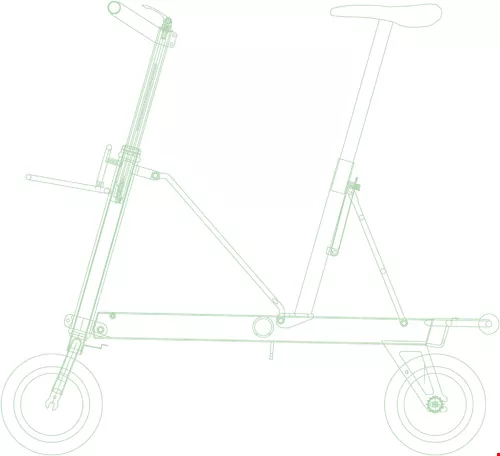
A Phoenix from the Ashes--Taiwan's Pacific Cycles
Chang Chiung-fang / photos courtesy of Pacific Cycles / tr. by Scott Williams
January 2009


Taiwan has long been known as bicycle central. Giant and Merida are local firms with global reach, and smaller producers like KHS, CSK, and Pacific Cycles each have their fans. But Pacific, maker of the distinctive Birdy line of cycles, differs from the other local manufacturers in one key respect: its cycles are truly 100% "Made in Taiwan," designed and assembled entirely in Taiwan from Taiwanese components.
In recent years, interest in healthy living, growing environmental awareness, and soaring fuel prices have made biking to work a measure of one's sophistication. After specializing in folding bikes for nearly 20 years, Pacific now finds itself caught up in the trend. Taking "small is beautiful" as a core tenet, the company has created small, high-end folding bikes that have won the hearts of cyclists around the world. Popular in Europe and Japan, these folding bikes are now catching on in the land that produced them-Taiwan.
Cyclists in Taiwan refer to Pacific Cycles' Birdy series as the "bird bike" or sometimes the "superbird," but there's nothing chintzy about either its quality or price. The bikes are treasured by their owners, many of whom have designated their garages "nests." Recognizing that the Birdy has gotten better with every iteration, some of its most devoted fans own one from each of the 15 years in which it has been made.
Taiwan's Pacific, the UK's Alex Moulton, and the US's Bike Friday constitute the "big three" at the high end of the global folding bike market. The Birdy has the best reputation and the best sales of the bunch (about 10,000 units per year since 1997), and is a real bargain compared to the US$14,000 Alex Moulton.
Prices for folding bikes vary widely in Taiwan. Merida has models ranging from NT$2,500 to NT$30,000; Giant offers models for NT$4,000-NT$10,000; and KHS prices its models at NT$15-30,000. Prices for Pacific's Birdy are closer to the Rolls-Royce end of the scale, with models starting at upwards of NT$30,000 and going as high as NT$100,000.
Why is the Birdy so much more expensive than other folding bikes?
Pacific's visionary chairman George Lin, who worked with two German engineers to develop the Birdy, says that the company has kept prices for the Birdy at about US$1,000 since its 1994 introduction, never raising them in spite of the bike's popularity. He also notes that the Birdy's six-month delivery times are simply the result of backorders, rather than of a desire to make things difficult for buyers.
One of the Birdy range's most unique features is its anti-dive front suspension, which makes the bike instantly recognizable and "kills two birds with one stone" by placing the fold at the point where the suspension meets the frame.
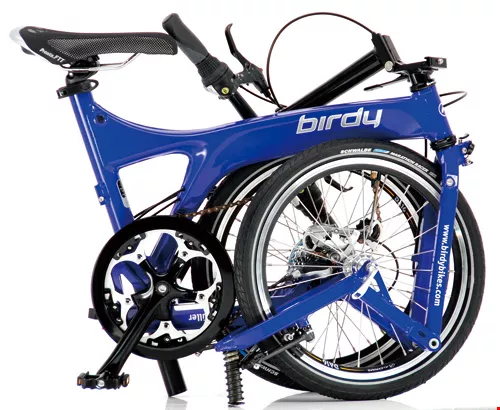
Where most folding bikes fold the front wheel towards the back at a joint in the middle of the frame, potentially compromising frame strength or even allowing the joint to slip in the middle of a ride, the Birdy has two joints, one each where the front and rear wheels join the frame. In addition to creating a stronger bike, this approach allows riders to fold or unfold their bikes in just ten seconds or so. The bike earned the name "Birdy" for its light weight (just ten kilograms) and very compact folded dimensions (72 x 39 x 60 centimeters).
"Other companies' bikes differ only in the nameplate that's slapped on them," says Lin. "Take off the label, and they're all the same. Pacific's bikes are different. Even in Japan, where trademark issues have forced us to sell the Birdy as the BD1, everybody instantly recognizes the bikes as Pacific's Birdy range."

A very popular "bird"
Pacific's unique approach to folding requires that the Birdy have an asymmetrical structure. Since 2005, the bike has also featured a highly rigid monocoque frame that must be made partially by hand. These two factors effectively limit production to just 10,000 units per year. Even with the bicycle market as a whole booming, Pacific has elected to keep its slow, hands-on production process in place.
Pacific employs 116 people, only about 50 of whom actually work on the factory floor assembling bikes. It employs another 20 persons in development, producing 50 or 60 new designs every year. Bicycle-industry innovators from around the world are also constantly bringing Pacific new ideas and partnership proposals. "We do everything ourselves-from early-stage design and prototype development to late-stage assembly," says Lin. "It's the only way we can be confident in the work."
Pacific has also designed a variety of special-needs bikes, including a bike for amputees in areas with minefields, a four-seater for use in tourist areas, a bicycle-ambulance, and the world's first light, safe, pushable folding tricycle for seniors.
Before beginning production, each of Pacific's bikes goes through more than 200,000 design iterations on the computer. Keenly aware that it costs NT$2.5 million to create a mold, the ever-methodical Pacific uses precision computer modeling to avoid the potentially high costs of doing it by trial and error.
Lin is equally meticulous on the manufacturing side, taking pride in his company's idiot-proof by-the-numbers approach.
Bike manufacture can be roughly divided into the welding, heat treatment, painting, and assembly stages, and Pacific closely monitors quality during each. The company's attention to frame alignment is a case in point. Most manufacturers realign frames just once, right after they heat-treat them. Pacific, on the other hand, realigns its frames after every step in the assembly process to ensure that they don't warp. It also clamps pieces into place while welding to keep the frame from getting out of true. The frames are loaded into welding jigs, welded, pulled out, realigned, and reloaded again and again to get them just right. Large, automated manufacturers can't even begin to emulate that level of perfectionism.
Slow, conscientious work yields a top-notch product. Most major manufacturers spend an average of seven to eight seconds assembling a bike. At Pacific, where quality is more important than efficiency, workers spend about an hour.
Interestingly, the company has not bothered seeking patents for many years. "We don't fear imitators," says Lin. "No one can imitate our bikes and no one is willing to build them the way we do."
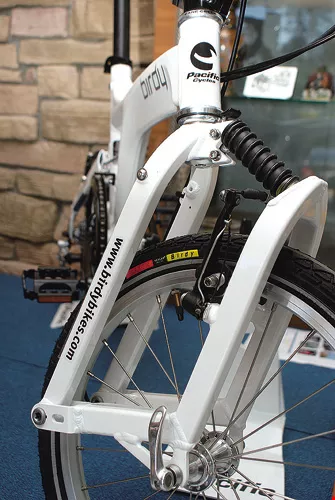
The Birdy's unique anti-dive front suspension "kills two birds with one stone" by placing the fold at the point where the suspension meets the frame.
Go your own way
"Taiwan has tremendous manufacturing capabilities," says Lin, "but most manufacturers have chosen the cost-cutting, mass-production route." He compares manufacturing to test-taking: when the questions are easy and everyone can answer them, you can't tell who really knows their stuff. Pacific has therefore gone its own way, focusing on technology and doing the kind of business that others are unable and unwilling to do. "We aren't trying to be big," says Lin. "We're not trying to be number one. We're not even trying to excel. We're just seeking to develop sustainably." In his view, Pacific's niche-precision manufacturing and customization-is an area unserved by major manufacturers.
Pacific hasn't actively marketed its products over the last 15 years, choosing to rely instead on word-of-mouth and online sales. Their business model-they don't produce a bike until they've received a deposit and don't deliver it until they've been paid in full-has remained unchanged as well. It depends on the principle of supply and demand, and the fact that no one else provides what they offer.
Pacific is basically two businesses: one develops and manufactures bicycles for the Pacific brand, including the classic Birdy range, while the other provides product-development services to third parties. In this latter role, the company has designed, developed, prototyped, tested, and built a variety of folding and special-purposes bikes for more than ten bicycle manufacturers. These bikes may be sold under other companies' names, but the "Designed by Pacific" label counts for a lot, sometimes even more than the ostensible manufacturer's own.
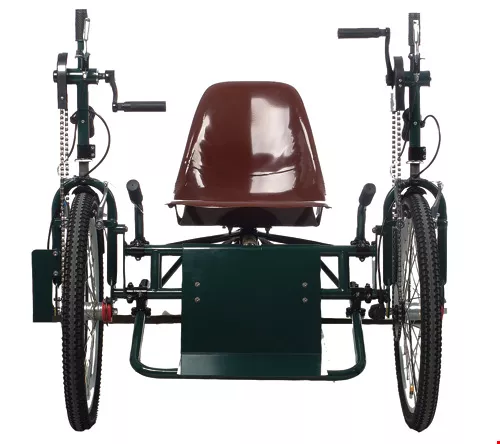
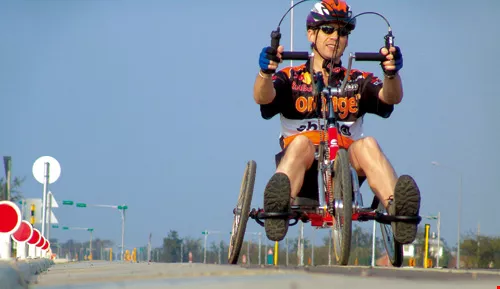
At the UN's request, Pacific designed a hand-powered cycle for people with lower-limb disabilities in areas where minefield injuries are common. The thick steel plate at the bottom of the bike protects the upper body from further mine injuries.
Reborn in flames
Pacific Cycles didn't actually begin life as a low-volume, high-end manufacturer. Established in 1980, the company initially took the same high-volume route as Giant and Merida, growing its annual sales to NT$1 billion in ten short years. Then the 1992 recession caused its German subsidiary to lose its line of credit. Forced to make cuts, the company scaled back volume, cut production lines, and chose to focus on its more profitable folding and special-purpose bikes. It also completely changed its business strategy, electing never again to engage in high-risk businesses.
After stumbling badly, Pacific largely toiled for others from 1992 to 2005 by helping clients design and develop new products. But Lin felt that both he and his products were being wronged by the lack of respect and lack of marketing they received. By 2000, Lin was thinking about refocusing the business on its own products. Pacific spent a few years preparing and, in 2006, formally reintroduced the "Pacific" brand and targeted the Taiwan market, which now accounts for nearly one-quarter of its sales.
Given the last three or four tumultuous months and a large economic downturn now underway, Lin is glad to have already battened down the hatches. Pacific's neighbors in Taoyuan County's Yong'an Industrial Zone have been folding right and left, and "For Sale" and "For Rent" signs now hang everywhere. Not only is Pacific one of the few companies still afloat, it's thriving, with a new facility under construction just a few hundred meters from its headquarters.
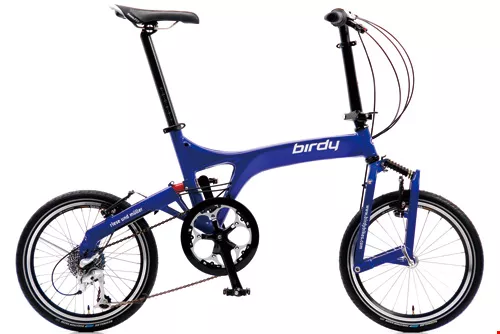
When folded, the Birdy measures just 72 x 39 x 60 centimeters.
Biking to work
Lin's success is founded not just on his company's technological leadership, but on its determination to forego fashion and stick to its core ideas. Pacific's focus is neither leisure nor competition. Instead, it has been promoting the use of folding bikes as urban commuter vehicles, ones that are convenient for 30-minute commutes and easily carried on public transport, for 20 years. Happily and somewhat unexpectedly, the company has been caught up in the current folding bike craze and has suddenly become popular.
"Getting people to treat bikes as commuter vehicles and to cycle to work or school is good for their health and for the environment," says Lin.
The company's concern for the environment also accounts for its continued use of aluminum alloys rather than carbon fiber for its bikes: the latter, though light and strong, cannot be recycled. "Lightening a bicycle by half a kilogram or a kilogram just isn't that important. That's even truer for Pacific's folding bikes, which can be trundled around like a suitcase when folded up," explains Lin.
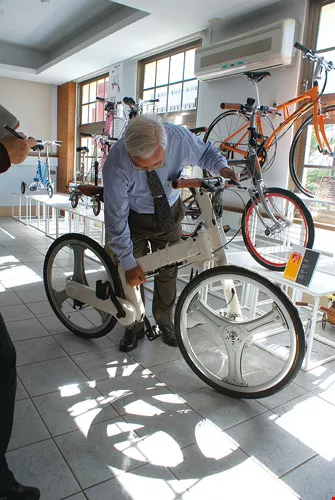
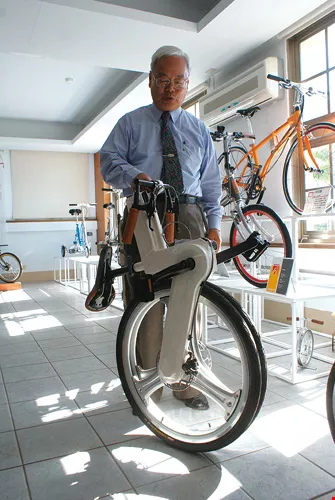
Spurred by the Birdy's popularity, Pacific has developed three other series of folding bikes, each with their own specific purposes. The first of these is the Reach (Lin's personal favorite), a series of performance bikes for cycling enthusiasts that began appearing on the victory platforms of local triathlons soon after its release. The second is the Carryme series, which folds up into a bundle about the size of a large umbrella and is easily carried on public transport. The third is the iF series, which incorporates a wealth of ideas and functionality into bikes that can be folded into a wheelable package in just three seconds.
Lin personally designed both the Carryme and the Reach series, and has "wheeled" his own Carryme through 16 countries. When folded, the bike becomes essentially just two wheels and a handlebar, a configuration that even the 70-year-old Lin can easily push around. "I ride every bike I design for more than 1,000 kilometers before manufacturing it. I won't put a bike into production until I've tested it to my own satisfaction," he says.
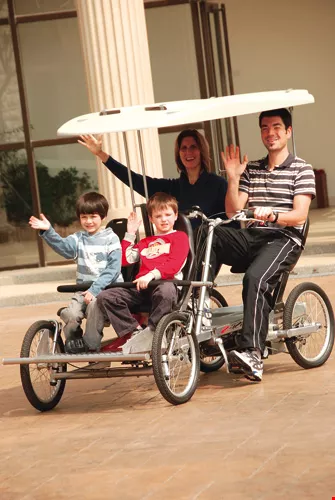
Pacific Cycles has taken the custom-manufacturing route, designing bicycles with different functions to meet different clients specific needs.
Grit and determination
Though well known to enthusiasts, Pacific only began printing marketing materials in 2006 and is still in the early stages of growing its sales. "We were spoiled," Lin admits. Though Pacific's bikes are sold in more than ten nations, it has lacked an integrated marketing strategy and consistently good distributors. The company is therefore actively seeking to improve the quality of its distributors and add service and maintenance capabilities.
The success of the Birdy or even of Pacific Cycles as a whole is about more than bicycles. In fact, there is a truth easily grasped but not easily put into practice undergirding every "Made in Taiwan" product in every field-there are no tricks or shortcuts on the road to success, only grit and determination.
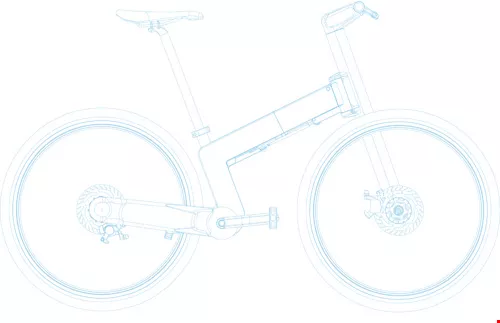
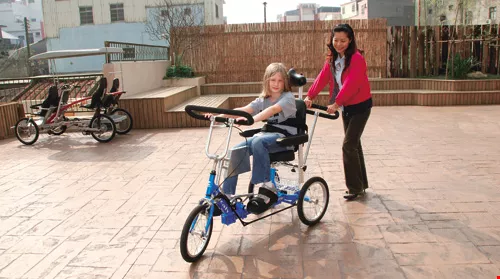
Pacific Cycles has taken the custom-manufacturing route, designing bicycles with different functions to meet different clients specific needs.
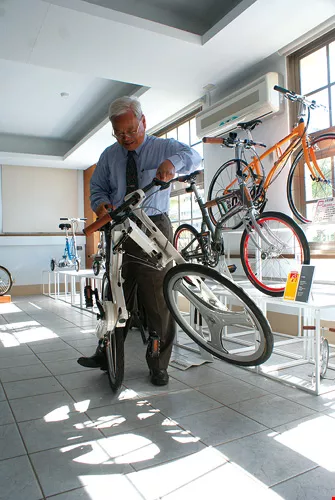
Pacific Cycles has developed a number of lightweight folding cycles to promote bicycling to work and school. The iF shown in the photos at left folds into a wheelable package in just three seconds.
Pacific Cycles has developed a number of lightweight folding cycles to promote bicycling to work and school. The iF shown in the photos at left folds into a wheelable package in just three seconds.
Pacific Cycles has taken the custom-manufacturing route, designing bicycles with different functions to meet different clients specific needs.
When folded, the Birdy measures just 72 x 39 x 60 centimeters.
Pacific Cycles has developed a number of lightweight folding cycles to promote bicycling to work and school. The iF shown in the photos at left folds into a wheelable package in just three seconds.