Decluttering: Self-Cultivation by Subtraction
Chen Hsin-yi / photos Chin Hung-hao / tr. by Jonathan Barnard
May 2012


In recent years a Japanese home organizing movement based on “subtraction” has made big inroads in Taiwan. In Japan one can find certified organization specialists and full-fledged organizing curriculums, as well as a never-ending stream of books and television shows on the subject. In Taiwan, meanwhile, the Japanese book Danshari, which provides a systematic and theoretical basis for decluttering, has proved hugely popular, and the word that serves as its title has entered the popular lexicon.
Japan often sets trends for Taiwan. Will the self-help organizational philosophy transform Taiwan as well? And should we Taiwanese, who are by nature shopaholics with a deep attachment to our possessions, adopt this severe method of domestic self-restraint?
Now 56, Mitsuko Azuchi, who speaks fluent Chinese, came to Taiwan for her job 10 years ago. Here she met and married a Taiwanese man. They have had a blessed and beautiful life together, except for one “little problem” that rankled her from the first day that she moved in with him: “I never would have expected it from someone so capable and gentle-natured, but he simply had acquired too much junk, so that no matter how much I cleaned the place, it was always a mess.”
What’s more, every time that she asked her husband to help straighten up and get rid of some of the clutter, he would always use the excuse of being too busy, or would say, “I’m too attached to that!” or “What a shame it would be to throw that away!” or “That might be useful in the future.” He was never willing to part with much of anything.
About three years ago, his overflowing clutter had begun to feel oppressive, and Azuchi exploded, delivering an ultimatum: “It’s me or your stuff. What’s your choice?” Shortly thereafter, she happened to visit her family in Japan, where she took a popular “domestic decluttering” course. The philosophy resonated deeply with her, and she went on to obtain certification as an “organizational consultant” before she returned to Taiwan to hang out her shingle as a professional organizer. She has delivered several lectures on the subject and paid six or seven home visits to clients.
She describes the chaos typical of a Taiwanese home: shoe racks jam-packed at the entrance, hallways piled high with all manner of junk, dining tables nearly completely covered, wardrobes providing no room for clothes to breathe…. Open a closet and you’ll find a stash of rarely used or difficult-to-remove and completely forgotten objects. “Most people mistakenly believe that shoving objects into cabinets so that they’re out of sight counts as organizing,” she explains. “But with that approach you’ll just end up accumulating more and more stuff and forgetting what you have. Regularly used objects will get misplaced, only adding to the chaos.”
Her advice is to get rid of unnecessary objects, leaving only what best suits you or is currently necessary. “Miraculously, as your living space takes on a new look, your life will also take a turn for the better!”
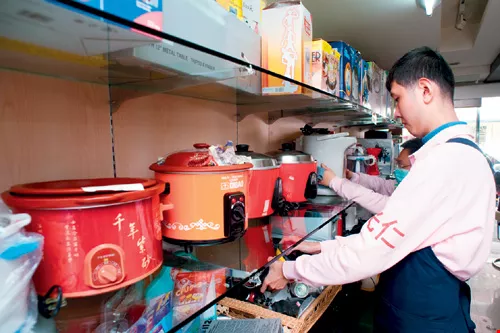
At the thrift stores of the Catholic Kuang Jen Social Welfare Foundation, discarded goods are painstakingly organized, inspected, and cleaned up before being set out to invite the embrace of a new owner.
There are many organizing experts like Azuchi in Japan, where the field has already evolved into a well-established industry. Its exemplar is the consultant Hideko Yamashita, whose 2009 book Danshari has sold 2 million copies.
Yamashita credits yoga techniques as the inspiration for her organizing methods. Since 2000, she has held over 500 seminars in different places in Japan on danshari, which translates literally as “refusal, disposal and separation.” The philosophy urges people to refuse to acquire unneeded goods, to dispose of excess possessions and to separate themselves from their attachment to those possessions.
A home organization movement has also been gaining ground for many years in the United States. The National Association of Professional Organizers is at the movement’s forefront, with a membership that has grown from 16 at its founding in 1985 to over 1000 today. Its ranks used to be filled with former secretaries, teachers and others who had left low-paying professions. But in recent years it has also attracted lawyers and business executives. The specialized services on offer include home organization, office organization, social-contacts organization, and special handling of homes that have been a mess for long periods. There are even organizers that specialize in serving celebrities.
Why does decluttering have such appeal in Japanese society? And will Taiwan follow in its footsteps?
The author Chen Ruojin, who has studied life in Taiwan during the Japanese colonial era, notes that living spaces in Japan are cramped and the society there has long paid fastidious attention to the “aesthetics of life.” Domestic kit and caboodle includes different tableware and utensils used in different seasons. What’s more, the Japanese reverence for antiques extends from high government officials to regular families and supports an army of itinerant antique assessors, who come to homes to evaluate family heirlooms. Consequently, however much outsiders may regard the Japanese “art of organization” as a manifestation of extreme fussiness, it has arisen from necessity. The new approach of “organization via subtraction” can be regarded as a swing of the attitudinal pendulum from venerating “painstaking attention to detail” to emphasizing “clarity and simplicity.”
Azuchi, who travels back and forth between Taiwan and Japan, notes that Japanese junk dealers assess detailed charges based on weight when disposing of large pieces of furniture. Hence, everyone in Japan realizes that accumulating stuff has its costs, and that in turn leads to greater self-discipline.
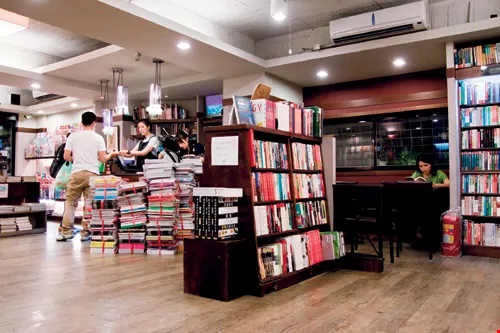
“Please regard this space as your own home library!” The mission of Mollie Used Books has deeply resonated with bibliophiles and turned the store into an effective platform for the recirculation of old books.
Remarkably, the rapid rise of the profession has even spurred a counter movement in Japan and the US. In their 2007 book A Perfect Mess, Columbia University business professor Eric Abrahamson and science journalist David H. Freedman argue that organizing efforts are growing overzealous. Constant calls to organize and put things in order create needless pressures and sap one’s energy and vitality, they argue. Opposition has also come from a new wave of interior designers, who oppose what they regard as an excessive emphasis on order and simplicity. They intentionally design in a little chaos so as to foster a more relaxed and human sensibility.
To counter the call for order, the book cites Einstein, who justified the state of his notoriously messy desk by asking: “If a cluttered desk is a sign of a cluttered mind, of what, then, is an empty desk a sign?”
Author Lill Liu, a resident of Japan, argues that the truest danshari approach puts the focus on purchasing very little or only buying what you absolutely need. Japanese society, however, seems instead to have put most of the emphasis on disposal, believing that the indiscriminate purging of possessions will somehow bring inner peace. The upshot is that shopaholics end up with an excuse to feed their addiction in a big way. Moreover, forcing danshari upon the reluctant can spur unhealthy reactions. After danshari purges, some have been known to gorge themselves or drink excessively as a way to release pressure. Others end up regretting having discarded so much and buy some of it back.
“Taiwanese homes don’t have any more stuff than Japanese homes, despite being larger. It would be hard to argue that there is a pressing need for danshari in Taiwan,” says Liu. “Nevertheless, we should take to heart its principle of refusal and buy less to begin with.”
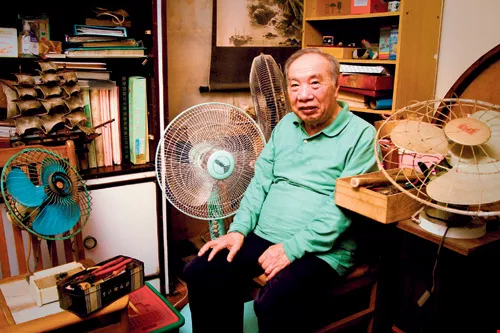
Having grown up in an era of material hardship, the older generation typically holds a deep love for its possessions. Grandpa Su, an octogenarian, has always taken great pleasure in repairing old things. His collection of fans—some bought and some found—far exceeds his needs.
To fully understand how messy homes and calls for organizing have given rise to anxiety and controversy, we must first answer the question: Why do we own so much stuff?
Consumers serve as a pillar of economic development. The material riches of modern society have given consumers more choices and convenience, but they’ve also enabled compulsive and irrational shoppers.
What’s more, product lives have grown ever shorter in post-industrial society. New gizmos are quickly replaced by even newer gizmos. Some are eliminated altogether. People may feel compelled to purchase the newest and shiniest and also to collect older products out of nostalgia.
Whether objects are acquired for rational or irrational reasons, once they enter the home it’s hard to get rid of them. That simple truth turns houses into warehouses.
In the essay “Never Moving,” the singer René Liu shares her experiences with the memory-filled home where her grandparents resided for many decades.
Liu’s grandfather, a high-ranking military officer, was allocated a home that was more than 3600 square feet. For 50 years, purchases brought in never left. In addition to all the furniture and clothes, the home ended up holding an unimaginable variety of odds and ends.
Upon the grandfather’s death, the military informed the family that it was repossessing the house. When Liu set about sorting through her grandfather’s things, she came to a realization: For the older generation, which had experienced turmoil at a young age, keeping one’s possessions together served as an act of defiance against the loss of memory and an affirmation of one’s roots. Consequently, although Liu diligently approached the task of clearing her grandfather’s home with a proper stress on reuse and recycling and threw away as little as possible, she still couldn’t help but feel guilty, as if she were somehow punishing her own family.
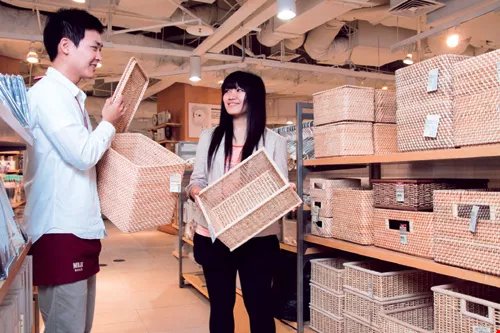
Muji, a Japanese household goods producer brought into Taiwan by President Enterprises, sells various lines of storage containers and an elegant, pared-down lifestyle.
It’s worth considering whether a generation gap exists when it comes to accumulating: Did previous generations collect memories, whereas the new generation collects fresh playthings (such as technology products)?
A Miss Lin cared for her father in his last days as a terminal cancer patient. She recalls that to obtain a room in which to care for him, she had no choice but to clear out a “secret room” where he had kept his accumulated treasures. Her father had become an enthusiastic fisherman in his forties and had collected more than 100 rods in the 40-some years of his avocation. Many looked brand new. The bookshelves were packed with fishing hobbyist magazines. Realizing how much her father treasured these items, she moved them to storage rooms at her sisters’ homes, telling her dad, “I haven’t thrown any of them away, and I can bring them to you anytime you want them.” As for the stuff he had kept not knowing when he “might need it”—odd bits of hardware, broken umbrellas, spools of wire, plastic bags, advertising supplements and so forth—she threw it all away without the slightest hesitation.
When it came time to give away or recycle his treasured collection after he passed away, she experienced an unnerving and disorientating sensation: How was it that what had taken a lifetime to acquire could be scattered to the wind so quickly?
Or perhaps, amid the inexorable march of new products which lay waste to all that precede them, the collectibles of each era settle in archeological layers in a manner that reveals both the history of technological development and the tracks of individual melancholy. Take those boxes of well-worn cassette tapes owned by many born in the 1960s, or those containers of generation-Y keepsakes: elementary school contact books, handwritten love letters, job offers, and the like. Some people lug these with them on every move, even after marrying. Still others insist on keeping all their old cell phones, as if they see the tracks of their own lives in the scratches on the phones’ surfaces.
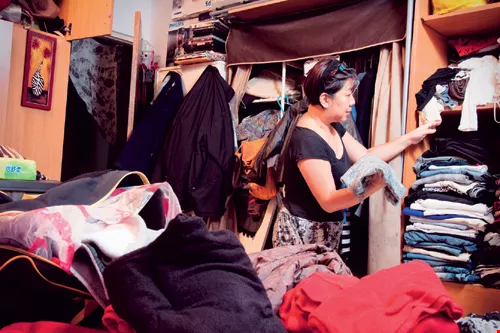
Wash, dry, iron, fold, put away, and then take out at the right season…. All the meticulous efforts of a housewife are easily undermined by a love of shopping and a reluctance to part with one’s surplus clothes.
People have never regarded their possessions in purely utilitarian terms. The relationship has always been fraught with various levels of sentimentality and psychology. Although we tend to quickly find fault with others for acquiring so much “junk,” we all have our own soft spots for collecting certain items.
The television personality Claudia Lin and the writer Cai Shiping have been happily married for many years. Yet Lin has long held that Cai’s book collection of nearly 200,000 volumes is a great waste of living space. Three years ago, she took advantage of a trip that her husband took by picking out a bunch of books that she felt he would never read again and lugging them to a used bookstore. Unexpectedly, the store called a few days later to ask about what to do with the letters and name cards that its staff had found jammed in their pages. When the usually even-tempered Cai found out what had happened, he brooded angrily for three days. Just thinking about the incident gives Lin the chills.
Hideko Yamashita believes that the feelings of attachment expressed in such statements as “What a shame!” or “I hate to part with them” constitute the thorniest issue encountered in the quest for danshari. Yet unused stuff that takes up space engenders its own kind of emotional burdens, and objects that trigger memories can also serve as shackles. Constant hoarding isn’t healthy. Sometimes disposing of these objects requires a special ceremony, such as bringing them outside to burn or offering a few words before saying goodbye.
The Japanese author Marie Kondo, who has developed the “heartbeat organizing method,” explains that decluttering techniques typically set numeric parameters—say, by mandating that you discard anything that hasn’t been used for two years. But Kondo believes that people should set their own yardsticks. “When you come into contact with an object, do you feel that it moves you in some way?” If not, get rid of it. She also recommends that beginners avoid starting with objects that have sentimental value. Instead, she suggests the following order: clothes e books documents keepsakes. That approach keeps dillydallying spurred by nostalgia to a minimum.
New joy in old lovesIn Taiwan, the decluttering movement has been abetted by a growing number of stores selling used goods, as well as other channels facilitating recycling and reuse. Take Mollie Used Books, which is as elegantly appointed as the Eslite bookstores. When the store was established 10 years ago, consumers in Taiwan lacked a conception of how old books could be recirculated. To fill its shelves, Mollie had to buy books from paper recyclers. Today, it has become a chain with five branches and a never-ending supply of books that booklovers sell or donate. “What’s more, half of our suppliers don’t ask us to collect the books but instead bring them to us,” explains owner Mollie Dai. “They identify with our mission to protect the environment and to serve the public interest.”
The Catholic Kuang Jen Social Welfare Foundation has pioneered the model of “sheltered workshops,” using handicapped workers to staff its stores selling second-hand products. When its first store opened nine years ago, Taiwanese lacked an understanding about reusing goods. But the model has gradually caught on. Today, the foundation has six thrift stores in the greater Taipei area. They collect and resell clothes, furniture, appliances and other used items in good condition.
The dao of discardingIn pursuit of danshari, some misgivings are inevitable: To what degree must one dispose of one’s possessions? Won’t impetuousness sometimes lead to regrets?
Steve Day, the chairman of Wowprime Group, once shared with the media his own experiences at organizing. Twenty years ago he found it difficult to part with any of his possessions, and so, for his year-end cleanings, he forced himself to close his eyes and simply get rid of all of that year’s clutter. But he ended up having deep regrets.
Now he uses a folder in which to place each month’s items that he can’t bear to part with—a particularly moving letter from a customer, say, or an invitation to a colleague’s mother’s funeral or an illustrated itinerary created by his children for a family trip. These precious keepsakes are then stored in boxes, which he will be able to peruse and savor at his leisure after he retires.
“My principle for decluttering is that I keep those items that are connected to memories. Just imagine suddenly losing your memory so you couldn’t recall anything. It’d be like you had never lived at all. But those stored items would give you back your past.”
In a society of affluence like ours, we may forever be searching for just the right approach to take to our possessions. Surely, it will remain a love-hate relationship, but let us hope that it will become, on balance, a more joyous and enlightened one!


@List.JPG?w=522&h=410&mode=crop&format=webp&quality=80)


