Shaping the Future of Ceramics:Artist Li Hsing-lung
Kuo Li-chuan / photos courtesy of Li Hsing-lung / tr. by David Mayer
November 2003
Pottery is a flourishing art form in Taiwan. The feeling of accomplishment that comes as you watch the lines traced by your own fingers in a spinning column of clay is addictive. As many an avid potter will attest, it is often impossible to tear yourself away from it.
Taiwan's early pottery was by and large intended to serve a practical purpose. Perhaps the most common ceramic product was the teapot. After Taiwan's economy started growing by leaps and bounds in the 1970s, enjoyment of fine teas became a popular pastime, and one for which the teapot was indispensable. A number of outstanding teapot masters appeared on the scene to meet the demand. Consciousness of the existence of pottery as an art, however, has led potters since the 1990s to look beyond the teapot and explore the other creative possibilities open to them. Li Hsing-lung has been among the most notable practitioners of this new type of pottery.
Artistic creation is an expression of an idea. As long as the artist is spiritually alive, things he wants to say will continue to emerge from within. The myriad whisperings of the inner voice gradually meld into the beauty and life that inform the artist's works. The folk totems in the painstakingly executed works of potter Li Hsing-lung rearrange traditional linear patterns, transforming them into symbols, resulting in entirely new creations uniquely representative of the culture from which they sprang. Bearing gold, red, blue, and indigo colors typical of Eastern art, Li's works are redolent of the Orient, and of Taiwan in particular.

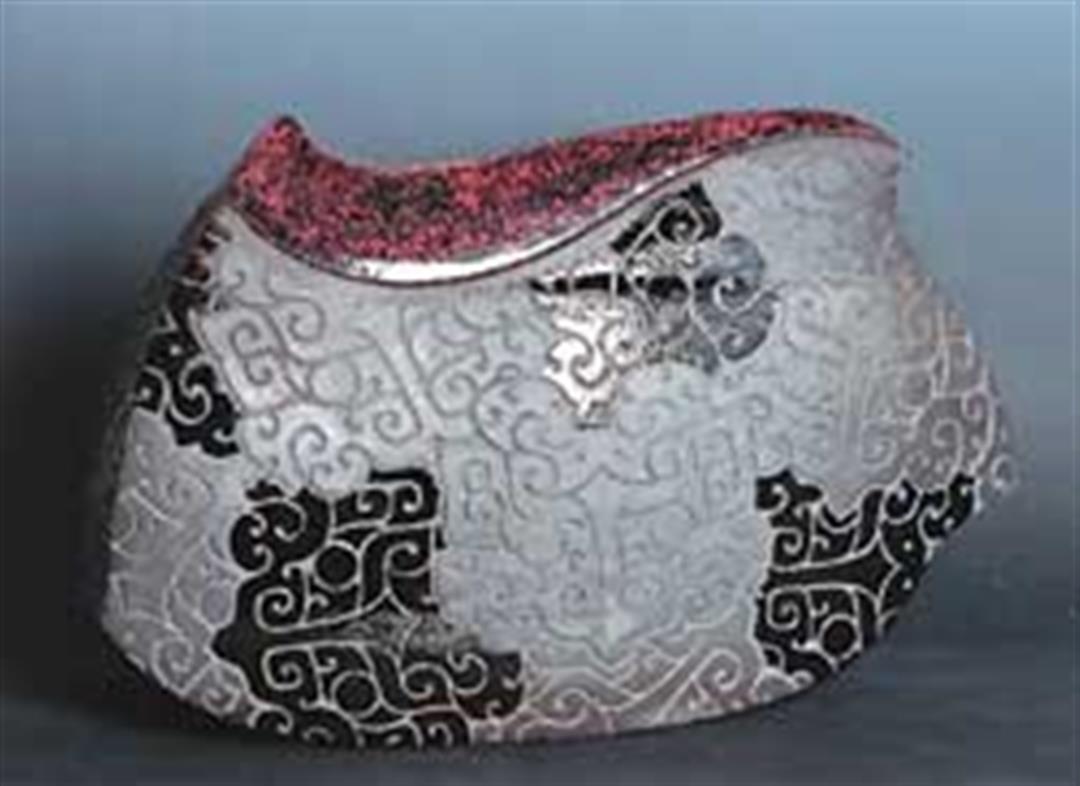
Li Hsing-lung won the first Award for Folk Arts in 1992 for Awakening China. The work's elegant decorative motifs and Oriental color scheme introduced a strong note of ethnicity into modern ceramics.
Ceramic dreams
Li was born in 1964 in Chingshui Township, Taichung County, and was in the first class of graduates from Tachia High School's pottery program, which he was inspired to enter after watching instructor Wang Ming-jung drawing out lumps of clay into bowls and teapots. After graduating from high school in 1982 he decided to make a career in pottery. It was a decision based on pure love for the art, for the practical obstacles were formidable. Li headed off for Yingko, the famous pottery town south of Taipei, but found no one willing to take him in as a student, so he returned to his old high school to use the facilities there, only to be run out. Withering criticism from family members and financial pressures shook his confidence, nearly nipping his career in the bud. Fortunately, however, youthful stubbornness and a single-minded devotion to pottery kept him from giving up.
In 1987, Li established the Fey Yang Guu pottery workshop in Chingshui. To keep operations afloat he produced practical products at first, concentrating especially on teapots, which are harder to make than just about any other item he could have chosen; the body, cap, spout, and handle are made separately, then joined together. The maker must be in perfect mastery of his craft, for the challenges are numerous. The firmness of the clay as it is thrown, the resistance of the handle as it is being rolled, the dampness required as the parts are joined together and the method for doing it. . . all these elements vary from one type of clay to the next, and failure at any step will turn a half-completed pot into a throwout.
Great precision is required in the making of teapots, for the clay contracts by about 15 to 20% in the kiln, often cracking the handle, deforming the cap, or leaving the cap stuck to the body. The reject rate is higher with teapots than other items. And the functionality of the finished teapot is affected by many different factors, including the angle of the spout, where the handles are thickest, the spacing of the holes in the cap, the firing temperature for various types of clay, etc.
When Li first got his start, most tea lovers used Yixing teapots, made in mainland China, and few had any use for teapots thrown in Taiwan. But Li established himself among collectors with the extraordinary utility and beautiful shape of his teapots, not to mention the unique linear patterns that were his hallmark.

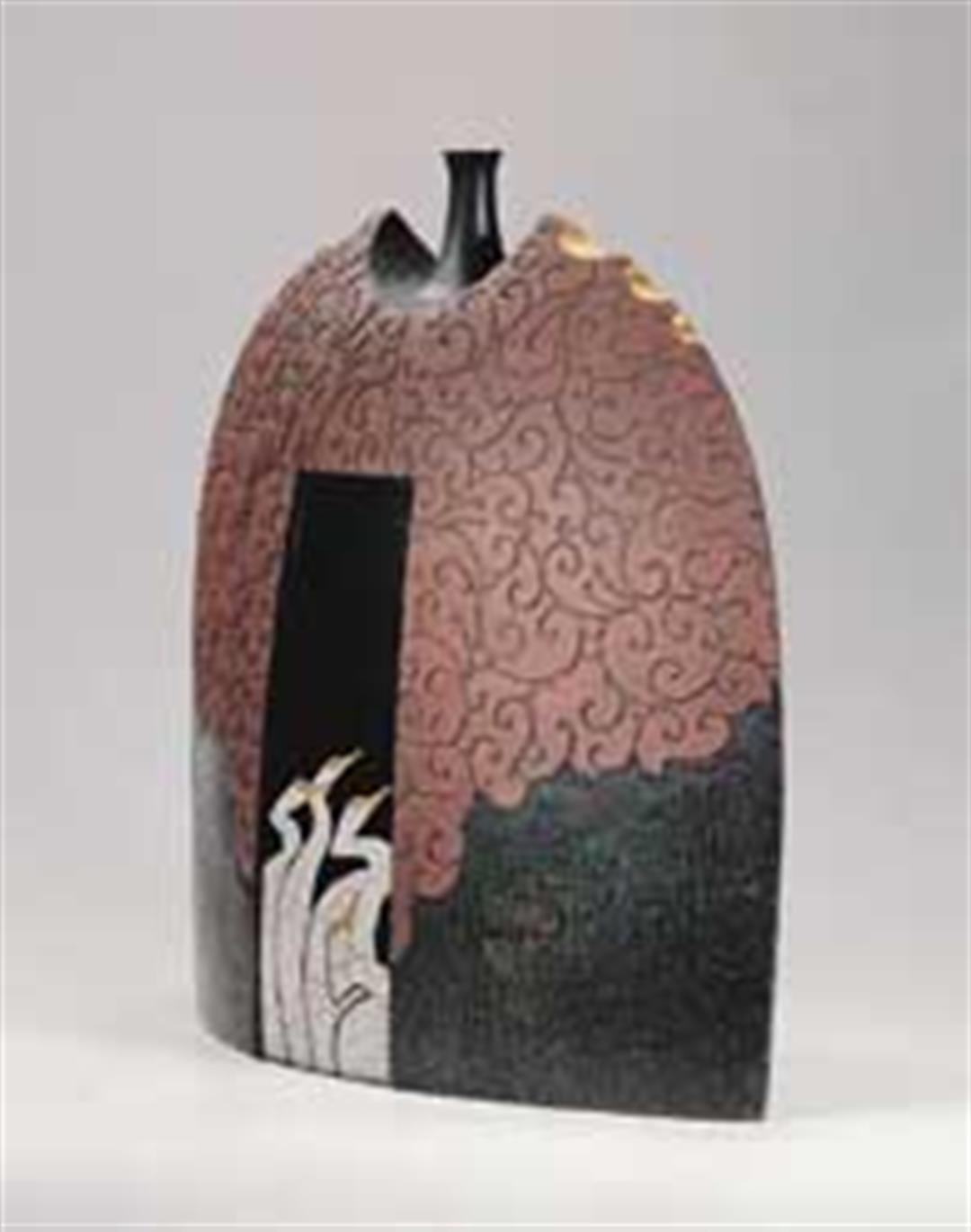
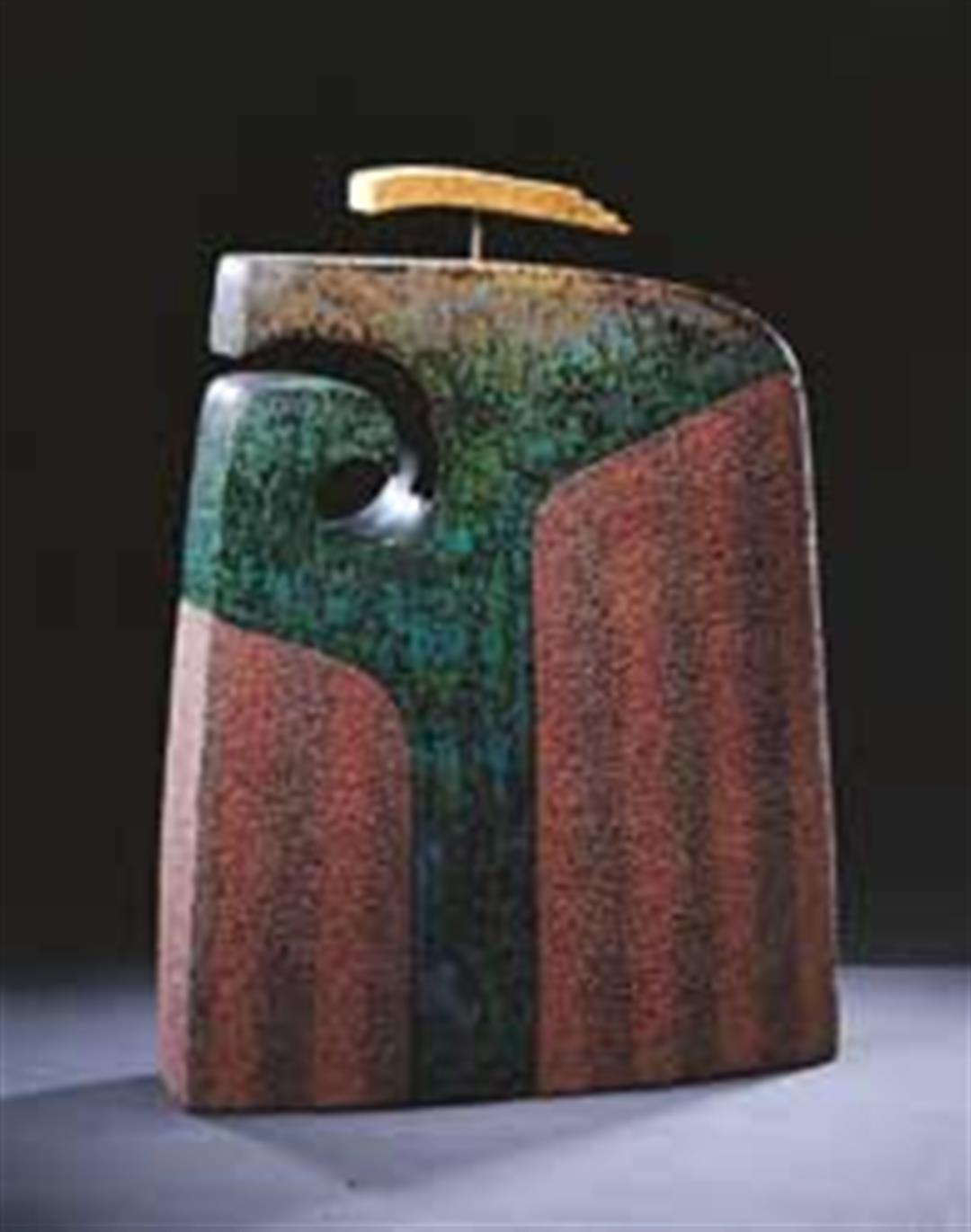
Many years of blood, sweat, and tears went into the marriage of lacquer and pottery. Li's My Sky won a prize at the first Traditional Crafts Awards ceremony in 1998.
Teapot master goes his own road
Li's first teapot exhibit was in 1988 at the Taipei-Lukang Gallery. This was followed by an invitation to put on the World of Teapots traveling exhibit across Taiwan in 1990, and he also published a book entitled A Collection of Li Hsing-lung's Teapots. The poet Kuan Kuan wrote in his preface to the book: "A potter is like a mother, taking lumps of clay and making them into little clay babies. Li has become a 'mother' at such a young age, and the striking thing is that every one of his teapots is so unique. Each has its own 'facial features' and personality."
Li by this time had achieved considerable recognition in Taiwan for his skills, but he wasn't satisfied, and so in 1991 he went to Yixing, a famous pottery center in China's Jiangsu Province, to learn the secret of how the teapots from there got to be so perfect for the function of brewing fine teas. Studying under master potter Qin Youtao, Li learned to make Yixing-style teapots. His aim was to combine artistic sense and utilitarian excellence in his works.
By 1991 the 27-year-old Li had reached a crossroads in his career. He had won fame and respectable market share among collectors with his unique teapots, but he was restless to break away from the utilitarian teapots that were keeping him in business. He was already experimenting with purely artistic teapots, but in fact he had not gone into pottery with the idea of making teapots at all. He wanted to do ceramic art, no matter what the form. In 1988 he had taken second prize with a pair of vases called Traditional Door Gods in the first Taipei County Arts Festival. In the following year he again took second prize with a ceramic vase (Harmony) in the 16th Taipei City Arts Festival. His incorporation of beautifully executed folk art decorative elements into traditionally crafted vases did not go unnoticed in the arts community. But the question was whether he should walk away from the fame he had gained as a teapot master, and forego the steady income that teapots brought in.
One day the conflicted Li picked up a hunk of clay and told himself: "What the hell. I'm young. If it doesn't work out, I'll land on my feet somehow or other." And so he left teapots behind to concentrate on modern pottery.

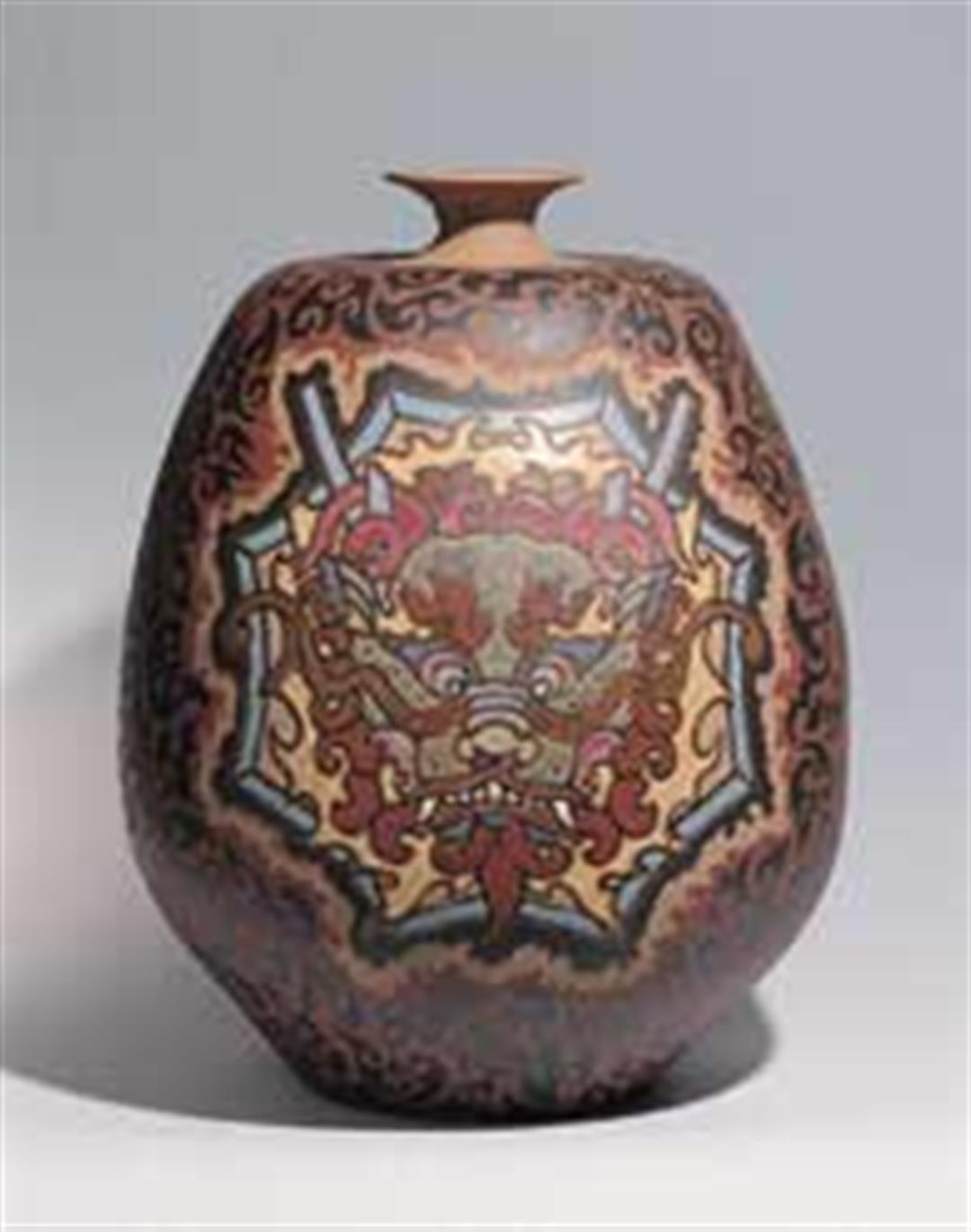
The luster of Black Pottery shows up all the more brilliantly when offset by lacquer and gold foil. Shown here is Dragon, a new work in Li's Jet Black series. (photo by Jimmy Lin)
Mixing tradition and modernity
There is an unmistakable flavor of local culture to the colors, linear patterns, and manner of artistic expression in the work of Li, who asks: "Why can't we express our own culture in works of modern ceramic art? People doing modern ceramic art have always played down local culture, so I decided to seek creative motifs in my ethnic background. That fits in well with today's emphasis on things rooted specifically in Taiwanese culture."
After embarking on his new path, Li at first made heavy use of the motifs appearing in traditional paintings used for celebrating Chinese New Year. The most famous of his works in that genre was Awakening China, for which he won the first Award for Folk Arts in 1992; the combination of elegant linear patterns and a distinctively Eastern color scheme injected a strong note of ethnicity into modern ceramic art. In that same year Li also won the seventh Nanying Fine Arts Award with A Daughter Prepares to Marry, which incorporates the colors and linear patterns of traditional Chinese clothing into a modern design, subtly expressing the curvaceous beauty of the Oriental woman shyly ensconced in her maiden's quarters.
Sung Lung-fei, a modern ceramics critic and former editor-in-chief of the National Palace Museum Monthly of Chinese Art, has been high on Li ever since he first started producing modern ceramics. Says Sung: "Li Hsing-lung's works have always expressed the social psychology and customs of ordinary people. It's not just anyone who can pick out the commonplace things we don't stop to notice. And the things he zooms in on provide a sense of direction for modern ceramics from the standpoint of both decorative effect and artistic creation. At a time when most ceramicists are feeling ambivalent about tradition and flocking to Western trends, Li has managed to take a fresh look at tradition and make a place for it in modern art. My hat is off to Li for his spirit and his courage."
The string of prizes won by the New Year's series bolstered Li's confidence and made him the first modern ceramicist to work in-residence at the Museum of Contemporary Ceramics. Head curator Yu Po-wen describes Li as a "professional" ceramicist, by which he implies two things: first, a distinctive personal style capable of expressing the artist's thoughts; and second, a willingness to work hard on one's creations. Yu comments that some ceramicists in Taiwan are long on personal style but lack the work ethic, while others are hard working but don't real have anything truly distinctive to offer.
With the museum acting as his professional agent, Li was able to concentrate on his art and take part in lots of competitions. From 1988 when he took second place in the Taipei County Arts Festival, through 2001 when he received an award in Japan, Li entered nearly 50 competitions at home and abroad (including New Zealand, Portugal, Australia, and Japan). His creativity is stunning, as is the regularity with which he brings home prizes. The recognition is a great encouragement for Li, and spurs him to work all that much harder.

The artist's eternal quest is "to go where no artist has gone before." With A Life of Books (part of the Written Word series), Li has taken thousands of Chinese characters fashioned from lead type and applied them in densely packed rows onto a fired ceramic piece. It is a means of expressing his appreciation for the importance of the written word in transmitting culture.
It's all pottery
Li feels that the most important part of artistic creation is the concept, which he says is seven-tenths of the life force in a work of art. But he laments that ceramicists in Taiwan either ape Western fashion or get trapped in the confines of tradition; the former have been swept away in the powerful current of Western art, while the latter piddle away at their antiquarian copycat pursuits without injecting any note of modernity into their work. For many years now, by contrast, Li's oft-changing and unique style has shown through clearly in his many series, including New Year's Paintings, Heart of the Flower, The Written Word, Mountain Dialog, On Stage, Analysis, Woven Patterns, Lacquered Pottery, and the series he is now working on, Jet Black.
His ability to make everyday objects the subject of his works makes Li's art extremely interesting. Once while driving through the Yangmingshan mountains north of Taipei he happened across a big field of calla lilies shrouded in thick morning fog, and was inspired to study up on flowers. His studies once prompted him to make a special trip in the middle of the night to Tienwei Rural Township in Changhua County to watch the flower farmers carefully tending to their daisies by the light of electric bulbs. Moved by the flowers and the farmers who grew them, Li eventually came out with his Heart of the Flower series, featuring the orchids of spring, the lilies of summer, and the daisies of autumn. Li included three flowers in his works, with the spring flowers still in bud, the summer flowers in full bloom, and the fall flowers having lost their petals and gone brown. It was his way of emphasizing Taiwan's four seasons and symbolizing the planting of spring, the tending of summer, the harvesting of autumn, and the fallow idleness of winter. His work won a prize at the fifth Awards for Folk Arts in 1996.
In the Written Word series, Li takes thousands of Chinese characters fashioned from lead type and applies them in densely packed rows onto fired ceramic pieces. It is a means of expressing his appreciation for the importance of the written word in transmitting culture. The Mountain Dialog series expresses his concern for environmental preservation. In this series he shows indiscriminate building on steep mountain slopes and destruction of scenic beauty, followed by the backlash of nature in the form of landslides wreaking havoc on future generations. He creates a mountainscape to express the oblivion into which the mountains have fallen, and the precious natural resources that lie stored up there, such as the nighttime canopy of moon and stars; people, birds, streams, and trees; and the changing of the seasons. All this he does in the hope of stirring viewers to a concern for nature, that from this concern there might spring forth understanding and action to return nature to its original state.

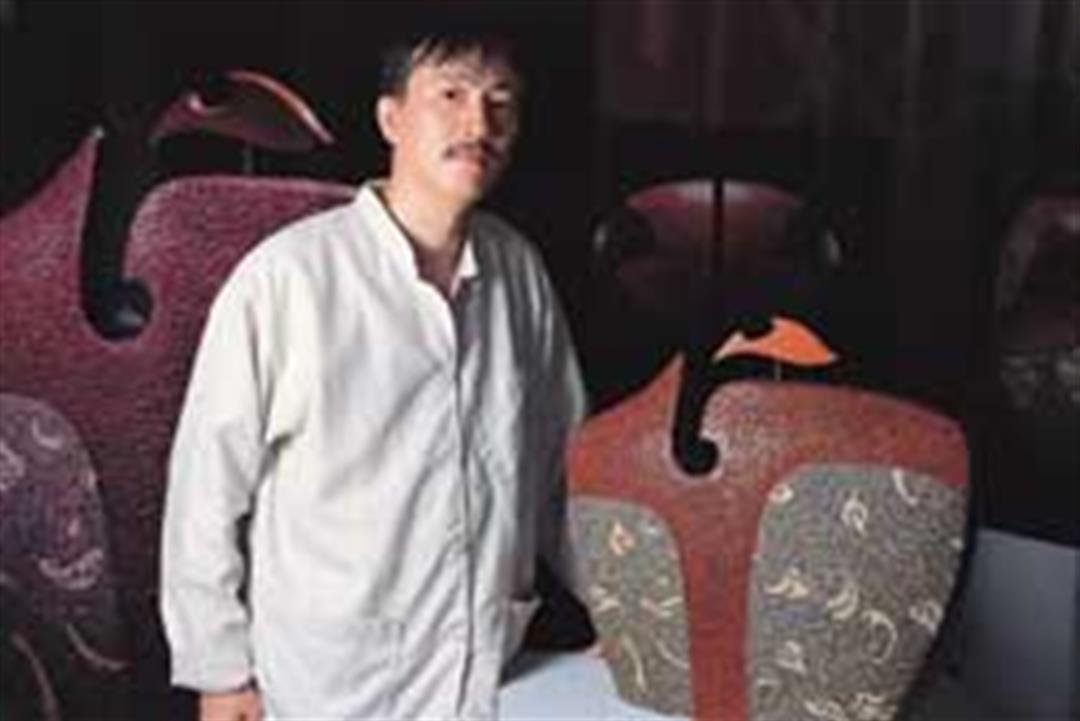
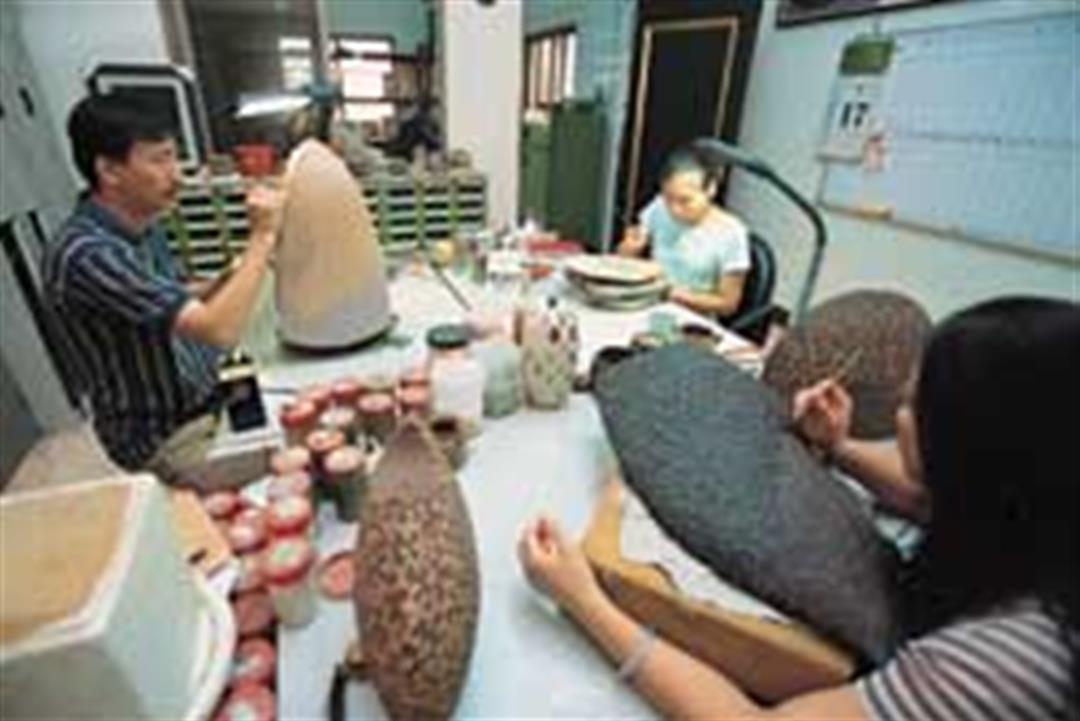
Composing, drawing, sculpting, and applying lacquer can all be part of the limitless world of ceramic art awaiting Li Hsing-lung's creative energies. (photo by Jimmy Lin)
Pushing the envelope
One of the most important tasks facing the artist is to infuse life into his work and make it more artistic so that it will offer greater value to collectors. That is what prompted Li to strike upon the idea of combining pottery with other forms of art. In 1995, as he was pondering how to give his works an increased feeling of light and texture, the first thing that popped into his mind was glass. To understand the production of glass he traveled south to Santimen in Pingtung County to study under the Aborigines there. The venture wasn't a complete success because he later encountered difficulties when he attempted to work the glass into his pottery.
He then turned his attention to lacquerware. Pottery is solid and simple, while lacquerware is fancy and ornate. The result of the communion between ceramic and lacquer can be seen from a distance, and it can also be appreciated from up close. And so in 1996 Li took up a year-long apprenticeship under Lai Tsuo-ming, who comes from a long line of lacquerware masters.
The lacquerware was little more than a dalliance at first; only after starting up the apprenticeship did Li learn how complicated its production process was. All too aware of the staggering physical and emotional commitment that pottery had already exacted from him, the prospect of plunging deeply into yet another branch of artistic endeavor gave him pause for thought. He had already experienced the number one scourge of lacquerware production-a terrible case of sumac poisoning through exposure to the lacquer. His skin swelled, blisters formed, and the itching drove him wild. It took months to develop lacquer tolerance. Once he finally made it through the "baptism of itching," however, he decided he would stick it out.
In combining lacquer with pottery, Li departed from the way lacquer is usually used. His objective was to achieve a new kind of texture and break with the norms of traditional lacquered pottery. Artists before Li simply took pottery as the base for the lacquer, while Li sought to preserve the linear patterns and texture of pottery along with the "layered light" effect of lacquer right on the surface of the finished work, thereby adding to its visual impact and achieving a melding of these two millennia-old art forms and blazing a new trail in the arts.
To combine lacquer and ceramics, the first task is to increase the porosity of the ceramic piece so as to aid adhesion by the lacquer. This requires experimentation with clay mixtures and firing techniques. The best way, Li found, is to add powder from pre-fired clay before the clay piece is fired. The more powder is added, the more porous the ceramic becomes upon firing. The other important point is to keep the firing temperature at around 1200 oC, which also increases porosity.
In 1997, Li established a lacquered pottery workshop, and in 1998 he put the workshop's lacquered pottery on exhibit. He invented a new Chinese character, Q, as the identifying mark for his lacquered pottery. The left side, '√, is the ancient Chinese character for lacquer, while the right, A?, is the ancient Chinese character for pottery. Q represents the combination of these two art forms. For Li, this is only the beginning
Unlimited possibilities
Li has been working for the past few years to revive the Black Pottery of China's prehistoric Longshan Culture. This was a type of low-fired pottery, soft and relatively quick to weather or dissolve, and susceptible to discoloration under exposure to sunlight. To enhance the collector's value of Black Pottery, Li had first to find a way to fire it at a higher temperature. After three years of experimenting, he finally hit on success. Firing the pots in an electric kiln, he took the temperature first to 1230 oC then turned off the kiln and waited for the temperature to drop to 1000 oC, at which point he would stuff a lot of camphor balls into the kiln through the peephole. Upon exposure to the high temperature, Li learned, the camphor balls would throw off carbon and thick black smoke in great quantity, imparting a black finish to the pottery. In the course of his experimenting, Li found that the pots were most absorbent at 800 to 1000 oC, so timing was key to getting the best results. As the temperature drops further, the pots don't blacken so well.
But there's more to blackening than just exposing the pottery to black smoke. The clay itself must be high in iron oxide for the smoke to penetrate. After trying many different types, Li finally settled on red clay from a couple of different places (Chingshui Rural Township in the Tatu Mountains, and Yuchih Rural Township in Nantou County). Li's "neo-Black Pottery" features clean, simple lines and decorative elements of lacquer and gold foil to offset the stark blackness of the pot itself. He plans to exhibit his Black Pottery for the first time next year.
More and more people in Taiwan have been taking up pottery in Taiwan since the advent of modern ceramics in the 1990s. Li stresses that pottery requires a wide assortment of different skills. The artist must be expert at throwing pots and mixing glazes, must know all about the structure of kilns and methods of firing, and must further be an accomplished sculptor and painter. And despite all that skill, firing pots in a kiln remains a black art; even a potter of nearly 20 years like Li must put up with a failure rate of 10 to 15%. Li advises potters to turn the frustration of failure into inspiration, using the rejects as an occasion to look into the reasons for failure and find a path to success. The subtle psychology of pottery is precisely what attracts so many to it.
"Work hard to be the best you can be." That is Li's advice for those thinking of taking up pottery, and it's also what he demands of himself. He points to glazes as an illustration of his point. There once was a time when each potter had to study and experiment endlessly to get just the right color. Today, by contrast, glazes can be bought in many different ready-mixed colors. But for the ceramicist who really wants to create something new, there are still a lot of colors that can't be bought off the shelf, so learning how to mix one's own glazes is the only way to open the door to unlimited artistic possibilities.
When asked what other materials he would like to combine with his pottery, Li goes deep into thought and starts naming some surprising materials, counting off on his fingers: Glass, wood sculpture, metal, stone. . . . I couldn't help feeling a surge of anticipation as I listened, wondering how long I'd have to wait before this restless young ceramicist would come up with his next big breakthrough.