The Fire Beneath the Snow--Yang Mu
Kuo Li-chuan / photos courtesy of Yang Mu / tr. by Jonathan Barnard
April 2007


"I believe that poetry is a language of emotion. A poet has no greater satisfaction than when, if writing for a star or a cloud, the star or cloud understands his language; or when, if writing for a person, the person understands his language."--Yang Mu, in the afterword to Water's Brink.
Unlike many famous writers of his generation, Yang Mu didn't flee mainland China for Taiwan. Rather, he is a native, born and raised on the island. In the 1950s, when many writers were recalling the scenery of the mainland, Yang Mu wrote about the landscape of Hualien, which nurtured and comforted him. Yang's work--a mixture of starlight, Taiwanese children's songs, Chinese parasol trees and pebbles, as well as the surging Pacific Ocean and towering Mt. Chilai--is colored by sweet and salty memories of childhood.
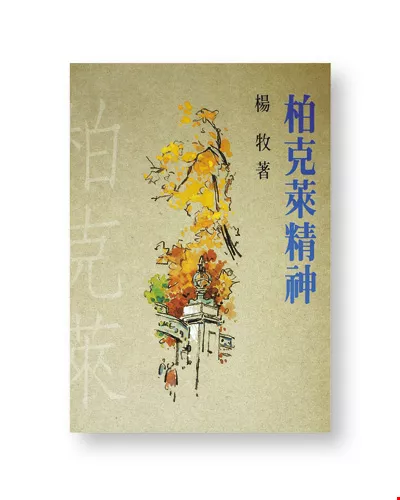
In 1975 Yang Mu returned to Taiwan to publish his observations and feelings about Taiwan in The Berkeley Spirit.
Japan, Chiang Kai-shek, Aborigines
Yang Mu was born in Hualien in 1940. His father, who was surnamed Yang, ran a printing factory. But Yang Mu was born Wang Ching-hsien; he bore his mother's family name. When he was a child, he loved to watch clouds and especially enjoyed studying their reflections on the surface of water as they slowly changed shape. He was also fond of gazing at the moon and counting stars, for which he would drag his mother from her bed in the middle of the night to their home's doorstep. When she grew too exhausted, the small and bossy Yang would sometimes try to rouse his father to replace her on watch. In the moonlight, his mother would sing to him: "In the bright moonlight, the scholar rides a white horse...." She hoped the lullaby would coax him to sleep.
He was born amid the turmoil of World War II and its food shortages. When he was five, the family moved to an Amis tribal village to avoid US bombing raids, and he experienced love from a stranger, a Japanese policeman:
"That year the whole village--without telling the Japanese police--went up the mountain to gather firewood. I can still remember the tremendous crash that a huge tree made when it fell. Afterwards, a policeman in a raincoat came up the path and stared at me through the mist. Everyone else had gone, so he asked me who felled the tree. I said: 'Our whole village needs firewood.' He raised his head and, at a loss for words, laughed. He then patted my head and departed. At that moment I had experienced the love of a stranger."--"But Love Me for Love's Sake."
At the end of the war, he returned to downtown Hualien. In 1949 Chiang Kai-shek led a million soldiers and other mainlanders to Taiwan, and soldiers turned his elementary school into their barracks. He and his classmates were sent to have class in the City God Temple instead. "I always had a very insecure feeling in class there. What with the burning of ceremonial money and incense, the whole atmosphere was nerve-wracking and terrifying."
When Yang was a senior at Hualien High School, Chen Chin-piao, a recent graduate, gave him a copy of the Kung Lun Pao newspaper's Blue Stars Poetry Quarterly to read. Soon Yang was publishing poems in Blue Stars under the pseudonym Yeh Shan. He was only 16. At the time Chen was preparing to publish his own poetry journal and asked Yang to be his assistant. Seagull would appear as a Monday supplement in the Eastern Taiwan Daily News.
With a place to express their opinions, they wrote with even greater relish. As editors, they also published their own poems. Every Monday, Yang would ride his bike to the newspaper offices to get a copy of the paper, and would eagerly open it up on the way to school: "The smell of fresh ink wafted from the lines of print. That smell spread through the morning corridor, as vigorous as the poems themselves, possessing a mysterious beauty, a magical destiny." Yang Mu thus recalls the sounds of voices echoing, the air thick with the smell of newsprint and joy of a young poet.
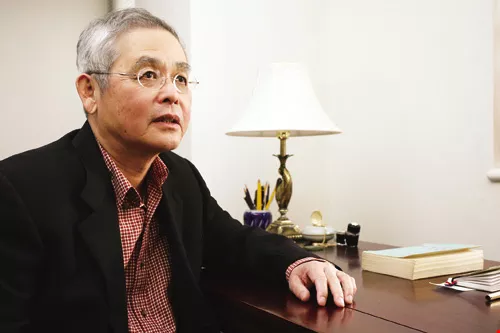
The poet Yang Mu's rich and fluid writing style is steeped in deep feelings for his hometown of Hualien. Both his literary and creations and his academic work have had a big impact on Taiwan's literary realm.
The images and music of poetry
In 1960 Yang Mu published his first collection of poetry, Water's Brink, which his father's company printed. Its cover was designed by sculptor Yang Ying-feng, then editor-in-chief of the Chinese-American Joint Commission on Rural Reconstruction's Harvest fortnightly. Yang Mu, who was studying at Tunghai University in Taichung, specially went north to visit him.
"Speak of my past days of wandering! / I've returned from the fog. / The evening clouds neither leave in a huff nor offer parting words. / Speak of starry nights; / The fog was thicker and heavier. / Remember water spraying from the fountain and laughter surfacing. / No more wilting love, no more worries. / Speak of my incomplete star drift! / From the fog, I've returned...."
"Return" was written in 1956, when Yang was only 16. So what sort of "days of wandering" could he have experienced?
Given that question, Yang Mu pauses to think, reflecting upon what was going through his mind when he penned those words: "There was a stage of life, neither long nor brief, when I was searching for something, where I wandered in the realm of my will and imagination. There was a kind of joy in finding poetry, and poetry has since become my hometown."
With regard to his process of poetic searching, Hu Chu-ching, a Chinese literature teacher, inspired him a lot. Even though Yang never left his home, he had absorbed a sense of the feeling of exile from his teachers who were mainlanders. What's more, he knew the story of his mother's sister who had eloped to the mainland with her husband-to-be during the Japanese era and then returned after the disruptions of war. Through guesswork and by capturing the loneliness of his mainlander teachers, who had been forced into exile, he wove storylines about wartime turmoil and displacement into tapestries of foreign lands and strange customs:
"Memory is a stone marker, erect amid the silence / The clouds of wandering linger / Linger like sadness! / Memory is a stone marker, erect amid the silence."--"Words after Death."
Water's Brink mostly comprises poems he wrote during high school, which reflect the literary awakening of that era. Taiwan poetry was gradually modernizing as the dust was clearing after the war amid a powerful "invasion" of Chinese. On the one hand, the literature of Taiwan was nourished by Japanese literature; but on the other hand it was absorbing styles of contemporary poetry popular in Shanghai and developing a native Taiwanese style. The most important journals of poetry were Modern Poetry, Blue Stars, and Epoch Poetry Quarterly.
Yang Mu's second book of poems, Flower Season, collected the poems of his college era. That was the era of such periodicals as Literary Review, Literary Star, Modern Literature, and Pen Compendium Monthly. It was also a period when there was especially fervent debate about modern poetry.
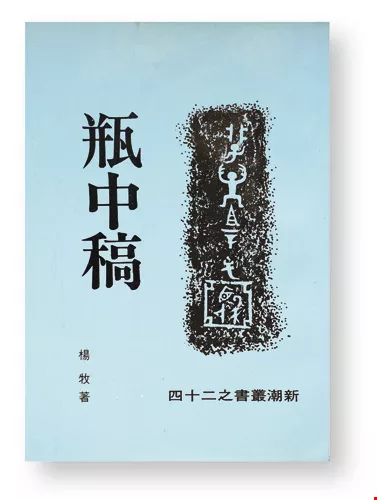
Yang's collection Message in a Bottle came out in 1975.
His mother's vocal rhythms
When he was small, there was an easy mix of Taiwanese and Japanese in Yang's home. Yang's mother was from Taipei, and she put great stock in the proper pronunciation, so although they lived in distant Hualien, they still maintained the Taipei accent. When Yang's classmates spoke with muddled accents, his mother would correct them. His mother's sensitivity in this regard influenced him, so that one of hallmarks of his poetry is its musicality. He once said, "I learned from the calls of peddlers, such as those selling soy milk. I also learned from the deliberate sounds of classical poetry and the unfamiliar sounds of foreign literature."
Techniques used in Western music and English poetry also provided inspiration. In Flower Season, he attempted to convey the wonder and mystery of "musical composition": "The music of poetry refers to the rhythm and sounds of verse, the logic to the rising and falling flow, and the appropriate volume and speed. These all ultimately rely on the author's control over a poem's main theme."
"I'm not an orchard; I'm a lush forest / I'm not a lake / I'm a vast ocean containing a sinking sword / As we turn and turn / Let's use our hidden sadness to spark ourselves / And then explode to fill the space between Heaven and Earth / At that moment, I will become another constellation / Guiding the way for wanderers on horseback."--"While We're Turning"
Majoring in foreign languages at Tunghai, Yang began to read works of Western literature in earnest, but he also frequently sat in on lectures in the Chinese department. When he was a senior, he met Paul Engel, a professor at the University of Iowa who had come to Taiwan to meet young writers.
Previously, any foreign atmosphere in Yang Mu's poetry came from his imagination. He went on frequent travels in his poetry, visiting Brussels, Madagascar, Rome, Greece and elsewhere, but in real life he had never left Taiwan. "As a modern person," Yang says, "one ought to keep an eye out for opportunities to surpass oneself in a new place." On the day that Engel appeared at Tunghai University, the idea of traveling to some foreign land turned from something imaginary into a real possibility. Engel's advice: "Come to America to study!"
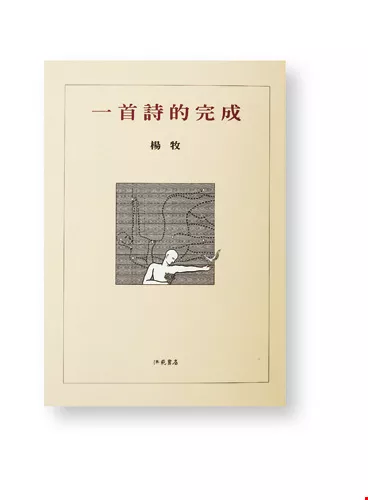
In 1984 Yang Mu began Finishing a Poem, a collection of 18 epistolary essays, which he wrote over the course of four years. The book's analysis of poems' form and content has greatly assisted younger generations of poetry students.
The impact of America
After college Yang performed his military service on Kinmen. "In that first year after graduating from college, I truly sensed the impact of real life. Suddenly I felt a lot of concern for the impoverished land of my youth." He asked himself: "Shouldn't literature serve society? And what kind of literature can serve society?" In one year on Kinmen, he wrote more than 20 essays. The darkness and beauty of his Hualien mountains and coast were interwoven with images of battlefield lanterns.
From that point on, literary essays would play an important role in Yang's output as a writer. Yang emphasizes: "Poetry is a compressed language, but you can't always speak a compressed language. Particularly when you want to directly and quickly serve society, compressed language isn't likely to be effective." He once discussed with the poet Ya Hsien the problems of "poets writing essays," and Ya Hsien made a marvelous analogy: "It's like Taiwan Sugar Corporation, which not only produces sugarcane but also calcium pills and particleboard from the leftover sugarcane fiber."
In 1964 he went to Iowa. Because Engel had actively recruited Taiwanese students to study creative writing there, the University of Iowa was a hotbed of cutting-edge Taiwanese writers. Those who preceded Yang included Yu Kuang-chung, Yeh Wei-lien, Kenneth Pai, and Wang Wen-hsing. Later, when Engel married the writer Nieh Hua-ling, they established an international writer's program, and Ya Hsien, Cheng Chou-yu, Huang Chun-ming, and Wang Chen-ho would also go there to study.
In less than two years, Yang earned his master's and entered a doctoral program at the University of California at Berkeley. Back then, wars raging throughout the world had triggered vibrant protest movements: the Chinese Cultural Revolution, the Vietnam War, Panamanian protests about American control over the canal.... In 1964, after the United States launched major air strikes against Vietnam, there was a wave of protest against the war within the US, and young students threw themselves passionately into anti-war demonstrations. It reached a boiling point in 1967, and nowhere were the protests more fervent than Berkeley.
At a campus that was especially sensitive to politics, in a social milieu that had been rocked by a war on foreign soil thousands of miles away, Yang Mu bid adieu to the fantasies of his youth.
"Berkeley's Free Speech Movement and its spirit of protest opened my eyes. They made me observe and experience society more critically. Apart from changing the way I observed and experienced things, they also had a big impact on my belief in the power of knowledge. Knowledge is power. But knowledge can't be confined to college campuses. Knowledge must be released into society. That's real power."
With this realization, in 1970 he edited a series of books with Lin Heng-che, a medical doctor and strong promoter of Taiwanese culture. New Wave Collection introduced Taiwanese students to important works by contemporary Western writers. Published by Chih Wen Publishing, this set of books opened windows to the outside world for young Taiwanese still living under martial law. They had a big impact. The following year, he earned his doctorate in comparative literature at Berkeley and took a post at the University of Washington in Seattle. His academic career was launched.
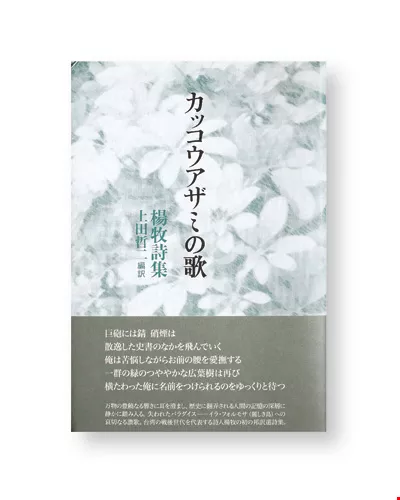
The Japanese writer Tetsuji Ueda translated a collection of Yang's poems for a Japanese edition that Ueda also published.
Social observations
After moving to Seattle, Yang Mu specially recorded his thoughts about the abundant salmon take in nearby waters. In Tree Rings, he writes:
"The behavior of salmon is odd. They use their tail fin and their cold blood to sense the season. In the ocean they try to swallow little fish and shrimp, as they grow big and strong, striving to produce many fertile eggs. Then they begin their dangerous journey to their ancestors' hatching grounds, which are also their dying grounds. Where there is birth, there is death. People would easily have gotten lost."
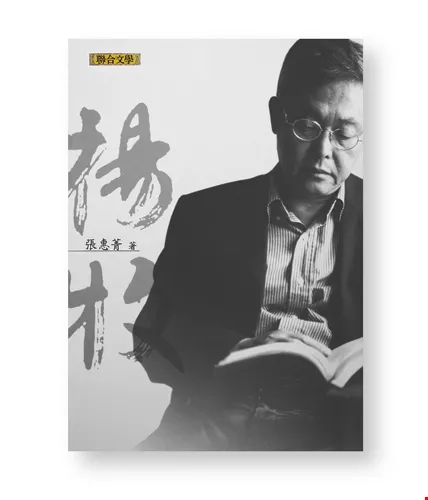
In 2000, when Yang Mu won a National Award for Arts, the writer Chang Hui-ching wrote a biography of him.
Are people really so easily lost?
In 1972, Yang Mu returned to Taiwan, eight years after leaving it. His hometown of Hualien seemed to have a cleansing effect on him, enabling him to reflect on his past. He suddenly decided to cast off the pseudonym that his readers were familiar with--Yeh Shan--and start anew. He began to write under the penname Yang Mu for the first time that year, in Pure Literature magazine. In the preface to his book Message in a Bottle, he wrote:
"Suddenly floating in society with these friends, I naturally had a feeling of loneliness like that of fish.... Perhaps because of the instinct common to all living things, eventually, as the tide pounded against the reef, I felt the pull of a river, heard a call, and happily swam against the current toward the waters of my ancestors' struggle and destruction."
In 1975, Yang Mu returned to Taiwan as a visiting professor in the department of Foreign Languages and Literature at National Taiwan University. He put together his observations about Taiwan society and culture during this period in his book The Berkeley Spirit. The book covered a wide range of material--from the misguided reverence that people in Taipei gave to those returning from study abroad, to pollution in Hualien, to his doubts about the Changhua County Government's plans to tear down a Confucian Temple. Time and again, he demonstrated his intention to actively focus on social concerns. It represented a major turn in his literary career.
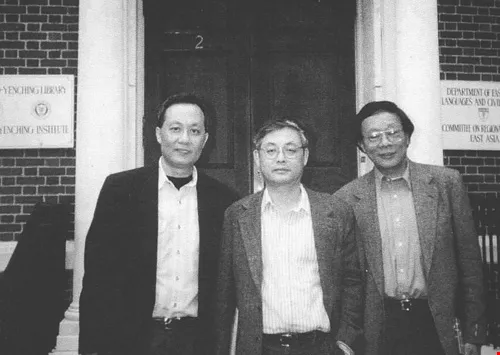
In 1998 Yang Mu (center) was photographed with the poet Chang Tsuo (right) and literary critic Li Ou-fan (left) in front of the Harvard Yenching Institute.
Democracy's awakening and reflection
Yang then returned to Seattle. Yet even though he was based abroad, he never stopped making observations about Taiwan. In Seattle Journal, he wrote about the Formosa Incident of 1979. He compared it to a big snowstorm at the end of winter, coming down hard just when people thought that spring had arrived. It was like a warning to people that winter wasn't over, that the White Terror had not yet truly passed, that spring was still a ways off.
Taiwan underwent birthing pains as it moved toward democracy, and reactionary counterpressure was fierce and relentless. After the Formosa Incident, the Taiwan print media reported in detail the judicial process. Yang Mu and friends who had likewise gone to America were deeply affected, and decided to draft a statement, which they all signed. Novelist Chen Juo-hsi then brought it back to Taiwan to give to President Chiang Ching-kuo. The letter described how the government did not keep its promises and turned people into criminals, and it pled on behalf of literary figures such as Wang Tuo who had been arrested in the wake of the incident.
In 1980, after the murder of the mother and young daughters of Lin Yi-hsiung, a human rights lawyer arrested in the Formosa Incident, was covered in the papers, Yang Mu angrily wrote "A Song of Sorrow for Lin Yi-hsiung."
"More was lost than a mother and daughters / Peace in the land, the promise of time / Tears surge into three generations' still-warm blood / On a suspicious, gloomy noon / Say goodbye to love, benevolence and expectations / Lost, lost is the difference / Between man and beast / Light and dark, discipline and knives / Harmony and explosion...."
In the poem Yang Mu uses the raging sea off Ilan to convey all the pain and sorrow he felt about this incident. He could not accept the authorities' "stupidity, arrogance and cruelty." The poem was censored, banned even from inclusion in his collection Some People in 1986. It wasn't published until Yang Mu's Collected Poems (II) came out in 1995.
Yang explains that he had never written "so direct, so loud a poem." It represented a change from his previous attitude of keeping a distance from politics. In The Sceptic: Notes on Poetical Discrepancies he couldn't hide his doubts about the democratic system:
"You cast a ballot for cabbages, letting them represent you in the 'Democratic Paradise' where they and others elect some oaf to be the great leader, and where they raise their hands to pass laws that will control you."
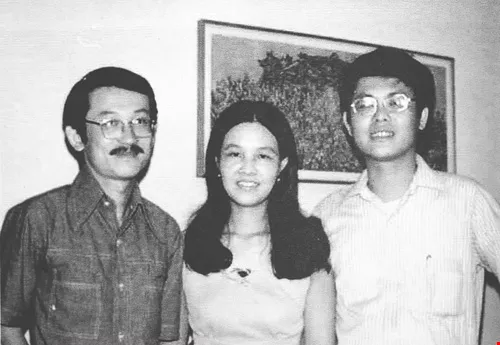
A 1970 photo of Yang Mu (right) during the innocence of his youth with novelist Wang Wen-hsing (left) and Wang's wife Chen Chu-yun (center).
Landscape essays
In 1983, Yang returned to National Taiwan University as a visiting professor, and he contributed a weekly column to the United Daily News titled "Interchange." The following year, he reflected upon a letter from a reader on a drive south to Taichung, and that night he wrote his first "letter to a young poet." Over the next four years he would write 18 such epistolary essays, which would be collected in Finishing a Poem. These discussed the meaning and methods of poetry and analyzed poems' form and content. He also described what he regarded as an ideal poem:
"Poems are without any goal. They travel beyond any social purpose, floating beyond the pursuits of people. But the poet, sharp like the cold tip of a sword, often realizes himself in the joys or sorrows of what he hears and sees himself, clarifying what is false and hypocritical, hacking through debased sophistry, getting rid of all the foolish details. In a confined space, poems expand boundlessly, leading you to the truth."
Over the course of a decade beginning in 1987, Yang Mu completed his masterpiece of personal essay writing: Chilai, the Prequel, which was constructed from three separate books: Mountain Winds, Sea Rains, Direction Returns to Zero, and The Old Me Is Gone. The work accurately records his early childhood, his days of development and searching as a student, and then his grabbing hold of what he ultimately wanted to do with his life: writing poetry. Describing the landscape of Hualien, the work served as a model for Taiwanese "landscape essays" and "geographical literature."
In 1996 Yang Mu finally returned to his hometown of Hualien, where he served as the first head of the College of Humanities and Social Sciences at National Dong Hwa University. There, at the suggestion of Wu Chien-cheng, director of the foreign languages department, and Professor Tseng Chen-chen, he established a Graduate Institute of Creative Writing and English Literature, the first of its kind in Taiwan. In place of master's theses, students produce creative manuscripts. And he founded a "writer-in-residence" program. Each year a different writer comes to the school to teach classes.
In 2000 Yang Mu won a National Award for Arts, and the following year he left Dong Hwa to become the director of the Institute of Chinese Literature and Philosophy at the Academia Sinica. After retiring in 2006, he returned to teaching, alternating between Dong Hwa and the University of Washington.
Yang Mu never stopped writing. Over his career as a professor and creative writer spanning half a century, he has produced some 40 or 50 works in all. These include poetry, drama in verse, essays, translations, criticism and anthologies of famous works. His work combines the poet's sensitive and melancholic aesthetic and the social critic's incisive, self-reflective style. His work's impact on Taiwanese literature runs wide and deep.
Although his life includes his wife Hsia Ying-ying and a beloved only son, Yang Mu is in the habit of pondering matters alone. "Solitude makes me happy," he says. "I seek out and indulge in solitude as much as possible." How many opportunities does one person have in one lifetime? Solitude leads to reflection, and in reflection one can completely face oneself.
As Yang Mu works in a corner of his study, all one can hear is the rustle of turning pages. The hubbub, bustle and neon exuberance of Taipei are shut outside. The night gradually turns silent....
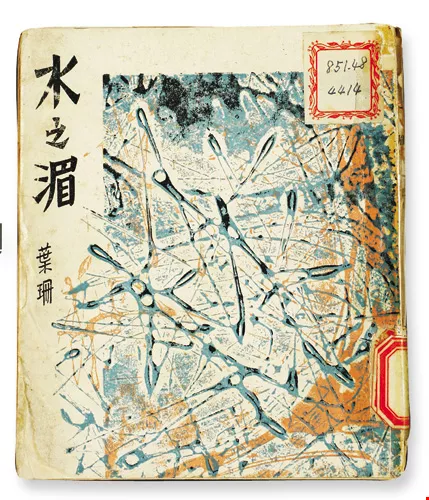
Yang Mu's poetry collection Water's Brink came out in 1960. Its cover was designed specially by sculptor Yang Ying-feng, who was then editor-in-chief of the Chinese-American Joint Commission on Rural Reconstruction's Harvest fortnightly.
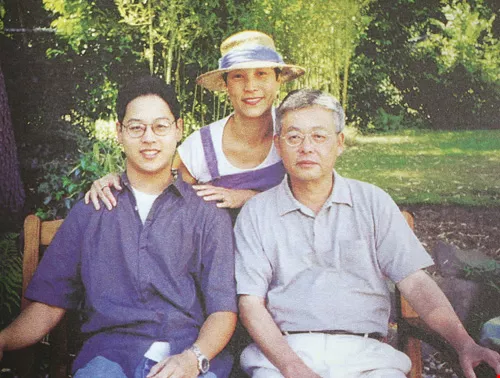
Introspective and intellectually incisive, Yang Mu (right) cherishes solitude as an opportunity for deep reflection. His wife Hsia Ying-ying (center) and his only son (left) make his life whole.
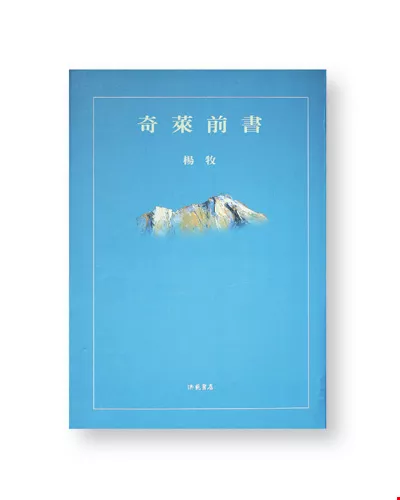
Yang Mu took ten years to write Chilai, the Prequel, a collection of autobiographical early essays that are models of the genres of the geographical and the personal essay.

@List.jpg?w=522&h=410&mode=crop&format=webp&quality=80)


