Returning to the Fray
Day Sheng-tong’s Second Act
Chang Chiung-fang / photos Chuang Kung-ju / tr. by Scott Williams
March 2013
Day Sheng-tong’s long and illustrious career has included serving two terms as chairman of the National Association of Small and Medium Enterprises and accompanying former presidents on more than 10 state visits to Taiwan’s foreign allies. Once known as “the hat king,” he saw his 30-year-old hat manufacturing business collapse a few years ago after an investment in Haiti turned bad. He went from being the head of a leading SME to selling his factories, his company, and even his home to pay debts that ran to NT$600–700 million.
Following a five-year hiatus, Day has jumped back into the fray with a new company. As author Jiao Tong has remarked of his friend Day’s successful reinvention of himself as an expert on food and travel: “Do you have to be so graceful even when getting up from a fall?”
When Day Sheng-tong launched the bimonthly magazine Taiwan VIP Travel in February 2013, he marked the event with a press conference attended by his wife and son, his friends in the hospitality industry, and his friends in the press.
Over the years, the 66-year-old Day has presided over any number of occasions large and small, but this time around he was as anxious as a rookie. It was only natural. After all, how many people having suffered a major defeat on the verge of their retirement choose to take the field again?

Day and his son Day Donghua now manage a Facebook page, publish a magazine, and operate a service offering home delivery of famous B&B menu items, all under the Taiwan VIP Travel brand. They also plan to begin booking Taiwan VIP Travel tours in the near future.
Day’s determination to forge ahead was both a major component of his early success and a key reason for his later failure.
When the president of Haiti visited Taiwan a decade ago, the government honored him with a state banquet in Changhua at which Day pledged to invest in Haiti as a testament to the friendship between our two polities.
Unfortunately, the investment proved to be ill-starred. When the relevant loans took longer than expected to clear, Haiti began experiencing political and social turmoil, and two employees were kidnapped, Day decided he had to take his losses and get out. “Money lost can be earned again, but lives lost are gone forever. How could I make that up to someone?”
More misfortune followed the failure of his Haiti investment. Competition from a company founded by former managers of his San Sun Hat & Cap Company’s factories eventually led to the closure and bankruptcy of his facilities in mainland China, Taiwan, and the United States.
Though the failure of his company has its roots in the Haiti debacle, Day has no regrets. “If I could go back in time, I’d do it again.
“I have no regrets and don’t blame anybody,” says Day. “Nobody forced me to do anything, and I did what I should have.” He says that he and his two brothers all walk the straight and narrow: they don’t smoke, drink, or dance, and all carry ROC passports. “Our love of Taiwan is genuine!”
Fate plays games as it will. While Day was struggling, younger brother Steve Day’s Wowprime was taking off. But the elder Day didn’t let it get him down. “Should I moan about my misfortune into my old age? Or should I pick myself up and set to work scaling a new summit?”
He reveals that he keeps himself sharp with a weekly trek to Taipei’s Longshan Temple. When he arrives, he first eats a bowl of noodles with oysters, then walks into the temple to meditate, observe the vagrants, and remind himself that if he doesn’t work hard, he too could end up on the street.

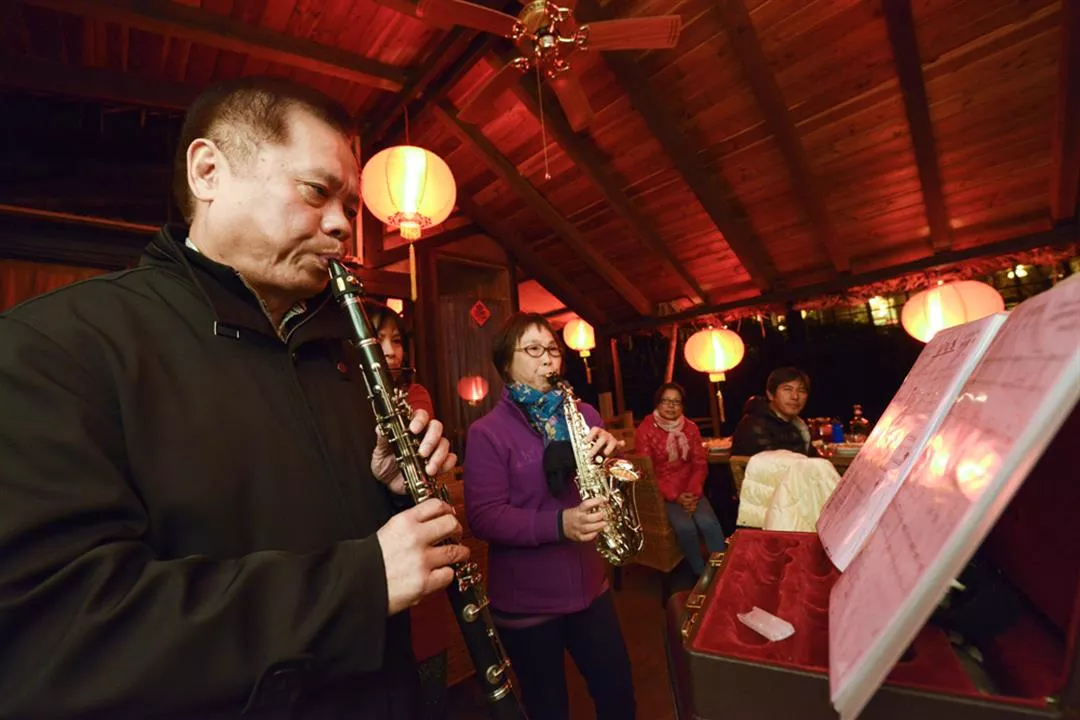
Having studied both the clarinet and the saxophone, husband and wife are in perfect harmony. Since the collapse of his hat business, Day has become more focused on his family life.
Losing a company is a traumatic experience for a businessperson, and it’s not hard to imagine Day’s desolation. “I’d be lying if I said it didn’t hurt,” he admits. Without a company to run, he took his wife traveling around Taiwan. These wanderings introduced him to the owners of many of the island’s restaurants and bed-and-breakfasts.
Day met the owner of the Zhou Ye Cottage hostel on one such trip. While driving in Sanyi, Miaoli, Day lost control of his vehicle and slid off the road. The owner, whose hostel was nearby, saw Day’s predicament, rounded up a small front loader, and got him back on the road. He says he received two boxes of hats from Day in thanks and jokes that for a time all his employees decked themselves out in San Sun hats.
Zhao Jiqing, manager of Sanyi’s Walk Cloud restaurant, remembers Day very well. “The chairman sits in the same seat every time he visits us.”
His knowledge and appreciation of the food, beverage, and entertainment industries honed by his five-year “vacation,” Day has made the field the focus of his second business venture.
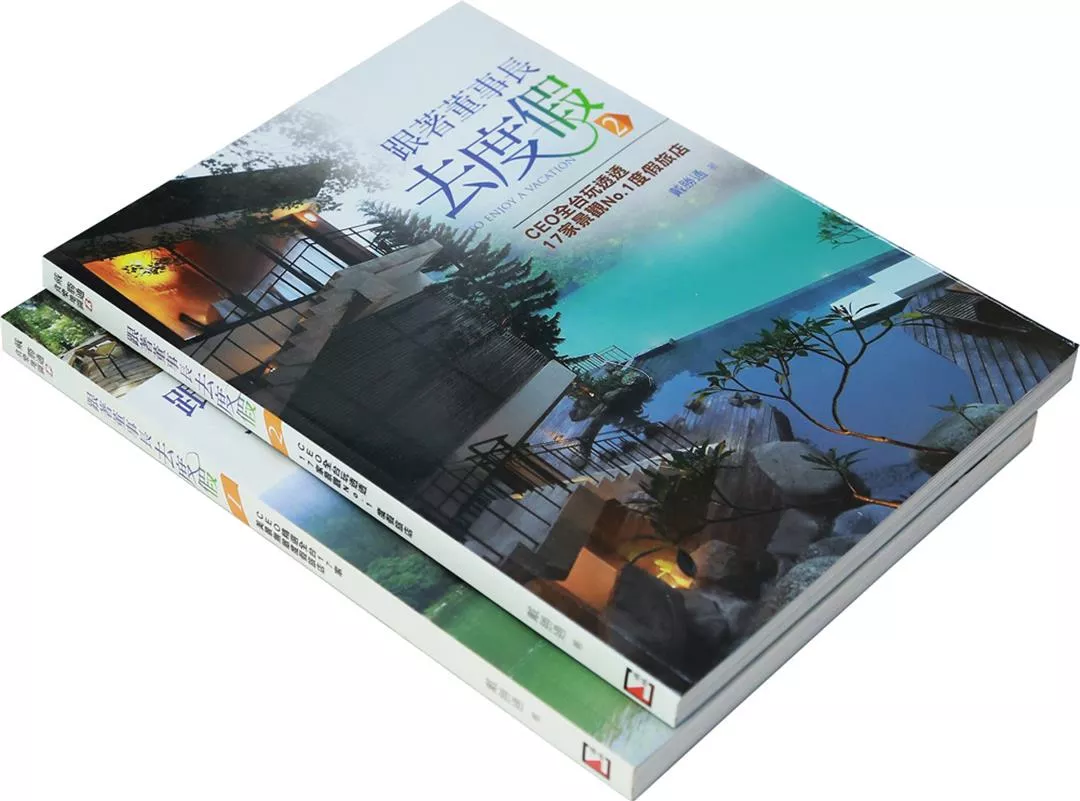
Drawing on what he learned, he published 14 travel books in succession. Then in June 2012 his son Day Donghua built him a Facebook fan page called “Taiwan VIP Travel.” The elder Day uses the page to help him update the information in his books and through it has become one of the hippest seniors in this youth-oriented medium.

Day and his son Day Donghua now manage a Facebook page, publish a magazine, and operate a service offering home delivery of famous B&B menu items, all under the Taiwan VIP Travel brand. They also plan to begin booking Taiwan VIP Travel tours in the near future.
“I have to mention the pan-fried milkfish and the oyster omelets at the corner of Wenhua Road and Zhongzheng Road in Chiayi City. The milkfish is offered with or without bones, and is pan-fried such that the skin becomes crispy while the flesh remains flavorful. With a bit of lemon, it’s truly divine. If someone hadn’t stopped me, I would have ordered three more servings. The oyster omelets, meanwhile, are the size of your head, the batter is just right, not at all too firm, and the oysters are fresh. Served with a bit of bok choy and topped with sauce, they are excellent.” Day’s weekend posts on Facebook make you want to rush out and stuff yourself full of whatever he’s been eating.
Since Day no longer has a secretary, he now handles all routine matters himself.
Day has a remarkably sharp memory. He recalls plunking down NT$480,000 for a second-hand Mercedes when he was 26 years old to increase his foreign customers’ confidence in his export company. Since then, he’s owned nine Mercedes. From age 30 to 62, he employed a driver to drive them. Nowadays, he lives far less extravagantly. He not only rents a home, but now drives himself around in an inexpensive second-hand Nissan Tiida.
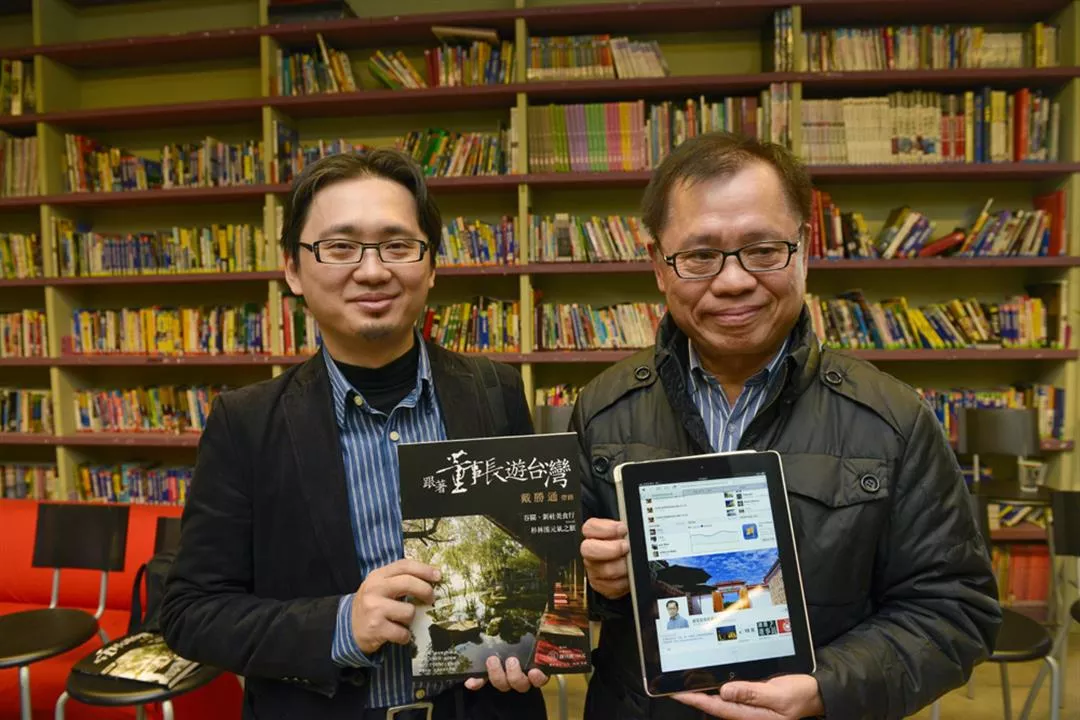
Once he became active on Facebook, Day also began carrying an iPad. The device, a gift from his son, sees constant use as a portal for interaction with his fans online. Day has even been known to check in and respond to posts when waking up to use the restroom at two or three in the morning.
With Day managing the page himself and media reports calling attention to it, his online profile soared. According to likeboy’s rankings, Day’s page is Facebook’s fifth most popular travel page in Taiwan, and number one for interactions with followers.
At the mention of his fans, a smile breaks over Day’s usually serious face. “I had only 2,000 or so last August. I’m up to more than 190,000 now.”

Day and his son Day Donghua now manage a Facebook page, publish a magazine, and operate a service offering home delivery of famous B&B menu items, all under the Taiwan VIP Travel brand. They also plan to begin booking Taiwan VIP Travel tours in the near future.
Given the support of his followers, Day decided that there was potential in his Taiwan VIP Travel project and turned it into a brand. The name now appears on travel books, a website, a bimonthly publication, and a service offering home delivery of famous B&B menu items. As of April 2013, it will also grace a number of other businesses, including group tours.
Every weekend, Day and his wife zip off in their black Tiida. List in hand, they carefully check out one bed-and-breakfast after another, sticking precisely to their itinerary.
Day is a bit of a busybody by nature and did a fantastic job as head of the National Association of Small and Medium Enterprises. During his stint with the association, he gave Taiwan’s SMEs a voice and looked out for their interests. Initiatives such as the Small and Medium Enterprise Credit Guarantee Fund, micro-loans to entrepreneurs, and individual retirement accounts were all based on recommendations he made during his tenure at the organization.
Day kept at it even after his return to “civilian” life. When he ran across businesses failing to distinguish themselves from their competitors or that were poorly run, he’d offer the owners advice or give them a book while always politely declining their offers of a cup of coffee or a snack.
During Day’s five-year “retreat,” he and his wife visited more than 1,400 bed-and-breakfasts and more than 1,000 innovative restaurants and tourist hotspots. Over time, these reconnoiters and investigations became more targeted and expert.
“I want to work as long as I possibly can,” says Day, who founded his hat-making empire at the age of 26 with just six employees. “I’ve been luckier than most. Forty years after starting my first business, and I’ve got an opportunity to start a second!”
Some people have wondered why younger brother Steve Day, who has established a NT$5-billion charitable trust, didn’t give his elder brother NT$100 million or so to start a new business.
“I didn’t want that kind of help. I like to do things myself.” Day Sheng-tong says that though he no longer has any money, he still has his network, his experience, and his expertise. He wants to see if, starting from scratch, he can use his own creativity and resources to expand the domestic travel market.
“I want to be the ‘entertainment committee’ for Taiwan’s 1.24 million SMEs and their 8 million employees,” he says.
Day’s tours will attend to every detail, arranging restaurants and providing travelers with all the basic necessities: towels, slippers, shampoo, a toothbrush and paste.... They’re even planning to use L’Occitane en Provence products.
Sticking close to home“You have to look ahead, and have to have some drive.” Though Day can’t help but sigh at the mention of his past triumphs and the precipitous rise and fall of his business empire, he remains philosophical. But when the conversation turns to his deceased parents, his stoicism breaks down.
“Life!” he exclaims. His father’s passing coincided with the failure of Day’s business. Though he was the eldest son, he no longer had the means to pay the funeral expenses, and his younger brothers had to cover them in his stead.
“The family lost contact with one another the day after the Jiji Earthquake [of September 21, 1999]. My father, who was in Dajia, asked our driver to take him up to Taipei to look for me. When he saw that I was alright, the two of us had a bowl of sishen soup in a streetside stand and then he went back home.” Day recalls that his father didn’t say a thing, but believes his actions demonstrated his feelings more than words could have. He adds that all of the choices he’s made in his life have arisen out of his feelings for his parents. Day says that this was true when his business failed, and just as true when he began his comeback.
When Day’s career was at its lowest ebb, he traveled abroad to sell more than NT$400 million in personal property, all of which he remitted back to Taiwan to pay salaries and suppliers. He then immediately bought himself a ticket home, having never for a moment considered absconding.
“Is it more unfortunate to be unable to go abroad or to be unable to come home?” Day says that he preferred to be “stuck” at home and that he certainly didn’t want to lose the opportunity to be near his parents in their waning years.
Praiseworthy courage“I feel like our society has been good to me.” He says that there are two sides to everything; it all depends on how you look at it. Even the failure of his business had an upside that most people couldn’t see.
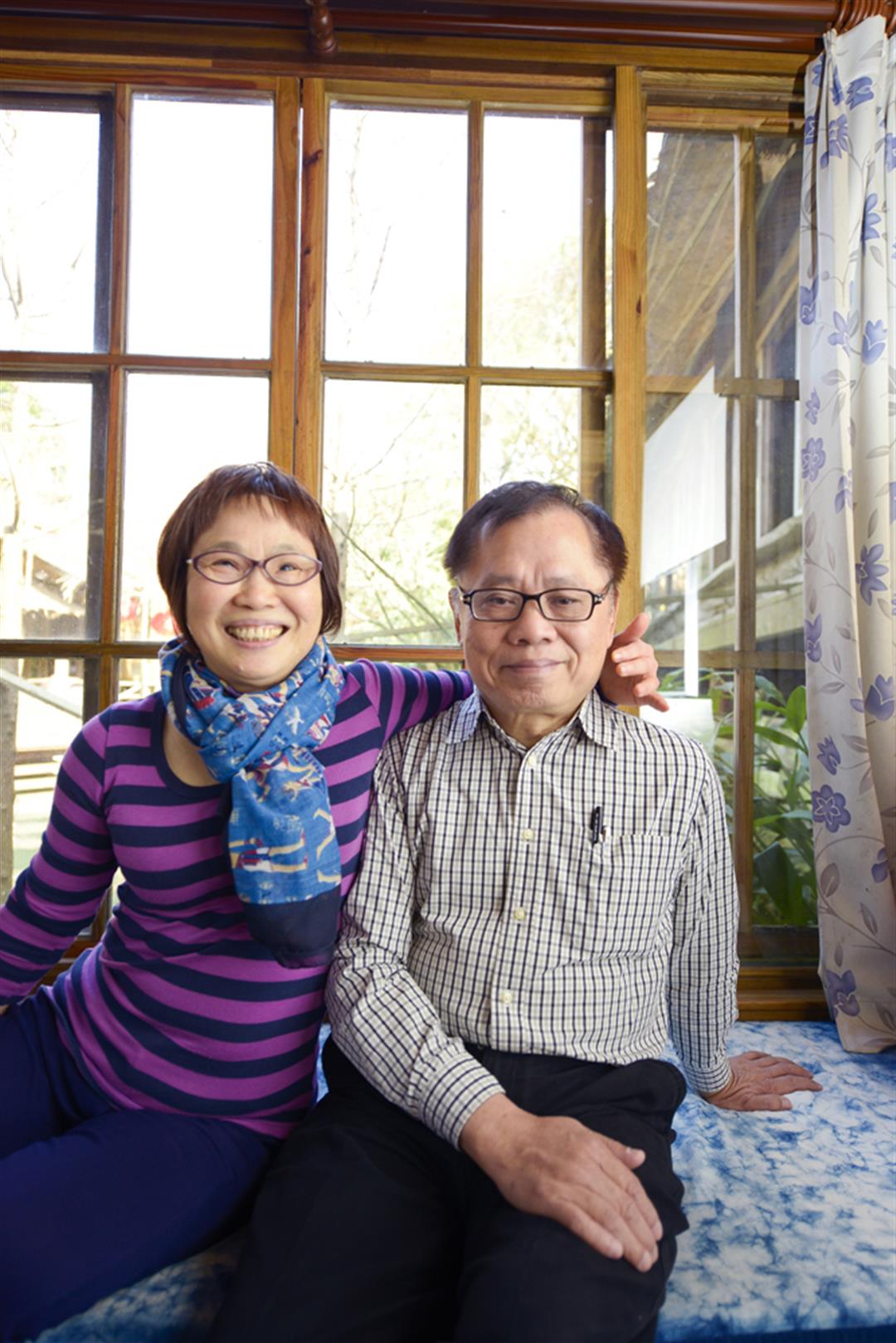
Day’s wife says that the two of them lived largely apart for 40 years. In fact, it was only after Day’s company went under that the whole family was able to live together in Taipei. “We probably only used to spend about 65 days a year together.” Now that the company no longer exists, the two of them spend all their time together and are finally truly a couple.
“Failure helped me to understand kindness and to face things, and also made me a believer in luck.” Day says that when all is said and done he’s actually gained more than he lost, and that his feelings for his wife are stronger than ever. “She’s never offered a word of complaint. How could I not hurry up and earn the money to buy her a new house?”
Whether or not Day’s new business ever reaches the heights of his old, his 190,000 Facebook followers must surely applaud the courage that got him back on his feet and back into the fray.