More "China," Less "Europe"-- Modern Composition in Taiwan
Jane Wang / photos Shih Wei-kang / tr. by Robert Taylor
October 1994


In the world of dance, we all recognize that the "Cloud Gate Dance Theater" has established a style which is unique to the Chinese people of Taiwan; but what about in the world of music?
Early this September, the Information Division of the Coordination Council for North American Affairs (CCNAA) Office in New York put on a four-day musical event entitled "A Score of Composers from the Republic of China on Taiwan," which for the first time brought together the works of the older, middle-aged and younger generations of Taiwanese composers, showing the contemporary style of music from Taiwan. The response was unprecedentedly enthusiastic. Of the three concerts in the event, two were completely sold out, and not even the extra standing tickets were enough to meet the demand. And with the New York audiences' rapturous applause, the concerts lasted two and a half hours instead of two as originally planned, breaking with the stereotype that modern music is a curse at the box office.
Looking into the background of this event, we cannot help asking: what kind of compositions best represent "Taiwan style"?
On the stage, eight cellists in black and white costumes sit in a circle around a flautist dressed in a blue traditional Chinese smock. The sound of the bamboo flute sometimes rises high and shrill, as if to break free from the deep and powerful tide of the encircling cellos; and sometimes rushes hastily, tagging along behind them.
This was the scene at a concert of the best chamber music pieces entered in the Taiwan Symphony Orchestra's third composers' competition. Although the piece's composer is from mainland China, the concept he wished to express--the turmoil and adaptation where Eastern and Western culture meet--is a subject which every Chinese has had to face in recent times.
Because pure musical composition ceased in China from the Song dynasty (960-1279), the first difficulty which composers as expressers of national sentiment must overcome is how to make up for this long deficit.
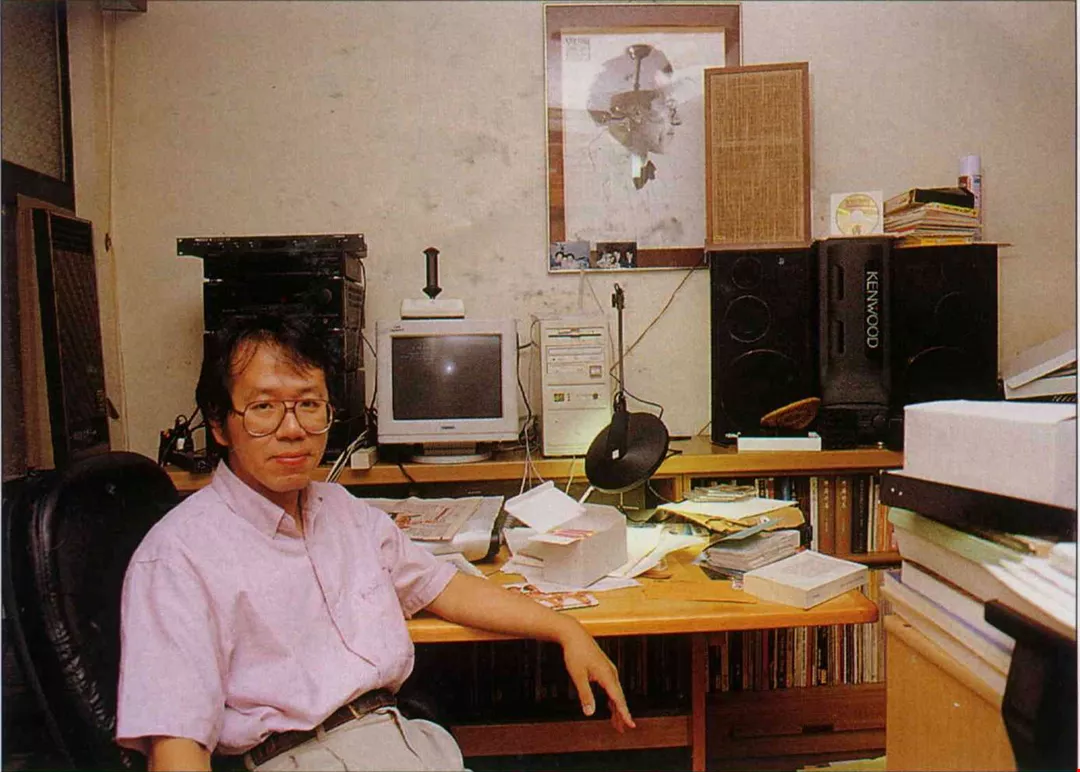
(Drawing by Liao Tzu-wen)Chen Shu-si, who holds fast to his intellectual style, believes the aloof, unworldly thinking of Lao-tze and Chuang-tze is the essence of Chinese art, for it reveals much about life, thus providing a rich source of inspiration.
Who am I?
But in Taiwan, composers have suffered the effects of an even greater "split." After Taiwan returned from Japanese to Chinese rule, traditional Chinese music was given no place in orthodox musical education. And yet the Western ideas which were taught always lagged behind developments in the West.
When Schoenberg's serialism (which broke away from the classical system of major and minor scales to give equal prominence to all twelve semitones in the octave) was already flourishing in the West, people in Taiwan had never even heard of Debussy's and Ravel's impressionism; and in the 1960s, when Hsu Chang-hui, who holds a degree in music history from the University of Paris, introduced Schoenberg's serialism to Taiwan, musicians in Europe and America were already experimenting with electronic music and aleatory music, which uses non-sequential methods to create musical effects (separating music into segments to be performed recombined in random order).
With this kind of educational gap, determined students had little choice but to go to the West for further study. But once they had mastered their techniques, they would naturally begin to ask themselves: "Who am I?"
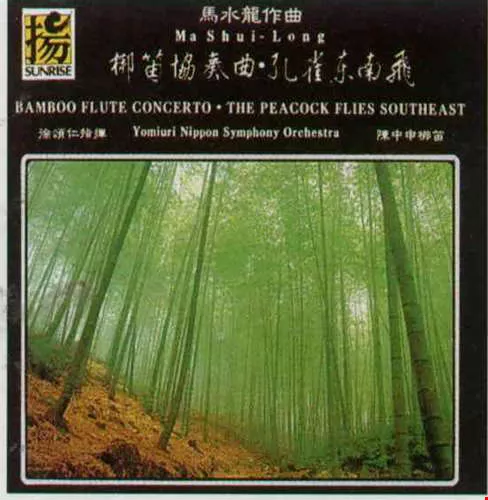
Ma Shui-long, former president of the National Institute of the Arts, cannot help a rush of emotion when he recalls his days of studying in Germany. "Believe it or not, the first thing they asked me was, 'Do you have pianos over there?'" This made him realize that music cannot be without national boundaries. The reason the Germans could be so conceited was because they had their own music. Thus the only solution was to return to work one's own native soil. This aspiration is one shared by almost all composers young and old.
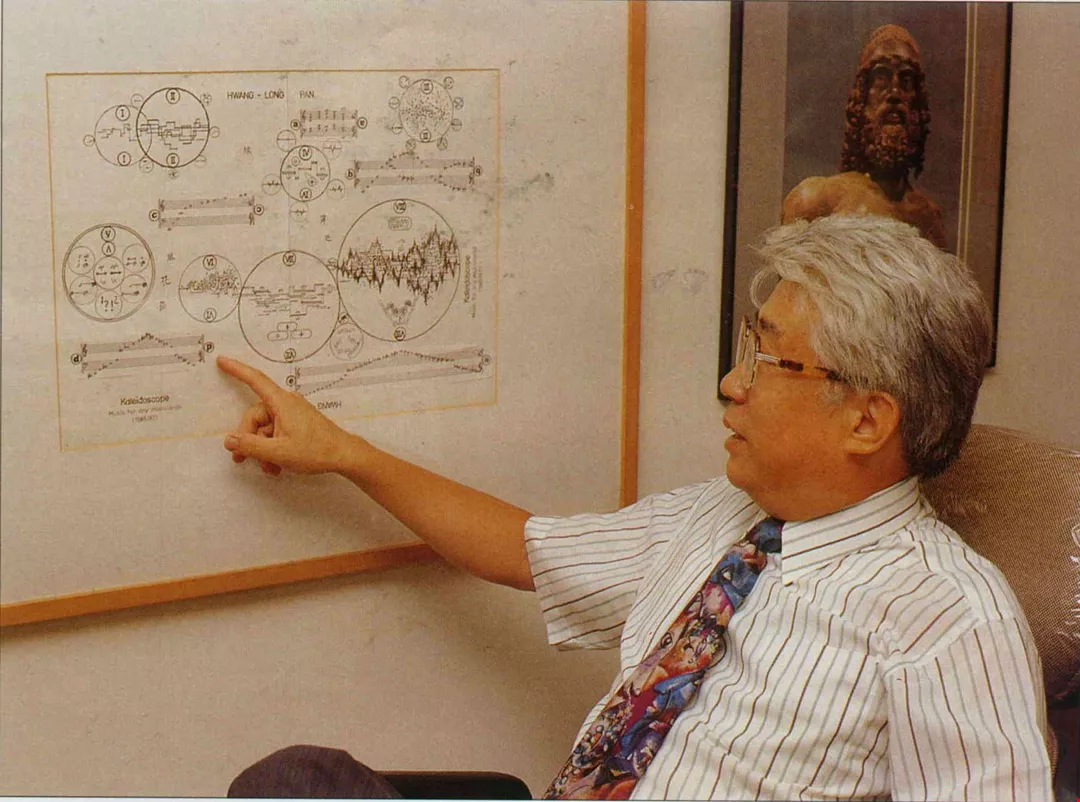
While he was composing "Kaleidoscope," Pan Hwang-long drew this picture to express the interdependent relationship between the notes, going from one-dimensional dot sand lines to two and then three dimensions.
Three mothers
But the complex historical factors which created the Taiwanese character, which combines broader Chinese traditions, local traditions and aboriginal culture, mean that artists are as if torn between three mothers. Opinions differ greatly as to what kind of musical content can best represent the thoughts and aspirations of today's generation of Chinese here in Taiwan.
Composer Huang You-li wrote in his book New Pearls on the Stave that music can be divided into four levels according to its degree of refinement and the number of listeners. The lowest level is the unadorned, primitive music which springs naturally from people's lives; the second level is lyric music with some degree of refinement and a greater emotional content; at the third level, the music of the first and second levels is refined by artists to produce music which can be enjoyed by both popular and highbrow audiences, having a high degree of artistic quality yet remaining accessible to the masses; and the fourth level is that of highly artistic and experimental music. Works composed using 20th-century techniques are representative of this level. This type of music is not easily accepted by contemporary audiences and appeals only to a small number of people, yet it often provides the impetus which drives musical progress.
These four levels form a pyramid, and only a firm base can support development at the higher levels. But in Taiwan the situation has been just the opposite, for it was refined Western art which was first transplanted here. This was because people wanted to first study the best others had to offer, but as a result little attention was paid to the music's roots. In the 1970s, however, this situation gradually began to change.
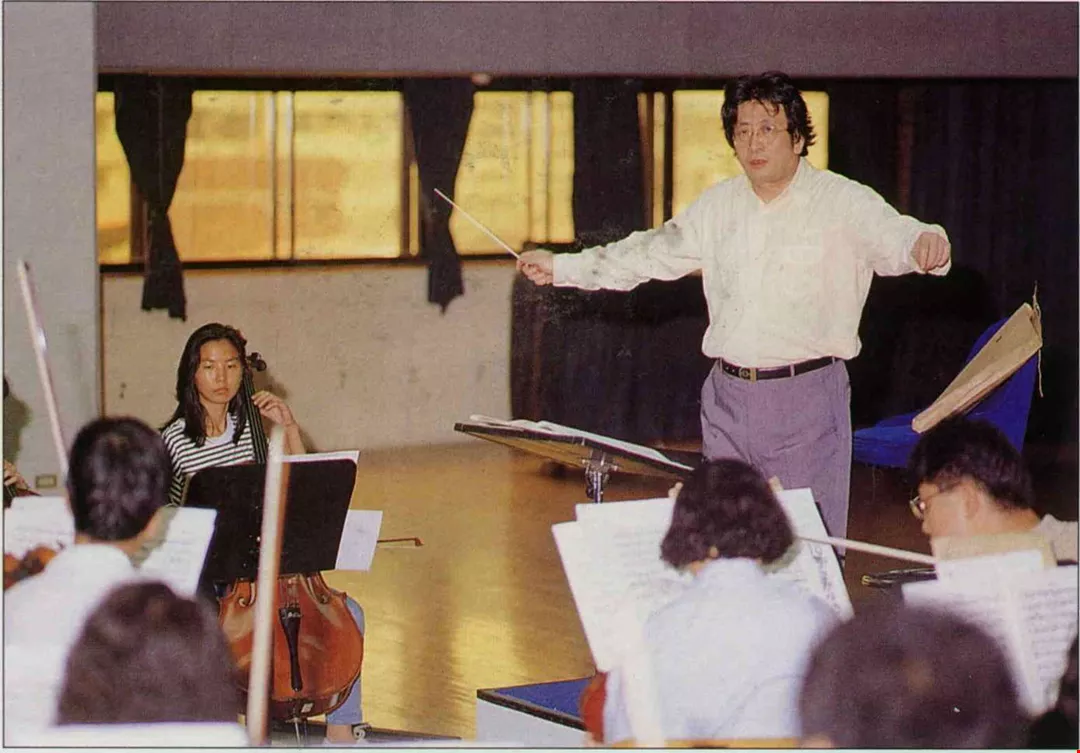
This August and September, Chen Chiu-sen gave two concerts on the theme of "Taiwan Contemporary Composers' Works." He believes that if local composers' works are mature enough, conductors will be happy to perform them.
You take the high road, I'll take the low
In 1977, the heated nativist debate in literature spilled over into the world of music, and people began to ask whether the music composed using techniques transplanted from the West was not simply the product of the ivory tower, out of tune with the real voice of Taiwan's people. In fact, even before this, people such as Hsu Chang-hui and Shih Wei-liang had expressed similar thoughts. Now, joining forces with the rejection of the 1960s fervor for modernization, they pushed the direction of modern composing distinctly towards the two extremes of the top and bottom of the pyramid: more people started to enter the field of folk music, while another group continued to follow the path of more original, high-level work.
In terms of numbers, the second group have always been the great majority. But, according to Professor Pan Hwang-long of the National Institute of the Arts (also president of the China-Taipei section of the International Society for Contemporary Music), "composers still mainly followed their own direction, and no particular Taiwanese style of music emerged." For instance, when he himself went abroad to attend performances of his new works, he was often mistaken for a Korean, much to his consternation. "Thus if you want to understand composers' style, the quickest and easiest way is to start from the background in which they grew up and their experience of life, for these are the things for which they feel the deepest emotions, and so are most likely to provide them with inspiration."
The Dream of the Red Chamber to drums and gongs
Thus it was natural for Ma Shui-long, who is from Keelung, to write "A Sketch of the Harbor in the Rain," describing the poetry of that pluvious place. When Pan Hwang-long, who comes from Puli in central Taiwan, was inspired by legislator Ju Gau-jeng's efforts to improve the status of Hakkas and Taiwanese aboriginals to write his "Formosa Landscape," in which he lets each of Taiwan's ethnic groups speak from its own perspective, he did not have to specially go away and collect the aboriginal music which he used, for close at hand was a tribal settlement by the name of Chungcheng Village. On the other hand David Liang, director of the Institute of Art at Chinese Culture University, grew up in a thoroughly bookish family (his father is Liang Tsai-ping, a great master of Chinese traditional music), as did Chen Shu-si, assistant conductor of the National Symphony Orchestra, whose father forced him to learn Tang poetry by heart when he was a child. Both Liang and Chen seek their inspiration in the Chinese classics and philosophy.
In the process of seeking out their own creative path, whether by coincidence or by conscious study they cast their net across their whole heritage of refined Chinese culture, such as ancient court ceremonial music, painting and calligraphy, the structure of Chinese characters, and Chinese philosophy and outlook on life.
With guidance from his teacher Shih Wei-liang, Lai Deh-ho began to come into contact with Peking opera, and attended classes given by the great Peking opera performer Yu Ta-kang. Lai had been educated in Western music since childhood, and at first he couldn't make head or tail of Peking opera, but as time went on he gradually became captivated and incorporated it into his own works. The best-known example is his symphonic "Dream of the Red Chamber," written for Lin Hwai-min's dance drama of the same name.
Throughout the piece, changes in atmosphere are initiated and controlled by the gongs and drums commonly used in Peking opera. In Peking opera gongs and drums are used as powerful regulators of the actors' movements, and to hint at their inner thoughts; but Lai Deh-ho also used the celesta, harp and piano, with their full range of notes, to imitate and echo the rhythm of the gongs and drums, thus creating a new sound based on the traditional yet different from it.
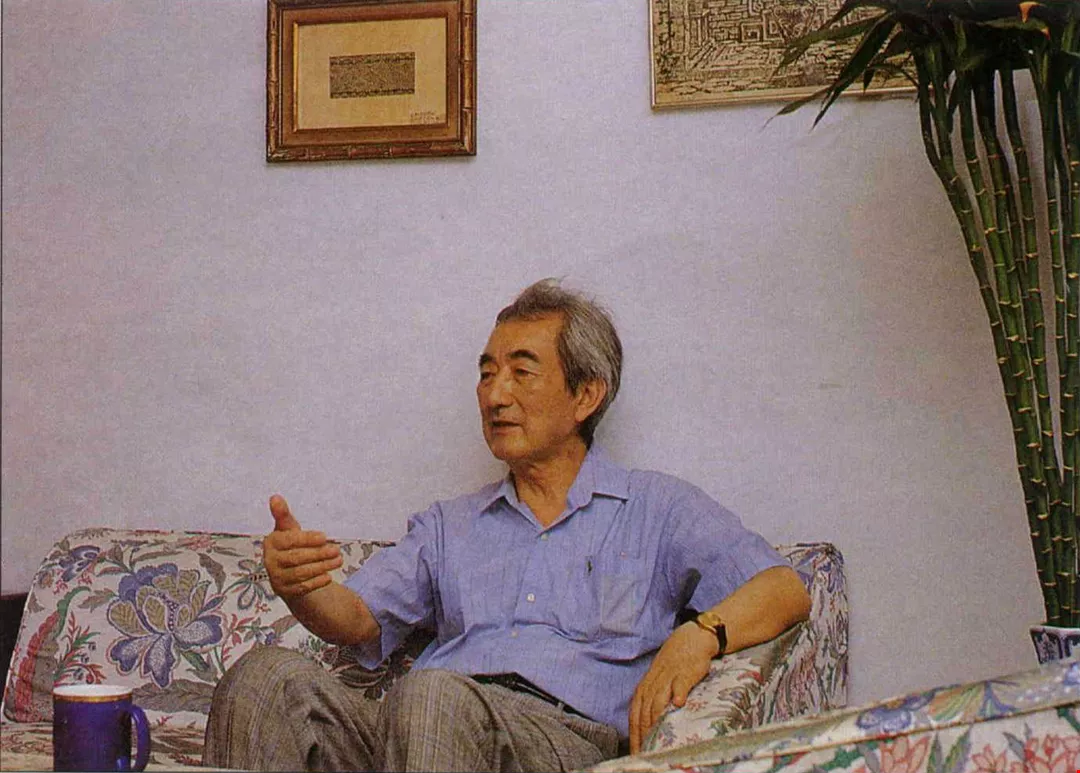
Hsu Chang-hui, a scholar of musical history, believes that history's most valuable role is to define the status of a person's achievements. Thus he took the lead in introducing modern Western compositional techniques to Taiwan, but at the same time also became the first person to return to his native soil to collect Taiwanese songs.
The Peach Blossom Spring flows inexhaustibly
When Chen Shu-si was reinterpreting the Tang dynasty poet Li Po's lines "The flowing water carries the peach blossoms far away; this is a world unlike our own," he racked his brains to find a way to express the image of the Peach Blossom Spring. Later it suddenly dawned on him that the Chinese ideal for human life is that it should be like water, which lasts longest when used sparingly--if one lives modestly, avoiding uproar, one's vitality will be inexhaustible. So he had all the instruments fall silent, to leave only the harp slowly plucking a stream of notes like flowing water, followed by the sound of a finger dipped in water rubbing on the edge of a glass. In this way he broke free of the twelve notes in the octave to which musical instruments are limited, to give the listener the illusion of being carried into a soul-cleansing heaven-on-earth.
As well as striving for unique artistic content, Chen Shu-si adjusted the form and arrangement of the performance and the choice of accompanying instruments to match the effect he wished to achieve, departing from the stereotyped image of the orchestra.
At the first performance of Pan Hwang-long's "Kaleidoscope" (subtitled "Music for any Musician"), a question mark appeared beside the conductors' names on the program leaflet. On the evening of the performance, three conductors appeared on stage, and Pan himself walked straight up onto the stage from among the audience as the mysterious fourth conductor. Because the piece was written in an open format, the number of conductors, the instruments and the sections chosen to be played could all be adjusted spontaneously, providing infinite scope for variation and interest.
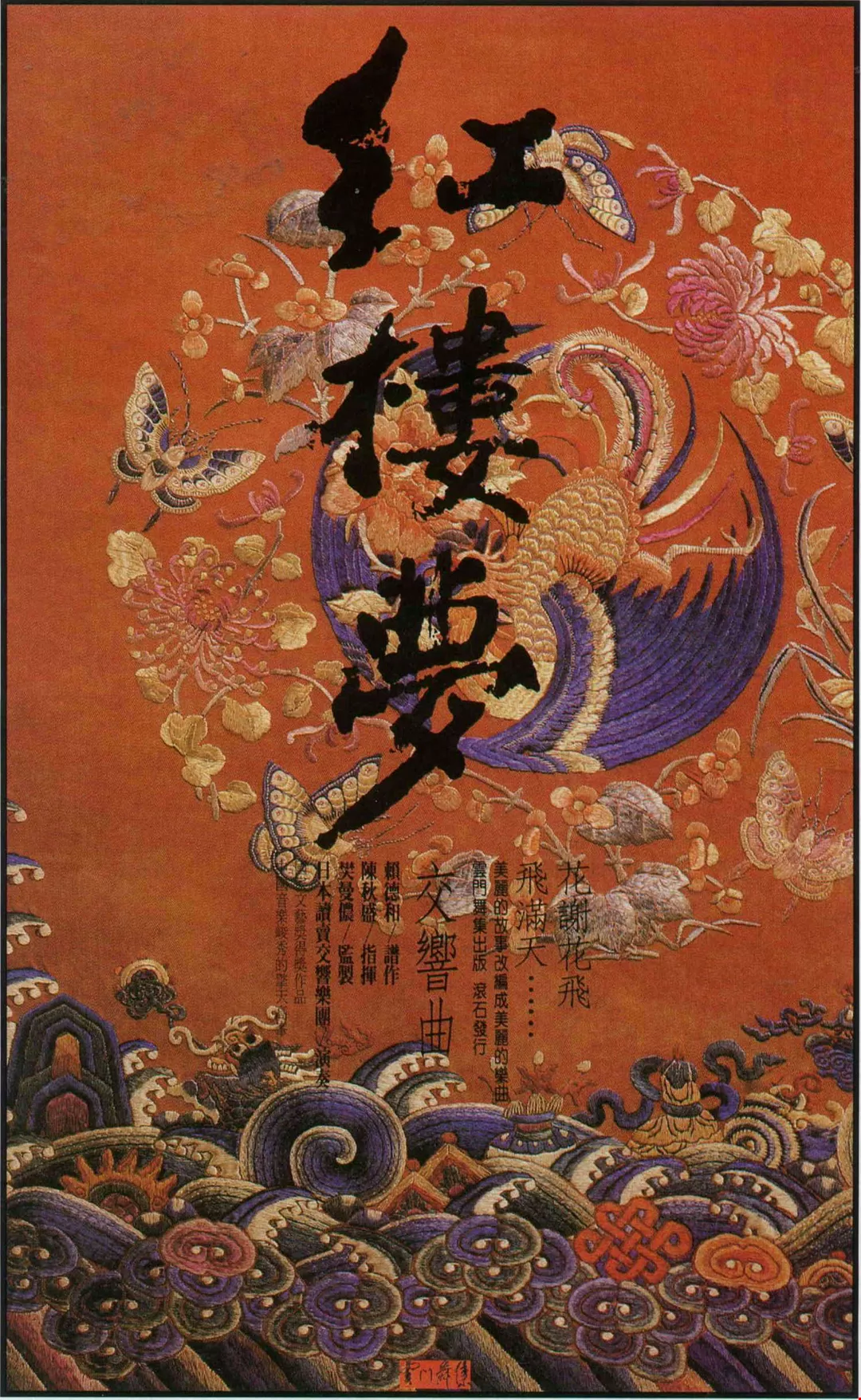
Lai Deh-ho's "Dream of the Red Chamber" uses the celesta, harp and piano to imitate and echo the rhythm of gongs and drums, creating a new sound based on tradition but different from it.(courtesy of Cloud Gate Dance Theater)
For NT$200,000, pop songs change to folk songs
On the folk music side, Shi Wei-liang and Hsu Chang-hui were the pioneers.
When Hsu Chang-hui started his "Music-Making Circle" and brought in Western compositional techniques to encourage creativity, he also faced the question of just what had to be done if Taiwan was to have its own music. Obviously, local composition was required, but where was the inspiration to come from? "Bartok's approach gave me some ideas," says Hsu Chang-hui.
The great Hungarian composer Bela Bartok was once confronted with the same problem. He believed that a nation's musical roots are to be found in its folk songs, and so he went among the people to collect this music, which reflects the life of the great majority--the lowest level in Huang You-li's pyramid. After sorting the wheat from the chaff, Bartok incorporated the folk songs into his own works, thus not only creating a unique personal style, but also preserving folk music and raising it to a higher artistic level.
However, to tackle this task in earnest requires economic support. In about 1966 an opportunity presented itself. A retired soldier who was general manager of a company in the Kaohsiung Export Processing Zone was also a big fan of the popular singing star Tze Wei, and specially set up a "Popular Song Research Society" to promote popular songs. Shih and Hsu thought he was just promoting vulgar, low-grade music which would not contribute much to Taiwan's musical development. They wrote several newspaper articles criticizing him, and this attracted his attention. "Later he invited us both to meet him and talk," recalls Hsu Chang-hui, his features livening to reveal something of the exuberance of his youth. "We talked all night, and in the morning he gave us a cheque for NT$200,000 to cover our expenses while collecting folk songs."
This activity continued for two years and was probably the first time that folk music has been gathered in Taiwan in a collective, comprehensive and organized way. In aboriginal music alone, they collected more than 2000 melodies. Later, the two took these ideas into the music colleges, where they did research into ethnic music. Composers such as Ma Shui-long, Lai Deh-ho, Chen Mao-hsuen and Wen Loong-hsing, with whom everyone is familiar today, are all former students of theirs. But because the time was not ripe, they did not arouse a very big response.
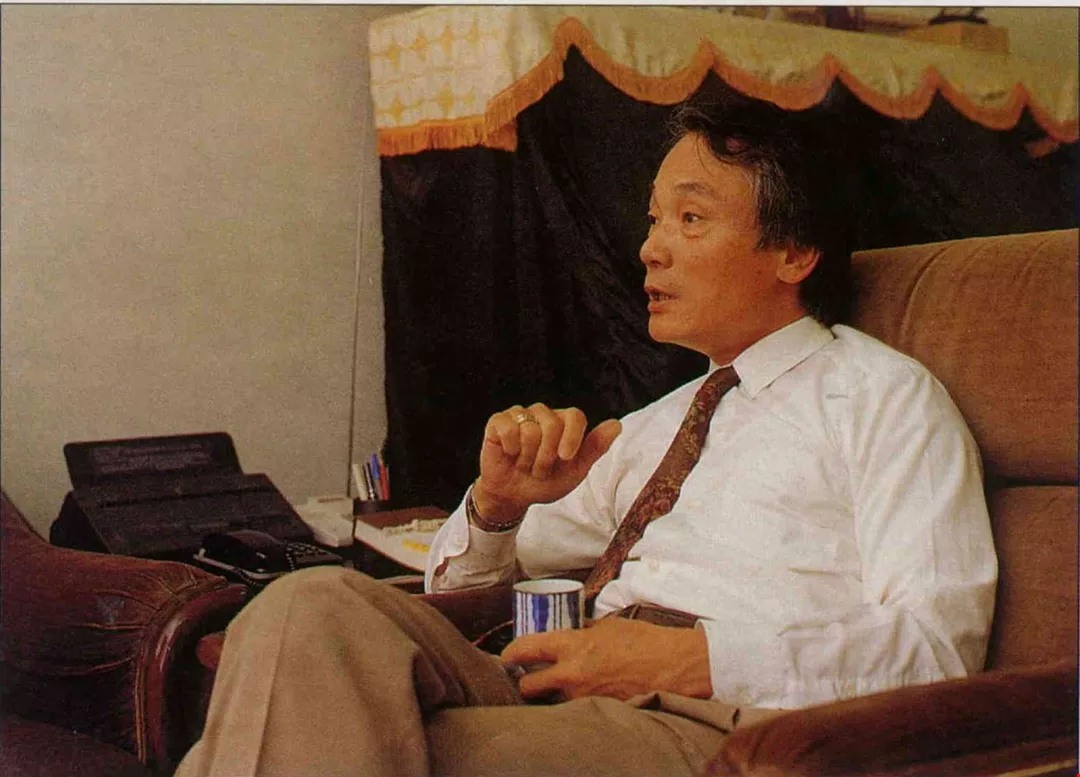
Chen Tscheng-hsiung suggests that composers should not shut themselves away in academia. Only by going out among the people and living and feeling with the masses will they be able to write works of any depth.
Local music is not just Taiwanese pop songs
Things changed little until 1987, when a sudden turnaround came after the lifting of martial law allowed nativist forces to come to the fore. In the past, speaking Taiwanese dialect was forbidden in schools; nowadays politicians vie with each other in singing Taiwanese songs in public. Concern for native Taiwanese music has been equated with digging up Taiwanese folk songs, and this has meant that modern composition, which is just as much native to Taiwan but more experimental in nature, has found the space available to it becoming ever narrower.
"Many people today seem to hold the mistaken belief that if we just keep singing Taiwanese songs they will become something world class," Chen Chiu-sen, director of the Taipei Municipal Orchestra, says with some emotion. "But they don't think about why we don't play Italian folk songs or German beer hall music. The reason is very simple: they're not refined enough." Thus he used Beethoven's Ninth Symphony to commemorate those who died in the February 28th Incident. The last line goes "All men are brothers." After this someone immediately wrote to him protesting that he ought to have used one of Teng Yu-hsien's works. But, Chen asks, "Why shouldn't I remember the February 28th Incident in my own way?"
This kind of over-reactive and intolerant attitude is also present in ROC cultural policy. Chen Shu-si says with frustration, "the organizations which put on events all want Taiwanese songs. Even when Su Hsien-ta went to Uruguay, he played a medley of Taiwanese tunes. If one day you take it into your head to write a fantasia on Peking opera, you may find yourself immediately labelled an unificationist. Ideology robs artists of too much of their creative space."
Thus whenever local works are to be performed, whether or not they have a "local flavor" becomes a prime consideration. This means that when composers who have chosen an experimental, "highbrow" path finish writing a piece, all they can do is throw it in a drawer and have done with it, for there is no chance of getting it performed.
A dialogue between modernism and nativism
Looking from the perspective of musical history, local Taiwanese music with its mass support and elitist experimental modern music must extend upwards or downwards respectively, into the third level of the musical pyramid, before they can intermingle to produce a "local music" which is capable of really expressing the feelings and aspirations of Taiwan's people, but which can also be played on an international stage and be shared with other nations.
But is a dialogue really possible between modern music and Taiwanese folk songs? "Actually, composers aren't really that isolated," says Pan Hwang-long with a smile. "You can try writing music at all different levels without having to lower your own tone. It's just a question of whether you want to or not." He himself has written a piece entitled "Hin-hang," made up of Taiwanese proverbs strung together, but with a postmodern treatment in which a melodic theme runs erratically through the whole piece. The work received an enthusiastic response.
Local Taiwanese music too should progress more quickly from the stage of merely compiling materials, and move towards more spontaneous creativity.
Chen Tscheng-hsiung, director of the Taiwan Symphony Orchestra, believes that "in fact there are people writing 'third-level' music." He immediately reels off a list of names including Ma Shui-long, Huang You-li, Hsu Chang-hui, Lai Deh-ho and Kuo Chih-yuan. "It's just a pity that most of them are over 50 and have stopped composing, and the composers who are now in their thirties and forties are the ones who studied the ideas of rejecting and dismantling tradition which were current in the West from 1950 to 1975."
Hsu Chang-hui takes the same view. He believes that we may have to wait until these composers go from youth to maturity before they slowly change direction.
In a review published in the New York Times on 14 September, the well-known music critic Bernard Holland, who attended all four parts of the "Score of Composers" event, wrote bluntly that modern music from Taiwan today is rather European in style. But nevertheless he was optimistic about the music's future potential: if it was possible for the blues to combine two entirely different musical traditions--African and European-- to produce a new and distinctive sound, why shouldn't a new music appear which combines Chinese and Western traditions?
Four days rice gruel, three days milk
But while waiting for composers to mature, how can audiences, who are responsible for pushing composers to progress, best fulfil their role?
Due to the influence of the university entrance exam system, most members of the public have little opportunity to learn much from the orthodox education system. They may not be very familiar with the structure and "grammar" of even classical music, let alone that of avant-garde modern music. Recently, the Ministry of Education has been toying with the idea of making music optional for second-year senior high school pupils. In Chen Tscheng-hsiung's view, this would be a disastrous move: "Without audiences, would there still be music?"
In Chen's conception, the only way to narrow the gap between modern music and Taiwanese folk songs is to educate listeners' tastes. As their tastes become more discriminating, even if they are still unable to appreciate the avant-garde of modern music, at least they may be more tolerant towards it.
Thus after he took over the Taiwan Symphony Orchestra, Chen Tscheng-hsiung immediately started working at the base of the pyramid. Using a mobile stage mounted on the back of a lorry, he took the orchestra to perform all over Taiwan. At first the programs mainly comprised Taiwanese folk songs which everyone is familiar with--the relatively primitive music which springs from everyday life. Once audiences became accustomed to orchestral performances, he gradually began to add "third-level" music refined from folk songs, with the aim of educating a wide public but still progressing towards refinement.
He illustrates this with a simple but vivid analogy. "If they were originally eating rice gruel, then at first we will eat it with them, but after a while we will suggest that once a week they should drink milk. Then we'll try to gradually wean them onto more, and if we can get them drinking it three days a week, then we think we've done very well."
But in fact, no matter how difficult the process of musical composition may be, and no matter how abstruse and impenetrable the concepts involved, if audiences can disregard these "obstacles" and simply listen to the music as something new, perhaps they can discover some unexpected pleasures!
[Picture Caption]
p.85
(Drawing by Liao Tzu-wen)
p.86
Chen Shu-si, who holds fast to his intellectual style, believes the aloof, unworldly thinking of Lao-tze and Chuang-tze is the essence of Chinese art, for it reveals much about life, thus providing a rich source of inspiration.
p.87
While he was composing "Kaleidoscope," Pan Hwang-long drew this picture to express the interdependent relationship between the notes, going from one-dimensional dots and lines to two and then three dimensions.
p.88
This August and September, Chen Chiu-sen gave two concerts on the theme of "Taiwan Contemporary Composers' Works." He believes that if local composers' works are mature enough, conductors will be happy to perform them.
p.89
Hsu Chang-hui, a scholar of musical history, believes that history's most valuable role is to define the status of a person's achievements. Thus he took the lead in introducing modern Western compositional techniques to Taiwan, but at the same time also became the first person to return to his native soil to collect Taiwanese songs.
p.90
Lai Deh-ho's "Dream of the Red Chamber" uses the celesta, harp and piano to imitate and echo the rhythm of gongs and drums, creating a new sound based on tradition but different from it.(courtesy of Cloud Gate Dance Theater)
p.91
Chen Tscheng-hsiung suggests that composers should not shut themselves away in academia. Only by going out among the people and living and feeling with the masses will they be able to write works of any depth.
p.94
For Ma Shui-long, music is music and the instrument is just a tool; but the soul is surely Chinese.

@List.jpg?w=522&h=410&mode=crop&format=webp&quality=80)


