A Thorough Facelift for Taoyuan International Airport
Lin Hsin-ching / photos Chuang Kung-ju / tr. by David Smith
July 2013


With the peak summer travel season coming up soon, Taoyuan International Airport has taken on a whole new look in keeping with its status as Taiwan’s No. 1 gateway for international arrivals.
Terminal 1, which used to look vaguely similar to the caps worn by imperial officials in days of yore, has a new glass roof that has transformed the structure from an ugly duckling into an elegant swan. Moreover, the terminal’s annual passenger handling capacity has been increased from 12 to 15 million.
During the four-year refurbishment project, the terminal had to continue serving travelers even as construction went ahead. How did they pull off such a tricky feat?
Travelers who’ve passed through Taoyuan International Airport in the last year have been struck by how much more attractive Terminal 1 has become. Seen from afar, a building that was once rather solemn in character seems to have grown wings.
Prior to its refurbishment, Terminal 1 appeared to be shaped a bit like a hat of the sort worn by imperial officials in ancient China, with a deck extending outward from each side of a taller central structure. The terminal today preserves the main roofline of its former self, but the flying eaves now extend further, while the entire top has been converted into a giant sunroof made of glass and concrete.
Terminal 1 has also been considerably lengthened. As a result, it now has about 13,000 square meters of additional floor space, making it much more roomy and comfortable.
The departures concourse is covered by a stepped, sloping roof made of glass and concrete. While letting natural light into the interior, the roof also shields those inside from direct exposure to the harsh midday sun. The staggered concrete segments nicely complement the wood-grain pattern of the exterior wall to create a simple elegance that is almost Zen in nature.
Where there were once 10 cramped airport check-in counters, these have been redone into six long check-in islands. The old counters were just eight meters apart, but an international-standard 19 meters now separates one check-in island from the next, and the wood-grained paneling with which the islands are faced adds a beautiful touch. In fact, this is the first airport in the world to install check-in facilities with an all-wood look.
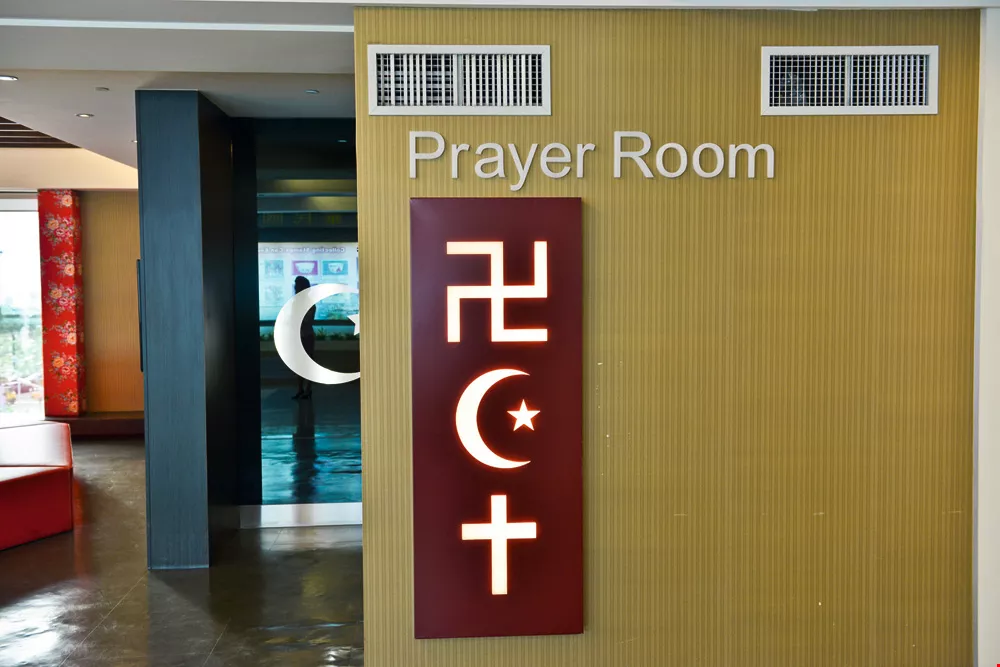
The concourses leading to the boarding gates feature super-deluxe bathrooms as well as a multifaith prayer room.
The four-year project, begun in 2009 and completed at a cost approaching NT$3 billion, has given the airport a completely new look. But anyone who understands construction knows it must have been incredibly difficult to refurbish a building that more than 30,000 travelers were passing through each day.
Terminal 1 had once been derided in the media as “the most backward in all of Asia.” So how has its rebirth been achieved? The story starts 34 years ago.
Terminal 1 first went into service in 1979, and at that time was part of one of the most advanced international airports in Asia. Its “H” shape, for example, influenced the design of the subsequently built Changi Airport in Singapore and Suvarnabhumi Airport in Bangkok.
After 30 years in operation, however, the building was showing signs of age, and came up sorely lacking when compared with Terminal 2, which was completed in 2000.
Samuel Lin, the president of Taoyuan International Airport Corporation, admits quite frankly that Taiwan had long seen its airports only as transportation hubs, and clearly paid insufficient attention to such things as maintenance, rest and leisure facilities, and duty-free shopping. The idea of designing facilities with the customer foremost in mind wasn’t much of a concern. A service-oriented approach was lacking, and our airports just couldn’t compare with those elsewhere in Asia.
For example, says Lin, both Narita Airport in Japan (1978) and Changi Airport (1981) have been in operation for over 30 years, “but at both of those airports, they put a tremendous amount of money and thought into such questions as how to improve service quality and upgrade systems and physical facilities. Such new ways of thinking didn’t guide the process at Taoyuan International, which is why it had fallen behind.”
In 2004, the Ministry of Transportation and Communications (MOTC) Tourism Bureau held an international competition titled “New Taiwan by Design” to decide who would be awarded the design contract for a planned refurbishment of Terminal 1 at Taoyuan International. The winning entry was submitted by Japanese architects Norihiko Dan and Associates. In 2007, the MOTC’s Civil Aeronautics Administration (CAA) started planning the project, and actual construction work got underway in 2009.
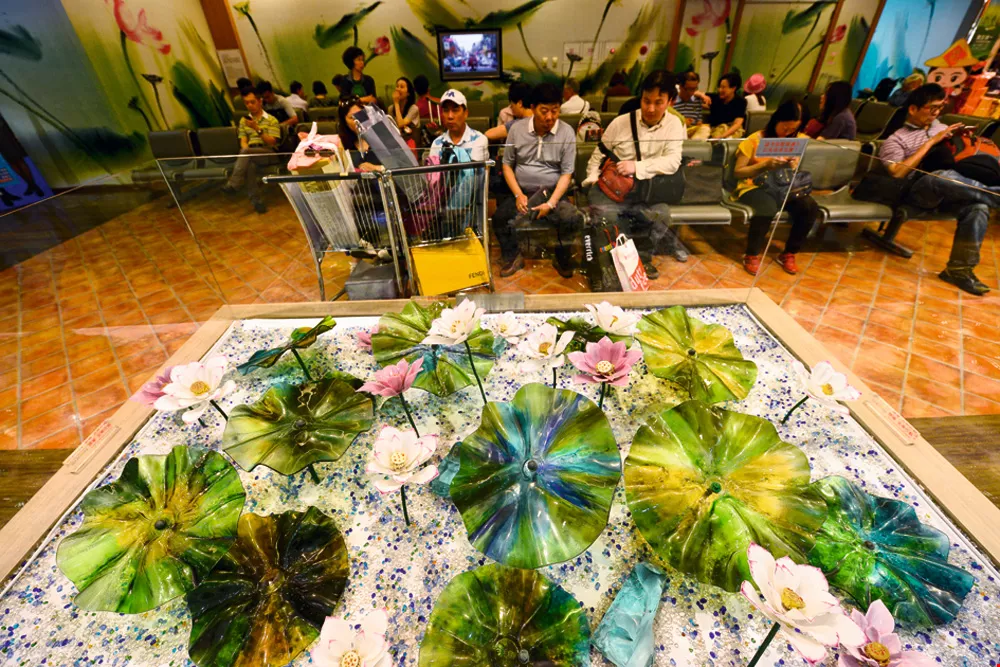
Each of the departure lounges designed by Ever Rich Duty Free Shop features its own unique theme, including such focal points as down-home Taiwanese cuisine, images from around Taiwan, and the nation’s postal service. The Hello Kitty world clocks and telephone booths are especially popular.
The Terminal 1 refurbishment project was every bit as big and complex as building an entirely new terminal would have been. The biggest challenge arose from the fact that the terminal had to keep on operating as the work was going on.
Fan Hsiao-lun, director of the CAA’s Airport Engineering Department, draws the following analogy: “Suppose you’re completely renovating your house, but the entire family still has to live there, and on top of that you have friends and relatives coming to visit every single day. Can you imagine how chaotic that would be?”
An airport has transportation, leisure, and commercial functions, making it an entity of considerable complexity, perhaps on the order of a small town. In addition to the international travelers who pass through each day, there are upwards of 32,000 employees working at over 100 airport tenants, including airlines, the police, the National Immigration Agency, restaurants, and duty-free shops. To minimize interference and security problems, the CAA decided to take what might be termed a “half-and-half” approach, i.e. drawing a line basically down the middle of the structure and working on one half while keeping the other half in operation.
But when the government began allowing direct cross-strait flights in 2008, it threw a wrench in the refurbishment plans. With only half of Terminal 1 plus Terminal 2 in operation, the airport was handed the impossible task of handling a greatly increased volume of passenger traffic. Those running the project had to abandon their “half-and-half” approach in favor of a “checkerboard” strategy.
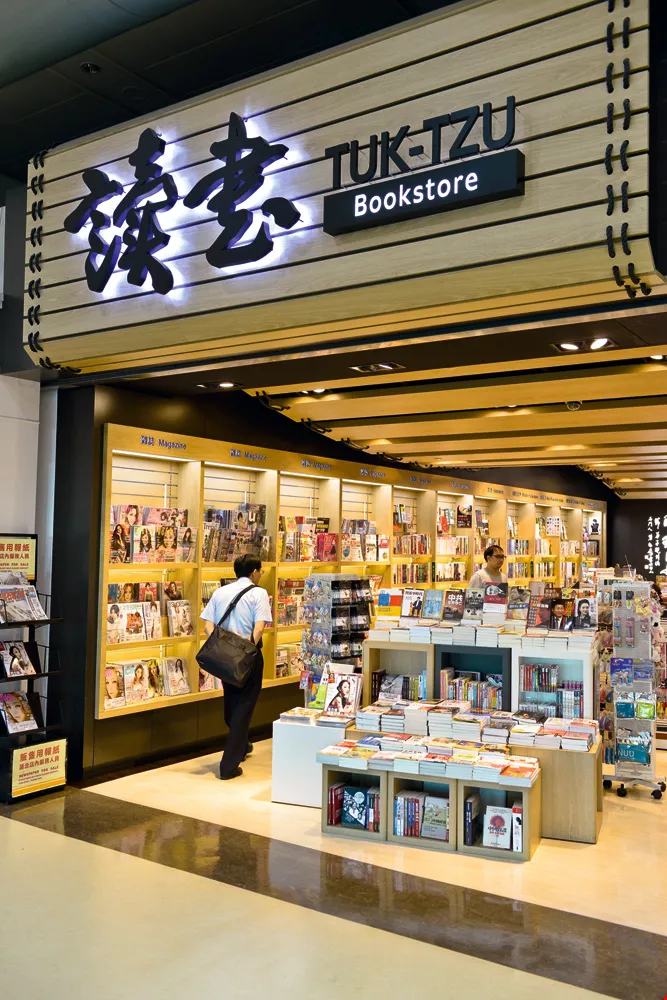
Tuk Tzu Bookstore, whose name comes from the Taiwanese term for “to read,” is an excellent place for travelers to pass the time and pick up some interesting reading material while waiting for their flights.
The hardest thing about the checkerboard approach was that, as the project progressed, operating spaces and passenger routing had to be reworked fairly often.
Each time the terminal’s operating space was reconfigured, airline check-in counters, airport security, and customs declaration counters had to be moved in a mad rush between 1:00 and 4:00 in the morning, when relatively few flights were arriving and departing. All employees were mobilized on these occasions to work furiously through the night.
In addition, there was always the danger that construction workers might accidentally cut service lines. If the original “half-and-half” approach could have been used, the accidental cutting of a line on an upper floor would not have affected travelers too greatly because the lower floor would also have been closed at the time. But with the “checkerboard” approach, there was no such margin for error. The occasional water leaks seen during the project, for example, were not good for the country’s image.
To make matters worse, tensions arose between Norihiko Dan and the CAA during the project, and Dan even contributed a guest editorial to the press to complain that the CAA had changed the project design without his consent.
Director Fan of the CAA’s Airport Engineering Department explains that Dan’s original design had called for the removal of an unattractive pre-stressed beam (now located beneath the glass roof), but the CAA evaluated the design and became worried that removing the beam would affect the building’s structural integrity.
Says Fan: “Some 30,000 to 40,000 passengers arrive or depart Terminal 1 each day. Ensuring their safety is our top priority. After a lot of communication, Norihiko Dan eventually accepted our recommendation.”
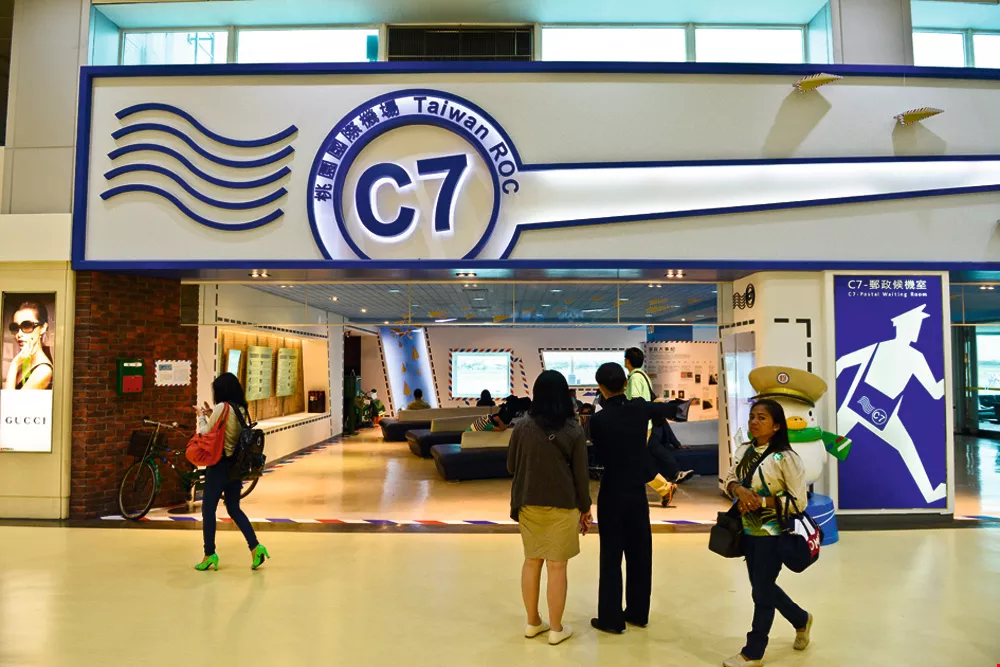
Each of the departure lounges designed by Ever Rich Duty Free Shop features its own unique theme, including such focal points as down-home Taiwanese cuisine, images from around Taiwan, and the nation’s postal service. The Hello Kitty world clocks and telephone booths are especially popular.
In addition to a revamp of the terminal’s physical appearance, Taoyuan International Airport also underwent a reorganization. The airport had formerly been administered by the Taoyuan International Airport Office, an agency of the Ministry of the Interior, but the Airport Office was replaced in late 2010 by the Taoyuan International Airport Corporation (TIAC). Samuel Lin, a former executive at Eva Air and the Taiwan High Speed Rail Corporation, was brought on board as president of TIAC to improve management and service quality.
Lin likens the project at Terminal 1 to a person “getting clothing altered while wearing it,” and bluntly concedes that everyone involved went through hell. But he also points out that it was quite worth the trouble, because building an entirely new terminal would probably have cost tens of billions and taken some 10 years to complete.
“We, however, completely renovated a 30-year-old terminal in less than four years at a cost of only about NT$3 billion.”
Lin notes that annual passenger volume at Taoyuan International Airport has reached about 28 million. Further growth of 5% to 10% each year would mean 58 million passengers per year by 2030, so something had to be done. At a third terminal that is now in the planning stages, designers may follow the example of the Hong Kong airport by building a satellite boarding lounge that would be linked to the main terminal by rail shuttle. A terminal thus designed would increase passenger handling capacity by 43 million per year. Phase 1 construction is scheduled for completion in 2018.
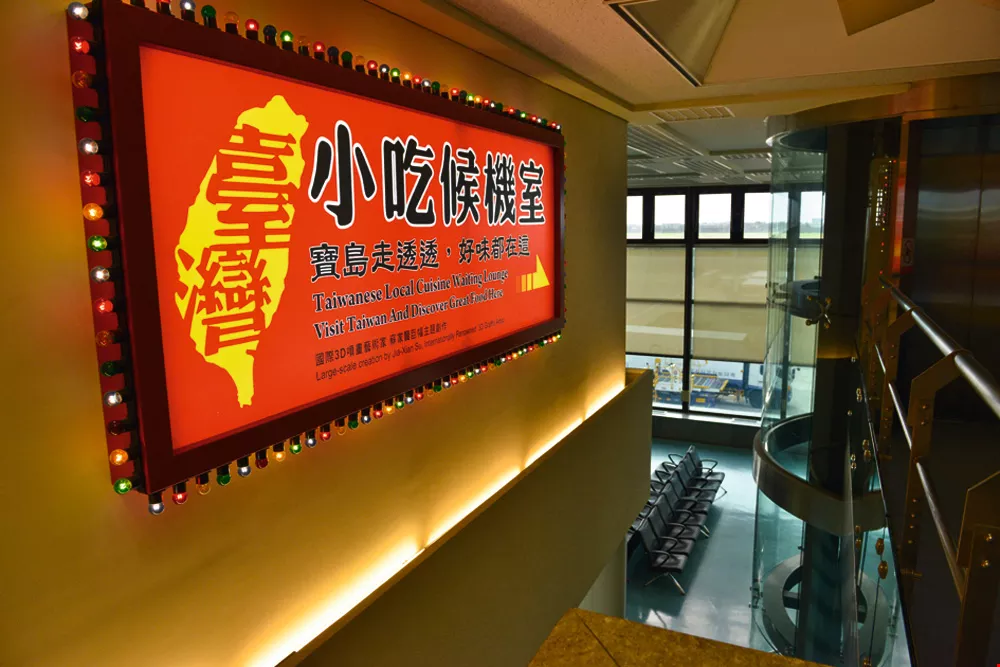
Each of the departure lounges designed by Ever Rich Duty Free Shop features its own unique theme, including such focal points as down-home Taiwanese cuisine, images from around Taiwan, and the nation’s postal service. The Hello Kitty world clocks and telephone booths are especially popular.
Travelers today find a Terminal 1 that looks utterly unlike its predecessor.
At the third-floor gate for departure security and ID checks, for example, the baffle ceiling is designed to look like a star-filled sky, with warm yellow lights ensconced in row upon row of deep blue aluminum baffles.
In the past, there was almost nowhere to sit back and relax, but today the terminal features a Starbucks and a well-known Sichuan restaurant. There’s also an area where noted local agricultural products are sold, including the very attractively packaged “Tianzhong” rice and Nantou plums.
The terminal is equally attractive in the area housing the duty-free shops and departure lounges.
The contract for design of this area was awarded on an “ROT” basis (Reconstruction, Operation, Transfer) to Ever Rich Duty Free Shop, which had just been awarded a 2013 DFNI Asia/Pacific Award for Travel Retail Excellence in the category of best retailer operating only in their own country in the Asia-Pacific.
To coordinate with the heavy focus on local Taiwanese flavor in the redone Terminal 1, Ever Rich hired Vincent Fang, a song lyricist noted for his excellent feel for classical Chinese poetry, to pen a poem entitled “On the Road.” His work was then rendered into calligraphy by master calligrapher Chu Chen-nan and engraved into acrylic-covered metal panels that now line a wall along a key corridor, brightly illuminated with LED backlighting to enhance the beauty. The installation is called “The Literature Wall,” and is located along the wall of a corridor leading to the boarding gates.
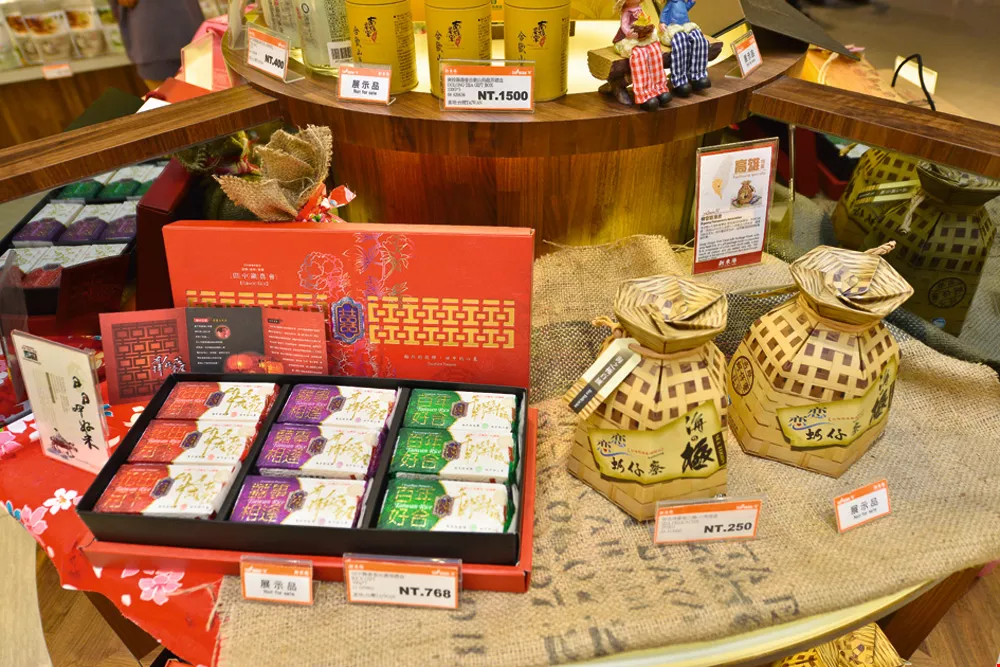
The international departure lounge, designed by Hsin Tung Yang, features many shops selling gifts with a distinctively Taiwanese character.
Another particularly noteworthy contribution from Ever Rich is the world’s very first group of theme-based departure lounges.
Terminal 1 has a total of 14 departure lounges, each of which has its own unique theme design. One lounge displays the rich variety of butterflies to be found in Taiwan. Another features a big collection of paper-cut orchids, reflecting Taiwan’s status as one of the orchid hotspots of the world. Other themes include Taiwan’s night markets, famous Taiwanese athletes, textiles, and high-tech industry. Each theme calls attention to an area where Taiwan excels. For travelers, these unusual lounges make the wait a lot more bearable.
Administrators from Incheon International Airport in Korea and Beijing Capital International Airport have been to Taoyuan International to study these trailblazing theme-based departure lounges. And The Moodie Report publisher Martin Moodie urges readers to buy a ticket and come to Taiwan to see Taoyuan International.
The new Terminal 1 is now the airport’s crown jewel. Once the airport rapid transit line, Terminal 3, and various peripheral facilities are up and running, the airport will become the core element of the Taoyuan Aerotropolis, a key national development project.
Taoyuan International is working hard to improve service quality, and in 2012 was named the world’s third best airport in the 15–25 million passenger category by Airports Council International (ACI).
In “On the Road,” Vincent Fang perhaps sums things up best: “There’s a place full of energy, by the name of Taiwan.” If you want to get to know this land, you would do well to start your exploration at Taoyuan International Airport!
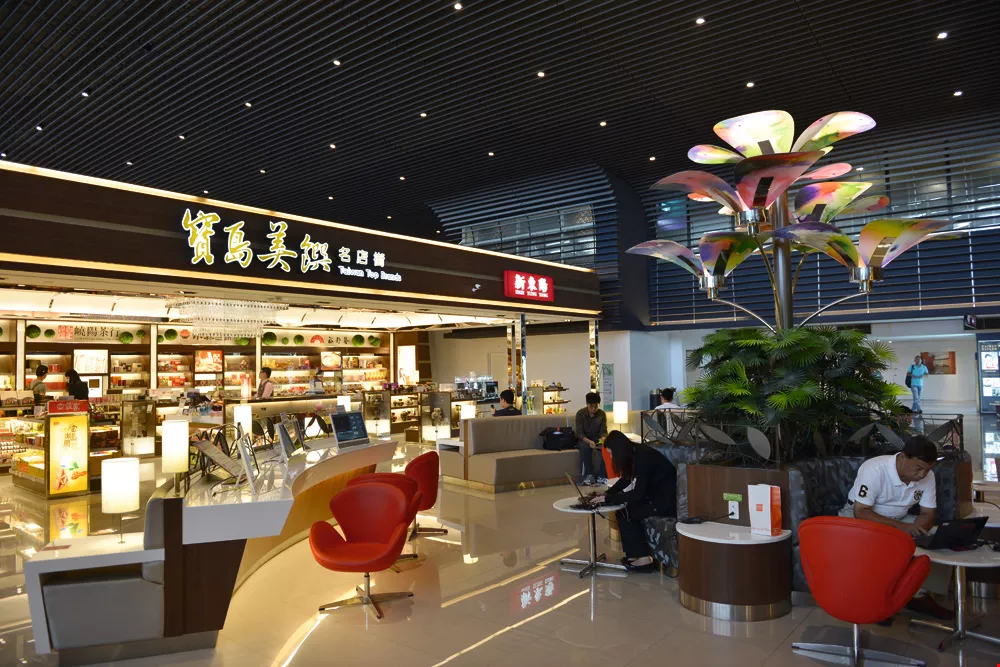
The international departure lounge, designed by Hsin Tung Yang, features many shops selling gifts with a distinctively Taiwanese character.
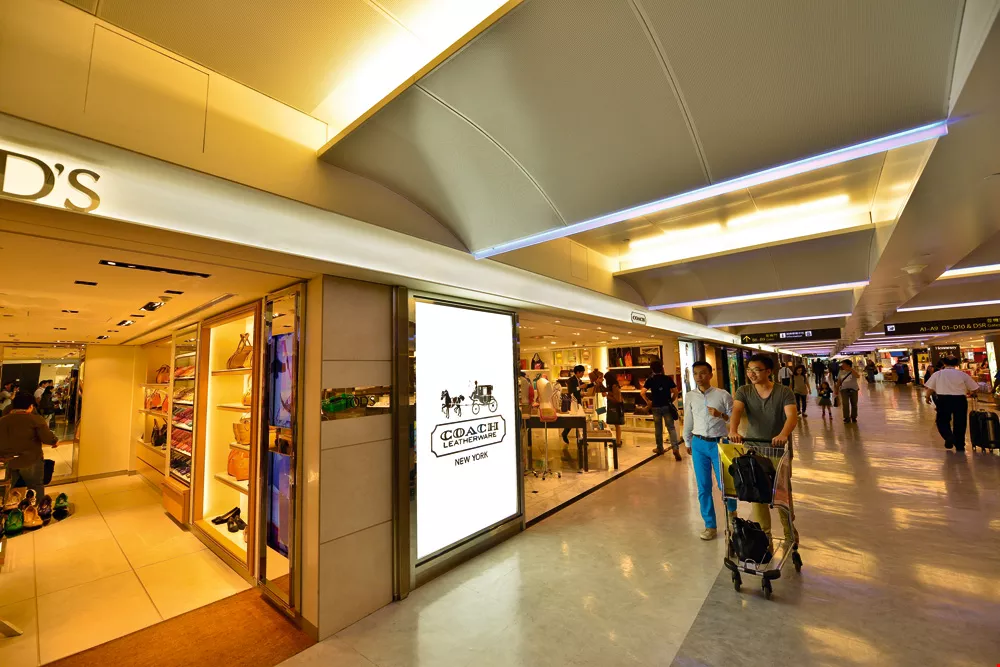
Duty-free shops sell a wide selection of major international brand-name goods.
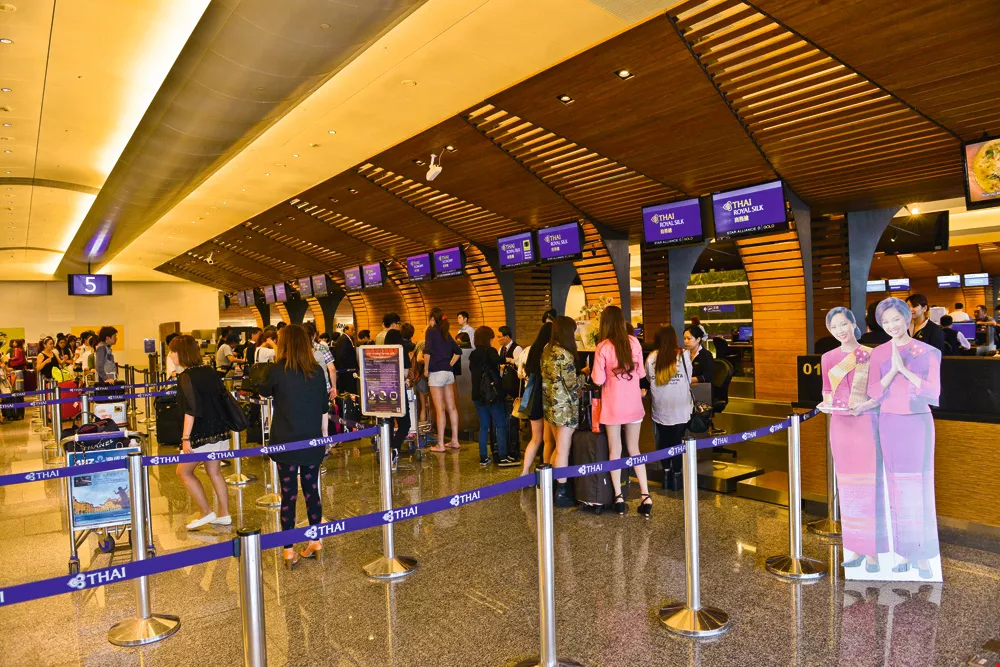
The wood-grained check-in islands leave much more space for luggage-pushing travelers, who can now wait in line without feeling crowded.
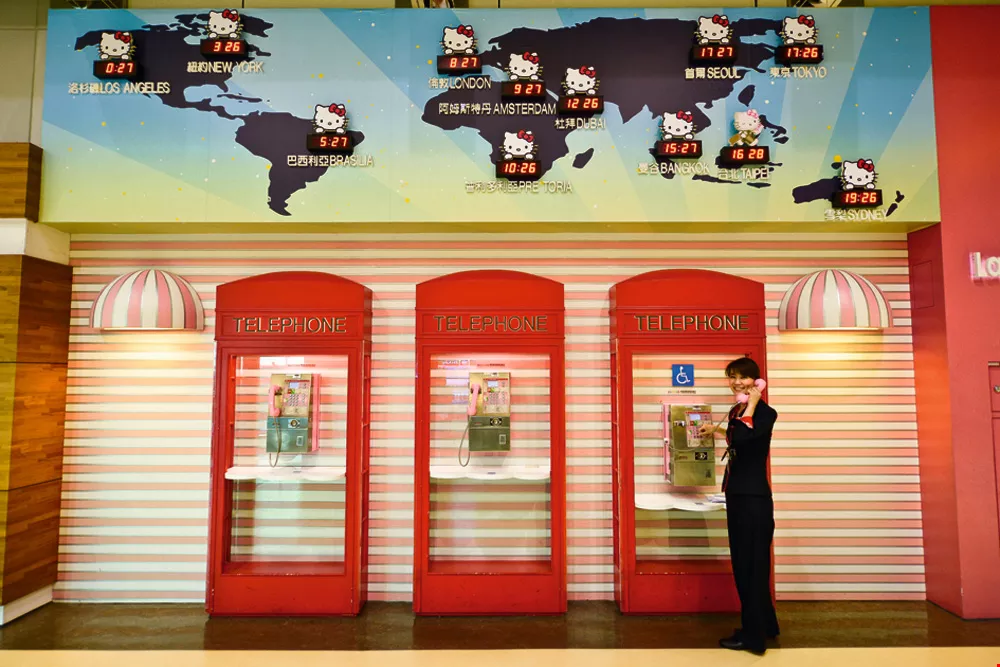
Each of the departure lounges designed by Ever Rich Duty Free Shop features its own unique theme, including such focal points as down-home Taiwanese cuisine, images from around Taiwan, and the nation’s postal service. The Hello Kitty world clocks and telephone booths are especially popular.
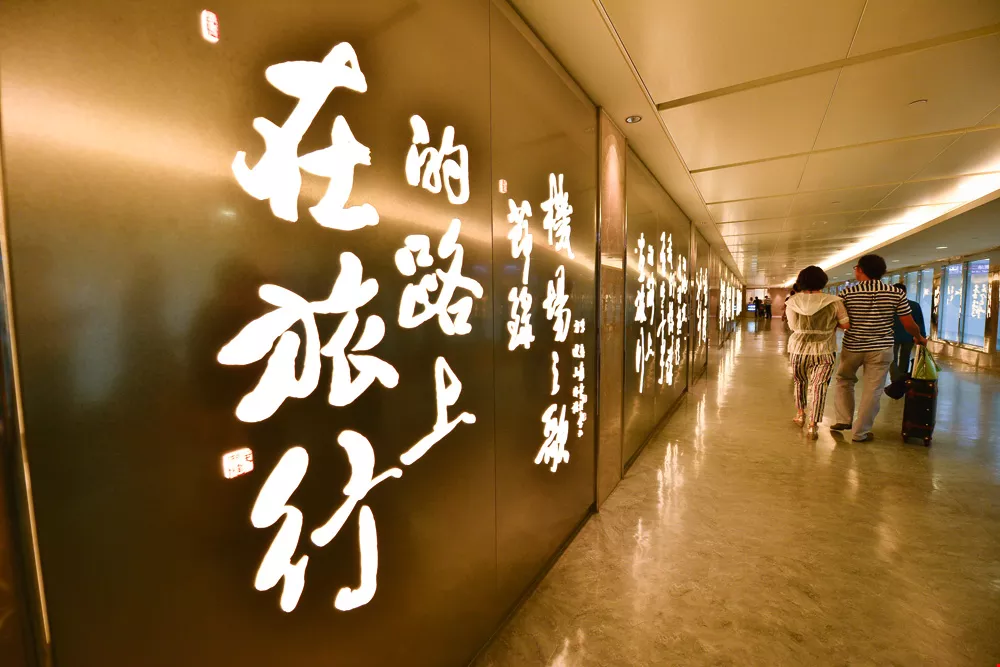
The “Literature Wall,” featuring a large calligraphy presentation of the poem “On the Road,” makes an unforgettable impression on visitors who pass through Taoyuan International Airport.
@List.JPG?w=522&h=410&mode=crop&format=webp&quality=80)

@List.jpg?w=522&h=410&mode=crop&format=webp&quality=80)


