The Low-Carbon Future:Taiwanese Industry Goes Green
Coral Lee / photos Jimmy Lin / tr. by Scott Williams
April 2010


In industries ranging from information technology to energy technology, carbon has become the burning issue of the 21st Century.
Carbon-related terminology is all over our newspapers: there's a trend towards labeling goods with their "carbon footprint"; Taiwanese industry is facing the prospect of trade barriers in the form of international "carbon taxes"; once laws limiting the emission of greenhouse gases are implemented, businesses will face mandatory "carbon audits"; the global "carbon trading" market is expected to grow to US$3 trillion in value over the next 20 years; Pinglin Township in Taipei County is working towards becoming a "carbon neutral" community....
The rapid increase in greenhouse gas emissions (primarily carbon dioxide) over the last 50 years has led to global warming and climate change. The United Nations' Intergovernmental Panel on Climate Change (IPCC) Working Group has warned that humanity must act to ensure that global temperatures rise by no more than 2o Celsius by 2050 if it is to survive the 21st Century. Achieving that goal will require limiting atmospheric CO2 to less than 450 parts per million (ppm), which means reducing carbon emissions by 7 billion tons by 2050. Given natural demand resulting from a growing global population, that means cutting carbon emissions by 50%.
As the world mobilizes to reduce carbon emissions, the various actions being taken-appeals to consumers, trade mechanisms, and government controls on total carbon emissions-are all affecting industry. At the same time, we are also relying on the business community to develop the new low-carbon and power-generation technologies necessary to resolve the crisis.
As Taiwan faces the challenges of the low-carbon economy, a number of forward-looking corporations have begun actively "greening" their operations to improve their competitiveness, splicing the low-carbon and energy-conservation "genes" into their design, purchasing, manufacturing, transportation and recycling DNA. These efforts are not only creating both tangible and intangible benefits for the companies, but are also raising awareness of energy conservation in Taiwanese society at large.
When the curtain closed on late 2009's Copenhagen Climate Conference, no tangible carbon-reduction agreement had been reached. But Niven Huang, secretary general of the Business Council for Sustainable Development, ROC, noticed that in spite of the grumbling about Copenhagen's failure to produce results, the conference had actually given Taiwan a little extra push.
Huang says the conference heightened the Taiwanese business community's concerns about climate change. "Perhaps the fact that Taiwan had just suffered severe flooding from Typhoon Morakot also played a role," says Huang. And it wasn't just the big firms who were asking questions; Taiwan's small and medium enterprises were also making inquiries. That was a first for Huang, who has been promoting carbon audits and carbon reductions to the business community for seven or eight years.
As the Lunar New Year approached, Huang visited one company after another, analyzing trends in the low-carbon economy. "Even distributors for Teco and Tatung were talking about Copenhagen at their New Year's banquets," says Huang. When carbon reductions become a "hot topic," it helps corporations "internalize" low-carbon thinking into their actual operations.
Huang says that the consensus on the 2o-of-warming and 450-ppm limits makes the timetable for carbon reductions clear: the nations of the world will need to cut carbon emissions by a further 20-30% over the eight years following the Kyoto Protocol's 2012 expiration.
As we seek to complete this daunting mission while also maintaining human living standards, we need to focus on practical matters-things like demanding that industry use existing technologies to improve energy efficiency (e.g. with intelligent appliances and high-efficiency motors) and that it work together to pull the world back from the brink-rather than cross our fingers and hope for a revolution in energy.
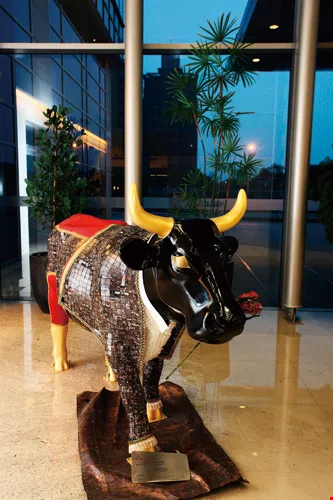
Visitors' eyes are drawn to a piece of installation art constructed from hundreds of Asus motherboards and located at the company's Guandu headquarters.
In fact, energy efficiency has been a mainstream issue for corporations around the world for nearly a decade. In 2002, institutional investors including Merrill Lynch, Goldman Sachs, and HSBC created the Carbon Disclosure Project (CDP), which every year distributes a questionnaire to major businesses around the world (4,500 in 2010). The CDP gathers data on large companies' carbon emissions and carbon-risk management, then provides it to investors.
CDP is a London-based organization representing institutional investors with US$57 trillion under management. It has sent its questionnaire to 30-some Taiwanese firms in the electronics (50%), traditional manufacturing (25%), and financial (25%) sectors.
Few Taiwanese firms responded at first because CDP operates on a voluntary basis and carbon audits are a newly emerging practice. But with carbon data becoming a key means of estimating a firm's future viability and the CDP itself continuing to press for answers, almost all of Taiwan's large electronics manufacturers, including Taiwan Semiconductor (TSMC) and AU Optronics (AUO), have, since 2005, begun to disclose their carbon data.
Wells Lin, a senior manager with AUO's Risk and ESH Management Division, says that most companies' carbon audits rely on the ISO14064 standard or on the Greenhouse Gas Protocol established by the World Business Council for Sustainable Development and the World Resources Institute in 1998. Such audits have three major sections-manufacturing processes; facilities and administration (including electricity usage, business trips, and employee commutes); and outsourced production and labor (including transport and waste disposal). Companies must calculate all of their energy consumption and greenhouse gas (GHG) emissions.
"The audit showed us that the perfluorinated compounds (PFCs) we use in the TFT-LCD production process comprised our largest source of GHG emissions," says Lin.
Lin explains that sulfur hexafluoride, a PFC, is 22,800 times more potent a greenhouse gas than CO2. In response to the audit, AUO spent NT$800 million installing equipment that breaks PFCs down into other gasses. The equipment, which can only be installed during the construction of a new plant, reduces GHG emissions by 20-30%.
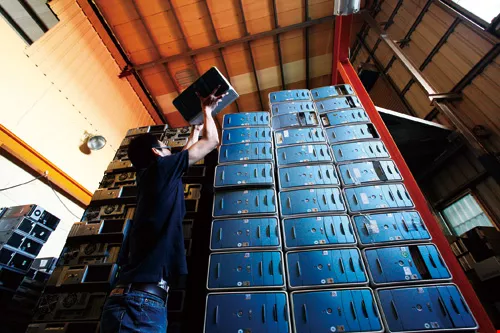
Asus recycles computers from every manufacturer. In an effort to "help itself, help others, and help the world," the company refurbishes the computers, then donates them to disadvantaged groups and schools in remote areas. Asus is even training people in the Philippines to act as "seeds" for recycling programs there. Shown here is Asus' downstream refurbishment partner Xunfeng Information.
While the CDP has been pressing the business community to focus on carbon, other groups have been developing product directives and analytical tools to encourage companies to save energy and cut carbon emissions.
In 2005, for example, the European Union introduced its Ecodesign directives for Energy-using Products (EuP), which focus on improving the energy efficiency and environmental performance of a broad range of products. Companies will not be permitted to sell products that fail to meet the standard in the EU market. In the US, a revised version of the Energy Star program set energy-consumption ceilings for 3C products. In 2006, the US also introduced the Electronic Product Environmental Assessment Tool (EPEAT), a standard intended to encourage the purchase of green electronics. But these myriad new rules can get on companies' nerves. The slightest slip up can result in huge corporate headaches.
Unsatisfied with simply asking major corporations to disclose their carbon data, in 2007 the CDP established the Supply Chain Leadership Collaboration (SCLC) to encourage corporations to have their supply chains and outside manufacturers also reduce their carbon emissions. SCLC helps its members identify and manage their own carbon emissions, and calculate the carbon footprint of their entire supply chain.
The likes of computer giants Dell and HP, consumer products monolith P&G, and retailers Tesco and Wal-mart all jumped on board when the SCLC rolled out its new approach. The organization now groups together 40 leading companies which in turn influence many hundreds of thousands of other firms.
Corporations are facing pressure on multiple fronts. SCLC has a bearing on the reputations of major transnational corporations. EuP and EPEAT affect consumer demand and government purchasing.... Given all the pressure being brought to bear on the carbon issue, we are likely to see a carbon-reduction chain reaction spread across international business in the near future. And no one wants to be left out.
Wal-mart, the US's largest retailer, sent shockwaves through the market early this year when it announced that it would require all the products on its shelves to carry a carbon footprint label within the next five years. The new policy will compel Wal-mart's hundreds of thousands of suppliers around the world to calculate the lifecycle carbon footprint-which covers everything from raw materials, production and transportation to usage and recycling-of every product they place on the store's shelves. Consumers will then be able to evaluate and compare the scores.
Calculating a lifecycle carbon footprint is no mean task, and, in the case of Asus' N51V laptop computer, which earned a carbon footprint certification last year, it was a truly daunting undertaking. It wasn't just a matter of auditing the raw materials, manufacturing and assembly of the motherboard that it manufactured itself. Asus had to do the same thing for some 2000 other components (e.g. the mouse, the case, and the graphics card) supplied by manufacturers from all over the world, then get each of its suppliers to provide it with data on the materials used and the process energy consumed, for every item.
"It took the efforts of several dozen people over the course of more than a year before we finally received what was the world's first carbon footprint certification," says Frank Lin, Asus's chief quality officer.
"The basics of business used to be limited to delivery dates, prices, and cooperation," says Ma Sheng-shong. "In the near future, these basics will also include carbon data." Ma, a manager with the Foundation of Taiwan Industry Services who consults with corporations on energy conservation and carbon reduction on behalf of the Ministry of Economic Affairs, stresses that cutting carbon emissions is no longer just a moral issue. It's becoming a matter of survival. In the future, companies that are unwilling or unable to disclose their carbon data will alienate themselves from the market and fail.
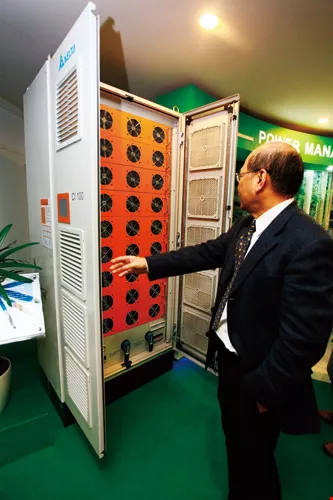
Delta Electronics now manufactures a 100 kW solar inverter. The photo shows Delta president Mark Ko.
Big name corporations and retailers face a more serious challenge-they have to extract carbon-reduction promises from their suppliers. After all, carbon footprint calculations are only the prep work. It's only after you've identified which links in the chain are producing the most carbon and which have the greatest potential for carbon reductions that the real work of cutting carbon emissions begins.
Given that leading corporations want to broadcast their determination to save the planet, they certainly don't hold back when setting carbon reduction targets. Take Google, which consumes huge amounts of energy running the servers that deliver services to more than 2 billion people. The company recently announced that it had achieved carbon neutrality in 2008, and that it planned to invest hundreds of millions of US dollars in wind and solar power generation with the goal of generating more clean energy and reducing its purchases of carbon offsets.
Last year, Microsoft announced that it would cut its 2012 carbon emissions to 70% of their 2007 level. HP, meanwhile, has cut its carbon emissions by 30% a year over the 2004-2010 period. Taiwan's major corporations have made similar promises. As their carbon emissions decline, it falls to mid- and upstream suppliers to do the dirty work. Taiwan is at the heart of global supply chains in many key industries, and is under strong pressure to cut emissions.
Fortunately, Taiwan's major corporations have a long history of coming out on top. Local firms began working together on energy conservation and carbon reductions a decade ago, soon after the Kyoto Protocol was signed. Their objectives were threefold: first, being good global citizens; second, establishing a competitive niche; and third, cutting fuel and electricity costs through energy savings. Recognizing that we live in an era of thin profit margins where every cent matters, Taiwanese corporations set out to master energy conservation techniques.
Below are five tactics Taiwan's tech firms have used to green their way to greater competitiveness:
(1) More energy-efficient manufacturing
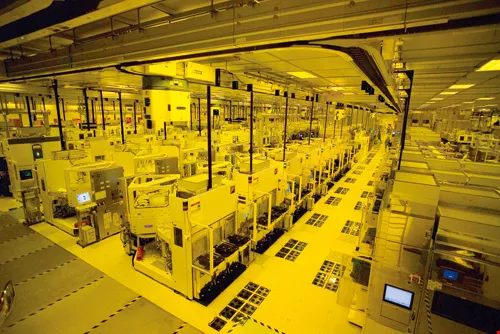
TSMC manufactures IC wafers in tightly sealed clean rooms that require enormous ventilation systems to keep the air clean. "In order to get rid of the dust and particulates in the air, our circulation systems used to have to move large volumes of air in and out," says Hsu Fang-ming, deputy director of TSMC's Risk Management and Corporate ESH division. Hsu recalls that more than a decade ago, TSMC pioneered the "Mini Environment" approach as a means to reduce its energy bills. The approach minimizes the size of the spaces in which equipment makes direct contact with wafers and through which wafers are transported. Air-circulation systems inside the equipment then clean the air within these spaces to the highest standards of purity, which allows the air inside the clean rooms to be kept at a lesser level of purity. An example of the "small systems" concept, the approach recognizes that it's not necessary to clean all the air in the room, just that in the area that comes into contact with the wafers.
"Once TSMC had shown the way, other chipmakers followed suit," says Hsu. "The Mini Environment has now become the world standard." Hsu says that even with such a "nitpicking" approach, the group's monthly electricity bill is over NT$6 billion. To get the most out of every bit of energy, the company even seeks to avoid losing air through the door seals. The little bit of manpower it takes to close doors tightly can save 10% on air conditioning.
(2) Designing green
Implementing energy conservation measures in the manufacturing process can certainly reduce carbon emissions. However, in recent years lifecycle carbon footprint surveys have revealed that the long hours for which IT products, communications devices and consumer appliances are used (many cell phones stay on around the clock) mean that the carbon emissions generated by the use of these products often greatly exceeds those generated by either their manufacture or the creation of the raw materials used in their manufacture.
Take Asus's N51V laptop computer. Usage accounts for roughly 40% of the product's carbon footprint over its entire lifecycle (37% for home users, and 48% for office users). In the case of a carbon-footprint-certified 32" LCD built by AUO, usage is expected to account for as much as 60% of lifecycle carbon emissions.
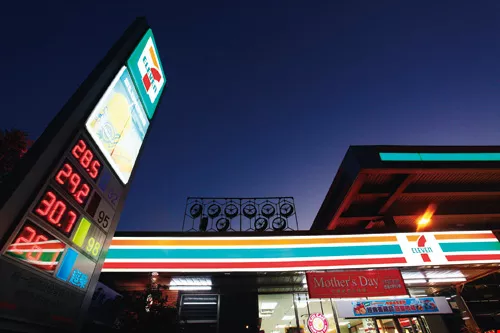
Going low-carbon is more than just a means for the electronics industry to enhance its competitiveness. Taiwan's traditional manufacturers and service sector also need to address the carbon risks and carbon opportunities brought on by a warming world. The photo shows President Chain Stores' first wind-and-solar powered location.
"Firms can only demand things of themselves," says Asus's Frank Lin. "Its very hard to get consumers to change their use habits." But corporations can limit the amount of electricity products consume through advanced product design. "Design is the key to a product's lifecycle carbon footprint," explains Lin.
In Asus's case, the company's pursuit of green design has resulted in the implementation of much more stringent controls than called for in the EU's Restrictions on Hazardous Substances directive (the RoHS applies to six hazardous substances; Asus has implemented controls on 57) and an intense focus on energy conservation and efficiency.
Asus, which was founded as a motherboard manufacturer, recently developed a technology it calls the Super Hybrid Engine (SHE) for its new motherboards. SHE allocates power based on how a computer is being used, dynamically switching between 16 power configurations in response to the user's needs. For example, while working on a document takes only minimal power, listening to music or watching a movie takes a little more, and playing a game requires a huge amount.
"In other words, the technology won't deliver 150 units of power when the consumer only needs 100," says Lin. This design increases energy efficiency by 33%.
Asus also designs with recycling and reuse in mind, further improving energy efficiency.
Lin explains that roughly 2,000 parts go into an Asus computer, but there's not a screw among them. Instead the company uses snap-fit fastening systems that facilitate disassembly and recycling. It also avoids welding together incompatible materials (such as plastic and metal), which further facilitates recycling.
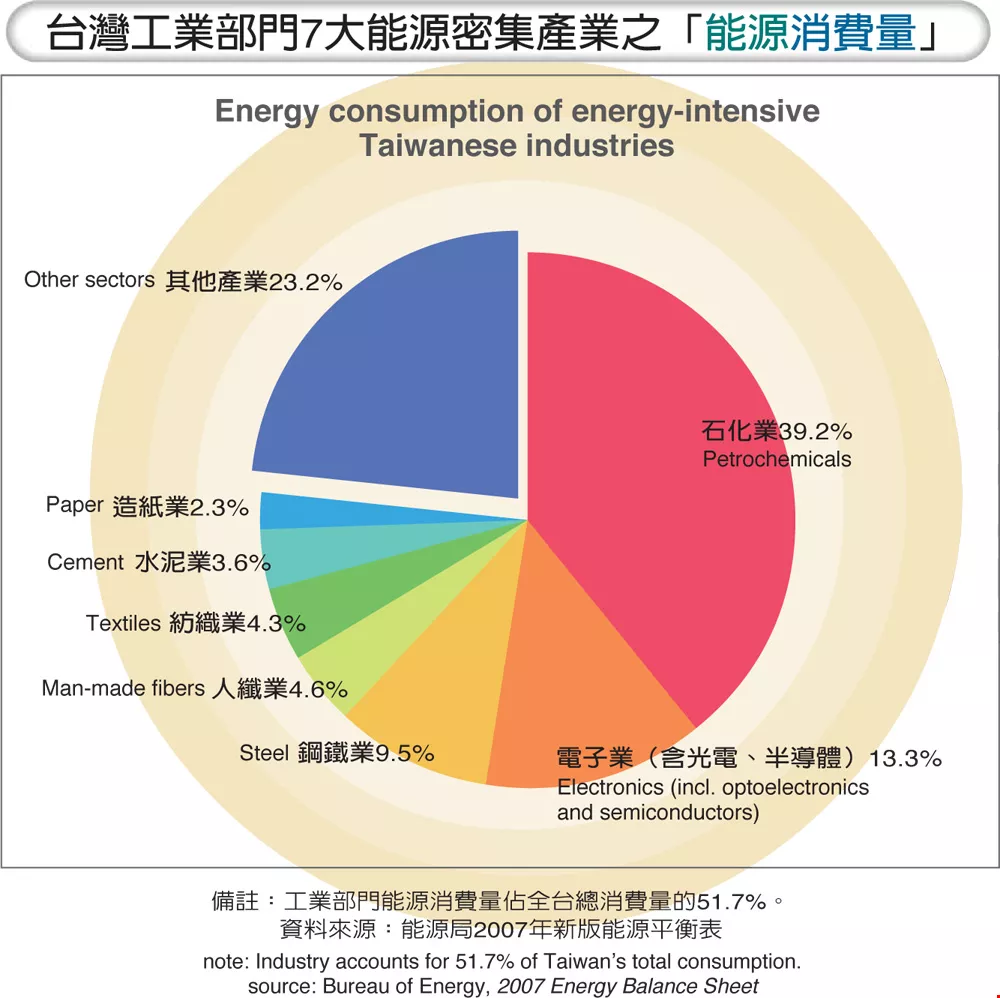
Energy consumption of energy-intensive Taiwanese industries/source: Bureau of Energy, 2007 Energy Balance Sheet
Where Asus is using motherboard design to save energy, Delta Electronics, a maker of power supplies, is utilizing improvements in conversion efficiency to make 200 million computers and servers more energy efficient.
A computer's power supply converts the 110-volt AC power from the power company into stable DC voltages (e.g. 12V, 5V, and 3.3V) that the computer can use. This process wastes power and generates heat. Increasing the conversion efficiency not only reduces the amount of power lost in conversion, but also reduces the amount of heat generated, and thus the amount of energy expended on cooling.
Delta, which became the world's largest producer of power supplies in 2002, manufactures power supplies for more than half of the world's laptops and servers, and about one-quarter of its desktop computers.
"We make roughly 17 million power supplies per month," says Mark Ko, president and COO of Delta. "That means that if we increase our devices' conversion efficiency by just 1%, the world needs to build one fewer 600-megawatt power plant every year." The company has increased its conversion efficiency by 0.5-1% per year for the last five years.
Delta chairman Bruce Cheng has for years been fervently urging companies to pay more attention to the environment. He's also applied some of his own company's resources to the development of new energy. In 2004, Delta established DelSolar to develop and manufacture solar cells. More recently, the company has begun developing inverters for wind turbines and components for the power systems of electric cars.
Cheng's now thinking about designing a new "inheritable" TV. The case and most of the components of such a TV would be intended for long-term use, while the control board, consumables, and firmware would be updateable, allowing the TV's functionality to be continuously upgraded. The design epitomizes the "cradle to cradle" spirit, discouraging obsolescence and flipping mainstream market logic on its head. It has great potential to save energy... if consumers will accept it.
(3) Mobilizing the supply chain
When calculating product lifecycle footprints, manufacturers must not only take the end-use of products into account, but must also look at carbon emissions associated with the raw materials. The process can represent a huge headache for corporations because 1) huge numbers of parts and raw materials go into products and 2) every supplier, from the very large to the very small, has things that it has difficulty accounting for.
"For us, the toughest link in the chain is reducing the carbon emissions of the materials phase," says AUO's Wells Lin. He explains that the materials that go into liquid-crystal panels include glass, plastic, metal frames, liquid crystals, LEDs, and cold-cathode fluorescent lamps. Getting in touch with more than 500 suppliers large and small, getting those suppliers to provide carbon-footprint data, then getting them to reduce their carbon emissions is a herculean task.
He says that some of the big-name suppliers that dominate key parts and materials markets are oligopolists that won't even provide carbon-footprint data. Glass substrate manufacturers, for example, are extremely reluctant to publish carbon data because fuel and power comprise such a large proportion of their costs that providing carbon data would be equivalent to revealing their entire cost structure. Some large Japanese firms that supply chemical products (e.g. photoresists) face similar difficulties.
Recognizing the existence of this kind of bottleneck, international guidelines on the assessment of lifecycle GHG emissions permit companies to utilize data from similar firms in lieu of actual data (e.g. the carbon numbers for glass from another nation or firm). But the specification prohibits such "second-tier numbers" from accounting for more than 10% of a product's lifecycle carbon emissions.
Unlike the more obstructionist of the major materials firms, most small and medium-sized suppliers of electronics components face intense competition. As a result, they are more responsive to pressure from their customers. But firms often have more than 1,000 suppliers. How can they get their entire supply chains on board with their energy conservation efforts?
"We ask all our suppliers to set up a contact window," says Asus' Frank Lin. He says that Asus' order system contains links to webpages with technical specifications. Whenever suppliers go online to check for a new order from Asus, they are compelled to view the newest energy-conservation specifications. Suppliers have to adhere to these specifications when delivering goods, and can't claim "you didn't notify us!"
(4) Intelligent distribution
Companies aren't just analyzing their designs, materials, parts purchasing and production processes in search of energy savings, they're also examining post-production processes such as packaging and transportation.
It turns out that one of the keys to reducing carbon emissions from the transport of goods is intelligent packaging.
Low-carbon packaging"We decreased the weight of the packaging for a 15" laptop computer from 890 grams to 620 grams," says Asus' Lin. By lightening and improving packaging (e.g. by strengthening the inner box and eliminating the exterior packaging), Asus was able to increase the number of laptops per air-freight pallet from 54 to 78, and per sea-freight pallet from 90 to 130. By cramming an extra 840 laptops into every shipping container, the company improved its shipping efficiency by 45%, reducing the carbon footprint of its laptops and greatly reducing its transportation costs.
Shortening and merging transportation routes can also reduce carbon footprints. It is particularly important that companies take action on products for which transportation constitutes a significant proportion of carbon emissions.
For example, while the production of agricultural products involves relatively simple processes, such goods are often sold to buyers on the other side of the planet or shipped thousands of miles for processing. This increases the carbon footprint of agricultural products, and, in the future, may reduce their sales.
(5) Recycling
Can raw materials and products be recycled? How many times can recycled materials be reused? How should the product be disposed of? The answers to these questions have a significant impact on a product's carbon footprint. Full recyclability can reduce a product's carbon footprint score, helping offset carbon emissions generated by its production or use.
"We can't recycle and reuse without ensuring that downstream recycling plants can achieve economies of scale," says TSMC's Hsu. "You have to establish sufficient incentives to keep these plants viable in the long term." Hsu says that in keeping with the concept of environmental friendliness, TSMC stresses cooperation, not competition. In fact, the company's cooperation with new recycling facilities over the last few years is a case in point.
Hsu mentions the recycling of antistatic plastic bags: TSMC uses as much as 5 tons of antistatic plastic bags every month as packaging for IC wafers. These bags contain aluminum foil and used not to be recyclable. But Taiwanese industry consumed such a huge number of them (the semiconductor and optoelectronics industries alone use nearly 100 tons per month) that they became a problem for Taiwan's landfills. That fact, together with the global semiconductor industry's move to switch metrics from "recycling percentage" to "final landfill volume," prompted TSMC to help recyclers develop the technology to deal with the bags.
With TSMC's support, recyclers need only invest NT$2 million to be able to separate the aluminum from the plastic. Once the materials are separated, the aluminum is cast into ingots and reused, while the plastic is turned into foam sandals and similar products. TSMC went on to share the technology with its industry association and with each of Taiwan's technology parks to encourage other firms to recycle their plastic bags.
"If you want to reduce carbon emissions, you need more than one firm working at it. To do it effectively, you need the entire business community, the entire nation involved," argues Hsu.
Risk vs. opportunityThe tech industry is one of the pillars of the Taiwanese economy, and we should applaud its efforts to green itself to greater competitiveness. However, given that at present more than half of Taiwan's 15 carbon footprint certifications are clustered in this sector and that few of our traditional manufacturers and only one of our financial firms has responded to the CDP questionnaire, it is clear that Taiwan's business community as a whole is not yet paying sufficient attention to the carbon issue. This suggests a worrying lack of awareness of risk management.
"Taiwan has yet to institute a carbon tax, and our GHG reduction act has languished in the legislature for more than three years," says Allen H. Hu, director of the Institute of Environmental Engineering and Management at National Taipei University of Technology. "As such, it is impossible for us to control our total emissions of carbon in the way Europe does." Without the carrot and the stick, the business community has little incentive to stop dawdling.
Hu argues that once overall limits are in place, carbon quotas for industry will urgently need to be elaborated. These quotas plus a tax on carbon will create a market mechanism for pricing carbon (through the trade in carbon credits). This, in turn, will create an incentive for all industries and sectors of the economy to cut their carbon emissions and sell their excess carbon credits for cash.
Hu cites the EU as an example. When the Kyoto Protocol was adopted in 1997, signatory nations established carbon reduction targets for 2012. When the UK and Germany achieved their targets in 2005, they forged ahead, setting new, more stringent targets. Spurred on by government policy, companies developed new technologies and alternative energy sources that nations outside the EU are having difficulty matching.
With the low-carbon economy virtually on our doorsteps and the tech industry already greening, are the government and our other industries ready to address the carbon risks and carbon opportunities of a warming world? Are they ready to again shoot for the stars, for themselves and for Taiwan? There is clearly plenty of scope for greater efforts.