K.C. Chen Writes a Happy Ending for a Taipei Story... House
Su Hui-chao / photos Chin Hung-hao / tr. by Phil Newell
November 2013
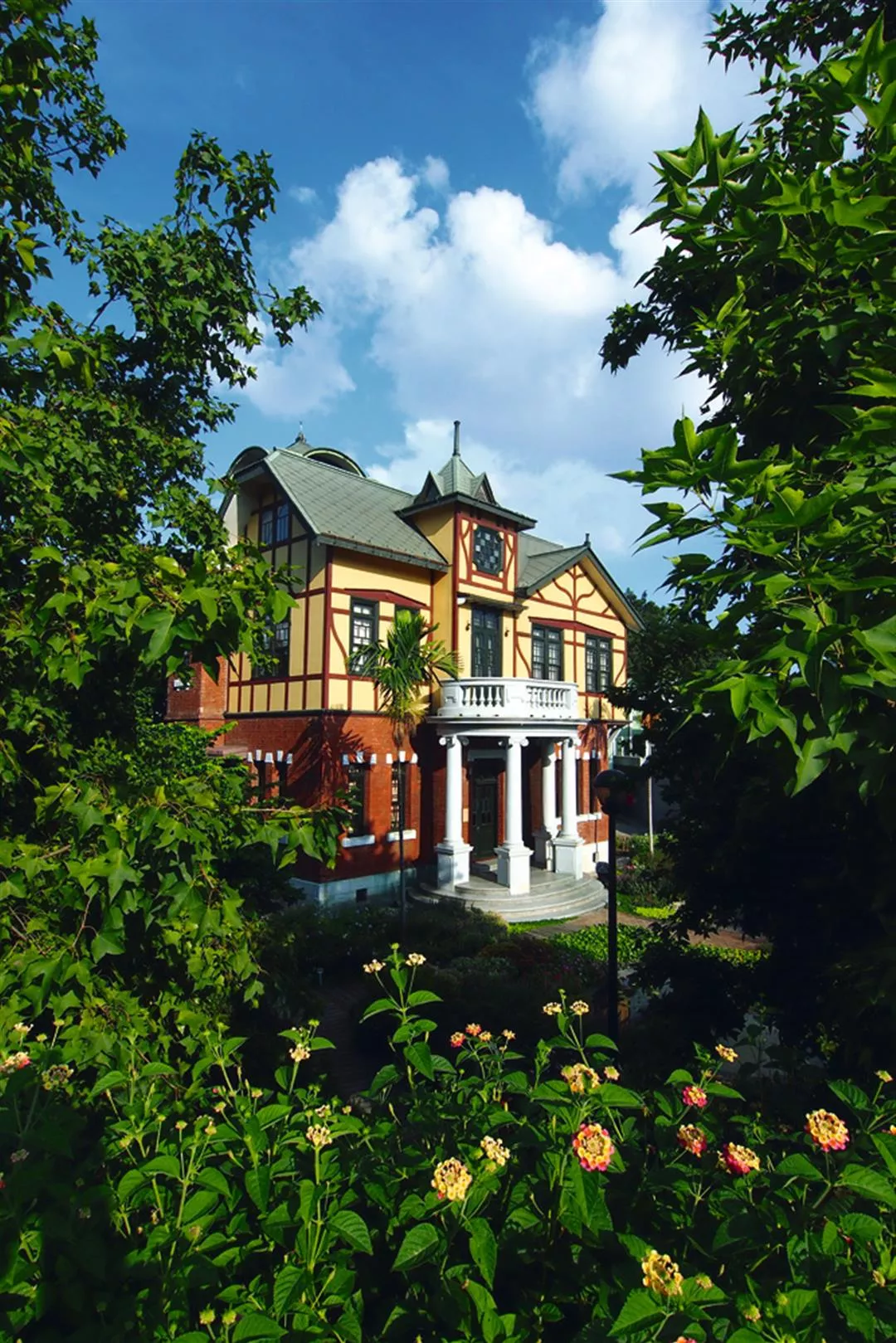
In 1913, a Tudor-style house sprang up next to the Keelung River in Taipei City. Known as the Yuanshan Villa, it was a unique oddity in Taipei’s urban architecture. It knew a period of grandeur, then years of neglect.
In 2003, K.C. Chen retired as chief of legal affairs at Taiwan Semiconductor Manufacturing Corporation. In the same year, through an invitation from Lung Ying-tai, then head of the Taipei City Department of Cultural Affairs, she became the first and only person in Taiwan to personally “adopt” a historic site.
Having found someone to take care of it, Yuanshan Villa—now renamed as Taipei Story House—has bloomed once again. K.C. Chen’s elegant ideas about managing a historic site have, step by step, been realized.
The ten-year-old Taipei Story House has a new mini-park. K.C. Chen leads her guests around the back of the European-style flower garden and up a flight of stairs, where a retro Taiwanese-style mini-park, installed on a reclaimed piece of abandoned land, is hidden away.
If you are someone born before 1980, your memories will certainly still include a concrete slide, old-fashioned swings, a polished-stone public washbasin, and the sounds of laughter drifting through the air.
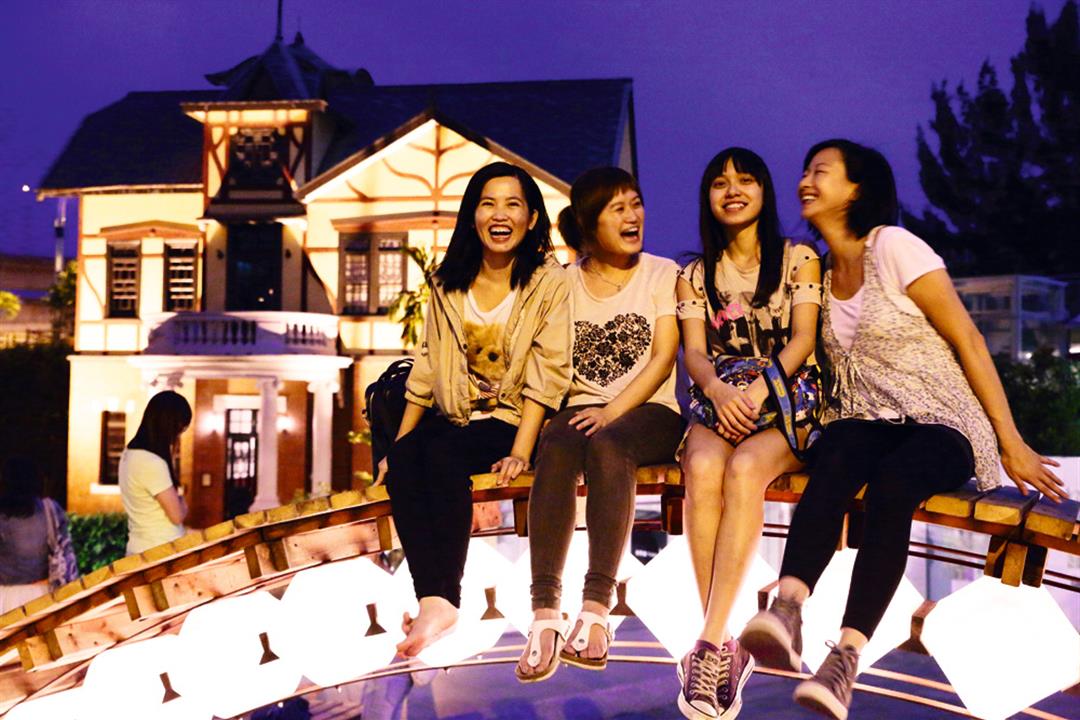
Each detail is imbued with knowledge, and every step brings a new delight. Not only does Taipei Story House have a steady 12,000-plus visits a month, the latest survey shows that whereas early on most visitors were in the 50–55 age bracket, it is 30–45-year-olds who now predominate, and 40% of those who come are return visitors. The number of foreign tourists has also been steadily increasing.

The century-old Taipei Story House, an English Tudor-style structure that is today a historic site, was adopted ten years ago by a single individual, K.C. Chen. Once neglected, it is now alive with greenery, birdsong and flowers.
“Yuanshan Villa” was built by a tea merchant named Chen Chao-chun, who lived in the Dadaocheng neighborhood of Taipei. He used this Western-style house to play host to leading Taiwanese gentry and political figures, and for meetings of tea merchants from many different lands. It was a place where literati, artists and performers gathered and where nanguan music hung in the air, a place filled with the fragrance of tealeaves and osmanthus flowers.
Chen Chao-chun died young, and there was no one to succeed him. Eventually, management of the building was taken over by the Taipei Fine Arts Museum, which was opened on an adjoining plot of land in 1983. In 1998 Yuanshan Villa was designated as a municipal historic site, and survey and restoration work was begun.
Yuanshan Villa was not the home of a famous person, and no great historical events happened there. But it was a unique remnant from its era.
When Taiwan Semiconductor Manufacturing Corporation (TSMC) president Morris Chang asked K.C. Chen to take charge of legal affairs at the company, she decided very clearly in her own mind that this would be “my last job in law.” She wanted to devote herself in her remaining days to pursuing personal passions, to finding the missing pieces of her life puzzle, such as her ambition of becoming a pianist, which she had had to abandon when she was 18. She also decided to devote herself to her real vocation: work in the cultural world.
Chen’s adoption of Yuanshan Villa was really a matter of a lot of factors falling into place serendipitously. First, she is unusual in her passion for old houses. They always make her think about a long-gone Fujianese-style mansion that her grandfather had built in Singapore, though she has long since transferred her passion to Taiwan. That was one factor.
She was also the first chairman of the board of Taiwan’s National Culture and Arts Foundation. She broke new ground, terminating the old “black box” system of art subsidies and creating a new transparent system. In the process she gained a deep understanding of Taiwan’s cultural ecology and made many valuable friends in artistic and cultural circles. That’s a second factor.
The third, and you’d have to say the most important, was her legal background and management experience.

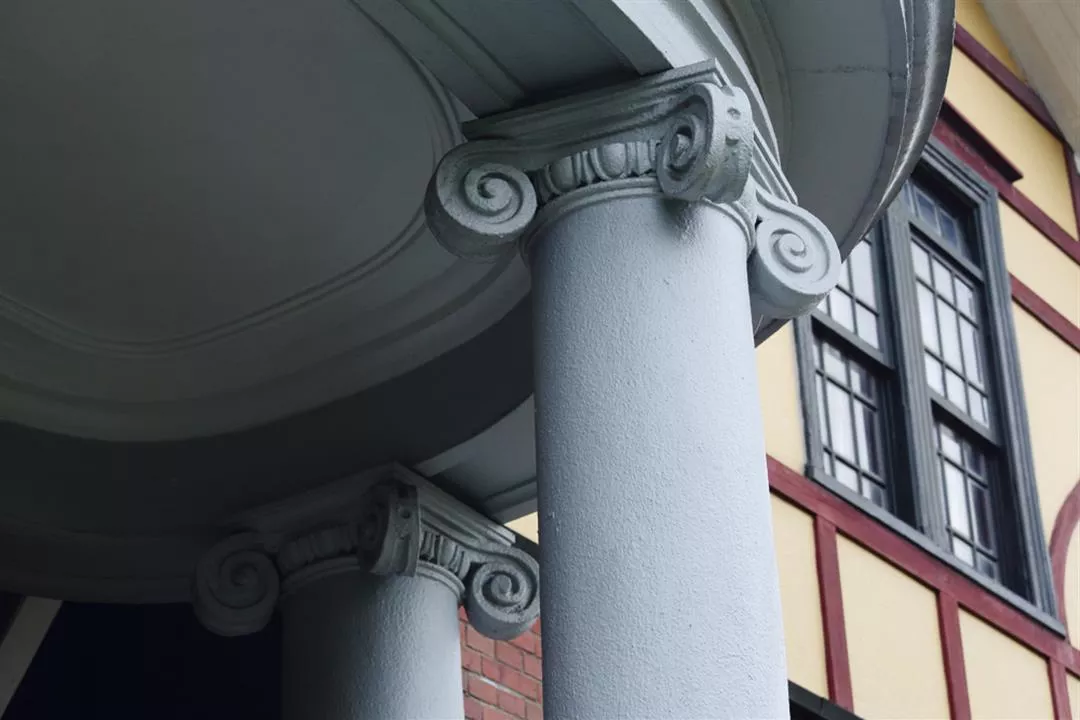
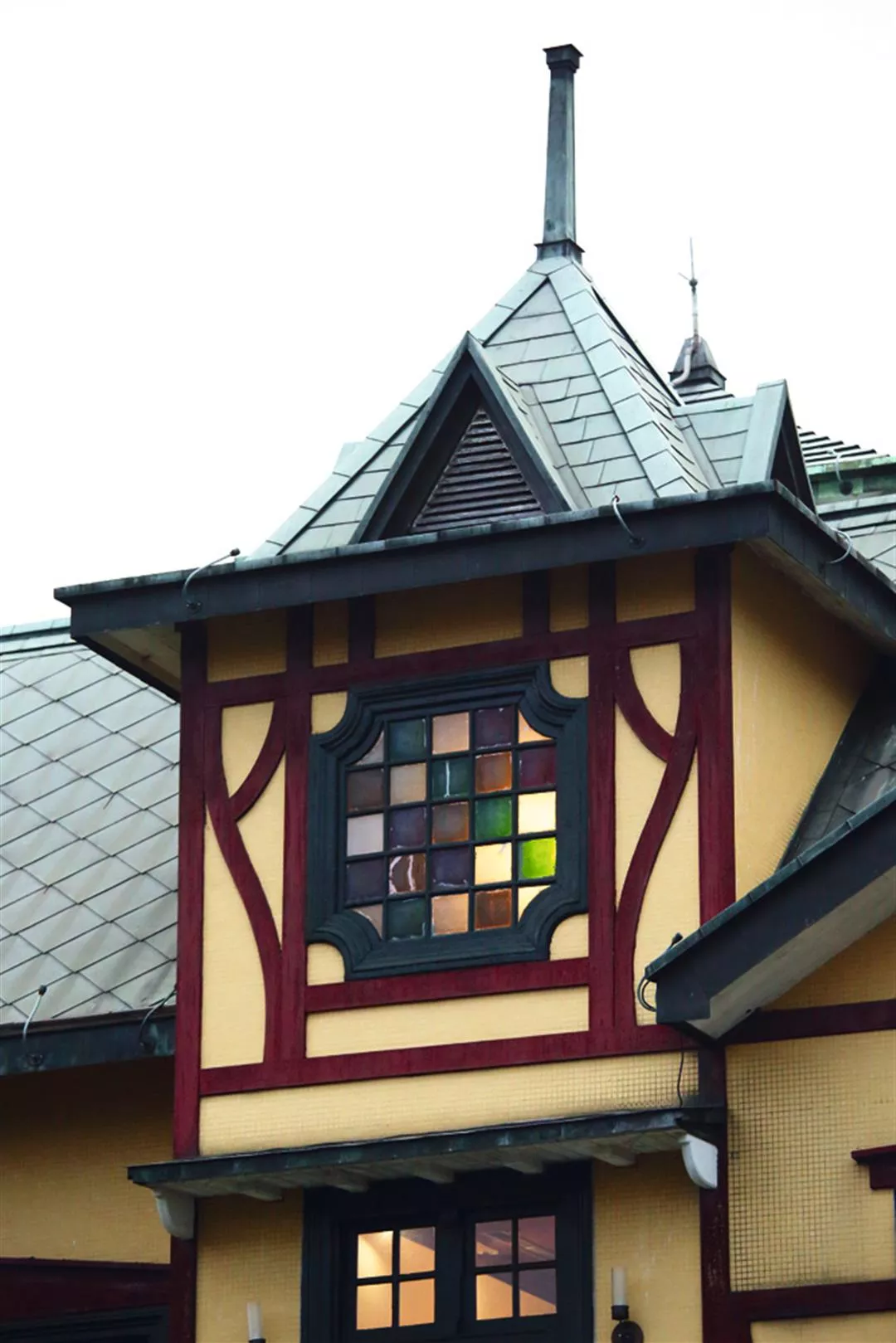
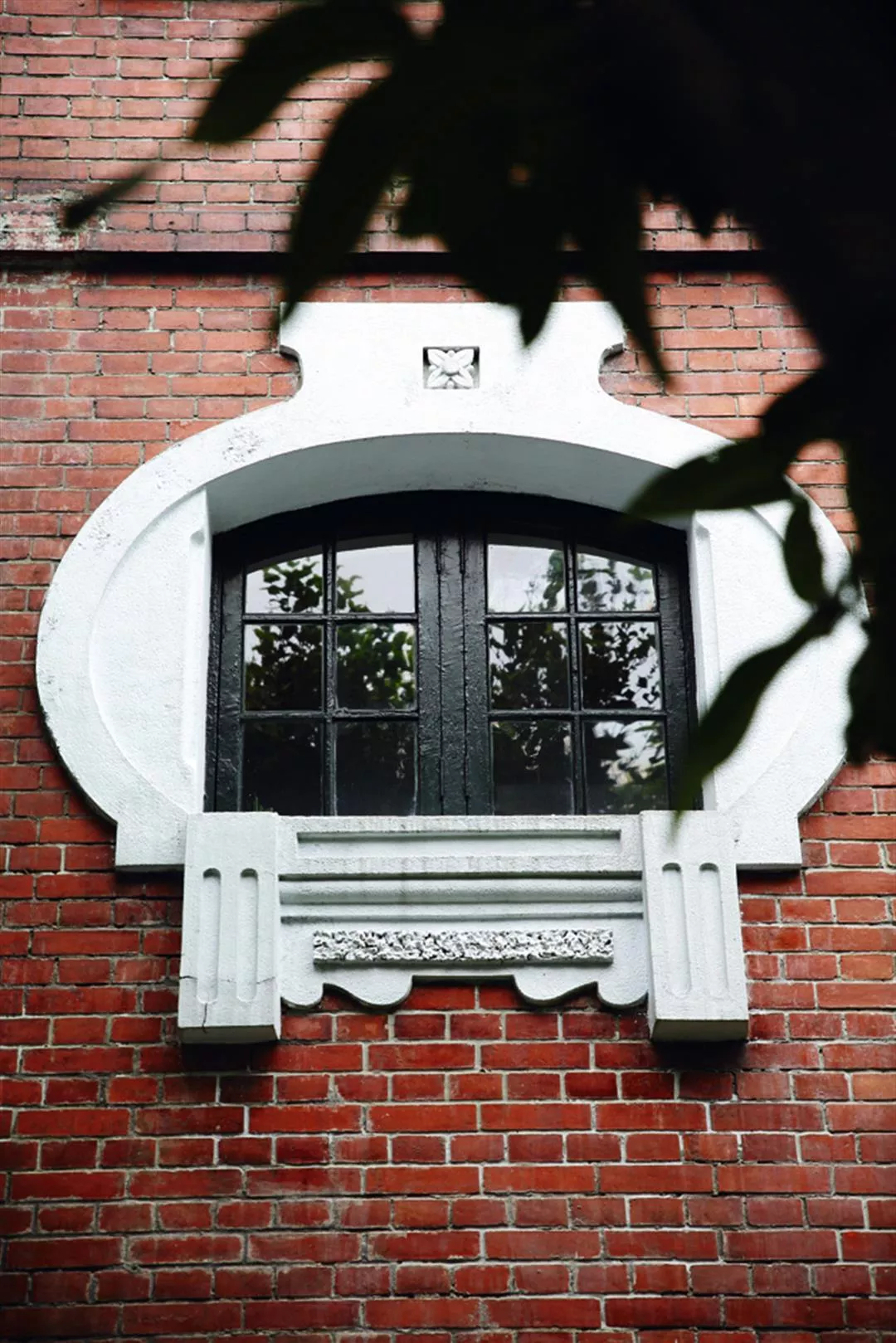
Quirky windows, Greek pillars, and stained glass are just a few of the intriguing elements in the design of Taipei Story House.
Having an individual adopt a historic site is an experiment for Taiwan, and there have been a lot of legal glitches along the way. Chen had to grope her way through these one after another in the first three years after taking charge of Taipei Story House. The first problem she encountered was how a “natural person” (in contrast, under law, to a corporate entity) could hire employees and take care of matters like workers’ health insurance and payroll tax deductions.
After repeatedly discussing the issue with the Taipei City Government, she decided to operate within a “sole proprietorship” structure. The “firm” comprises only one person, but is able to hire employees, enter into contracts, issue invoices, and sell tickets, so long as the purpose is “in the public interest.”
The next problem encountered was that Chen found out that her personal donations were not tax deductible. She donated NT$30 million of her own money to Taipei Story House in the first four years, but this money could not be counted against taxes. “Who on earth would want to adopt a historic site after finding this out?!”
After discussions, they finally found a solution. The Department of Cultural Affairs set up a “historic site fund,” and Chen submitted her donations to it, specifying the precise purpose for each separate donation.
Chen believes that putting historic buildings to new uses is not work for artsy dreamers—it’s a job for practical managers. Everything from routine maintenance, to manpower allocation, to holding exhibitions and events that create name recognition for your site, is built on a foundation of meticulous management.
“It’s really like a huge management jigsaw puzzle. The only reason I’ve been able to pull it off is not that I am especially capable,” says Chen, “it’s just that I’ve acquired the tools through my working experience over the years.”
She has defined Taipei Story House’s role as one of coordination. For all exhibits, including the special exhibition “The Story of Greeting Cards” and the current one telling the story of Zhongshan Bridge, all the pre-show research, design, and planning work is turned over to experts. Story House acts as the final implementer.
Story House has held 30 special exhibitions so far. All of the explanations and labels are in both Chinese and English, with Chen personally crafting the English. “Our goal is that a person who comes here without being able to read Chinese will leave with the same experience and understanding, from start to finish, as a person who does read Chinese.”

Quirky windows, Greek pillars, and stained glass are just a few of the intriguing elements in the design of Taipei Story House.
English is Chen’s mother tongue.
When Chen first set foot in Taiwan more than 30 years ago, she could read Chinese but couldn’t speak standard Mandarin. “Just answering the phone was terrifying!” Whenever she missed her family, who lived in Hong Kong and who spoke Hokkien dialect, she would wander into the small alleys and back streets of Taiwan where Hokkien was spoken, and just hearing it had a calming effect.
Until her 18th year, Chen lived in Hong Kong. Her parents were both Overseas Chinese, Dad from Burma (now Myanmar) and Mom from Singapore. After World War II, her father was assigned to Hong Kong to be head of the Burmese consulate there.
In colonial Hong Kong, Chen, like the children of many ethnic Chinese elites in the territory, spoke her local dialect at home, spoke Cantonese out on the street, and went to elite schools where she spoke only English. It was very possible that she could have grown up not knowing Mandarin Chinese at all, and she only studied reluctantly at her father’s insistence, until she happened upon a book by romance novelist Chiung Yao. Like most teen girls of her era, she found Chiung Yao enthralling.
“Taiwan should award special medals to Chiung Yao and [martial arts writer] Jin Yong in recognition of how they kept up interest among Overseas Chinese in learning to read Chinese.”
At age 18, she became the first child in her family to test into the University of Hong Kong. Nonetheless, she still felt that music was her real calling, and without thinking too much about it she also applied to music school. Little did she expect that she would run into vociferous opposition from her father.
She was basically an obedient child, limiting her resistance to refusing to speak to her dad. Her father gave her three non-music options, and she ultimately chose law. Like her elder brother and elder sister before her, she went to study in the UK.
The day she moved into her new place in the UK, the first thing she saw was a piano in the living room. Her brother told her, “Dad wrote to me and told me to rent it for you.” In that instant she realized her father was expressing his love for her in his own way.

The century-old Taipei Story House, an English Tudor-style structure that is today a historic site, was adopted ten years ago by a single individual, K.C. Chen. Once neglected, it is now alive with greenery, birdsong and flowers.
Logical and disciplined, Chen discovered that her musical brain was also very suited to the law. She passed all necessary exams to earn her qualifications as a lawyer by age 19, after which she finished all her studies, then practiced first in the US and then in Singapore.
She opted not to become a trial lawyer, but to focus on international business law, and there is a story behind that decision. When she was just a novice attorney, she backed up a senior defense attorney in a rape case involving a young girl. As she watched, the lawyer forced the girl to answer detailed, humiliating questions, trying to trap her and suggest that she was “asking for it,” thereby getting his client off.
Chen was unable to accept the idea of putting service to one’s client ahead of finding the truth, so she chose not to practice as a trial attorney. “But I don’t regret having studied law. Being a lawyer is a job that requires rigorous thinking, cool analysis, and the sensitivity to see the heart of an issue.”
After coming to Taiwan to practice, in order to learn Mandarin to the point where she could draft a contract without anyone’s help, Chen studied with an assistant chief editor at the Mandarin Daily News. Reviewing tirelessly two hours a day, within a year and a half she could express herself very precisely without having to resort to a single word of Cantonese or English.
At that time she had no idea that she would become so attached to Taiwan. But then she got married and had children here, her children went to local schools, and as a Mom it was her job to sign off on their school notebooks each day, prepare lunches.... In this way she little by little blended into the Taiwanese way of life, and identified herself with Taiwan.

Quirky windows, Greek pillars, and stained glass are just a few of the intriguing elements in the design of Taipei Story House.
Progress and success depend ultimately on disciplined practice day after day after day.
Historic sites also require maintenance day after day, much like taking care of an elderly person in ill health. Besides keeping their condition stable, however, if you want to improve their quality of life, you have to add some new elements.
With Taipei Story House now ten years old, Chen’s ideas about putting historic sites to new uses have also changed from what they were before.
At first she was very stubborn, and rejected turning historic sites into commercial venues run for profit. But managing a historic site is hard enough as it is, so deciding to make elegant and profound art the operational axis of Taipei Story House was piling difficulties on top of difficulties.
Except for someone like Chen, who comes fully qualified in every way, there are few people who would be able or willing to dig into their own pockets every year for NT$3–4 million to make up for financial shortfalls. This is the reason why no one has come along to follow in her footsteps and adopt a historic site as an individual. “So I’ve changed my own thinking somewhat. In the past, I was too romantic, and not practical enough. Now I’ve reversed course, and set a lowest minimum criterion.”
Chen’s minimum criterion is that it is not so important how a historic site is used just so long as it does not turn into an empty, wasted structure. Take for example the old Western-style building on “Futai Street” (now Yanping S. Road) that she also once adopted for three years. She feels it would make an ideal Japanese restaurant, with seating in the front wing and the kitchen in the back. “It would be so beautiful you would swoon.”
Chen’s change of mind can also be traced in part to the reality of the government’s faltering efforts to get the private sector to adopt historic sites. She says the value of having private citizens adopt historic sites lies in greater diversity and creativity. Each adopting organization will be different, so each site will take on its own character. But if the government does everything, with its mindset of ordering always the same types of tables, always the same kind of chairs, and so on, the result will be the “McDonalds-ization” of historic sites, with everything looking the same and no uniqueness.
A new model of corporate adoptionAre corporations willing to adopt historic sites?
As Chen understands the situation, willingness is very high, and to a big company the NT$3–4 million it would cost to maintain a historic site is chump change. What’s more, these days the shareholders of most listed companies are hip, and often raise questions at shareholders’ meetings about what the company is doing to fulfill its “corporate social responsibility.” The way things are going, every corporation will be on the lookout for a “flagship project” that it can use to burnish its image.
“The most suitable flagship projects are located in the same place as the corporation, or in the hometown of the founder. And what else besides adopting a historic site allows a company to be of service to art and culture and at the same time contribute to community development? They can even recruit employees to serve as volunteers.” The problem, says Chen, is that while getting them to come up with cash is easy, getting them to focus on management of sites is not.
The model of how a designated historic site like Taipei Story House is being put to new uses was unprecedented at the time, and remains the only example of its kind. Acknowledging reality, Chen proposes a model of “corporate sponsorship, government management.” Corporations can provide the creative input and capital, while government can handle day to day oversight, and together they can infuse old buildings with new life.
A city without old buildings is like a person with no memories, a timeline that has been clipped. Sentiment, knowledge, elegance, and people constantly coming and going—that is the kind of historic building that K.C. Chen dreams of.