Tsou-Ma-Lai Recreational Farm:Where Hainan Officials “Learn from Taiwan”
Sam Ju / photos Jimmy Lin / tr. by Phil Newell
August 2012


China’s Hainan Island is aiming to become an international tourist destination, and as part of that plan has recently been promoting the “recreational farm” industry. And their strategy is to “learn from Taiwan” both in theory and in practice. Officials from the township to the provincial level have eagerly come to Taiwan to check out how the recreational farm industry operates here. But paying a whirlwind visit to watch a master at work is not the same as mastering the skill itself, and both government officials and the private sector in Taiwan say that it will take at least 30 years for the recreational farm industry in mainland China to attain the level of quality in Taiwan today.
On a June afternoon, our car is traveling along the expressway towards Tainan’s Yujing, famed for its mangos, when our immediate destination comes into view: Tsou-Ma-Lai Farm, considered by mainland Chinese officials to be the standard-setter in the recreational farm industry.
Just a few hours previously a visiting group from Sichuan Province had checked in to the luxury resort hotel. The day before there had been one from Nanjing, the day before that one from Liaoning, and in the few days before that groups from Xuzhou, Quanzhou, Anhui, Hubei....
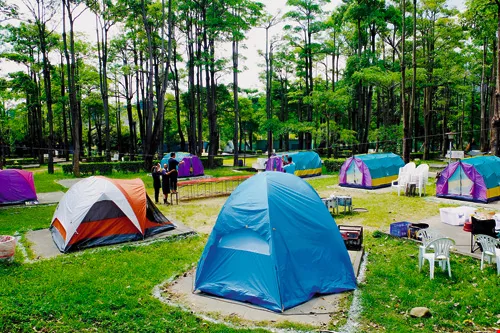
Tsou-Ma-Lai Farm not only retains its rural character, it also provides up-to-date leisure activities like archery, grass sledding, and camping, which are especially attractive to the younger set.
Agriculture is widespread and valued in mainland China no less than in Taiwan, but lags far behind Taiwan in terms of quality and diversification. The 120-hectare Tsou-Ma-Lai Farm, run by the Tainan Farmers Association, is Taiwan’s premier recreational farm, and is a model case of a successful transition from producing farm products to becoming a leisure facility.
Tsou-Ma-Lai Farm is located in the greater Tainan area, technically within the city limits of Tainan City but in a rural area recently attached to the municipality under the reorganization of local government jurisdictions. A few centuries ago, this area was inhabited by the Siraya plains Aborigines. Looking out over the surrounding area, you see a ring of mountains and beautifully laid-out forest roads, while in the remote distance is the extraordinary landscape unique to Tainan—the “moon world” of badlands where no almost no plants grow.
Before its transformation into a recreational farm in 1988, Tsou-Ma-Lai had passed through previous incarnations as a sugarcane plantation in the Japanese occupation era and later as pastureland.
Director Tian Qiusong relates that in the process of Taiwan’s transition from an agricultural to an industrial economy, it was inevitable that the operational model and sources of income in agriculture would likewise have to change. “At one point, we were losing a million NT dollars a year planting sugarcane, but in the first year after becoming a recreational farm, we earned NT$1 million.”
Tian remembers the excitement that surrounded the site’s opening. It was originally estimated that the farm would get 5000 visitors a day, but in fact the figure quickly hit 15,000. “There was literally a traffic jam of tour buses, and people had to wait in line two hours just to get in.”
Though recreational farms do not have production of farm products at their core, they cannot deviate too far from agriculture. After the abandonment of sugarcane, the site was devoted to cultivating pangola pasture grass (from New Zealand), and 40 hectares of this grazing land was retained in the recreational farm, thereby turning meadow that was not producing any profit into a source of added value as part of the leisure industry.
Indeed, over the last two decades, this pastureland has become the trademark of Tsou-Ma-Lai Farm. Not only are the broad and open meadows a scenic attraction in their own right, there is also grass-skiing and sledding, and a demonstration class in do-it-yourself “pasture-grass bread.” Other spin-off products for sale include pasture-grass noodles and pasture-grass popsicles.
“Without the grazing land, Tsou-Ma-Lai would never have become what it is today,” says Tian.
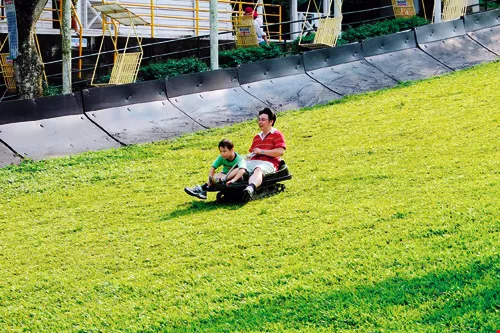
Tsou-Ma-Lai Farm not only retains its rural character, it also provides up-to-date leisure activities like archery, grass sledding, and camping, which are especially attractive to the younger set.
From reports in the mainland media showing various officials or celebrities going “down on the farm” to pick fruit, eat home-made cooking, or enjoy the slow pace of rural life, you can see that mainland Chinese officialdom has been starting to talk up agriculture. The provinces that have been most active in transforming and developing their rural economies have been Shandong, Fujian, and Hainan.
Shandong and Fujian have already reached non-governmental agreements with the Taiwan Leisure Farms Development Association. And Hainan has formally included recreational farms into its master plan to become an international tourism and leisure island.
Tian Qiusong takes two huge stacks of name cards out of his drawer, and says that, estimating conservatively, “At least 150 mainland groups come each year on official inspection visits, with as many as 10 arriving within a single week!”
The titles on the name cards range from provincial governor and general secretary of the provincial branch of the Communist Party to secretaries and bookkeepers from state-run firms. Tian estimates that each year well over 1000 mainland officials, academics, and businesspeople come to visit and study Tsou-Ma-Lai.
What is it they want to know? Tian says that the most common questions include: How does Taiwan’s agricultural production and marketing system operate? What kinds of services and activities do recreational farms in Taiwan offer to customers? What kinds of problems are encountered at the operational level? What is the best approach to designing and planning a recreational farm?
But even more essential questions for mainland visitors are: Who actually owns the farmland? What roles do government and farmers’ associations play in the development of the rural leisure industry?
Since last year, visits from the Hainan provincial government, which says openly that it intends to “learn from Taiwan,” have been especially frequent, as agriculture and economic development officials at all levels have made a special point of coming to Tsou-Ma-Lai. Tian Qiusong relates that Hainan government officials say that, when it comes to recreational farms, “if you absorb the Taiwan experience, then you can’t go wrong!”
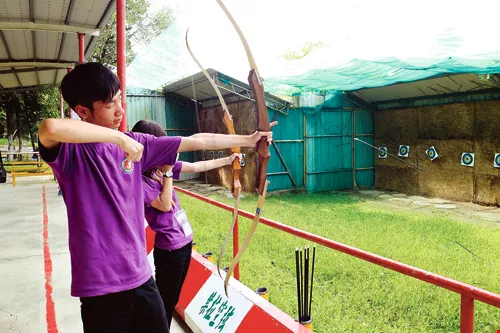
Tsou-Ma-Lai Farm not only retains its rural character, it also provides up-to-date leisure activities like archery, grass sledding, and camping, which are especially attractive to the younger set.
Last September, the Hainan Provincial Bureau of Foreign Experts Affairs brought a group of 11 city and county CPC secretaries to Taiwan, with Tsou-Ma-Lai being one of the specifically designated high points of their tour. After their trip they reached a consensus on those aspects of Taiwan’s recreational farms that they found most worthy of emulation: intensive use of resources (both natural and human), construction of comprehensive facilities, attention to detail and refinement, preservation of the surrounding natural environment, and branding.
Tian says that China starts off with huge advantages in terms of natural scenery that Taiwan can’t even dream of.
But for now, the vast majority of Taiwanese businesspeople residing in Hainan are not optimistic about the recreational farm industry there. There just doesn’t seem to be a critical mass of people with adequate wealth to invest much of it on vacations designed to let people just stroll around and commune with nature.
However, officials from Hainan counter that the income level in their province has already reached the level needed to generate a consumer market for leisure, and as a result development of the recreational farm industry is merely a matter of time, and is a natural and logical step.
However, Tsao Shao-hwei, director of the Department of Farmers Services at Taiwan’s Council of Agriculture, has reservations about the idea that “high incomes lead ineluctably to high demand for leisure.” The two are not necessarily directly correlated. “The current situation in the mainland is very similar to when Taiwan’s economy had just taken off, and at that time people didn’t think a lot about recreation and leisure in their consumer attitudes,” she says, “At that stage, people preferred more highly charged ways to spend their money, going abroad or going to one of the big theme parks, rather than visiting the countryside.”
“There must be an intermediate, transitional phase for consumer demand to make the shift from tourist attractions to bucolic rural leisure locations: Education and culture must be raised, and people’s life experiences have to be different.” Tsao argues that for this reason alone, “it will take at least 30 years” for the recreational farm industry in the mainland to enjoy the kind of environment that Taiwan’s industry currently operates in.
Let’s look at the number of international visitors as an indicator of the appeal of Taiwan’s recreational farms. According to the Council of Agriculture, in 2011 there were nearly 170,000 such visitors, almost triple the number in 2008. In 2008, the amount of business generated by foreign visitors was nearly NT$200 million, whereas in 2011 it reached about NT$500 million—very impressive results indeed.
There are currently 268 licensed and registered recreational farms in Taiwan, and last year the total value of the industry was NT$7.2 billion.
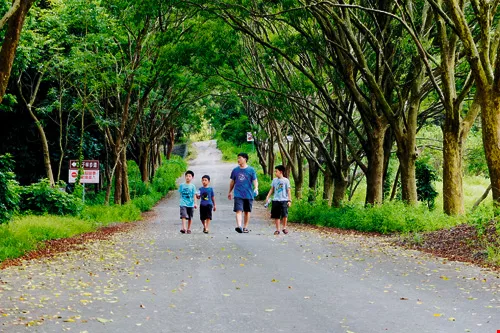
For those looking for a relaxing and healthy alternative to crowded and noisy amusement parks and beach resorts, Tsou-Ma-Lai offers woodland walking and cycling trails where you can just chill out and commune with nature.
Annual revenues at Tsou-Ma-Lai are about NT$200 million, coming mainly from lodging, food and drink, and admission tickets.
Director Tian Qiusong says that it is difficult to book a room at any of the farm’s lodging facilities, whether it be the forest cabins, the meadow villas, or the newly completed high-end hotel and conference center. He says that mainland groups are no exception, and to get weekend lodging it is necessary to make reservations at least three months in advance.
Tian relates that most foreign visitors come from Hong Kong, Japan, Korea, Singapore, Malaysia, and Indonesia. There are very few individual travelers from mainland China. Of particular note is that this year some Japanese visitors have begun coming for long stays, which is to say for a month or two at a time.
Most of these people are “business vacationers.” By day they visit Taiwanese businesses, play golf with their clients, or take day trips to the Yoichi Hatta Memorial Park in the Siraya National Scenic Area. At dusk they return to the farm and, in the last light of the day, take a walk or go on a bike ride through the forest trails, surrounded by alpine vistas.
Tian says that long-stay Japanese visitors spend NT$60,000 per month at Tsou-Ma-Lai. In comparison, respondents to a survey taken in Japan in 2011 said they would only be willing to spend on average NT$10,000 to visit Taiwan. Obviously Tsou-Ma-Lai can draw big spenders.
Tsao Shao-hwei says that the reason Taiwan’s recreational farms are popular is that: “They’ve got the service, the scenery, and the agriculture, yet they’re easily accessible.” Taking a macro look at the distribution of recreational farms in Taiwan, the main concentrations are in Yilan, Nantou, and Miaoli counties. On the other hand, there are relatively few in the traditional rice baskets of Yunlin, Chiayi, Tainan, Kaohsiung, and Pingtung.
“The recreational farm industry is an integrated services industry that emphasizes the ‘soft power’ of service, and can’t just be copied.” While mainland officials, businesspeople, and academics come to Taiwan looking for clues, Tsao has great confidence in the “cultural depth” underlying Taiwan’s recreational farms, and feels the mainland still has a long way to go.
It won’t be hard for the mainland to construct large recreational farms. But if they are all produced out of a single, stereotypical mold, then people will visit once but never go back again.
In Taiwan, on the other hand, where there is a foundation of high-quality and high-tech agriculture underpinning the rural way of life, each recreational farm has its own unique selling points, and each has created its own “ambience” that can emotionally connect with visitors, making them unforgettable experiences for visitors both local and international. This is the real essence of the Taiwan recreational farm experience.

@List.jpg?w=522&h=410&mode=crop&format=webp&quality=80)

@List.jpg?w=522&h=410&mode=crop&format=webp&quality=80)

@List.jpg?w=522&h=410&mode=crop&format=webp&quality=80)
@List.jpg?w=522&h=410&mode=crop&format=webp&quality=80)

