Braving Turbid Waters--Life and History in the Work of Chung Chao-cheng
Eric Lin / photos courtesy of Chung Chao-cheng / tr. by Julius Tsai
March 2005


In January 2005, the first Taiwanese novel series in the roman-fleuve genre, Chung Chao-cheng's Turbid Waters trilogy, was reissued by Vista Publishing Company. This edition, in celebration of the author's 80th birthday, has been attracting readers to the bookshelves with its fresh new cover design.
The Turbid Waters trilogy was first published 42 years ago, yet has stood the test of time. Chung's more than 50-year writing career has resulted in a literary legacy of nearly 20 million characters. Weathering the political oppression of the White Terror and the literary establishment's neglect of "native literature" with Hakka tenacity and perseverance, Chung has not only worked on his own writing, but has led the way at Taiwan Literature and Art and the literary pages of The Commons Daily. During his tenure, he has shown an editorial vision that has inspired a homegrown literary movement and left a lasting mark on Taiwanese literature.
"What does it mean to be Taiwanese?"
Chung has sought an answer to this question through his roman-fleuve novels, delving into the collective memory of the Hakka people.
"What does it mean to be Taiwanese?"
Chung began asking this question for the rest of us 50 years ago. With circumspect, erudite writing, Chung has searched history's flow to confront the unavoidable queries that rise within us all.
"The lupins have withered, leaving behind their seeds. Next year their yellow flowers shall once more provide adornment, fertilizing the tea fields in their blooming and withering. In the human realm when the flowers of genius wither away, what is it that they leave behind?"-from Lupins.
In the language of flowers, lupins represent maternal love. In Chung's novel of the same name, they represent the sisterly love of Cha-mei for her younger brother and for her family, an everyday love that yet is precious. Because the novel's scenes ring familiar to readers, and its images are impressed deeply upon the heart, today in Taiwan the lupin has become a common symbol for Hakka women.
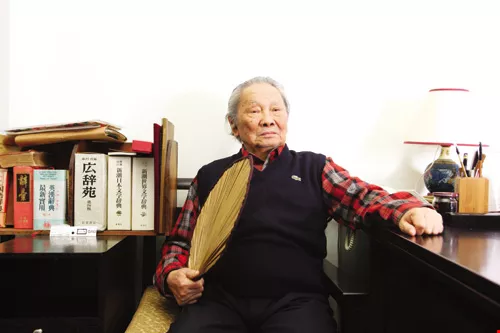
In a lively, intelligent fashion, Chung chronicled a turbulent era in Taiwan through his stirring literature. His achievements mark an important page in Taiwan's literary history.
A stack of writings
A wintry fog permeates the landscape out of which Lupins was imagined. Traveling through Lungtan Township in Taoyuan County, one cannot but anticipate the stirring scene of the ice-dew flowers, intertwining yellow and green, among the teafields. What is in fact most visible along Highway 3 is the sight of fast food chains and clothing stores lining the route in this seemingly urbanized area that receives tourists on their way to Shihmen Reservoir and Leofoo Village Theme Park.
Lungtan is where Chung spent half of his life as a writer. Ask any of the shopkeepers here and they will tell you that the Lupin Quiltworks is the author's own house, also adding that the Hakka cultural center that just began construction at the end of last year was single-handedly brought into being by Chung.
Rain was falling on the skylight overhead, and a quiet calm permeated Chung's living room on this chilly day. Chung, hearing aid in place, spoke deliberately and exuded a refined manner.
The Taoyuan County Government has just published the 38-volume Collected Works of Chung Chao-cheng. When stacked up, the books are almost as tall as a person, graphic illustration of Chung's reputation for being a prolific writer. The author is happy to point out that his granddaughter Wang Chieh, who teaches at National United University in Miaoli, is now helping him put some of his works online, and that he is pleased that readers are able to thus access his writings conveniently and without cost. "I'm still full of the creative spirit. I had planned a sequel to Gothic Melodrama, but my wife tells me that writing is too much work for someone my age," Chung says. Even though that work brings him great pleasure, Chung himself acknowledges that his stamina nowadays does not allow him to continue to put pen to paper.
The question of ethnicity
Chung represents the sixth generation of a Hakka family in Taiwan. The family endured great hardship in their journey to this place, pioneering a new life, and weathering the Japanese occupation, the Second World War, and the arrival of the Nationalist government. Chung's great-grandfather even briefly led clan members to return to Guangdong during the early era of Japanese rule.
Chung's parents were educated under the Japanese school system. His mother was of the Southern Min ("Holo") ethnicity and during his childhood years Chung lived with his parents in the Tataocheng area of Taipei. There he became fluent in the Southern Min dialect, but could not have known that he would be mocked for that upon his return to his Hakka village in Lungtan at the age of eight. His classmates laughed at him for being a Holo, and his uncle even derided him for betraying his own people. Even at that early age, Chung was beginning a lifelong inquiry into Taiwan's unique and varied ethnic landscape.
Chung continued to be provoked to think about the question of ethnicity. In 1940, while he was attending Tamkang High School, ethnic conflicts erupted between the Japanese and the Taiwanese. Given the Sino-Japanese conflict and the Japanese campaign to assimilate the Taiwanese people as loyal subjects of the emperor, students were asked to adopt Japanese names. Once during a conflict between teachers and students, a teacher even tossed him a knife, remarking, "This is a conflict between us islanders and the Japanese."
"Being neither Japanese nor under Chinese control, how should the Taiwanese define themselves?" asked Chung, beginning a lifelong inquiry.
Towards the end of the war, the Japanese phrase "shattered jade" expressed their desire to fight until the last soldier was dead, never surrendering. To avoid "fighting someone else's war," most high-school students sat for entrance exams to enter universities or teachers colleges. Hoping to put off being conscripted, Chung entered a teacher training college at Changhua, but could not avoid being pressed into the military after graduation as part of an effort to mobilize the students. It was during this period that he contracted malaria, severely damaging his hearing.
A translating mind
After the war, Taiwan went from being a Japanese colony to being governed by the Chinese Nationalists. The political change also brought linguistic challenges for Taiwanese authors. Unlike writers such as Yeh Shih-tao, Chung only started writing in Chinese after the war. Being educated in Japanese, it was only after he became an elementary school teacher that he began to read classic texts such as The Three Character Classic, Chinese Surnames and Treasury of Knowledge for Children. Lacking guidance, even though Chung relied on the Kangxi Dictionary to look up Chinese characters, he was still unable to read out the correct pronunciations. The challenges were thus considerable.
Chung recalls, "There were three cram schools that taught Mandarin in Lungtan, each in a different pronunciation. It was very chaotic." When not teaching, he was studying Mandarin, the next day teaching his primary school students what he himself had just learned.
Chung had no real problems speaking Chinese, but writing in Chinese was not a proficiency that he could acquire over the short term. Once, feeling inspired, Chung wrote to a friend in this still-unfamiliar written language. His friend replied with much praise, further motivating Chung to write.
At first, Chung would think in Japanese, write out a draft, and then translate that into Chinese. After a while he dispensed with the Japanese draft and translated directly in his head, using what he calls his "translating mind." "This is one of the unique features of post-war Taiwanese literature and represents, I think, a phenomenon not found in foreign literary traditions." After three or four years, Chung began to think and write in Chinese.
In 1951, the 26-year-old Chung successfully submitted an essay entitled "My Other Half" to Forum, a monthly publication, after the magazine had called for contributed articles. "The author is a Taiwanese youth who has only been studying Chinese for a few years. His level of achievement is rare indeed," wrote the editor in the preface. Chung began a career of submitting much, but also receiving many rejections.
Taiwanese literature had entered an anti-communist phase after the war, and writing from a Chinese perspective was a politically correct thing to do. Chung, a Taiwanese author who had not personally experienced communism, could not but write from his experiences in rural Taiwan; this may explain the high rejection rate he encountered in those years. In 1957, Chung started The Literary Friends Newsletter, a publication that had a two-year run and that featured works by Chen Huo-chuan, Li Jung-chun, Chung Li-he, Shih Tsui-feng, Liao Ching-hsiu, Wen Hsin, and other "native" writers. The newsletter, mimeographed on two sheets of quarto-size newsprint, covered writing news, obviated the need for the writers to correspond with each other individually, distributed their works, and served as a source of mutual support.
In one of the issues Chung raised for discussion the topic "Personal Views on Regional Dialects and Taiwanese Literature." After collecting the various responses he wrote, "We are pioneers of Taiwanese literature, a literature with unique characteristics. The use of native dialects should be a part of expressing those unique characteristics, though it will take our determined effort." Putting his principles into practice, Chung even went so far as to write his first novel in the Hakka dialect.
Through The Literary Friends Newsletter, Chung became fast friends with Chung Li-he, who was in poor health and in financial straits. Chung Li-he would send his writings to Chung Chao-cheng and ask the latter to submit them for publication. Although the two never met in person, Chung Chao-cheng arranged for the posthumous publication of Chung Li-he's collected works, authored his biography, and established a memorial hall. Theirs has become a touching story in the literary world.
Bursting on the scene: Lupins
After many years of receiving rejection slips, Chung unexpectedly burst onto the literary scene with the publication of Lupins in 1961, published in serial form in the literary section of the China Times. The novel was only published because the piece that was originally to run in the paper never materialized. Lupins caused a sensation, and fan mail, says Chung, "came like the falling snow."
Lupins tells the story of a young prodigy of a painter. Buried by the poverty of his family, the painter himself dies an early death. The novel criticized the failures of the educational system and the problem of "vote-buying" in politics. Through Chung's style was fresh, there might also have been a slight lack of creativity of the novel due to its simple, classic structure. In 1989 the novel was adapted for the screen as Dull Ice Flower, and it left a lasting impression of a melodramatic story. Today, decades later, the problems that Chung identified still remain, a testament to the inability of the educational system to truly embark on reform, and perhaps to Chung's prophetic vision. Lupins was written with spare, unadorned realism, reflecting the struggles of the rural intelligentsia in engaging their ideals for the advancement of Taiwanese society. Chung's unprecedented achievement was to finally win a mass audience for Taiwanese literature.
With the success of Lupins, Chung's writing was in demand, and slowly he cleared out the rejection slips in his desk drawer. He took the opportunity to work on another long piece. In that same year, he moved three extended works to completion: Turbid Waters, Expansive Mountains and Rivers, and Flowing Clouds. The three works formed the Turbid Waters trilogy, Taiwan's first roman-fleuve novels.
According to Chung, the trilogy was an autobiographical work that told its story through the life of Lu Chih-lung, the male protagonist. Set in the years just before and after the restoration of Taiwan to Chinese rule, the novel describes the plight of intellectuals during the years of merciless warfare, harboring hopes of a return to the motherland. This dream, however, was shattered after the ensuing transformations in national and cultural identity, causing the intellectuals to drift about in their anxiety and doubt, like clouds in the sky.
The Turbid Waters trilogy deftly described those most intense years of change in Taiwan, a historic time of suffering and turbulence, and in doing so opened up new possibilities for the roman-fleuve novel in Taiwan.
Escaping to Mount Chatien
To write "native" literature during the era of martial law was to court political risk. Chung became an object of governmental scrutiny beginning with his work with The Literary Friends Newsletter. In 1967, Chung began work on another trilogy that he titled after its first novel, called simply The Taiwanese. The Taiwan Tribune intended to publish the works in serialized form in its literary pages, but an advance copy was seized by the authorities, who objected to its provocative title. Publication was delayed for two weeks.
When Taiwan Daily News invited him to contribute the story to its pages, Chung changed the title of The Taiwanese to Fallen, and it was successfully published. Nonetheless, Chung was accused by a senior legislator of being one of three figures plotting Taiwanese independence (along with Kao Yu-shu and Tao Pai-chuan). In communist China, Deng Xiaoping also directed criticism his way during radio addresses broadcast to Taiwan.
Being hindered in his work on the trilogy The Taiwanese, Chung turned to writing Song of Mount Chatien.
Song of Mount Chatien was a novel filled with political overtones. On the surface, it was a tale of a Taiwanese intellectual on the run from the Japanese, escaping to Mt. Chatien. In fact, while on the surface it took an anti-Japanese stance, it described what Chung suffered under the White Terror of the Nationalist government. Chung had it published in the Central Daily News, which was affiliated with the Nationalists. As he remarks, this move "offered the best protection possible."
Chung would later turn Song of Mount Chatien into the third novel of his trilogy The Taiwanese. The second novel in the trilogy, On the Waves, was the last to be completed. The Taiwanese spanned the historical period from the anti-colonial movements against the Japanese until the war in the Pacific. In reviewing the novel, Yeh Shi-tao has written that Chung, "in the midst of the White Terror, still affirmed the autonomous identity, vibrancy and desire for nationhood of the Taiwanese people."
A force for native literature
As he wrote The Taiwanese, Chung also joined Wu Chuo-liu in editing Taiwan Literature and Art, fostering native literature and its writers. He also began editing the literary pages of The Commons Daily. In these ways, he continued to open up new territory for Taiwanese literature.
During that period of time Chung invited Yeh Shi-tao and Peng Jui-chin to create a literary forum for The Commons Daily. Through this forum, they provided in-depth reviews of ten to 12 novels each month, thereby promoting a new wave of literary activity out of which emerged such authors as Wu Ching-fa, Wang Yu-hua, and Peng Jui-chin. Moreover, Li Chiao's Wintry Night trilogy; Tung-fang Pai's Waves of Washing Sands; Chen Ying-chen's The Night Truck, his first post-incarceration novel; as well as Chen Jo-hsi's Crossing, were all brought to fruition with Chung's encouragement.
Continuously writing, editing, and translating, Chung worked with amazing speed and perseverance. During his years as an elementary school teacher, he spent all of his weekends and winter and summer breaks on his writing. When asked how he managed to write so much given all of his editorial duties, he remarks only, "I suppose it's because I had a sense of mission."
Chung notes that his generation faced myriad, urgent questions in navigating the complex identities and experiences of the Hakka, Taiwanese, Japanese, and Chinese peoples. He tried to solve the dilemmas he faced in life through his own actions.
Whither, drifting cloud?
In 50-some years of writing, the straightforward realism of Chung's literary style has remained fairly constant. Yeh Shih-tao attributes this to the negative effects of growing up in a rural Hakka village, writing that "a lack of exposure to new information and a difficulty in discerning changes in ways of thinking in the outside world caused Chung to remain insulated from the challenges brought on by new literary trends."
"Drifting cloud, drifting cloud, where are you headed?" Yeh once used these words to criticize his old friend's tendency towards a realism that seemed to lack symbolism and theory. Others have been more stringent in their criticism, labeling Chung as a writer "lacking a strong intellectual background and suffering from intellectual anemia."
The explanation Chung offers is that he started writing more than a decade after other authors typically got their start, and considers himself a latecomer to the literary world. Moreover, lacking mentors, he had to find his own way, and thus it was natural that he would have adopted a more naturalistic literary style.
Peng Jui-chin, assistant professor of Taiwanese literature at Providence University, opines that Chung represented a new wave of writing that came up during the era of Japanese rule. This was a style of writing characterized by being "without ideology or structure." Peng continues, "This is not, however, to say that Chung's writing lacks self-consciousness," for "the value that he placed on realism rent the veils off reality, illuminating history without being deceived by history." Peng says, "Realism is a literary vision that takes the concrete and the everyday and, through the author's vision, transforms them to manifest the power and meaning of everyday life."
Chung has used his own life experience as an overlay upon the turbulent history of Taiwan. Indeed, most of his works are lengthy pieces connected with Taiwanese history.
"Because of this, I've spent a lot of time collecting and studying historical material," says Chung as he describes how he has interviewed elderly Hakka men and women, researched the tiniest geographic details, and examining a variety of classical textual sources. "I did all this on the strength of these two legs and this pair of eyes," he remarks.
Chung says that he has walked almost every square foot of land surrounding Highway 3, and that writings are more persuasive when one chooses familiar environments as one's setting.
That Chung creates art out of life is precisely why his works have proven so appealing. His female characters display the characteristics of Hakka women: hardworking, giving, and tender, as seen in the character of Cha-mei in Lupins, Yin-Mei in Turbid Waters, or Pen-mei in Song of Mount Chatien, all vivid characters that the reader encounters.
The character mei ("little sister") is often a part of a Hakka woman's name. Chung's wife, for example, is named Chang Chiu-mei, and it may be that her generosity and supportiveness have made their way quite naturally into Chung's female characters.
Leading by example
In the study of Chung's house stands a redwood desk that dates from 1956.
"This is a gift from my wife. She bought me this desk after selling her first lot of pigs," says Chung as he sits at the desk and touches its surface. The desk, a tangible sign of Chang's support of her husband's writing career, cost NT$900 at a time when Chung made a little over NT$400 a month as a primary-school teacher. It was at this desk that Chung wrote Turbid Waters, The Taiwanese, and other works.
Chung has chronic bronchitis, and on this chilly winter day his coughing steadily increases during the two-hour interview. When he can no longer continue speaking, he can only indicate so by waving his hands apologetically. But with a sip of tea in the living room, he continues to speak. Authors must lead by example, he says, and there is nothing that simply falls from the sky. One must fight for everything. This applies to the struggle for Hakka dignity, and to his own freedom of expression.
Chung recalls the scene many years ago when he participated in street demonstrations. "We met up at Chungshan Soccer Stadium, and the rain started pouring down. Even though I was dripping wet, I had dried off quite a bit by the time I boarded the train, and did not end up catching a cold. Fighting for your rights is often like this."
In recent years, praise has come in from all quarters. Numerous commendations and awards fills a bookcase in the living room, and a birthday present from the Office of the President remains yet unopened. This recognition notwithstanding, Chung remains reluctant to comment on recent trends in Taiwanese literature.
"My eyes are failing, so I don't read much anymore. I really have not got much to say when it comes to the works of the younger generation of writers. However, I do believe that literature is an active endeavor and that one can find fulfillment if one has ideals," says Chung
These sentiments express the values, courage and perseverance that have sustained Chung throughout his long career as a writer. Through the example of his substantial literary corpus, Chung has opened up new horizons for Taiwanese literature. These are Chung Chao-cheng's values, demonstrated in the courage and perseverance of his long writing career. Through his strength and tenacity, he has opened up new horizons for Taiwanese literature and left behind a substantial corpus of writing as a model for future generations to follow.

@List.jpg?w=522&h=410&mode=crop&format=webp&quality=80)


