The "Art" of Community Preservation--Treasure Hill
Chang Shih-lun / photos Chuang Kung-ju / tr. by Scott Williams
May 2006


Treasure Hill is a maze of mottled old illegal struc-tures packed together on the slopes of a hill in Taipei's Kungkuan district. In highly developed urban Taipei, the village is an anachronism, a fossilized relic of the city's past.
In Taipei, "illegal structure" used to be synonymous with "dirty" and "backward." Historical Treasure Hill, however, appears to have escaped that fate. In the wake of the last few years' debate over whether to tear it down, the community has been featured in The New York Times as one of Taiwan's must-see destinations and visited by a crew from Lonely Planet Television. Suddenly, this long-forgotten community has become the focus of a great deal of positive attention.
Most importantly, the community is to be preserved at its present location, its "disadvantaged residences" developed and integrated into an "arts village." These plans have granted Treasure Hill a new lease on life, and mark the start of a new chapter in Taipei's city planning.
Most of Taipei's residents have never heard of Treasure Hill. Without property rights and without urban planning disadvantaged groups have, over the last 50 years, built and shaped this place into a community through their own efforts.
Some of those who do know it refer to it as "Little Chiufen" because its low houses and winding streets recall those of the better-known tourist destination. Its demographics have led others to call it "Taiwan's Rennie's Mill." Like the Hong Kong enclave where many KMT soldiers settled following the Nationalist government's relocation to Taiwan, the bulk of Treasure Hill's residents are single, elderly veterans.
Treasure Hill's four hectares rise to a height of about 80 meters above the banks of the Hsintien River. Its approximately 150 residents live in about 70 of the 100-odd structures on the hill. These residents include old soldiers from the mainland, their foreign brides, emigres from central and southern Taiwan, and students leasing flats. Each group tends to occupy its own corner of the hill, and, because their backgrounds are so different and their struggles to make ends meet so time-consuming, they rarely interact.
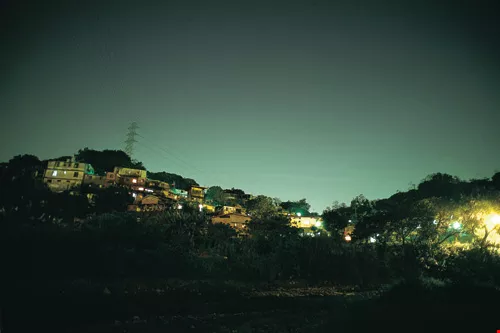
Lights sparkle on Taipei's Treasure Hill, located in the foothills in the city's Kungkuan district.
At the margins
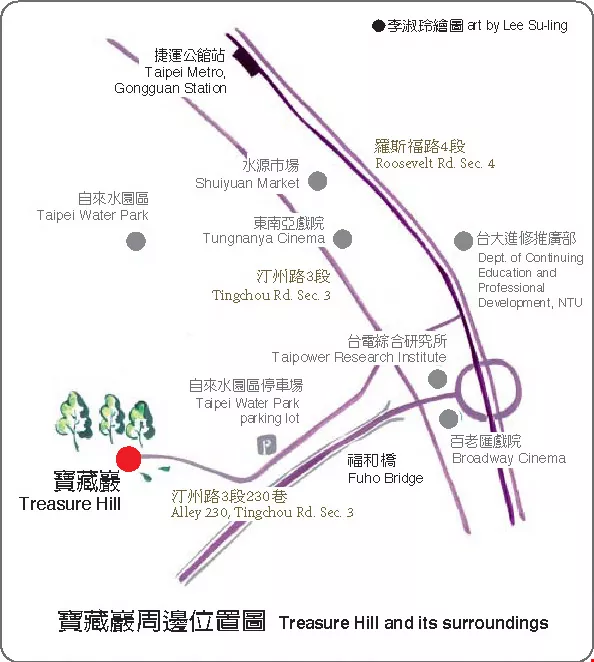
Treasure Hill is located in southern Taipei, only a few minutes' walk from the bustling prosperity of Kungkuan's markets. But for many years it has been a world unto itself, an obscure location connected to Kungkuan by only a single road.
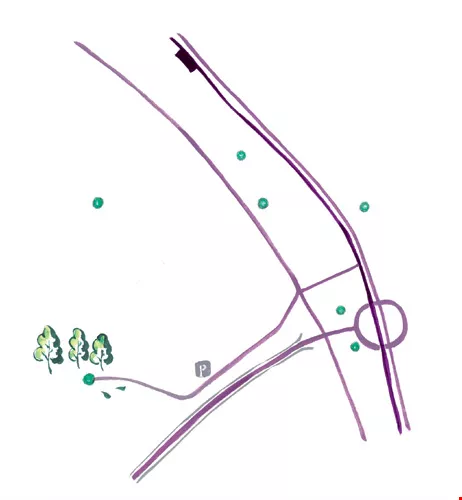
When you turn into Alley 230, Tingchou Road Section 3, the first thing you see is the parking lot for the Museum of Drinking Water. To get to Treasure Hill, you must follow the small road that runs along the left-hand side of the parking lot to its end. Once you wind past a break in the hillside, the Hsintien River appears in front of you, the Fuho Bridge to one side, and Mt. Hsiaokuanyin behind you. Treasure Hill runs along the slope of the hill beside you.
Located between a hill and a river, the village is somewhat isolated, cut off from the clamor of Tingchou Road. From the village, the only thing you can see in the distance is the sparkling of the headlights of the steady stream of cars crossing the Fuho Bridge. When the Hsintien River brought Han Chinese here during the Emperor Kangxi's reign 300-some years ago, they built a Buddhist temple. They named the temple Treasure Hill, and made offerings to the Bodhisattva Avalokitesvara (Guanyin in Mandarin).
The Treasure Hill temple has been renovated many times over the years and the current structure dates back only to the period of Japanese rule. It is nonetheless considered to be one of the oldest Buddhist temples in Taipei and has been designated a historic site by the city. When a village grew up behind the temple, it naturally came to share its name.
Treasure Hill sits in a water catchment zone and at an important gateway to Taipei. Consequently, when the Nationalist government relocated to Taiwan after World War II, it stationed troops on the hill and restricted the general public's access. However, low-income soldiers were, with the military's tacit approval, allowed to erect "illegal" structures on the slopes behind the temple, effectively turning it into a military dependents' community.
Over the years, the "illegal" hillside village has gradually acquired a diverse population. The transformation began in the 1970s, when industrial and commercial development drew large numbers of Taiwanese from the central and southern parts of the island north to Taipei. At around the same time, troops were being gradually withdrawn from Treasure Hill, resulting in low rents that attracted the new arrivals. Meanwhile, the poverty of the old soldiers who continued to live on the hill prompted some to marry women from Indonesia, Korea and mainland China. Low rents also attracted poor students from National Taiwan University and National Taiwan Normal University.
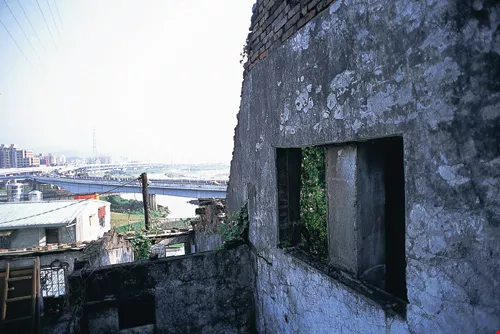
Standing in front of the mottled old buildings atop Treasure Hill, the cars streaming down the Huanho Expressway just a stone's throw away seem to belong to another world.
Building their own houses
From a legal standpoint, there is no question that the structures put up on Treasure Hill after the war were illegal. But because the military permitted the construction and the village itself is so remote, there was never an urgent desire for a crackdown. As a result, Treasure Hill has been able to gradually assume its present form within sight of the Huanho Expressway, amidst the hurly-burly of the city.
According to Kang Min-jay, an assistant professor in the architecture department of Tamkang University, in recent years a number of scholars have begun using the expression "self-built homes" to describe "illegal structures." Kang says that most of the poor who live in illegal structures do so because public housing policy does not meet their housing needs and they lack the money to buy or lease other housing. Their situations have compelled them to use their own labor, materials and ingenuity to build "homes" for themselves in spaces that are technically off-limits.
As you walk through Treasure Hill, you can't help but note that necessity is the mother of invention. Cast-off wood, tiles, bricks, sheet metal, plastic and cardboard have been turned into the building blocks of "home-made" homes. And a little work with wood and paper have transformed an image of the Buddha that drifted down the Hsintien River into a covered Earth God shrine.
Boundaries between public and private spaces are often unclear in the tightly knit village, and families' living spaces often overlap one another. Residents have developed distinctive interpersonal networks to help them deal with their material poverty.
One of the first things you see on entering the village is a row of old mailboxes, all numbered 29. But each has a second number appended to the first, ranging from one to more than 100. The village began using a common number to make life easier for their mail carrier because the layout of the village was complicated, and most illegal structures didn't have their own house number.
Kang sees the village as something like a natural ecosystem. This patch of land between the hills and the river may be wild and disorderly, but its fierce vitality has enabled it to survive for more than 50 years in a hidden corner of the developing city. Vital or not, Treasure Hill was brought face to face with extinction in 1980 when the city began making plans to turn the site into a park.
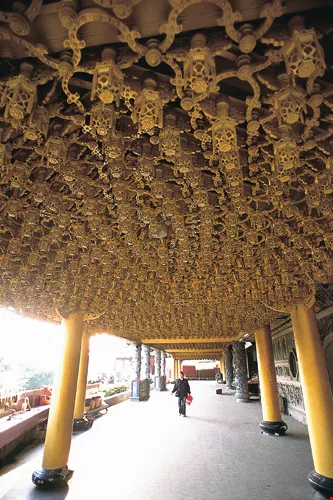
The village takes its name from the Guanyin temple around which it grew up.
From demolition to preservation
There was a public outcry in 1997 when the Taipei City Government began tearing down the illegal structures on the sites of the future Linsen and Kangle Parks because it had not made arrangements for the elderly living in these military dependents communities. Public complaints spilled over into the Treasure Hill situation, compelling the city to temporarily suspend plans to tear it down. Students and teachers from NTU's Graduate Institute of Building and Planning then became involved, advocating the preservation of the village. They lobbied the government to designate Treasure Hill a historic site under the Cultural Heritage Preservation Act, which they hoped would enable the village's disadvantaged residents to stay where they were and preserve their interpersonal networks and the area's distinctive character.
In the past, illegal structures were viewed as ugly urban cancers that were torn down and turned into parks through the intervention of state power. But because Treasure Hill is so remote, there is little public benefit in turning it into a park. In addition, social activists began claiming that with the number of illegal military dependents' communities declining, Treasure Hill had acquired cultural and historical value. These activists hoped to use the arts to achieve their objectives--preserving the site and making it unnecessary for residents to move. In 2004, the Taipei City Government agreed to designate Treasure Hill a cultural heritage site, and the village moved one step closer to becoming a community for the disadvantaged with an "arts village."
Kang thinks that Treasure Hill holds a mirror to urban development. "It reflects that the people whom we often forget or ignore when we operate with a development-is-paramount mentality have a right to exist," he explains. But why choose the arts as a gateway into the community? How feasible is it to bring Treasure Hill and the arts together?
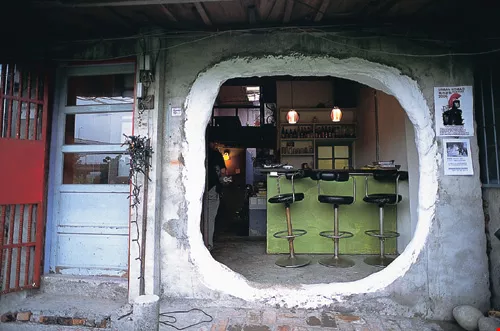
Treasure Hill isn't just becoming arty, it's becoming younger. The photo shows a local drink shop called Treasure Hive.
"Artivists"
Actually, Treasure Hill has a connection to the arts that predates the recent calls to get arts into the community: Hou Hsiao-hsien's Goodbye South, Goodbye, Hsu Hsiao-ming's Dust of Angels, Tsai Yan-ming's Big Head, Lin Ching-chieh's He Never Gives Up, Chu Yu-ning's My Whispering Plan, and even Japanese director Takashi Miiki's Rainy Dog, as well as any number of music videos, were all shot on Treasure Hill.
In the work of these directors, Treasure Hill is a part of the protagonist's background, a place on the margins through which he or she drifted in a kind of exile from the world. The activist organizations that want to preserve the village hope that their Treasure Hill arts movement will bring the village into the foreground and make it the protagonist.
To that end, Taipei City's Department of Cultural Affairs has hired the Organization of Urban Re-s (OURs) to run a studio in Treasure Hill. Lin Fang-cheng, a very experienced community worker, says he hopes that the people who come to Treasure Hill to make their art won't be purely "artists," but will instead by "artivists"--people who are active, integrate into the community, and are passionate about using art to change their environment and getting non-artists involved.
Since 2003, OURs has promoted a series of art-related activities in Treasure Hill, including one planned by Finnish artist Marco Casagrande. After looking over the remains of some of the village's demolished buildings, Casagrande decided to hand-build a wooden stairway over them to make it easier for people who lived upslope to get to and from their homes. He also cleared space for a vegetable garden among the remains, and has encouraged locals to plant their own veggies in it. The garden is as diverse as the community--residents from southern Taiwan prefer to grow the kinds of vegetables common in their hometowns, while the community's Southeast-Asian brides cultivate mosquito-repelling citronella. But to Casagrande it also reflects a kind of unity: the act of creating life amid the wreckage is symbolic of the dauntless spirit shared by the community, and of its quest for rebirth.
The village's diverse ethnic background is also apparent in its multitude of accents. Lo Song-ce, a sound artist, has hidden eight microphones around the village in places including the forest, the footpath, the studio, and the tower where the ashes of the dead are kept. The sounds are sent to eight large pipes in front of the square, where, if you listen closely, you can hear the elements that make up the village's distinctive soundscape, including voices, the blowing wind, and mahjong tiles.
OURs is also seeking to build a resident-artist program. Photographer Yeh Wei-li has been running his Treasure Hill Tea and Photo Studio in the village since February 2004. Yeh's hope is to tell the village's story through images. His approach has been to make his studio a semi-public space for drinking tea and chatting. Locals have a standing invitation to drop in for tea, and, if they are interested, have their portraits shot for free.
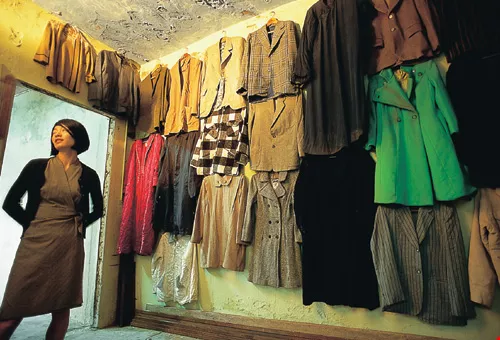
Artist Wu Yu-hsing cleaned up an old wardrobe found in an abandoned Treasure Hill home, and used it as an element in a work titled "Garbage."
Life-arts
People often have very romantic notions about the relationship between the arts and the community. But in Treasure Hill, where the ethnic diversity undermines any sense of community homogeneity, the entry of art into the community didn't reverberate as intensely as traditional community-building efforts.
Yeh, who has resided in Treasure Hill longer than any of the other artists, believes that because of their poverty and the many years they have spent living in fear that their homes would soon be demolished, locals lack a sense of either material or spiritual stability. "It's only natural," he says, "that they don't have much time for artistic activities aimed at rebuilding the community."
Kang, who also happens to be the managing director of OURs, is more optimistic about the current distance between the community and the arts. He believes that it is in the nature of art to keep a "critical distance," and that creators should observe and interpret from their own perspectives. In Kang's view, artists needn't serve the community's residents, and needn't demand that residents create. "If they spend time living next door to each other," says Kang, "the public character of the art will become apparent. It doesn't need to be forced."
Lin, who has long been in the front lines of community work, says that people traditionally think of the arts as a local industry, or of artists as providers of community resources. But Treasure Hill's aging population has left it unable to develop art-related activities with tangible economic value. And its poverty and ethnic diversity have watered down the effects of the artistic resources poured into it. "Most events draw fewer than 20 participants at the most," says Lin.
Lin thinks that if the arts are to grow roots in Treasure Hill, artists and locals must learn to deal with one another; the only thing that will spur their creative energies is a greater understanding and respect for each other. Lin further believes that all the art activities of the last few years have begun to have an effect.
For example, when Casagrande turned stair-building into art activism, a village carpenter lent a hand, adding another flight and a viewing platform for the community to share.
Lin believes that Treasure Hill's art should grow out of local life rather than be an ivory-tower construct. The village's poverty has taught many residents to be good with their hands. "There are fewer and fewer people who know how to fix shoes, lay bricks, work wood, build a house, and grow vegetables," says Lin. "These skills should be considered 'art' in the broad sense of the word."
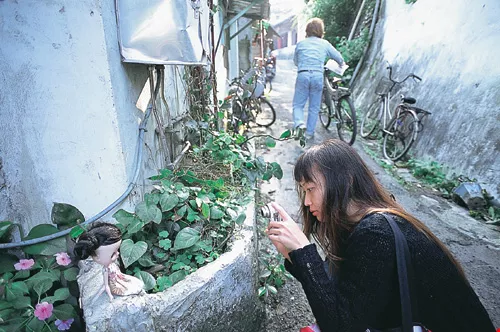
Many young people are fond of Treasure Hill's old-world air, and come here to shoot photographs.
Symbiotic arts village
Because the buildings on Treasure Hill were originally illegal structures, many are haphazard, crumbling affairs that raise safety concerns. To bring them into line with current building codes, the city will begin helping residents strengthen and renovate their homes beginning in the second half of 2006. During this period, residents will have the choice of receiving a subsidy to move away for a time, or staying in shared temporary housing. Once the renovations are complete in 2008, they'll be able to return as tenants.
The Treasure Hill Symbiotic Arts Village blueprint is a four-point plan developed by OURs and the Department of Cultural Affairs that calls for homes for disadvantaged residents, for the participation of the arts in the community, for the construction of an international youth hostel to provide inexpensive housing to students from around the world, and for study of the unique features of the village and its environment.
Kang says that the name of the game in establishing art villages is to create a symbiosis. In Treasure Hill's case, this means getting the village's underprivileged residents, its resident artists, and those who rent rooms in the youth hostel to come to respect one another in the long term. "Living together will gradually break down the barriers between them," says Kang.
Lin likewise stresses that even if Treasure Hill becomes an "art village," disadvantaged residents will still account for at least 40 households and remain the heart of the community. The resident artists and youth hostel guests, meanwhile, will make up about 20 households each. "We can't let the artists become the center and make the community into something other than it originally was--a home for underprivileged people," avers Lin.
In the past, Taiwan's art villages have usually come into being when the government let out some empty homes to artists, providing them with a space in which to create on their own. This approach has led to a lack of interaction between the artists and the surrounding neighborhood. Treasure Hill is being planned in such a way that the artists will have to learn to interact with the residents, and the residents will have to respond appropriately to the fact of having art "stationed" in their midst. "What it amounts to is that Treasure Hill has nominally latched onto 'art' as a means to preserve itself," says Kang.
At the village's highest point sits a row of mottled homes offering a fantastic view of the surrounding area. These days, however, the only person who lives up there is a retired old soldier from Jiangxi named Mr. Wang. "All my neighbors have either died or returned to their home towns," says the 82-year-old Wang, who has been living here on the margins of the city for more than 30 years. "I couldn't care less about these art or not-art games," he says, responding to the years-long debate down the hill over whether to preserve or raze the village. His only hope is that this time they resolve the issue for good. "Let us finally have a home," he says.
Three hundred years ago, the Hsintien River brought temple-building Han to the land. They have been followed by Japanese, Nationalist soldiers, immigrants from southern and central Taiwan, foreign brides, poor students, and artists. Only time will tell how the story of Treasure Hill will play out from here.
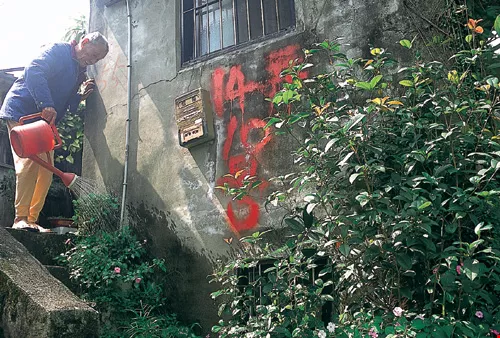
Treasure Hill's residents make excellent use of their living space--there is a shared garden along the path through the village.
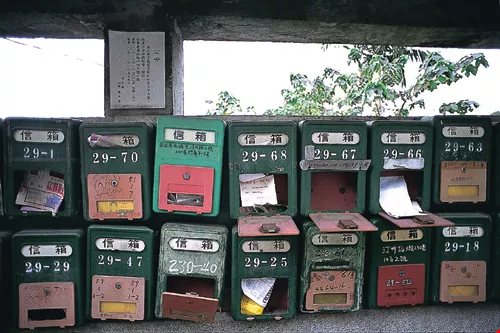
Most of the residents' homes are illegal structures without a formal street address. Residents therefore use a shared number on the mailboxes at the entrance to the village.
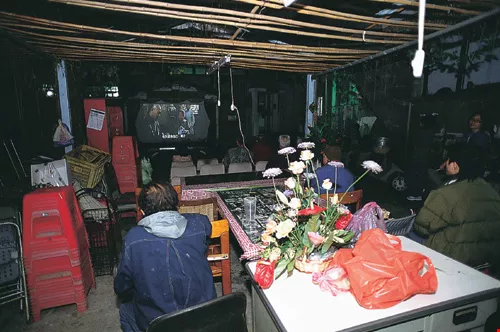
The village's weekly outdoor film screenings bring the community together.
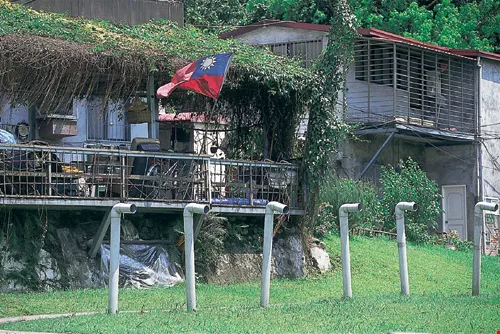
Artist Lo Song-ce designed a work that allows people to hear the village's soundscape by listening at large water pipes.
Lights sparkle on Taipei's Treasure Hill, located in the foothills in the city's Kungkuan district.
Lights sparkle on Taipei's Treasure Hill, located in the foothills in the city's Kungkuan district.
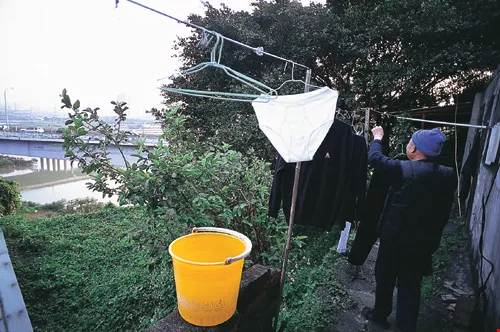
The majority of the village's residents are retired soldiers born in mainland China. Most have been living here in poverty for more than 20 years.


@List.jpg?w=522&h=410&mode=crop&format=webp&quality=80)


@List.jpg?w=522&h=410&mode=crop&format=webp&quality=80)
