The Long Road to Community Reconstruction--The Piyahaw Community
Coral Lee / photos Hsueh Chi-kuang / tr. by Jonathan Barnard
August 2003


Located at the southern ex-treme of the Ilan coast, the Atayal community of Piyahaw in Nanao on the alluvial plain of the Peihsi is one of only two aboriginal communities in Ilan. Like so many aboriginal communities in Taiwan, the community had long suffered under the onslaught of the dominant Han culture and was down-at-the-heel for many years. But recently, invigorated as a result of community development, it has found a way forward and turned the corner in efforts to rebuild the tribal village.
On an afternoon in June, "A Demonstration of Efforts to Reawaken Traditional Atayal Song and Dance" was being held at the Chinyueh Elementary School in Nanao Town. With the distant green ridges of the Central Range seeming to hold the locale in their embrace, the air was fresh, the flowers fragrant and the birds singing, as the communities of Chinyueh and Piyahaw, young and old alike, came out to roast meat and enjoy the performances.
Clad in bright red traditional aboriginal garb, the Piyahaw's Piyahaw Dance Troupe danced energetically to a song by aboriginal singer Wan Sha-lang, their gestures expansive and full of confidence, looking for all the world as if they had many years of dancing experience under their belts. "When we were just starting out, we had stage fright," admits Wang Shu-min, the troupe leader. But now, little more than a year later, they have already played at many performance spaces and are very relaxed when they perform. And apart from dancing, these mothers of Piyahaw also make their own clothing. Wang explains that the clothing they wear for the bamboo pole dance was created from scraps of discarded fabric!
At the end of June, these women of Piyahaw, already excellent dancers and singers, participated in the community's "cuisine class." "Although we knew how to cook Atayal bamboo-steamed rice, and banana rice," explains Yu Yueh-hua, the dance troupe's bookkeeper, "we always felt that somehow they weren't very authentic." She had never thought that by seasoning them with wild herbs the flavor would be so light, fresh and delicious! The women's interest was piqued, and those who had small food stalls in the village now made plans to expand their menus.
This group of busy women provides a portrait of the Piyahaw community coming to life.
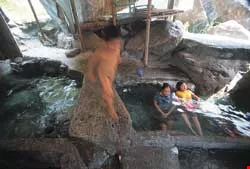
The Pei River's natural hot springs have yet to be developed. Locals just dig out a simple hot springs pool and relax as they soak.
No farming, no work
In recent years, in step with the government's promotion of community development and a growing focus on aboriginal issues within society as a whole, funding and grants of various types have come to this aboriginal community in remote eastern Taiwan, causing a quiet village gradually to come to life. Nevertheless, in comparison with other communities, Piyahaw's history of community development has met with its share of bumps in the road.
In comparison to other aboriginal communities, Piyahaw has experienced a steady series of economic, cultural, and educational upheavals over the last 20 years. During the Japanese era, the tribal village was moved here from its original location in the mountains. Because Nanao Town was only two kilometers away and transportation convenient, the tribal villagers' lifestyle came to be indistinguishable from the flatlanders nearby. Instead of planting what they needed as they had in the past, they switched to growing cash crops. "For a few years the money from mushrooms was good, and people put their earnings into building concrete houses," explains Lin Chin-chu, director of the community development association. Almost all of the concrete houses in Piyahaw were built with the money earned during that period. Unfortunately, some big financial consortiums started building greenhouses in order to grow mushrooms in polypropylene bags. With this, the market for mountain grown mushrooms collapsed. Then local farmers tried honeydew melons and watermelons. But with overproduction and consequent low market prices, everyone gave up on planting these too. Now almost all of the fields in Piyahaw lie fallow.
These days most residents of Piyahaw leave the community to work. The men work as laborers, dump-truck drivers, railway workers, concrete form molders, and so forth. Over the past five years, as a result of larger economic factors, such as the poor economy and the government decision to permit large numbers of foreign laborers, Piyahaw's unemployment rate has risen steadily. Some village residents have found odd jobs or gone up into the mountains to hunt or gather herbs for cash. Others just remain idle in their homes. Over time, it's hard not for this situation to cause problems.
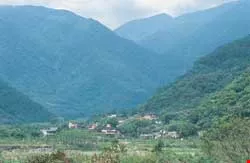
The mountains that wrap around Piyahaw are rich in natural resources. How to go about reviving the tribal village poses a great test for Taiwan's comprehensive community development.
From nothing
Amid the community's gradual decline, the Piyahaw Community Development Association was established in 1998. "We were the last community association organized in Nanao," Lin Chin-chu explains. Town Hall pushed its development in order to conform to government policy. The village mayor was then his brother-in-law, and because there weren't enough people he got Lin to join. Afterwards, Lin surprisingly got elected as head of the association. "Back then no one was really certain what a community development association was," explains Lin, who threw himself into the unfamiliar work of community development in a state of confusion.
Now in his fifties, Lin hadn't met with much luck in his career. After graduating from agricultural school, he joined an officer's training program in a military school, and served as an entry-level special corps officer. Then, protesting unfair promotions policies, he and 20 other aborigines who had joined up at the same time collectively submitted their resignations. Lin then returned to his old home in Piyahaw to pursue farming. He grew fruit and mushrooms for several years. But the marketing team assisted by the farmers' association had not yet been established and mushrooms were already on the decline as a cash crop. Failing as a farmer, he began to live an insecure life, floating from one job to another. "Watchman at a slaughterhouse, taxi driver, orchid picker, crab trapper-at one point or another I was all of them." It was only when he used a connection to get a job at Wuta Elementary School as a janitor that his working situation became stable.
After being selected as the director of the community development association, Lin Chin-chu discovered that the association was really just an empty shell, all structure and no substance. Practical by nature, he searched everywhere for information, asking those in the know how to draw up plans and hold activities, as well as how to apply for grants and funding. It may sound funny, but the community's first money came in as the result of a drunken promise: "Once when we had gathered to eat at a restaurant, we came across the department head for aboriginal affairs in the county government. I asked him about how to prepare a plan, and I told him about my idea for a basketball friendly," Lin recalls. Flushed with drink, the department head pledged NT$30,000. Later, although claiming to have forgotten what he had said, he nonetheless followed through. Later, when the director lacked time to plan activities himself, Lin would get his friends or neighbors to help.
Within a few years, Lin had gradually built up contacts in various departments. With the help of the Council for Cultural Affairs, the Young Culture & Education Foundation, and some enthusiastic academics, he put on activities to help seniors, some "back to your roots" tours for Atayals who lived elsewhere, rattan weaving courses and demonstrations, and painting and oral history projects.
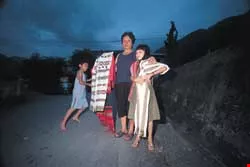
Atayal women learn weaving from the age of 15 until 19. Learning how to weave is a symbol of reaching adulthood. In recent years the Piyahaw community has been making efforts to revive this waning craft.
A one-man band
Many of the local Atayal had trouble just making ends meet, and most had little interest in participating in public interest activities. "At first, Huang Shan-chiao, who originally served as the association's general administrator, my family, and I were carrying on the struggle pretty much alone," says Lin. Quite a few locals felt that since the community development association was getting government money, they would only be willing to participate if they were going to get financially rewarded.
In reality, he didn't have sufficient funds to carry out several of the activities. Several years ago, the three activities of "Oral History," "Painting the Town," and the "Reappearance of the Treasure" ran to NT$40,000 altogether. "Oral History" was originally commissioned to Piyahaw Elementary School to administer. With only a week left the school backed out, and he had to do all the work himself, interviewing the village elders and editing the tapes until 2:00 or 3:00 night after night in order to do the job.
The "painting the town" plan also had a rocky road. The idea was to beautify the road leading into the village from the Suao-Hualien Highway by painting the 231 cement traffic dividers with designs. But apart from the money being insufficient, it was also hard to get people to volunteer their manpower. Hence, he would use his time in the early morning before work and in the twilight after work to lead his wife and children out to paint. After several days, drivers would stop their cars and ask him with great curiosity: "You really lucked out getting this job. So how much are you making?" Fortunately, as the word got around, other village residents gradually started to join in, and eventually, the entire student body of Piyahaw Elementary turned out, helping to make what had been an uninspiring two kilometers of road into a unique entryway to Piyahaw. Now when Piyahaw residents bring outsiders into the village, they invariably show them the "masterpiece" they painted themselves.
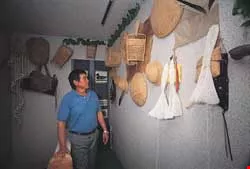
Apart from weaving cloth, the Atayal also weave baskets and other receptacles, though men have traditionally done this work. These items not only served to meet various daily needs but also had economic significance, and importance in traditional religious and social ceremonies.
Fresh troops
The association has since chosen traditional weaving, dance and cuisine as the focus of its efforts. "Now most of those participating in the community activities are women," Lin explains. Currently the weaving class has been held for three terms, and several dozen people have already mastered the basic techniques. The community has also sold looms. It's just unfortunate that the women of the village, after finishing their regular housework, don't have very much time leftover. Without any economic motivation, few continue with weaving after taking the course.
As for the dance group, it's accomplished quite a bit considering it's only been around for a year. "Everyone likes to dance," explains Liu Yueh-hua. "For one thing, you can get some exercise and build up a good sweat, and after practicing it's fun to hang out and talk." Currently, they practice two times a week, and whenever they are invited to perform they get really excited. Last year, they even came away with an award for folk arts excellence at a competition in Changhua.
What's more, Piyahaw's association has also been praised for its "basic work," such as its exhaustive survey of resources in the community and its community newsletter. Flip through the hundred-plus pages of the richly illustrated A Survey of Piyahaw's Resources, and you discover that the town's geographical environment, historical development, Atayal ceremonies and culture, and future prospects are all well covered. The survey methods included interviews with residents, oral history from tribal elders, on-site investigations, questionnaires, seminars and so forth. It took the four youths assigned by the Ilan County Cultural Bureau (who were performing community service in lieu of military service) six months to finish. "We hope that this report will help to carry on the legacies of the past and encourage the people of the community to develop sympathy, understanding and resonance, thereby increasing Piyahaw's self-respect and future prospects," wrote Chang Chih, one of the four young men who compiled it.
"Creating resonance" isn't easy. Lin Chin-chu explains that most people in the village with better economic situations are busy at work and lack interest, and that the unemployed are even less likely to come. Currently, some dozen mothers have helped to bring the community to life, but most of the villagers don't understand what's involved in making a community. The community suffers from a lack of participation. It's a problem that really gives him headaches.
"It's a road of no return that we've elected to go down," says Lin. Nevertheless, he's very grateful for all the support and supporters he has met along the way. For instance, County Legislator Chiang Ming-shun donated some office equipment, and Chang Peng-yeh, who handles community development at the Cultural Bureau, provided a lot of assistance. They helped Lin and the others in Piyahaw think about the direction of development. And then there was Huang Shan-jiao, who formerly served as Piyahaw's village warden. Lin finds it deeply moving that a Han Chinese like Huang would devote so much time and energy to helping an aboriginal village.
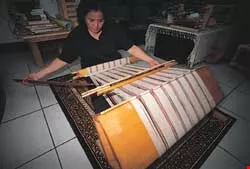
Lin Chin-chu's wife is weaving with a traditional horizontal back strap loom. The weaver straightens the warp by leaning back on the strap behind her.
Churches make peace
Last year, with the introduction of the Cultural Bureau, the Ilan County Office of NTU's Building & Planning Research Foundation prepared the Community Environment Improvement Plan on behalf of Piyahaw. The plan suggested taking the cement cover off the irrigation channel that runs through Piyahaw, building up embankments around it, and redesigning the space with some new plantings. "The irrigation channel was once the center of life in Piyahaw," Lin says. "It was where you bathed, washed your clothes, had fun.... Everybody would work during the day, and gather here at night." In the 1980s, after several children drowned here, the channel was sealed, and the whole situation changed. Then the mental barriers between the community's True Jesus Church and Presbyterian Church grew more pronounced, making it seem that the community was split in two, with the irrigation channel as the dividing line.
"This project was not only aimed at healing the divisions between Piyahaw's two churches; it was also aimed at building a collective discussion and creating an opportunity for community participation. Wang Chuan-ming, the Ilan Office director of the NTU Building and Planning Research Foundation, believes that the people of Piyahaw had previously lacked experience participating in community issues, and that it was desirable to hold forums in which they could talk about community matters. Last year, in order to gather villagers' opinions, he held various public hearings and workshops. Although he encountered some resistance at first, with communication the tribal people's passionate and sharing nature came to the fore.
"The community environment construction plan" included devising a midterm plan for creating a general-use space for the tribe, as well as a study of traffic patterns and a plan for a road around the township. "If the plan is approved, under the Government Procurement Law some of the workers for the project will come from the village. This will help to ease the unemployment situation," Wang says hopefully.
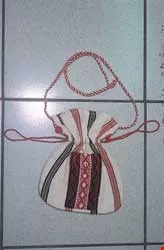
After students master the traditional craft of weaving, they also try their hands at designing modern items, such as briefcases, cell phone cases, and tablecloths.
Visions of Eco-tourism
Tribal development of eco-tourism, making use of the Pei River's abundant natural resources to attract tourists, should play a big role in Peihou's future. Lin Chin-chu explains that some people in the area want to develop hot springs along the river, but often when hot springs areas are developed, large financial groups rush in and the tribal peoples lose control. As a result, not only do local people not reap benefits, but in the process the natural environment on which they depend for their living is damaged. He hopes that in the future eco-tourism here will put an emphasis on environmental education, so that the combined wisdom of the Atayal ancestors and Mother Nature can be passed down for future generations.
Following along the Pei River in Nanao, amid the sound of the flowing water, you see rugged boulders and lush forests, as well as waterfalls and hot springs. According to local residents, because the Pei River has a complete ecosystem, it has abundant bird species, mammals, insects and fish. And the farther you go upstream, the more marvelous the scenery. "It's just unfortunate that several years ago lime mining caused some pollution," says current association director Tsai Shih-ming, pointing to gray accumulations under outcropping of rocks. It used to be possible to catch kooye minnows that were 15 centimeters long here; now there are none at all. Although mining upstream has already been banned, it will require some time before the river returns to its original state. The eco-tourism that the community is pushing will focus on the Naming Branch of the river: "Because there hasn't been any pollution there, there are a lot of crabs, kooye minnows, zacco, sweet fish and eels in the water. On the way you can see wild boars, muntjac and wild goats," says Tsai Shih-ming, who gets very excited when he talks about his experience of walking along the Naming Branch.
But how do you go about promoting Piyahaw? Many development ideas are still in the planning stage. Ideas include promoting tourist homestays, establishing a multi-functional cultural center (which will provide eco-tourism services), and training eco-tourism guides.
However rocky the road ahead appears to be, Lin remains sanguine about the future. Every morning he rises at 5:00 to tend to his garden. Then he goes to work during the day, and spends nights and holidays running around on behalf of the community and attending meetings outside the village. "I don't know why I've thrown myself into it the way I have," says Lin. But he goes on to explain how he once saw a youth helping a drunken middle-aged man home: "We aborigines don't abandon people. It's part of our cultural heritage. I hope that this kind of spirit will bring Piyahaw together."
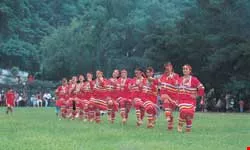
The Piyahaw Dance Troupe, whose members are mothers from the community, has made a bit of a name for itself in recent years. Exerting themselves for the glory of the community and also making friends through exercise, the members of the troupe really put their all into dance.

After students master the traditional craft of weaving, they also try their hands at designing modern items, such as briefcases, cell phone cases, and tablecloths.
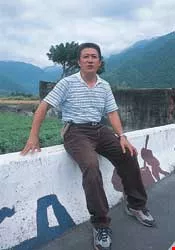
For five years, Ling Chin-chu has been working hard for the community.