Trend Micro--The Antivirus Elite
Yang Ling-yuan / photos courtesy of Trend Micro / tr. by Paul Frank
April 2006


Eighteen years ago, a small anti- virus software company named Trend Micro was born in Silicon Valley, the global mecca of software companies. After a period as a subcontracting partner for Intel, and experimenting with four business models--selling its technology patents, licensing its technology, selling product suites, and selling to corporate customers, Trend Micro made a name for itself with its PC-cillin antivirus software. It hopes to become for the IT industry what penicillin was for antibiotics.
Trend Micro stands apart from Tai-wan's hardware makers, which have traditionally focused on contract manufacturing, because it has a multinational management structure and sells software under its own name.
But the creative genius of founders Steve and Jenny Chang, and particularly its pioneering online antivirus scanner, have made the company a listed market leader in the United States and Japan, with a brand value of US$1.77 billion. For three years running, Trend Micro has been awarded first place among Taiwan's Top Ten Global Brands.
On May 3, 2004, a virus that had been lurking in the virtual world began to spread across the Internet. It caused havoc on an unprecedented scale, putting as many as 18 million computers and corporate networks worldwide out of commission, and thus causing incalculable losses. In Taiwan there was chaos and consternation as thousands of computers in the postal service were infected, forcing one third of post office branches to be closed.
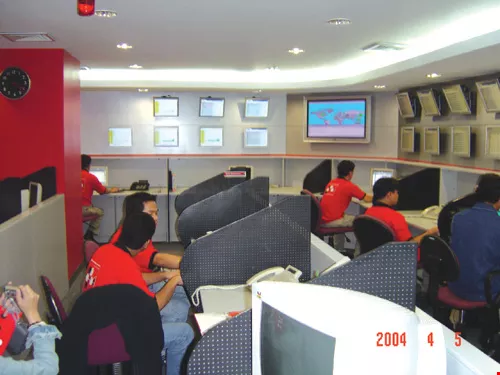
In 1997, a 15-strong Trend Micro crack team from Taiwan established an antivirus center in the Philippines. With a staff of 600, this center is now Trend Micro's only global antivirus response service center.
Virus doctors to the rescue
In fact, on the eve of the attack, TrendLabs, Trend Micro's 24-hour virus lab in the Philippines, began receiving virus reports from dozens of customers around the world. Its "virus doctors," who work in three shifts around the clock, identified the virus pattern within 45 minutes, compared it with other blacklisted viruses, and tested it to determine whether it was a new or an old type of virus.
Their analysis showed that it was indeed a new virus type, with a destructive potential beyond anything anyone had imagined possible. A red alert was issued throughout the lab, triggering a frantic race among more than 400 staff members, with one team working on a solution, another busy testing a variety of computer platforms, and a third answering thousands of requests for help from affected customers around the world.
Within a few hours, Trend Micro's head office in Taipei had a good grasp of the virus' origin and development. Jonny Wu, an assistant manager in the sales department, immediately alerted the company's senior managers, who called a meeting to discuss the problem. The virus turned out to be a network worm that targeted Microsoft products, causing computers to shut down and reboot after a one-minute countdown sequence. Engineers had to name the virus as quickly as possible to help customers identify the threat.
In fact, by the time the worm began wreaking havoc, the Trend Micro head office had already obtained an internationally approved English name, Sasser, after the process it attacked. But in Taiwan, a meaningful Chinese name had to be found that would strike a chord with local consumers and, more importantly, that could be used subsequently when combating the worm.
Because the Sasser outbreak occurred shortly after the March 19 shooting incident on the eve of Taiwan's presidential election, when the whole country was looking for the shooter, Trend Micro engineers hit upon the name shashou (hitman). They immediately issued a media alert and instructions to protect against the worm.
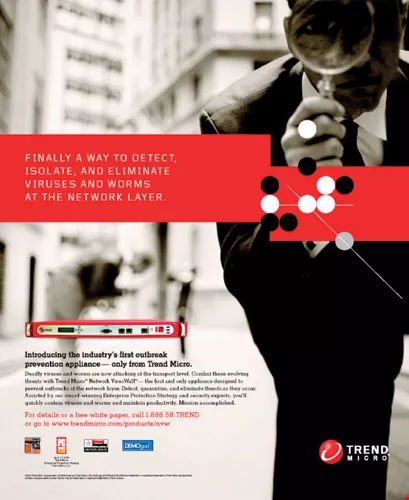
Trend Micro's "go-red" advertisement strategy is based on the game of Go. The color red represents security and competitive power--key principles in Go. The "go-red" concept has received an enthusiastic response and a variety of industry awards around the world.
At the forefront of the virus war
Trend Micro's rapid-response teams go into action every few months. New viruses are appearing and spreading as fast as the Internet is growing. In 2005, Panda-Labs registered over 46,000 new viruses. To minimize their clients' losses, virus protection companies make every effort to analyze new threats as rapidly as possible.
"Companies with the fastest response times are the only ones that can make it in the virus protection market," says Jonny Wu. The more clients a company has all over the world, the faster it can collect and analyze new threats. Without virus reports even the best analysts cannot set to work. That is why only the top two or three virus protection companies have survived in what was once a crowded industry.
Trend Micro has 26 international offices and more than 40 divisions around the globe. In the USA, which has the world's most developed IT industry, Micro Trend has cornered more than 80% of the virus protection market and counts the Department of Defense, AT&T, Bank of America, and Boeing among its customers.
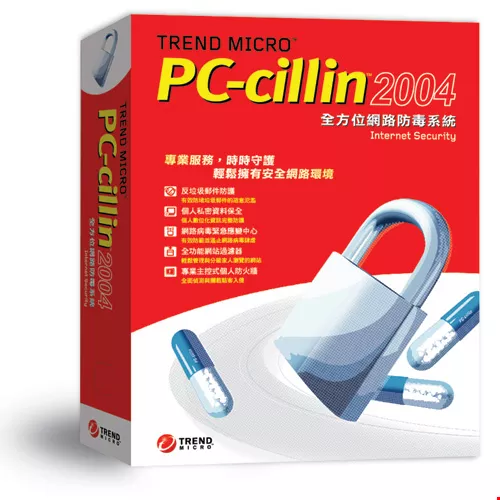
Since the release of its PC-cillin antivirus software in 1990, Trend Micro has won a leading position in the global virus protection market. In recent years, its server technology has made Trend Micro the world's leading online virus protection brand.
Work hard, play hard
Wearing a suit in Trend Micro's technology headquarters in Taipei, Jonny Wu looks like a typical executive. But he is quick to point out that he has a meeting and that his usual attire is jeans and a T-shirt. Almost everyone at Trend Micro is between 28 and 35 and wears casual clothes. The corporate philosophy is summed up as "Coke, flip-flops and jeans."
Shortly before lunchtime, groups of engineers streak out of their offices, some heading for the roof deck carrying yoga mats, some for a nearby badminton court, and some for the local gym. It is rare to see IT engineers who love exercise as much, says Wu. Their aim is to increase their energy because fighting computer viruses is much like firefighting. To respond rapidly and effectively, R&D team members must possess strong hearts and great endurance and patience.
"Unhindered communication is crucial to finding a cure in the afternoon for a virus that was detected in the morning," explains Jonny Wu in front of a red billboard that seems to exude energy. Unlike many other products, which can only be delivered after layer upon layer of tests and quality-control checks, antivirus software and programs are semi-finished products developed under great time pressure. To earn the trust and gratitude of its customers, Trend Micro has to find quick solutions for their emergencies. "That's why all our engineers are brimming with energy and enthusiasm."
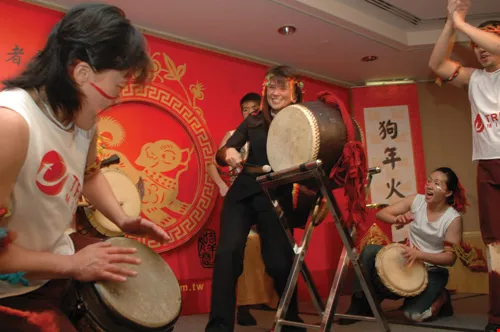
At the Chinese New Year office party to greet the Year of the Dog, Trend Micro CEO Eva Chen beats a drum to encourage her team to meet the challenges of the future.
The innovator wins the race
To stay one step ahead of computer viruses, which mutate very quickly, Trend Micro has to be able to respond with the same rapidity and flexibility. Creativity is everywhere. Most companies measure their performance in terms of growth rates and profits. But profit does not necessarily follow growth, nor growth profit. Trend Micro chairman Steve Chang has therefore devised a 100-point scale that combines both factors. The closer a Trend Micro office gets to a full score of 100, the better its performance. This enables the various branches to see how well they are meeting corporate and customer requirements.
Taiwan's SARS outbreak in the spring of 2003 was a further wakeup call for Steve Chang. He discovered that in the absence of an effective drug, forceful isolation and quarantine measures can also stop the spread of a virus. Trend Micro's R&D team therefore decided to move into the hardware field, and developed the Network VirusWall family of appliances that integrate software and hardware to stop and disarm virus threats on the outside. These products have effectively reduced network virus attacks.
For a number of years, Trend Micro has earned a name for itself as an innovator in a highly competitive industry. In 1997, Trend Micro filed a lawsuit against two competitors--Symantec and Network Associates--alleging patent infringement of its InterScan VirusWall technology. Trend Micro prevailed in this contest of a David and two Goliaths. Three years after the suit was filed, Symantec and Trend Micro signed an agreement to cross-license their respective patents for antivirus applications; Network Associates was ordered to pay US$125 million in damages. This victory greatly enhanced Trend Micro's clout and prestige.
The world of virus protection is a never-ending battle of wits and strength. Because hackers around the world are forever looking for opportunities to strike, Trend Micro is always watchful of possible pitfalls. In recent years in particular, all sorts of legal and illegal spyware and Trojan horse programs have been running wild on the Internet. A little carelessness is all it takes for customers' computers to slow to a crawl or suffer damaged files. Electronic transactions are also vulnerable to credit card theft and the loss of personal data. Online gamers can have their accounts stolen and "treasure chests" cleaned out. The fact that hackers are always developing new techniques and that the average Internet user has very little security awareness also causes Trend Micro's virus doctors plenty of headaches.
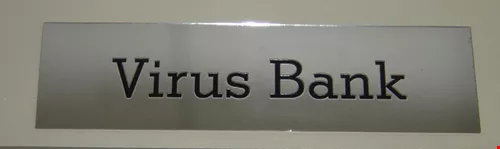
Over the past 18 years, Trend Micro's virus bank has collected more than 400,000 virus samples. But hackers learn new tricks all the time and an average of 10-20 viruses are released onto the Internet every day.
New services
Trend Micro dares to blaze new trails and relies on firsthand market research for product innovation. Its cellphone virus protection software, for example, was developed in response to demand from American customers. Cellphone viruses can drain a handset's battery and infect its memory card. PCs are also vulnerable when cellphone data is transferred to them. Another extremely worrisome threat is that cellphone viruses can spread via Bluetooth (short range wireless) networks. Chunghwa Telecom (CHT) and Trend Micro have recently forged a strategic partnership to offer a service featuring "Trend Micro Mobile Security" to CHT's smartphone subscribers on a free introductory trial basis. This is the first such partnership in the world.
A Trend Micro survey revealed that most corporate clients had highly qualified in-house IT engineers who spent half their time trying to solve staff members' virus infection and protection problems. Consequently, they had no spare capacity for crucial system design tasks within their company. This prompted Trend Micro to launch a virus protection service based on a 24-hour monitoring and reporting model. Trend Micro informs clients of any virus infections and if necessary immediately dispatches an engineer to solve the problem. It also offers prevention training for personnel found to have persistent problems with viruses.
During the three years since the service was launched on a trial basis, the response from corporate customers has been very positive. Trend Micro has made a successful transition from a company that sells antivirus software to one that provides online virus protection services.
Microsoft has also announced that it will launch its own antivirus software by the end of the year. Despite this threat from a former friend, Trend Micro remains confident in the knowledge that relationships with corporate clients based on trust and understanding cannot be built overnight. Last year Trend Micro's revenues were up by 18%; consolidated net sales for the first quarter of 2006 are expected to reach US$165.3 million. Both figures reflect the company's confidence and ambition.
Having led Trend Micro on its bumpy journey over the past 18 years, Steve Chang has concluded that is the player with the competitive edge that wins the biggest share of the market. Once he dominates the market he has to increase the distance between himself and his competitors and raise the bar for them. Then he has to keep pushing himself forward through innovation. In this way, Trend Micro has achieved a brand value of more than US$ 1 billion.
Steve Chang once predicted that "the software business will soon become a declining traditional industry," because he had not seen any new and successful software companies in several years. But Jonny Wu thinks that as long as the twin problems of network security and junk mail remain unsolved, there is room for business growth. Trend Micro may be on the last train in the global software business, but thanks to the energy and enthusiasm of its engineers, the ride should last several more decades.
Taiwan's Top Ten Global BrandsRankingBrand NameTotal brand value: US$4.6 billionCompared to 20041.TREND MICRO10.77+14%Note: Trend Micro has reached the US$1 billion threshold set by Interbrand for evaluating global brand value for Business Week's "Top 100 Global Brands" survey.2.ASUS8.82+4%3.ACER7.59+15%4.BENQ3.54+27%5.MASTER KONG3.17-14%6.MAXXIS2.64-8%7.GIANT2.53+3%8.SYNNEX2.39+20%9.ZYXEL2.36+6%10.D-LINK2.25+2%

@List.jpg?w=522&h=410&mode=crop&format=webp&quality=80)
.jpg?w=522&h=410&mode=crop&format=webp&quality=80)


