New Building on an Old Foundation: Remembering Dr. James Maxwell
Chang Chiung-fang / photos courtesy of Presbyterian Church of Taiwan, SinLau Hospital / tr. by Phil Newell
October 2001


When you speak of the history of Christian missionary work in Taiwan, or of the history of modern medicine here, most people in Taiwan would be able to identify two pioneers in both realms: Rev. George Leslie Mackay (active in Tanshui) or Dr. David Landsborough (Changhua). But few people know that Dr. James Laidlaw Maxwell, who worked in the Tainan area, came to Taiwan even earlier than these others, and was the real innovator in bringing Christianity to "Formosa" hand-in-hand with modern medicine.
Though Maxwell spent only seven years in Taiwan all told, he created the model for medical missionary work in southern Taiwan, and had a far-reaching impact on the island. As the first Christian missionary here, what obstacles did he face? How were these overcome? What was Taiwan's society like back then? If you want to really understand the history of Taiwan, then you have to know the story of James Maxwell.
It has been 136 years since the SinLau Hospital, located in what is now Tungmen Road in a bustling district of Tainan City, was founded in 1865. It is hard to imagine that this little clinic played a vital pioneering role in the history of medicine in Taiwan. The direct predecessor to SinLau Hospital was founded seven years earlier than what is now Mackay Memorial Hospital in Tanshui, and 30 years before National Taiwan University Hospital. But times change, historical records get lost, buildings get renovated, and amazing stories and established reputations-like those of James Maxwell-get forgotten.
Christianity comes to Taiwan
The first time Christianity came to Taiwan was back in the late Ming dynasty, when the Dutch and Spanish occupied key parts of the island. But after the Chinese general Zheng Chenggong (Koxinga) conquered the island, missionary work came to a halt, leaving behind as the only remnant of this phase the Roman alphabet used by the Dutch for romanizing Taiwanese.
In the late Qing dynasty, after the forcible opening of five Chinese ports to foreign commerce in 1842 under the Treaty of Nanjing, Presbyterians (whose denomination is that of the Church of Scotland, and who therefore were mainly Scotsmen), established missions in Shantou and Xiamen. Naturally, the Presbyterian Church also took notice of Formosa, which was just a strait away from Xiamen.
In 1858, the Treaty of Tianjin forced opened the ports of Tainan and Tanshui, and the Presbyterian Church "hit the beach" in 1860. A group of ministers led by Rev. Carstairs Douglas visited the island for a short stay, and noticed especially the dearth of medical resources and the seriousness of disease and epidemics. They decided to send Presbyterian missionaries to Taiwan to both provide medical care and proselytize, and James Maxwell was the first.
Maxwell was born in Scotland in 1836, and earned his medical degree from the University of Edinburgh. He thereafter trained in Berlin and Paris, becoming an outstanding surgeon. He arrived in Xiamen in 1864, and after a year of language training was sent to Taiwan.
Is it a church? Or a clinic?
The three most important settlements in early Taiwan were Tainan, Lukang, and Mengchia, all ports. Tainan, being the administrative capital as well as a major commercial port, was naturally the first place missionaries targeted to establish a base.
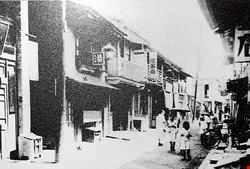
On May 28, 1865, Maxwell, part of a party that included Carstairs Douglas and two of the faithful, landed at Chichin Harbor in Kaohsiung. On June 16 the group arrived on Kanhsi Street in Tainan, where they began their medical missionary work. This day later became celebrated by the Presbyterian Church (the faith of the Church of Scotland) as the anniversary of the establishment of their sect in Taiwan.
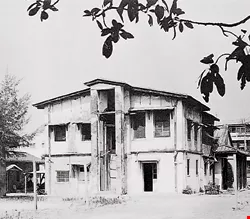
They began in a low-ceilinged building, in which the front part served as house of worship, the back as clinic. First came sermons, then diagnoses and prescriptions-a day in the life of the first facility in Taiwan to offer Western medicine.
It probably goes without saying that, this being the very first time anyone undertook medical missionary work in Tainan, not all went smoothly. Not only was Maxwell strongly opposed by practitioners of traditional Chinese medicine, but also rumors circulated that he tore out people's eyes or hearts to make potions. After operating for only 23 days, both church and clinic were forced to close.
Maxwell had no choice but to find refuge in the British consulate in Takou (now Kaohsiung). That September, he founded a clinic in Chihou with eight beds, and established a small church right across the street.
The camphor controversy
The early days of Maxwell's medical-missionary journey were rocky indeed. Besides facing cultural differences and a huge gap in basic attitudes, there were also complications with regard to the missionary situation itself. The appeal of a divine being that loves all mankind didn't find a ready audience in Chinese who still had their original brush with the West-looking down the barrel of a gun-fresh in their memories; people were suspicous of the relationship between Christian doctrine and economic interests; and they got life-saving medicine side-by-side with life-destroying opium. People were not well educated and standards of living were low, so there was fear and prejudice against foreign culture.
Taiwan Presbyterian elder Huang Mao-ching, in his book 120 Years of History at the Thai-Peng-Keng Maxwell Memorial Church of the Taiwan Presbyterian Church, discusses the background against which Max-well's early proselytizing efforts took place: "When the church was first established, Christianity as it then appeared to Taiwanese arrived in the wake of foreign soldiers and artillery, alongside economic invasion and unequal treaties, so they could not accept the gospels. All the more so when you consider that among the British who came to Taiwan there were many who came purely for profit, without scruple as to how they got it. . . ."
Fu Dai-wei, a professor of history at Tsing Hua University, describes the missionaries of that period as representatives of "semi-colonial medicine." In an article on this theme, he points out the many difficulties early missionaries like Maxwell faced, and makes the important point that they would never have been able to achieve what they eventually did without the kind of military backing demonstrated in the fortuitously timed "camphor controversy."
A Briton working as a customs official for the Qing government, though well aware that camphor was one of the most important and unique products for Taiwan merchants, illegally purchased a supply of it at a non-treaty port, hoping to smuggle it out by relying on British influence and authority. But the camphor was confiscated. The British objected to what they claimed to be interference with legitimate trade.
Coincidentally, it was at this time that the Presbyterian Church in Pitou (now Fengshan) was wrecked, and James Max-well's first convert in Taiwan-Kao Chang-was, while preaching in Fengshan, surrounded by a mob, beaten, and imprisoned.
The British response to the camphor incident and the destruction of the church was to dispatch two warships from Hong Kong to bombard Anping (modern Tainan). Eventually, the Qing court not only paid compensation to the Presbyterian Church, but also put in writing that foreign missionaries had the right to reside and proselytize in Taiwan, and that suppression of Christianity or its believers would be considered a criminal offense.
However, the general population, and even high-ranking officials, still had many misunderstandings about and prejudices against Christianity.
Barbarian medicine man
It was a constant objective of the Presbyterians to make Tainan the center of missionary operations. After the camphor controversy, Maxwell, now armed with the legal right to prosletyze, returned to Anping in 1868 and reopened his hospital. Thus began what people later would call the jiu lou period of Maxwell's missionary work. (Jiu lou means "old building," and refers to the precursor to SinLau Hospital; sinlau, or xin lou in Mandarin, means "new building.")
Maxwell was an outstanding surgeon, and most patients who sought help from him did so for surgical problems, such as eye problems, difficult childbirth, gangrene, and so on. When people couldn't find any help for their medical problems elsewhere, they turned to Maxwell.
Maxwell's medical practice was undoubtedly of immense benefit to his missionary work. Presbyterian elder Huang Mao-ching points out: "It was only by the concrete experience of lives being saved and illnesses cured that suspicion and prejudice against Christianity could be alleviated. Most of the early converts accepted Christianity because of the medical care."
It is especially noteworthy that Maxwell focused his missionary efforts on Pingpu indigenous people, and the early churches were entirely Aboriginal churches. A major reason is that unsophisticated Aboriginal people of that era were often cheated and oppressed by Han Chinese, so in comparison Maxwell's apparently selfless efforts were very much appreciated, and word spread fast to all the local tribal communities.
A vernacular Bible
Maxwell practiced his brand of medical missionary work in Taiwan for six-and-a-half years, travelling throughout central and southern Formosa, and he founded three Presbyterian parishes. One was in the southernmost area, inhabited by the Sir-aya indigenous people (around today's Mucha and Tsochen), a second in the south-central region of Taiwan (Paiho, Chiaya), and a third in north-central Taiwan, home to the Pazeh people (today's Puli, Fengyuan, and Shenkang).
According to documentary evidence, by 1872 Taiwan had 22 churches, and 784 adults had been baptized. On average 3500 people attended services, and there were 1632 full-fledged adult church members.
Besides medical work, another major contribution of Maxwell's missionary work was the translation of a vernacular Bible.
Since Pingpu indigenous people were the main focus of his missionary work, Maxwell traveled frequently to Aboriginal parishes. There he discovered that contracts for buying and selling of land between Pingpu people and Han Chinese were written using the romanized writing system that was a legacy of the Dutch occupation. The discovery of these "barbarian contracts" (as they were called) gave Maxwell the inspiration to produce a vernacular Bible in romanized Taiwanese. It would have taken a typical illiterate person in that era a long time to learn written Chinese, but they could grasp the romanization in just a few months. Maxwell translated the New Testament into Taiwanese in this romanized system, and the Taiwanese Bible still used today by the Presbyterian Church is based on Maxwell's handiwork.
Goodbye
After working in Taiwan for seven years, Maxwell, who was 29 when he arrived on the island, returned to Britain to rest. He did not expect that a spinal ailment would make it impossible for him to return to Taiwan any time soon.
During his recuperation at home, Maxwell carried on his work of creating a vernacular Bible, and finally completed his Taiwanese New Testament in 1873.
In 1880, Maxwell went further and shipped a complete set of equipment to Taiwan for printing the vernacular Bible, including a small printing press, type, and racks for type-setting. This printing press made a tremendous contribution to the spread of the romanized vernacular promoted by the southern branch of the Presbyterian Church in Taiwan. Thanks to the entree it provided, Presbyterian missionaries could get much closer to ordinary people, and many of the churches became closely connected to the lives and thoughts of people at the lower levels of society. Today, the Presbyterian Church remains the largest Christian denomination on the island.
Despite having left, Maxwell never ceased to be concerned about Formosa. He toured and lectured about medical care in Taiwan, described the importance of establishing health care facilities in central Taiwan, and was an active fundraiser in the cause.
Twelve years after leaving, Maxwell, accompanied by his wife, returned to Taiwan toward the end of 1883. He revisited the very spot where he began his proselytizing work, and was delighted to see the gains made by the church whose roots he had done so much, single-handedly, to plant. However, because his wife was in frail health, in October of 1884 they returned to the UK. Maxwell would never again set foot on Taiwan.
His medical missionary work was taken up by a series of successors, beginning with Dr. Matthew Dickson. In 1900, Dr. Peter Anderson built a new hospital building at the current site on Tungmen Road in Tainan, and formally christened it SinLau Hospital.
New building, old friends
In March of 1921, Maxwell passed away in his homeland at the age of 85. Nonetheless, his medical missionary work and his connection to Taiwan continued. Both of his sons also became physician-missionaries. His elder son went into practice in Xiamen, while his second son, James Jr., picked up his father's old trail in Tainan. In 1901, accompanied by his wife, who was a nurse, James Jr. came to work in the SinLau Hospital, the direct successor to the institution that his father had established 36 years before. Local people referred to him as "Young Dr. Maxwell."
During his tenure at SinLau, Young Dr. Maxwell worked hard to eradicate opium addiction, sexually transmitted disease, and leprosy. He and his wife remained in Taiwan for more than two decades.
Perhaps today, when we take advanced medical care for granted and there are hospitals and clinics seemingly on every street corner, SinLau no longer has much of an air of importance. Nonetheless, as a Christian hospital, it still has a special culture different from the ordinary medical institution. Joshua Pan, director of the Chaplain's Office at the hospital, points out that as a community clinic, SinLau hospital not only provides hospice care for the terminally ill and special care for mentally ill patients, it still continues its educational work. For example, there is a children's center which focuses on physically and mentally challenged young people, as well as an audiovisual center and lending library.
It may be a "new building," but the old warmth is still there. It's just that the people of Taiwan may not remember that this warmth originated in the heartfelt commitment of James Maxwell.
p.084
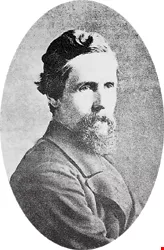
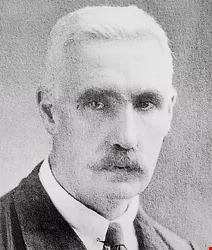
Dr. James Laidlaw Maxwell was-along with his entire family-devoted to medical missionary work.
p.085
James Maxwell wrote the first page in the history of Christian medical missionary work in Taiwan.
p.085
SinLau Hospital administrator Huang Chia-che came to Taiwan from Xiamen with Maxwell, and proved to be invaluable.
p.086
The clinic on Kanhsi Street in Tainan is the first place Maxwell began medical missionary work after arriving in Formosa; it was the first facility for Western medicine in Taiwan.
p.086
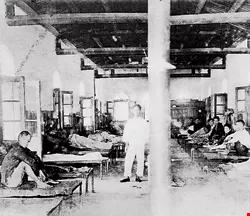
This was a ward in the SinLau Hospital of days gone by. It looks primitive, but it was the most advanced Western hospital of its day in Taiwan.
p.087
In April of 1900, the SinLau Hospital opened for service. It was equipped with the first elevator in Taiwan, for taking patients up to the second-floor operating room.
p.088
James Maxwell Jr., called "Young Dr. Maxwell" by local people, carried on his father's work and devoted 23 years of his life to SinLau Hospital. He went to Shanghai in 1923, and died in Hangzhou in 1951.
p.089
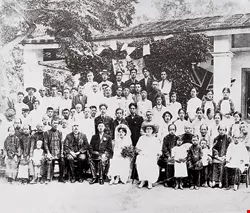
James Maxwell Jr. was not only a physician, but a benevolent father figure. When Dr. Shih Yuan-sheng, who worked at SinLau Hospital, married, Maxwell was asked to be the chief witness.

@List.JPG?w=522&h=410&mode=crop&format=webp&quality=80)

@List.jpg?w=522&h=410&mode=crop&format=webp&quality=80)


