Can't take it away
The international trends favor Taiwan, and after several years of development the broadband network in Taiwan is taking shape, providing a solid foundation for the digital content industry.
Oliver Weng notes that in 2000 there were only 220,000-plus broadband subscribers in Taiwan. Without the necessary bandwidth, downloading network multimedia programs was a slow process, and when they were played the characters' mouths were not in synch with their speech, and their movements were as jerky as puppets. At that time, in order to eke out their users' bandwidth, multimedia web sites such as GGLong and A-Kuei could only present their content in the simplest form and with little refinement.
Today, however, of Taiwan's current wired population of 8 million, nearly 2 million have broadband connections. Of these, 1.66 million are Chunghwa Telecom ADSL customers, and another 200,000 have broadband connections through the cable TV network. Industry insiders estimate that once the number of broadband subscribers exceeds 3.5 million, this will provide the impetus for all kinds of digital content to take off.
In terms of the commercial environment, the combined domestic and offshore production value of Taiwan's IT hardware industries such as computers and semiconductors still firmly ranks third worldwide, and with energetic promotion by the government over the past decade, the software industry has also advanced to 26th position. With large numbers of experienced personnel in both the software and hardware fields, Taiwan is able to keep up with the world's latest technologies, and this is another factor that gives it an edge.
In fact, for Taiwan to progress from hardware to digital content, with a focus on networked multimedia, is something that is both necessary and urgent.
Hwang Tai-yang notes that in the past two years, due to pressure to reduce costs, Taiwan's high-tech companies have all been moving their production west to mainland China, and the global PC market is now saturated. As a result, last year the production value of Taiwan's IT hardware industry fell for the first time in the more than 20 years of its existence.
This warning sign shows that Taiwan has already reached a bottleneck in hardware manufacture, and for the future it must turn toward development of the knowledge economy-of which digital content is a core component. Hwang also observes that the relocation overseas of large parts of the mainly contract-based computer hardware industry has brought people to a new realization about digital content, which is based on mental creativity: "It doesn't require big factory facilities, and it doesn't take up space. It's an industry based entirely on the interaction between brain and computer, and for this reason it can't be stolen away by other people!"
The Internet factor
At the same time, many hardware manufacturers have begun to understand that it is only by providing better information and content that one can attract consumers to use and buy hardware. "Hardware makers may be unfamiliar with the field of digital content, but if their huge financial resources can be brought to bear on the industry, this will be of tremendous help for its development," observes Andy Wang of Imagetech, whose shareholders include hardware manufacturer Hitron Technologies.
Another precondition for the development of the digital content industry is the increasingly powerful and robust Internet environment. Software published on CD-ROM for the stand-alone computer is easily copied by pirates, eroding the profit base of the original publisher. But the Internet provides a different commercial environment in which digital content can be protected against piracy.
Wang Chin-po, president of Soft-World International Corporation, one of Taiwan's largest computer games companies, says that back in the days of single-user games CDs, the company would lose over 80% of the market for a best-selling game to pirates, greatly reducing profitability. Fortunately, with the increasing maturity of network mechanisms and the growing popularity of online gaming, today players have to pay whenever they go online to play. Before long, CDs for stand-alone computers will also have to be registered online before the program can be run, leaving no scope for the pirates. Especially in the mainland market, where piracy is rampant, this mechanism will be crucial for profitability.
Piracy can be combated, but the notion that "information has a price" is still none too strong among Internet users. In the past, except for special industry databases, sources such as online news sites and all kinds of personal web pages provided an endless wealth of freely accessible information for people browsing the web, leaving little room for the survival of commercial web sites. Even portal sites such as Yam, and Yahoo's Taiwan subsidiary Kimo, which claimed to have millions of subscribers, were frustrated by their lack of an "excuse" to charge fees.
Today, this situation is gradually improving. After the United Daily News web site known as udndata.com began recruiting paying subscribers last year, it earned over NT$10 million in revenue in the first 12 months. When other portal sites such as PC Home have launched various "value added" electronic newspapers in addition to their free e-papers, their subscriber numbers have also risen steadily. This shows that the "user pays" concept is now gaining some acceptance among Internet users.
Mickey Mouse
Digital content may include virtually anything, but one thing that is certain is that whoever can meet the e-generation's preference for the exotic, the cool and the fun, will be the market winner.
In the visual media kingdom of the US, in the past few years revenue from productions that include animation and digital special effects has exceeded that from films shot frame by frame on celluloid in the traditional manner, and in Japan, computer games outstrip the automobile industry in sales value, showing remarkable popularity despite the stagnant economy. In view of this trend, this year the ROC government also focused its attention on the areas of digital content with the greatest earning potential-digital animation and computer games-as the first shot in its campaign to boost Taiwan's digital content industry (see "'Playing' the Market").
James Wang, chairman of Wang Film Productions, which was set up 24 years ago and has long been quietly doing contract work for eight major US film companies including Disney and Warner, admits to being flattered by this sudden flurry of government interest. He points out that digital content is a kind of "show business," in which creativity and style are all-important. Anyone who can achieve brand prominence will earn profits. Wang Film has been working behind the scenes for other people for many years, but James Wang believes that today, with Chinese style in vogue worldwide and the government beginning to value the industry, his golden opportunity has come at last and he can still get a piece of the action.
Wang reveals that in order to build brand recognition for his company and to aim at the global market, he is currently planning a feature-length animation, to be made under the overall control of Wang Film. The film is about Marco Polo-an "East meets West" theme of the type that is currently popular. Wang plans to hire a Hollywood director and producer, and the artistic work is to be done in both Taiwan and the US. He also intends to work with a film distribution company with a worldwide network. He hopes the film will be an instant success in Hollywood, and will propel Wang Film onto the world stage.
Oliver Weng of the IDB strongly supports companies' ambitions to build their own world brands: "When you mention the US, everyone thinks of Mickey Mouse and Donald Duck; with Japan it's Doraemon and Crayon Shinchan; and now even South Korea has its rabbit Mashimaro!"
Weng avers that one should not underestimate these cartoon idols. They not only create a large market for associated merchandise such as toys, stationery and clothing, but "their value grows as they age." The US's recent drive to extend copyright from 50 to 70 years has been laughingly called the "Disney clause." If Taiwan could also produce some successful independent brands, this would do much for its international visibility.
Digitizing culture
Games and cartoons can lead the market for the fashionable and the creative, but does digital content only have entertainment value? Far from it. In January this year, the National Science Council's "digital collections" project officially began, with the aim of digitizing the major items in the collections of nine national cultural and historical agencies including the National Palace Museum, Academia Historica, the National Central Library and Academia Sinica. The intention is on the one hand to preserve cultural assets, and on the other to create a public information system to enable businesses to access and use the data, and thereby to enrich the content of the digital content industry.
Previously, a number of small multimedia firms had already regarded the digital world as a base for a cultural and artistic renaissance, and had been quietly working to promote cultural transmission.
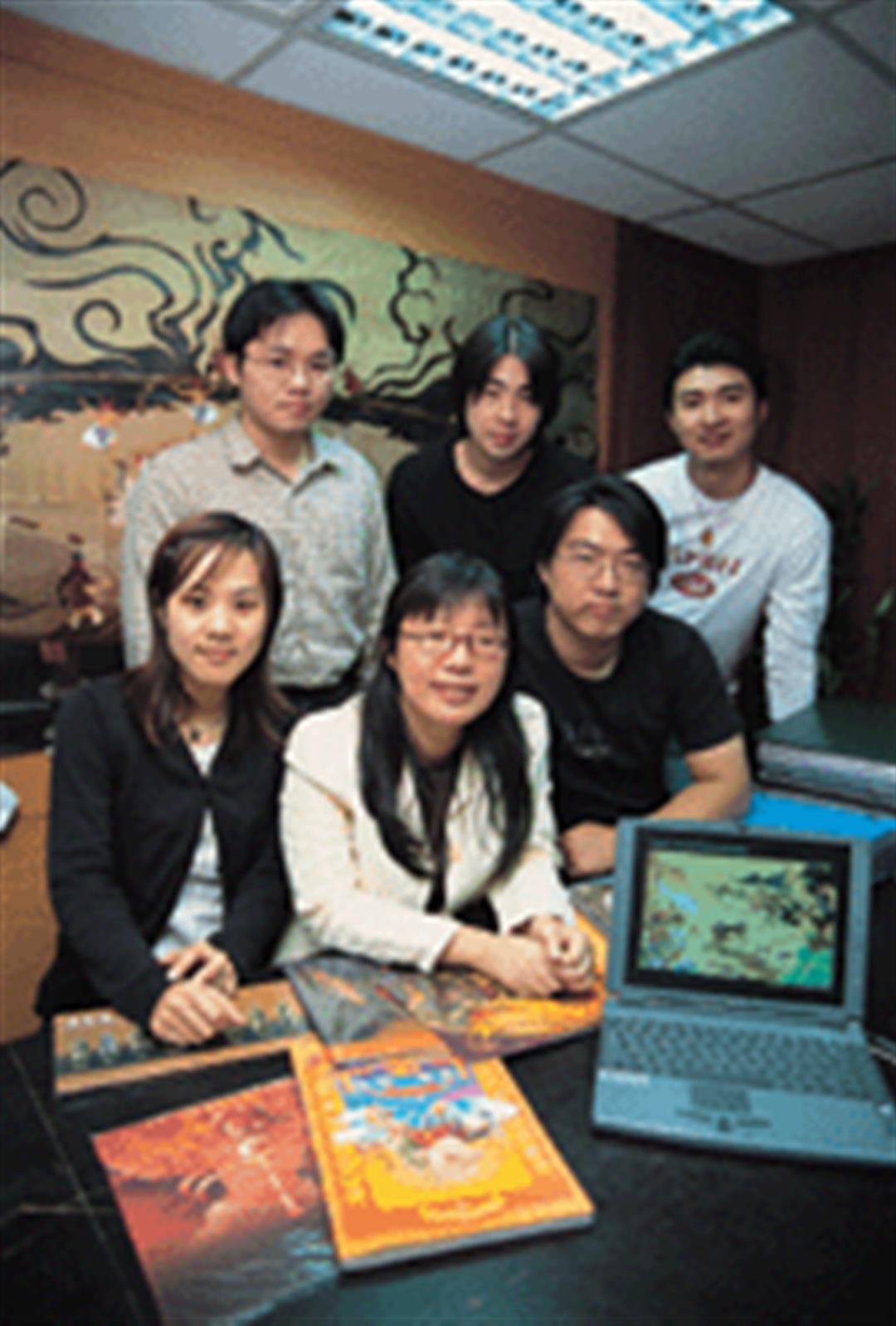
"Traditional culture is being lost so quickly," laments Lin Fangyin, creative director of Bright Ideas Co., which in recent years has produced audiovisual CDs for exhibitions put on by the National Palace Museum and the United Daily News group. At present, Bright Ideas is working on its own 3D CDs entitled Chu Culture Exhibition and Recollections of the Red Cliff, which use historical materials and ancient paintings to introduce Chinese culture. The company has chosen a lonely road amid a plethora of multimedia products that seek to outdo each other in novelty and exoticism.
Lin Fangyin holds an MA in art history from National Taiwan University. The reason she moved into the field of multimedia production was that she realized how the uniquely interactive nature of digital technology could give users a sense of participation.
"I hope that one day we can produce a game CD using the painting Upper River during Qing Ming Festival as a backdrop, so players can stroll through the busy streets of old Kaifeng, try their hand at buying ceramics and picking out pieces of real artistic value, and also test their knowledge of poetry and history. They will even be served tea by beautiful girls!"
Lin says that to produce such products one has to amass huge quantities of cultural content, and then seek inspiration from it and pick out the best. But at present Taiwan does not have a fully functioning platform for trading in digital content, and many companies are stymied by the difficulties of acquiring rights of reproduction. For instance, she says, the NPM has 650,000 cultural artifacts, and is now working to digitize its collection. But it should also open its image archive for commercial use by businesses. Whether it be clothes designers wishing to study Tang dynasty clothing, or architects wanting to appreciate the subtler points of buildings from the Qianlong reign, they should all have a route by which they can obtain licensing.
Constructing "digital policies"
Digital content is a fourth "C" after the "three Cs" of computers, communications and consumer electronics. Not only Taiwan is very keen to develop it-all the major IT countries have singled it out as the focus of the next wave of competition. With Taiwan's industry surrounded by powerful adversaries, the ability of government policies to facilitate development will be a decisive factor.
Sun Net vice president Hemingway Chiu cites the example of e-learning. In mainland China, the penetration of broadband and computers is far lower than in Taiwan, but the PRC government already recognizes degrees gained by online learning. If only an Internet student can pass the rigorous exams, they can receive a formal degree. In future, 30% of the courses offered by the mainland's 138 designated key universities will be available for online study-a far higher percentage than in Taiwan.
In Taiwan, to date the Ministry of Education only recognizes web-based course units as a means to gain credits for classroom-based degree courses. A student needs to pass the highly competitive college entrance exam to be able to enter a formal degree course, and credits gained by Internet study may not exceed one-third of the credits needed for a degree. This difference in the rules on opposite sides of the strait has prompted many Taiwanese students to enroll on mainland web sites, which indirectly impacts Taiwan's ambitions to become a hub for a "new world of study" for Chinese people worldwide.
Another example is the "real" film industry, which is the basis for visual digital content. In recent years Taiwan's film industry has been in continuous decline, and related laws and policies have not been effective in producing a revival. This is a cause of great worry for those in the digital content industry.
Andy Wang of Imagetech, which recently did the special effects for famous director Hsu Chin-liang's prime-time drama series Wind and Clouds, says that over the last two years locally-rooted dramas in Taiwanese dialect have been popular in Taiwan. These have no market outside the island, so there is no sign today of the huge sales in the worldwide Chinese-language market of past series like those on Song-dynasty magistrate Bao Qingtian.
With a shrinking market, the funds available for the production of each episode of a series have also shrunk, from NT$1 million ten years ago to only NT$600,000 today. When one compares this with the production costs of at least NT$2 to 3 million per episode for Korean and mainland dramas, it is hardly surprising that the quality of Taiwan's drama serials has continued to go downhill. Under these conditions, the funds available to pay digital multimedia companies for special effects have also been greatly reduced, and this undoubtedly deprives the digital content industry of a good "training ground."
"All told, Taiwan has over 70 free-to-air, cable and satellite TV stations. To put a positive gloss on it you could say this is a sign of a vibrant industry, but with such intense competition, many stations feel that producing drama series of their own is too costly and risky, so they prefer to buy ready-made Japanese, Korean or mainland offerings. With the large influx of drama from abroad, in fact the biggest losers have been Taiwanese film and TV production organizations," laments Andy Wang.
Hoping for funds
This view strikes a chord with Helen Huang, chairman of Digimax Corporation, which only this year set up the company Pandasia Entertainment, mainly as a distribution agency for films featuring, or made by, Chinese people. For instance, this year Pandasia carried The Touch, starring Michelle Yeoh, which generated royalties of over NT$80 million each on the mainland and in Hong Kong. But here in Taiwan it was a flop, and only brought in something over NT$20 million.
"In fact The Touch was originally meant to premiere in all the Asian markets at the same time. But because Taiwanese cinemas were booked up with popular Western movies over the summer holidays, we couldn't get it slotted at that time. After the premieres on the mainland and in Hong Kong the pirated editions came out, and naturally we couldn't get a good price," says Huang with frustration.
By contrast, in South Korea, after the 1997 financial crisis the government there began giving its full support to developing the computer games and digital audiovisual media sectors. It not only requires all cinemas to show Korean-made films on at least 121 days a year, but audience members can use the ticket stubs to claim tax allowances and can win prizes with them. If a Korean film studio has the opportunity to collaborate with a Hollywood studio, the Korean government will give it a subsidy. The government also invests in film productions made by private companies, and if the film makes money, the private company gets to recoup its investment first. All these "extreme measures" make Helen Huang very envious.
Huang worries that although Korea is not necessarily any better than Taiwan in terms of technology, creativity and marketing, with full government support, Korean film-, computer games- and digital-content-related companies are on a roll, and new firms are springing up all over the place. This is already creating a "critical mass" effect among overseas buyers, and Taiwan will have to act quickly to catch up.
"This is a new industry with a huge market. We're not afraid of competition. The more people in Taiwan get into this industry the better, for strength comes from solidarity." Eric Lee, president of Softstar Entertainment, a major local computer games company, says that companies such as Softstar, Wang Film and CGCG have already formed a strategic alliance. They have also set up an "academy of the new arts," in which experienced industry workers teach courses in order to pass on their knowledge and skills as quickly as possible.
For a new industry, funding can give a crucial boost. But to the frustration of those involved, over the last two years the government has kept a tight hold on its purse strings, and as a result the new "twin star" industries have received plenty of adulation but little in the way of real benefit. For instance, the government originally planned to spend NT$1.9 billion over five years to set up a national "digital content college," but only NT$50 million has been allocated for next year, the first year of the project. The research and development subsidies given to games manufacturers this year by the Ministry of Economic Affairs also only amount to NT$200 million, which is a far cry from the NT$12 billion spent in South Korea.
Taiwan has both strengths and weaknesses in the digital content arena. But the competition has already begun, and only by putting its best foot forward can Taiwan hope to attain successes in software technology to match its dazzling past achievements in the hardware field.











@List.jpg?w=522&h=410&mode=crop&format=webp&quality=80)