Hopes and Dreams:Can Taiwan TV Productions Make a Comeback?
Chang Chiung-fang / tr. by Phil Newell
October 2011


Across Asia, television series-melodrama, comedy, romance, historical dramas, and the "idol dramas" featuring the latest teen pop idols-are a staple of evening entertainment. But they are also an expression of national economic power, and in fact these shows, and the pretty-boys and prettier girls in them, have, beyond any doubt, become the public face of their countries.
Taiwan's homemade TV series also had their day in the spotlight, but in recent years, in the face of the dominance of the "Korean Wave," they have been more or less pushed off the stage. Some TV stations in Taiwan have even gone over to an all-Korean format.
Seeing that TV stations find it cheaper to buy the rights to foreign shows than to make their own, the government has begun to wield various carrots and sticks in an effort to rescue domestic production of TV series.
In August of 2011, the National Communications Commission (NCC) formally asked a number of television stations that were showing more Korean TV series than in the operating plans they had originally submitted to the government to qualify for licenses-including the all-drama channels of ETTV , Videoland, and GTV-to reduce foreign-made shows to under 80% of programming.
In September, the Government Information Office (GIO) announced that the budget for subsidizing the broadcasting of HD television programming will be increased from this year's NT$190 million to NT$500 million next year. The government wants to especially encourage the making of the "prime-time dramas" that are the pace-setters in the industry, and is working on a plan to subsidize part of the costs if a station invests at least NT$100 million of its own money.
Is it really going to be possible for Taiwan-made TV series to clamber back to the top? What do they have going for them? Against them? Given the current media environment, what is it going to take for Taiwan dramas to catch up to the leaders from Japan and Korea, and bring glory (or at least viewers) once again back home?
"Our feet move lightly across the courtyard, as the sunlight wraps us in halos, the gentle pitter-patter of our steps drifting through the warm air.... Who knew happiness could be so easy!" This dreamy blurb from a poster advertising the serial Material Queen neatly sums up the core ethos of "idol dramas."
Made at the extravagant cost of NT$126 million, Material Queen, it has been said, was made to higher technical specifications than any other "idol drama" in the history of TV in Taiwan. It debuted on CTS in mid-June, with reruns on Next TV and Super TV.
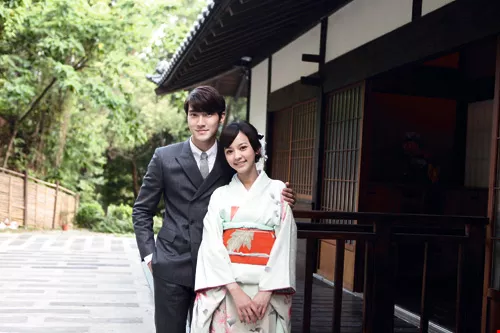
Based on a Japanese comic, starring members of the Korean pop group Super Junior, and made in Taiwan, Skip Beat is a model international TV production made for a multi-national audience. The photo shows the leads Choi Si Won and Ivy Chen.
"The idol-drama industry is something that gives people hope and inspires dreams," says Material Queen producer Frankie Chen, who previously had a string of successful series based on her close observation of the lives of the people around her. Her show Fated to Love You garnered the highest single rating ever for an idol drama in Taiwan, at 8.13 (the percentage of television owners tuned to that program) and she also had hits with Autumn's Concerto and My Queen. But she also recognized that "we can't always just be stuck in this cycle of seeking profit for every dollar spent," which is why she went to work with Next TV where, in an environment where there were fewer limitations on time or capital, she sought to raise the bar for Taiwan-made idol dramas. The result was Material Queen.
The series was filmed not only in Taiwan but also in Paris and Shanghai. In an effort to raise production values and generate buzz, Chen took the unprecedented step of hiring people like Patricia Field, the stylist of the US series Sex and the City, and Charles E. McCarry, the art director for Gossip Girl. She also spared no expense to outfit the male and female stars in brand-name fashions, accessories, and shoes. And the entire series was filmed using the latest gadgets from the worlds of feature films and advertising, to create an idol drama that was visually rich and of Blu-ray quality.
It was totally unanticipated that this high-budget series wouldn't strike a chord with the AV audience, and in fact there wasn't much of a commercial response. The ratings for the first run on CTS were less than 0.8, leaving both industry insiders and outside observers with their jaws hanging open in disbelief.
Looking back at the unexpectedly low ratings with "20/20 hindsight," commentators offered various interpretations. Some said the problem was with casting, that the 179-centimeter-tall Lynn Xiong of Hong Kong, who played the female lead, made male lead Vanness Wu "look short," and departed from the tradition that Taiwan audiences like their men tall and handsome and their women unthreatening. Others said that they shouldn't have broadcast the show on Thursday nights, when people who normally watch idol dramas are unlikely to be turning on the tube. (These shows mainly are slotted into Friday or Saturday night schedules.) Still others argued that the theme of choosing a husband based on material considerations just didn't sit right with the preference among Taiwan audiences for sentimental romances where true love conquers all.
Chen's own assessment was: "We were too far ahead of the curve!" The high technical quality of the production could not be brought out on television because the software is not advanced enough, making the images look cloudy. In addition, because of inexperience with shooting of scenes out of chronological order and problems with post-production, the series lacked coherence and continuity. "There was nothing wrong with the general direction, but we couldn't get our feet down in the right places."

Gliding across the courtyard, stepping into a dream of happiness. Producer Frankie Chen spent a lot of money to make Material Queen, even doing some of the filming in Paris, hoping to set a new standard for productions of "idol dramas" in Taiwan.
It's unfortunate that a series like Material Queen, made to such high technical specs, failed to get much of a response. Looking at the other Taiwan-made idol dramas recently on offer, you see pretty much the same pathetic results all around.
Take for example the drama Sunny Girl, a co-production involving personnel from Taiwan and mainland China, produced by GTV and shown first on TTV. Despite featuring the gorgeous pop idols Wu Chun and Rainie Yang, and going to all the effort of finding shooting locations in Okinawa, Shanghai, and Taiwan, the first run yielded only a rating of 0.78.
Next up came the series Love Recipe, produced in-house by CTV, an idol drama subsidized by the Council for Hakka Affairs. With Taiwan's rich cuisine serving as the central thematic axis, and featuring Kenji Wu and Lee Chia-ying as the male and female leads, its first run got an average rating of 0.77.
During this same period, the only real bright spot among idol dramas was Office Girls, a joint production of TTV and SETTV, about romance and career life among working women, which scored an audience of 3.58.
Though idol dramas keep coming off the production line with no sign of stopping, given the state that ratings are mired in, there should be no illusions-such programs are by no means all fun-and-games money spinners, and in fact locally made TV series look to be in dire straits.
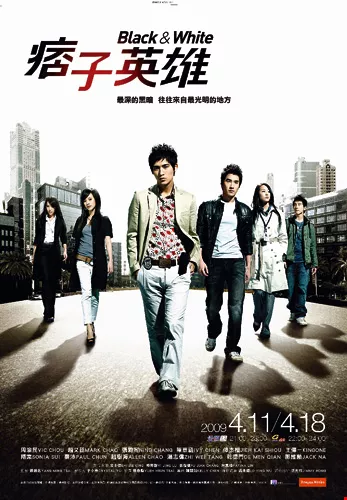
Taiwan makes about 50 "idol dramas" (each consisting of a number of episodes) per year, but given the small size of the market and the large number of channels, the average audience size per show is limited.
Twenty or 30 years ago, back in the day when there were only three broadcast channels in Taiwan (CTS, CTV, and TTV), ratings for Taiwan-made TV programs were in the 30s. There were even series, such as the historical dramas Empress Wu Zetian and Justice Pao, that hit the 50s or 60s! But today Taiwan-made serials are fighting for their very lives.
"These days the bottom line starts at 0.8, and if you can get to 2.0 that's already darn good," notes Fang Ko-jen, manager of the Planning Department at GTV. When things were going good, the combined ratings for the idol dramas at the Big Three could be in the teens, but now they're only half that. The fall in their ratings is related to the fact that there are now so many stations.
Jason Ho, director of the NCC's Broadcasting Contents Department, points out that when the laws allowing the founding of cable television stations went into effect in 1993, the number of channels sharply increased, and there are now a total of 98 firms in the satellite TV business, with 216 channels, the highest of any country in Asia.
As the number of channels has risen, the number of people served per channel has correspondingly declined. Ho does the math for us: With 200-plus channels serving a population of about 23 million, each channel serves an average of 110,000 people in Taiwan. In contrast, channels in Korea, Japan, and China serve at least 400-500,000 each.
The sharing out of the audience among so many channels affects ratings and, as a consequence, advertising revenues. Ho says that stations in China, Japan, and Korea can recover their investments in programs from the domestic audience alone, but in Taiwan a typical station pulls in only about NT$500 million a year total, about one-tenth of a station in Japan, one-third of one in Korea, and one-half of one in Hong Kong.
Kuan Chung-hsiang, an associate professor in the Department of Communication at National Chung Cheng University, adds that this "fragmentation" of the media market means that large numbers of channels are trying to get a bite of an advertising pie that is basically fixed in size. To make matters worse, the Internet has been cutting into companies' advertising budgets, and the volume of advertising going to TV has been declining, creating ever-more-ferocious competition.
With ratings in decline and profits falling, naturally production budgets have also been trimmed. Not surprisingly, TV companies have, after doing the bean counting, decided to go the cheaper route of buying foreign productions. And as TV stations have turned one after another to Korean and Japanese imports, demand for local productions has withered further.

Taiwan makes about 50 "idol dramas" (each consisting of a number of episodes) per year, but given the small size of the market and the large number of channels, the average audience size per show is limited.
The importation of foreign shows created a "comparison" effect. Kuan says that before competition arrived from other countries, Taiwan audiences lacked any basis for comparison, and were satisfied with cheap melodramas. After cable TV showed up, and Japanese TV series like Tokyo Love Story were introduced, people began to make comparisons and to develop new tastes and habits.
In fact, as early as 1982 a foreign-made program-the Hong Kong production Chu Liuxiang-had virtually emptied the streets it was so popular, and people even knew the Cantonese-language songs in it by heart.
In 1999, GTV set aside a specific segment of programming time specifically for series made in Korea, and they took off like a rocket, nurturing an audience for Korean programs that numbered over a million at its peak. In particular, the shows Dae Jang Geum and Full House, with shares of 6.35 and 6.12 respectively, hit levels that have never been equaled by other Korean dramas.
Fang Ko-jen recalls that the earliest of the successful series were, relatively speaking, isolated flashes of flame, while the real prairie fire started in June of 2009 when GTV broadcast Cruel Temptation. Despite the hackneyed story line-a woman mistreated by her mother-in-law, betrayed by her adulterous husband, and victimized by the vengeful former wife-and the fact that it had over 100 episodes, it still defeated Unique Flavor, the Taiwanese-language blockbuster from SETTV.
High ratings make for brilliant advertising revenues. Fang notes that this has particularly been the case for Korean series, because they are most popular among women from 20 to 49, who are the most important targets of advertisers. In contrast, historical dramas imported from mainland China, though also of good quality, draw mainly middle-aged to elderly males, and so aren't nearly as effective at drawing advertising dollars; inevitably they have become increasingly marginalized.
But the fast profits to be made from Korean shows didn't last long. More and more stations started bidding for Korean programming, and rising demand drove up the prices. Fang says that two years ago Korean shows were going for about US$3000 per episode, but now they are averaging about US$10,000 per episode, with the most desirable ones running as high as US$20,000.
The costs of Korean series rose, but the audience size stagnated, and as more and more channels ate into the market, naturally their ratings began to slide, as did their economic value. Some companies came back to where they started, and began seeking a lifeline through production of their own TV programming.

Taiwan makes about 50 "idol dramas" (each consisting of a number of episodes) per year, but given the small size of the market and the large number of channels, the average audience size per show is limited.
"The glory days of Korean TV shows are over," says Fang. She adds that GTV now has three channels, and while it still buys up Japanese, Korean, and mainland Chinese offerings, locally made programming is gradually increasing its share of airtime. Over the last two years the company has invested over NT$200 million per year in idol drama production, from four series per year at first to 12 or 13 series at present.
But it cannot be gainsaid that over the last two years it has been getting increasingly difficult to make idol dramas in Taiwan. The reason is that there has been a double drain, on talent and on money.
"Capital is the root problem," says Cindy Shyu, director of planning at the Public Television Service Foundation. The budgets for Korean productions are three to five times as large as those for Taiwan. In absolute terms, the NT$2 million spent per hour of programming in Taiwan is not bad at all, but by way of comparison, budgets for Korean shows run NT$8-9 million per hour.
Shyu says that KBS and MBC in Korea, both of which are "public" stations (mainly state funded but independently managed), both have some advertising revenue. The former, in fact, has total annual income of NT$47.6 billion. But the Public Television Service in Taiwan has only NT$1.4 billion which comes from the government and fundraising by the station. This is only enough to fund 40-60 hours of series-type programming. For example, PTS didn't have enough money to cover the costs of the critically acclaimed and popular series Black & White, and ended up having to sell off rebroadcast rights to make ends meet.
"PTV puts its emphasis on meaning, not profit," explains Shyu. Unlike commercial television stations, PTV's series are mostly realistic slice-of-life stories, or explore important local issues. Examples include one series about Typhoon Morakot, one called Gloomy Salad Days that was a conglomerate story based on the actual experiences of real young people, and one about protecting the natural environment around Kending.
The impossibility of increasing production budgets is linked to the loss of balance in the industrial structure. Jason Ho relates that 70.8% of Taiwan's AV audience forks out NT$500-600 per month for cable TV, but only about one third of that (NT$180-240) goes back to the program suppliers; the rest is pocketed by the system providers.
"When TV gets digitized and everyone is watching high-resolution content, then competition will resolve the problem of imbalances in the AV services supply chain," observes Ho. Only after digital set-top boxes have become widespread will it be possible to promote disaggregated fees, so that people will only pay for what they watch. And only then will the money go to the content providers and get back into budgets for production of programming.
Moreover, it is critical at this time to bring in new capital. Ho says that compared to neighboring Hong Kong, Japan, and Korea, Taiwan's market is very thin, discouraging the importation of capital. In the future the government will encourage corporations to provide more financial backing for making TV programs or televising sporting events. Moreover the government is actively studying the possibility of relaxing restrictions on advertising time quotas and on inserted advertising in programs.
"From the point of view of the cultural and creative industry, Taiwan has comparative advantages for the Chinese-language market," notes Ho. Among mainland China, Hong Kong, and Taiwan, we still have the highest level of creativity. So long as the capital comes in, and the production and marketing chain works more smoothly, there is still a lot of opportunity out there.
Besides a lack of capital, another problem plaguing Taiwan's AV industry is the outflow of talent.
"A concentration of human talent is the key requirement for innovation and creativity," says Fang Ko-jen. These days, people from the TV industry have either gone into making feature films or else relocated to mainland China to make TV programs. For example, among currently popular stars, Ming Dao and Joe Chen left for the mainland a while ago, and now Blue Lan, Mike He, and others want to follow suit. And the tech people are no different. These days if you want to make a TV series, you not only have a hard time finding actors, you can't find directors or planners either, and you have to reserve the time of scriptwriters well in advance if you want them working on your stuff.
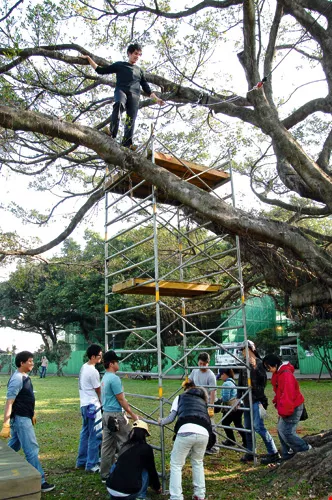
In the series PS Man, actor Blue Lan played a light-hearted ladies man, winning the hearts of many an idol-drama fan.
Given the shortage of capital, small market, and loss of talented people to mainland China, it would seem that joint Taiwan-mainland Chinese production would be the quickest and easiest solution.
In fact, as early as September of 2009, the GIO announced new regulations permitting joint production of TV series, making it possible for mainland producers to come and film in Taiwan. However, in an attempt to protect Taiwan's creative and technical people, the rules stipulate that only one-third of the people in the production team can come from mainland China, and moreover that post-production work must be done in Taiwan.
Since then, it has been possible to bring mainland capital into Taiwan and develop the mainland market for Taiwan productions. At a stroke Taiwan series shed the limitations previously imposed on them as "foreign programming," and have been able to grab the coveted 8:00 p.m. time slot. The best example is the series Love Keeps Going, made jointly by GTV and Zhejiang TV. The male and female leads, Mike He and Cyndi Wang, both from Taiwan, have enjoyed sharply increased name recognition in the mainland as a result.
Nonetheless, joint productions come with their own problems. Because the TV audience in Taiwan would find it hard to accept mainland actors and mainland accents, the only option is to give Taiwan actors top billing with the main supporting roles left to mainland performers. However, says Fang, as the mainland economy becomes ever more robust, what we may see in the future is mainlanders placing specific orders and Taiwan creating tailor-made series which will debut in the mainland.
Besides eyeing the mainland Chinese market, another new trend in idol dramas is to make multinational series featuring Korean stars and shaped for an Asia-wide audience.
Though famous lead players cannot guarantee high ratings, they can be decisive in getting your foot in the door of foreign markets. For example, GTV was able to sell its series Down With Love to Japan for US$20,000 per episode because the male lead was Jerry Yan, who is popular with housewives and middle-aged women in Japan. Recently two members of the Korean band Super Junior featured in a Taiwan series called Skip Beat, and another called Absolute Boyfriend starred Korean Koo Hye Sun as the female lead; both were therefore able to find buyers in Korea and Japan (where Korean pop culture is also very big). In fact, Skip Beat commanded US$50,000 per episode when sold to Japan.

Wu Chun and Rainie Yang played out a Prince Charming and Cinderella story in Sunny Girl, a story that conformed to all the expectations of the typical idol drama fan.
International cooperation can address the problem of Taiwan's market being too small, but it brings with it new worries.
Kuan Chung-hsiang says straight out that because Taiwan's market is so small, it is essential to target the Asian market as a whole. Nonetheless, he adds, when you take into account the tastes of the overseas market, you have to correspondingly reduce the share of local characteristics that are uniquely Taiwanese. Also, you have to avoid any political sensitivities and focus on pure entertainment and the lowest common denominator.
"AV production is not just an industry, it is also an expression of culture and lifestyles," stresses Kuan. Many countries use barriers to protect their home-made TV series, and it is quite common for states to have laws requiring that domestic productions get a minimum proportion of total air time. But those in the industry prefer to let the market decide-where there is demand, the proportion of locally made content will naturally rise. You could see this happening over the past summer, as many movie channels that had previously broadcast only foreign films switched over to Taiwan films.
"TV programs represent cultural power, and cultural power comes from economic power," says Fang Ko-jen. Everybody keeps their eyes on the leaders, following the trends whether in fashion, make-up, telecom products, or whatever. TV series are naturally no exception.
Jason Ho observes that lately most people have been focusing more on the film industry, but he says that we should not forget that TV series are more in tune with pop culture. "Japan and Korea don't have that many movies that come to Taiwan, but people come in contact with their TV series day in and day out." Ho says that cultural exports will have a definite impact in Chinese communities, and if Taiwan's television industry is well managed, it is not impossible that it can begin exporting once again.
"Enjoying the same language, ethnicity, and Confucian culture, Taiwan is well positioned to profit from Chinese culture. So long as the investment money is there, there will be a definite impact."
Times change. Taiwan-made television series once enjoyed the limelight, and the fad for Korean programs can't last forever. There's no reason to believe that audiences can't be won back, or that Taiwan's idol dramas will not rise again. With time, this industry of dreams and illusions will certainly once again hit the prime time.

(left) The series The Fierce Wife, a realistic portrayal of a woman faced with a cheating husband, was nominated for seven Golden Bell awards. It was also a successful series in terms of both ratings and street buzz.
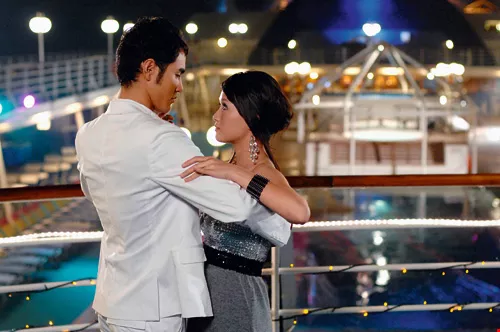
(center) Fated to Love You set records for ratings for an idol drama, making a superstar out of male lead Ethan Ruan.
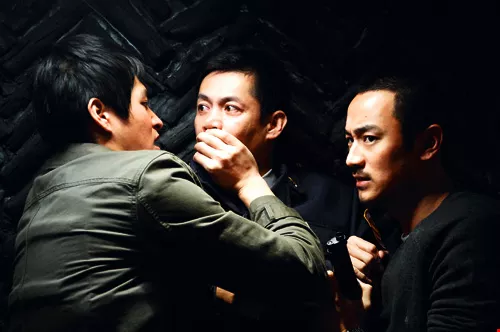
(right) Police et Vous is one of the few idol dramas to be a police story.
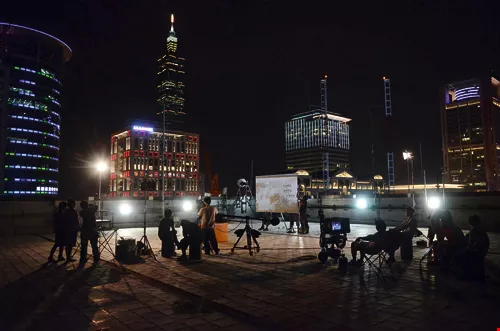
The series Office Girls, depicting the working lives and love lives of young city women, took its nighttime backdrops from Taipei's Xinyi Planned District.
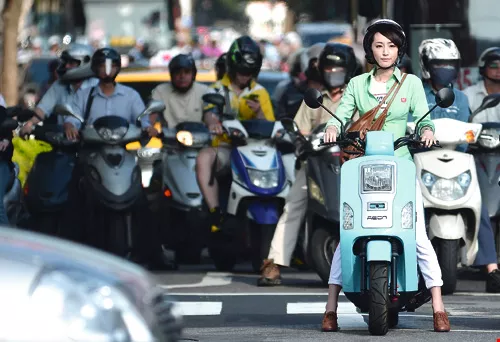
"I look forward to going to work more than anything else in the day." Alice Ko plays an office girl who has worked out a whole philosophy of survival in the working world.
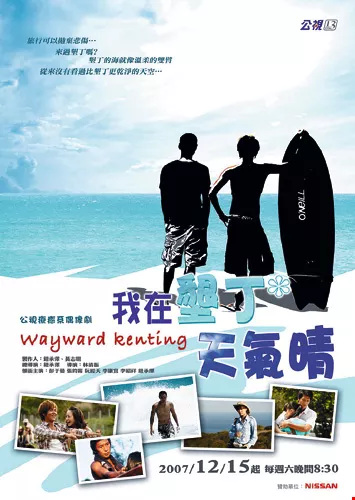
Taiwan makes about 50 "idol dramas" (each consisting of a number of episodes) per year, but given the small size of the market and the large number of channels, the average audience size per show is limited.


