Telling Their Own Tales—The National Indigenous Language Drama Competition
Kobe Chen / photos Chin Hung-hao / tr. by Geof Aberhart
May 2012
Taiwan’s biggest hit movie of 2011, Seediq Bale, brought to the big screen the culture of the Seediq people, and the use of the Seediq language was a major element of that. After all, the very idea of the courageous leader Mona Rudao calling his tribesmen to arms in Mandarin would be nothing short of laughable!
Back in the real world, Taiwan’s 14 officially recognized Aboriginal peoples speak some 42 languages and dialects, with 24 of them listed by UNESCO as endangered or vulnerable. One of the newer, more experimental efforts to keep Taiwan’s Aboriginal cultures and languages alive is the use of theater.
On the afternoon of March 3, some 700-plus competitors and attendees from as far afield as Pingtung, Kaohsiung, and Hualien made their way to the New Taipei City Government Multifunctional Hall for a contest of dramatic skill between 36 teams.
Organized by the Council of Indigenous Peoples, the theme of the Third National Indigenous Language Drama Competition was “concentric wishes,” representing the hope that Aboriginal culture and spirit would ripple outward from these performances.

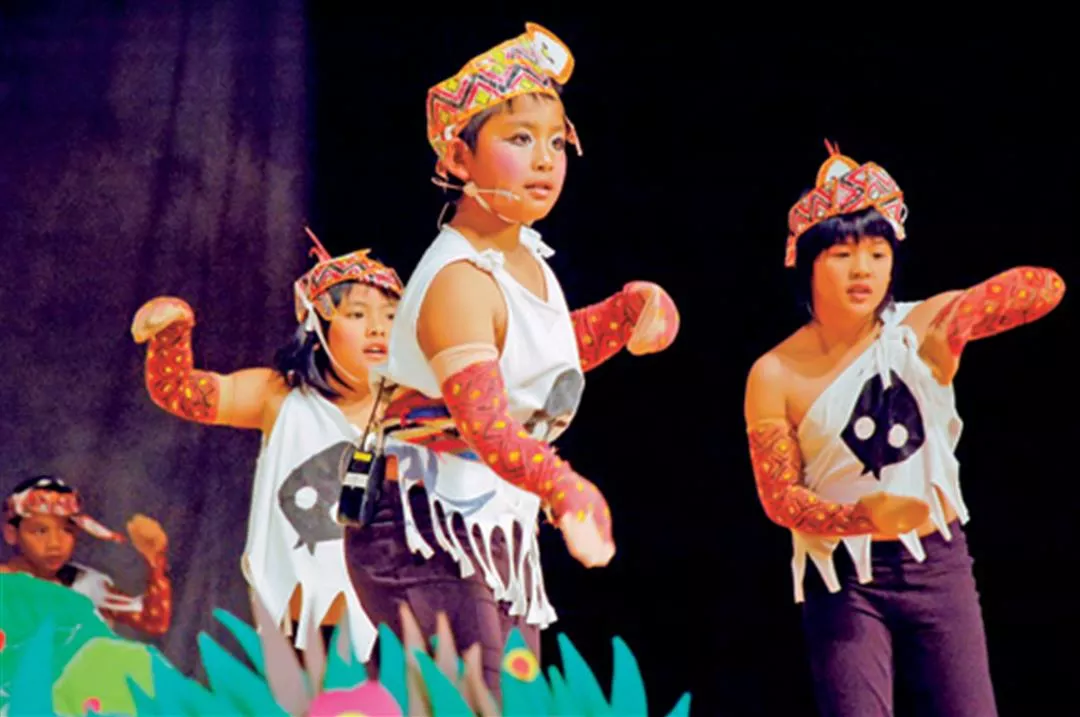
The troupe from Taitung’s Chulai Elementary School dressed up like snakes using socks and headgear, and through lively motions they brought to life the Bunun legend of the hundred-pace viper.
The scripts for the performances were all original works penned by the participants, and many of them were adaptations of traditional tribal legends, with others depictions of modern-day Aboriginal life. As well as giving the participants a chance to tell their own stories in their own languages, the competition will also serve as a source of teaching resources, with the plays being compiled by the CIP into book form.
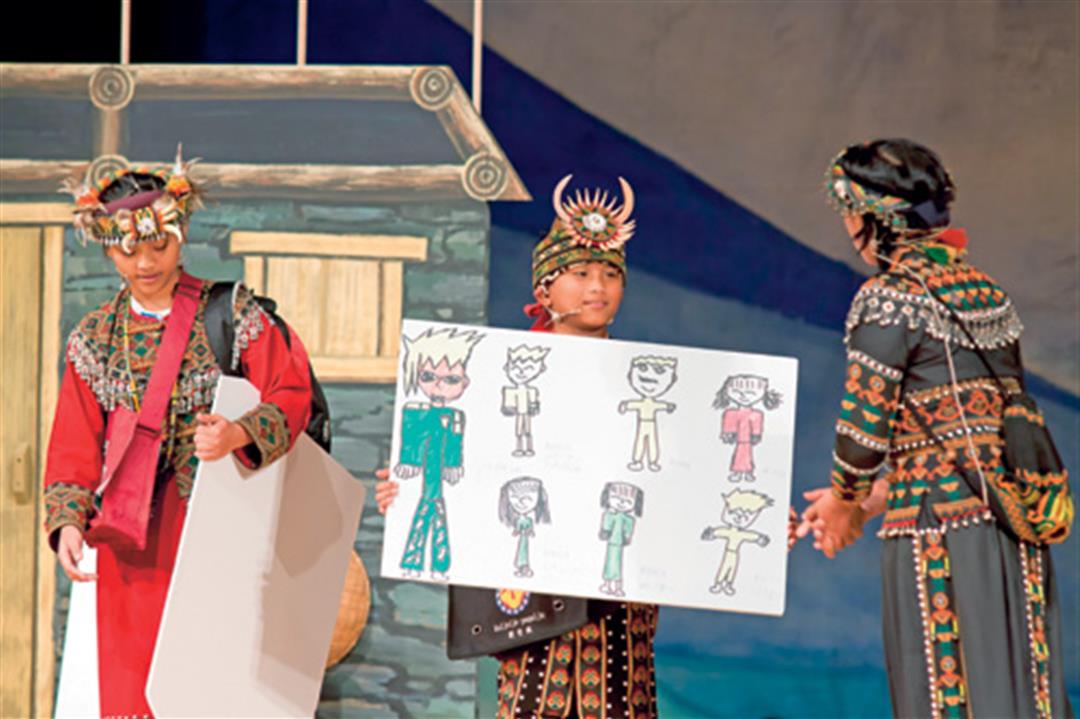
The group Paqalju used their unusual background to good effect by employing multiple Aboriginal languages in their performance. Hailing from a Paiwan “language nest” (from the Maori kohanga reo, a preschool education model using total immersion in native languages) in New Taipei City’s Sanxia District, their “father” is Rukai and their “mother” is Paiwan, and the group’s play was a depiction of lifestyles from various tribes.
Their play tells the story of three children attending an Aboriginal Hogwarts of sorts, experiencing tribal life with their Amis friends and hunting wild boar with their Atayal friends. The performance itself also incorporates elements of rap and beat-boxing.
This time around, the competition enlisted the help of renowned children’s theater troupe IfKids, making the most of the troupe’s rich experience in planning and promotion. On the first day of the competition, “An Evening with Theater Stars” was held, with performances that entertained and enraptured the audience.
“They’re amazing! If I had to do a theatrical performance in Paiwan like that I’d be at a total loss. I can hardly remember my own lyrics, never mind trying to memorize lines!” So says Resres Livulivuwan, winner of Best Singing Performance in the Traditional Music Category of the 15th Golden Melody Awards, and current lead singer for RS Legend and Miling’an Musical Theater.

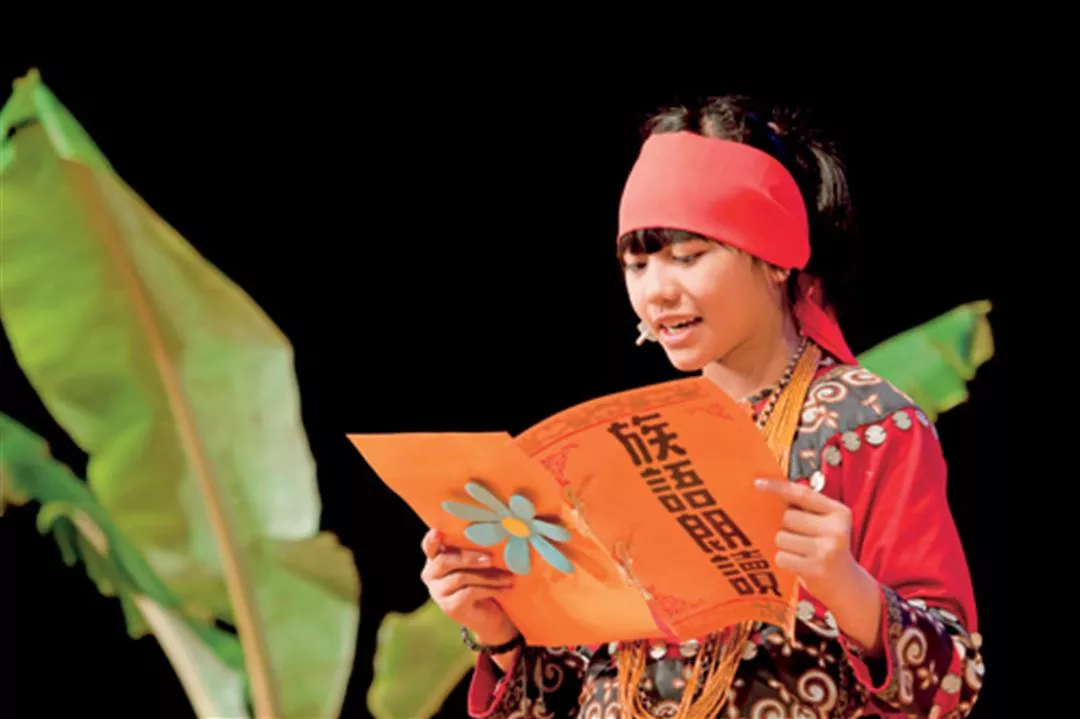
Through this competition, Aboriginal children get a chance to improve their native-language skills as well as developing the confidence to perform in front of crowds.
Everything about the performances was the genuine article, from the linguistic and performance skills of the participants to the sets and props they used. Backstage was a chaotic scene, with hunting rifles, bows, and other props—even boars!—stuffed into the space.
After two days of competition, Miaoli’s Lokahta Cultural Association took the top prize in the family section with “A Road Like a Tiger’s Mouth.” Their humorous depiction of modern day life and the Atayal language’s part in it, along with their intriguing performance style, earned rave reviews from the judges.
The Bunun Spirit Troupe, from Taitung’s Chulai Elementary School, took the group prize with “Friend of the Bunun, the Hundred-Pace Viper.” Wearing socks painted up like the eponymous snake on their arms, the children of the troupe lined up and wound their way around the stage, their lively dancing bringing to life the legend of how the hundred-pace viper came to hold a place of honor in Bunun culture.
Both of the winning groups’ pieces pointed thematically toward the push to keep Aboriginal languages alive by integrating traditional culture into modern life.
“In the past, IfKids focused on just doing what we could, but now we’re more focused on doing what we think is worthwhile,” says IfKids chief planner Zhou Zhao’an. Now that the troupe has grown and found its feet, it finally has the power to promote some important principles, including the preservation of Aboriginal languages through theater.
“Aboriginal cultures are minority ones in Taiwan, and if we don’t value them, they could easily just disappear,” says Zhou. “And once peoples lose their languages, they also lose their roots.”

The young participants in the Council of Indigenous People’s National Indigenous Language Drama Competition come from across Taiwan. Clad in colorful costumes, they eagerly await their turn on stage, ready to show off their long-rehearsed performances.
Cultural preservation is a pressing concern, and if we can’t help Aboriginal languages expand beyond the tribal villages, how can we get new generations speaking them in the cities?
It is this integration of old and new that is the greatest challenge for those working to preserve Aboriginal languages, especially with many of the languages falling behind the times, not developing new terms for new things, and becoming less practically useful.
“I can’t even use Paiwan to explain to my own mother what it is that I do,” says Resres. And any language that can’t be used in modern life is destined for the scrapheap of history.
According to the CIP, of the 700 people of Thao ethnicity, only some 20 can actually speak and understand the language fluently. And as those people grow old and pass on, that number edges ever closer to zero.
The mutual unintelligibility of the various Aboriginal languages is another challenge for the promoters of linguistic preservation, and can make a unified movement difficult. For example, says Resres, in Paiwan the word “bubu” means “ancestry,” while in Atayal it means “breasts.” “So when we’re talking about our ancestors, our Atayal friends can’t help but chuckle.”
While many schools have started courses in Aboriginal languages, few parents have any interest in having their children learn them, considering it a waste of effort because knowing an Aboriginal language won’t be a help to their futures. This, in turn, influences the children’s attitudes. And so just as the problem starts with parents, so too does the solution.
Nonagenarian Hong Liu, of the Bunun tribe, says that she is the last traditional shaman in her family line. Despite her age, she made the long trip north from Kaohsiung to perform, as well as having hand-stitched the costumes for herself, her children, and her grandchildren. She even demonstrated how to pull a bow to her grandchildren during rehearsals! One of Ms. Hong’s granddaughters says that at home, her mother and grandmother both speak Bunun, and so she naturally picked up the language. Studying in the Aboriginal arts class at school has made her all the more eager to take the Indigenous Languages Proficiency Test in the future.
Seediq culture specialist Dakis Pawan documented the making of Seediq Bale and the teaching of the movie’s lines to the cast in his book Truth Bale. He writes that while many Aboriginal children today are unable and unwilling to speak their tribal languages, there was one ray of light: that some of the film’s cast began developing an interest in learning about their own languages and writing systems through their experience on Seediq Bale.
“It’s a start. The film has inspired a lot of young people to value their own culture and origins more,” says Resres Livulivuwan.
Now, while the songs of the ancestors continue to be sung, the stories of the younger generation are just beginning.