A Cosmic Drifter Challenges Microsoft--Chu Bong-foo and Chinese Computing
Teng Sue-feng / photos Jimmy Lin / tr. by Robert Taylor
June 2002


Quirky computer genius Chu Bong-foo has a head full of oddball ideas, and his own way of doing things. More than 20 years ago, his invention of the "ChangJie" Chinese character input system came as a boon to countless Chinese computer users. Since then he has grappled with all kinds of thorny problems to make Chinese-language computing a reality. He pursues the most advanced computer research, but his heart is wedded to the mission of transmitting Chinese culture. Sixty-five-year-old Chu Bong-foo has never given up working for the computerization of Chinese. Amid a tide of Westernization accompanying the influx of technology, this has been a lonely and difficult endeavor. But Chu has always continued his revolutionary work, oblivious to praise or criticism from others.
In early May, just as the Business Software Alliance and the Ministry of Justice were beginning a crackdown on pirated software, this newspaper advertisement attracted computer users' attention: "Scared of getting caught using illegal software? Stop worrying with Chinese 2000-your best solution!"
The advert stressed that the "Chinese 2000" operating system is Linux-based, highly stable, and compatible with Microsoft's office software, and that one can use the included modem dial-up or broadband functions to go online and exchange instant messages or email with Microsoft Windows users. Also, all the system commands are in Chinese. An interactive installation program guides the user through the entire installation process, making it quick and easy. An even bigger selling point is that a copy of Chinese 2000 costs only US$50, just a fourteenth of the combined price of US$736 for a Microsoft operating system and office software suite.
Chinese 2000 is published by the Culturecom group, of Hong Kong. The advertising campaign is evidently pitched against Microsoft, and plays on computer users' frustration at high software prices. Behind the scenes, the development of Chinese 2000 is led by Chu Bong-foo, "the father of Chinese computing."
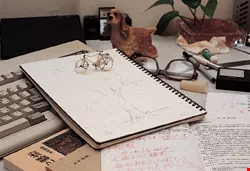
Chu Bong-foo has a highly individual approach to everything. Several times in his life he has withdrawn from the commercial fray to concentrate on research. Pictured here are early notebooks from his laboratory. (photo by Cheng Yuan-ching)
Taking on Microsoft
Chu Bong-foo describes himself as "a revolutionary." In the 24 years since he invented the "ChangJie" keyboard input method for Chinese characters in 1978, he has always continued to lead his students into new areas of research, to develop such products as Chinese-language computing platforms, central processing units, and e-textbooks, and attempt all kinds of "mission impossible."
In early March, Chu Bong-foo came from Macao to Taiwan to discuss the production of e-book readers with manufacturers, to launch his new book Cosmic Drifter, and to give lectures at National Taiwan University and National Taiwan Normal University on the "e-textbook" and "the theory and practice of 'genetic' analysis of Chinese characters."
A head of short, gray hair, a casual jacket, a pair of kung fu shoes. Chu Bong-foo is a frequent traveler between Macao, Hong Kong, Taiwan and mainland China. When he opens his mouth, the words flow like a great river, and his eyes sparkle with wit and determination behind his broad-rimmed glasses. "I'm a thorn in the side of people in lots of different fields, because there are so many things I'm not satisfied with. But don't get the idea that I've been pushed around a lot. My philosophy in life is to be a fighter. The more I'm attacked, the feistier I get," he said at his book launching.
Chu Bong-foo is not afraid to admit that his defeat when he took on Microsoft ten years ago caused him to throw in the towel for a while. In 1991, Microsoft was just preparing to enter the Taiwanese market with a Chinese version of its Windows operating system. Chu, who was then aged 55, was very displeased by Microsoft's attempt to monopolize the entire market for Chinese operating systems, working environments and application suites, and its refusal to publish the details of its Chinese Windows interface. He changed directions to help the Institute for Information Industry create a Chinese system to run on Windows 3.0, but unexpectedly got caught up in a bitter battle.
A powerful advertising campaign by Microsoft overshadowed Chu Bong-foo's product ads, and the following year, after Microsoft had successfully captured the market with Windows 3.1, Chu retreated into reclusion to concentrate on developing his "genetic" analysis of Chinese characters-rather like Confucius, who, when he was unable to convince rulers of the wisdom of his views, "took to a raft and floated on the sea." But although Chu was out of the limelight he was far from idle, and with some students led a life in the style of a traditional Chinese academy, variously staying in Hsintien in Taipei County, at the foot of Mt. Tulan in Taitung County, and at Yangmei in Taoyuan County.
In March 1999, Cheung Wai Tung, chairman of Culturecom Holdings of Hong Kong, sought out Chu Bong-foo, and the two hit it off immediately with their shared concept of "using technology to advance culture." Chu accepted an invitation to join Culturecom as a vice president, and moved to Macao with his students. Early last year when the price of Culturecom shares leapt from HK$0.48 to HK$1.20, Chu, who has a 10% shareholding in the company, found that his net worth had rocketed to some HK$100 million, at least on paper. After this he had more resources available with which to fight his good fight, and his research achievements began to fall into place.
"A Hong Kong reporter once asked me whether my assault on Microsoft wasn't like David taking on Goliath. I told him I never said I wanted to bring down Microsoft, but can't I oppose them? Bill Gates knows I oppose him. Gates' response was, 'Lots of people are against me, but he won't get anywhere any time soon.'"
"Ten years ago in Taiwan I lost out big time, but that doesn't mean that from then on Microsoft has been invincible." Chu points out that at the end of last year when the Beijing City government awarded a software procurement contract, Microsoft's US$29 billion bid lost out to a Linux-based offering from a consortium of Culturecom and six other software companies, priced at US$7 billion. After this first success, if mainland China succeeds in resisting Microsoft across the board, European countries will also join in.
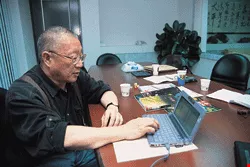
In March 2002, Chu Bong-foo came to Taiwan from Macao. As well as promoting his new book Cosmic Drifter, he also presented some of the fruits of his research.
Goodbye to bookbags
After many years out of the limelight, Chu Bong-foo has once again entered the fray with the fruits of his research. The first element of his strategy for Chinese information engineering to be launched is an "electronic book" reader.
In the broad sense, an electronic book, or e-book, means published content that is stored in the form of digital data on any kind of electronic storage media, such as a hard disk, floppy disk, optical disk or IC card, and transmitted through a data network to the user's digital reading equipment, such as a PC, notebook, PDA or even a mobile phone.
The first generation e-book reader developed by Chu Bong-foo's team is called "Culturecom eBook v. 1.0." At present it has only basic reading functions, weighs 350 grams, and is the size of a 16-mo format book. It includes a Chinese-language CPU, running at a speed of over 40 MHz. The display screen is a special "surface-stabilized, cholesteric-texture liquid-crystal display" (SSTC-LCD), which retains the last page image even when the power is turned off. This means that electric current is only needed when turning the page, so the unit uses very little power, and can run through over 10,000 page turns on two AA batteries. This is equivalent to two months' continuous reading.
The price of the e-book reader can be expected to be less than RMB800. The reason for this low price is that it uses a Chinese-enabled CPU developed by Chu Bong-foo's own team, that costs only a third as much as similar products. The CPU chip includes an embedded Chinese character generator that allows the device to display 32,000 different simplified- and complex-form Chinese characters. The memory is large enough to contain 40 of Jin Yong's martial arts novels.
In April 2001, Culturecom and mainland China's People's Education Press (PEP), which is under the control of the PRC education ministry, announced that they were launching a joint venture to set up Renwen E-Textbook Technology Company. Their aim is to develop the mainland's primary and secondary school textbook market, which serves a student population numbering in the hundreds of millions. PEP will be responsible for course planning and content, while Culturecom will provide support with e-book technology. The joint venture partners plan to produce 200 million e-book readers within five years. This autumn they will initially supply a million of the devices to first-year senior high school students. The trial units will be manufactured by the Taiwanese listed company Chen Uei Precision Industry Company.
In mainland China, an average of RMB100 is spent on textbooks per student each semester, with something like 100 million books being printed. This not only consumes a lot of timber, but also produces pollution. To make e-book readers you don't have to cut down trees, and they can be reused. They can be loaded with several textbooks at the beginning of each term, and new teaching materials can be added according to learning needs, by downloading from the Internet. The saving in printed books makes the devices extremely environmentally friendly.
"The product we're supplying at the moment is user-friendly but rather utilitarian," says Chu Bong-foo. He says they plan to use polymer materials to reduce the thickness of an e-book reader to that of a sheet of paper, so that users can feel as at ease with them as with conventional books; they will also be solar powered. He predicts that these ideals can be realized in six to seven years.
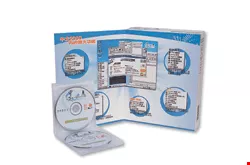
The e-book reader developed by Chu and his team is a low-power, low-cost, user-friendly device. One pair of batteries will last long enough to read 200 e-books.
Technology needs culture
In fact, the e-book is only one small step in the computerization of Chinese. Chu Bong-foo's groundbreaking inventions are all intended to prove that technology does not mean the destruction of Chinese culture. "Of all the ancient civilizations, Chinese culture is the last to have felt the impact of alphabetic writing systems. Only Chinese characters still retain their pictographic origins, and record the Chinese way of thinking," he says.
For this reason, he has spent decades assiduously researching the "genes" of Chinese characters, to analyze the basic structure of Chinese writing on the basis of six essential factors: the characters' constituent elements; the sequence of those elements; the shapes of the strokes and stroke combinations that make up the characters; recognition features; sound (in those characters with a phonetic element); and meaning. Using these factors, Chu hopes to make computers "understand" the concepts underlying the Chinese writing system. "Developing information technology without considering culture is putting the cart before the horse, because culture and content are the soul of the information industry," he says.
Chu Bong-foo is constantly developing new tools based on Chinese character "genes." His big projects include Chinese 2000, which he believes will be better than Microsoft operating systems, a Chinese-enabled central processing unit to replace Intel CPUs, e-book readers intended to change human reading habits, and a multimedia university.
One of the greatest of Chu's projects is a plan to develop an information network for mainland China's huge population of poor farmers. His idea is to get farmers to wear electronic watches with voice recognition systems and visual displays, with which they will be able to send each other messages by microwave, and which will even be able to measure their blood pressure and pulse, to let them know the state of their health. But more importantly, through this network farmers will be able access such information as where best to buy fertilizer, where to sell their produce, and how to borrow money, to allow them to sell their produce effectively. After the commercial network is established, educational functions can also be added, so that rural children need not rush into the cities, but can receive education over the network at his "multimedia university."
Seeing the many surprising sparks that fly out of Chu Bong-foo's brain, people often urge him to quickly launch products on the market. For instance, he has developed a "fully automatic three-dimensional animation production system," with which one can design a large number of characters, roles, costumes, props and backgrounds to build a complete "virtual reality database," and then define program parameters to control animation, sound, lighting, "camera" movements and editing. When this is completed, the author need only input the shooting script and the system will automatically generate the 3-D animation. With this software, an entire animated movie can be made in a month.
But, says Chu, "When you develop a technology, you shouldn't turn it into a product until you have assessed how it will benefit society. What if people used it to make violent or pornographic films? I don't want to create something that is harmful to society." For this reason, he has firmly resisted pressure to publish his software for fortune telling from the Book of Changes, and has so far only used it in creating his own science-fiction novel Cosmic Drifter.
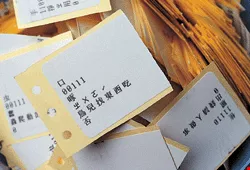
Chu Bong-foo has a highly individual approach to everything. Several times in his life he has withdrawn from the commercial fray to concentrate on research. Pictured here are early notebooks from his laboratory. (photo by Cheng Yuan-ching)
The Li Ao of technology?
Although Chu Bong-foo has achieved fame for information technology, and has carved out his own patch in the field, his ultimate concern is for the greater issues of culture and which way humankind should go.
Chu Bong-foo saw the premiere of 2001: A Space Odyssey at the Chinese Theater in Los Angeles, and the film inspires his imagination to this day. This is why, 30 years later, he has written a science-fiction novel himself. Last year, in six months of concentrated effort, he completed the 12-volume sci-fi novel Cosmic Drifter.
The novel, which combines science fiction, tales of immortals and kung fu fighters, and fable, has the structure of a traditional Chinese episodic novel, with each chapter headed by a line of seven-character verse to indicate the main points of the plot.
In the novel, humans have long since created intelligent computers, the Earth is in the complete control of a cosmic computer alliance, all material needs are met, the genetic codes of all organisms have been fully decoded, the human dream of eternal youth has been realized, and humans can acquire all kinds of knowledge at any time through the network communication systems that they carry with them.
To provide humans with work and entertainment, the computer authorities have created a high-grade virtual reality system-the "dream maker." People need no longer be disappointed in love, for they can have a romance with the person of their dreams, or even with somebody tailor-made according to their wishes. They can also choose at will the plots of their fantasies and the roles they will play in them. There is even a "forgetting device" with which they can erase memories and start everything afresh. The biggest vexation for people living in this new age is how to while away the endless time at their disposal.
Chu Bong-foo says he first conceived Cosmic Drifter in 1998. The ideas came from his previously published Nine Essays On Intelligence, in which he discusses thought, human nature and value in terms of energy conversion, the formation of matter, the nature of time and space, and the evolution of the universe. But the essays' content was dry and dull, and nobody understood it. Therefore he wanted to turn his theories into a popular novel that ordinary people would understand.
Before beginning to write, he used the Book of Changes to predict the major events of the next 50 years, which he then took as the "factual" backdrop against which to let the plot develop naturally. He also used the Chinese language systems he had developed himself to index the background and content of what he wrote as he went along, to maintain consistency. He wrote the novel in one stretch, churning out around 10,000 characters a day. Hence although the book was not completed until three or four years after he had the idea, the actual time he spent writing it was only six months.
"Writing is not a question of inspiration, but of whether you have sufficient information, and whether your will to express yourself is strong enough. I want to tell everybody my great insights into human life, so that people who are suffering no longer have to suffer." He says jokingly that he only has to think of who has wronged him and whom he has wronged, to get "angry enough to write."
"This book is sure to last, but what I mean by lasting is not how well it does today, but whether it is still around ten years from now," says Chu Bong-foo with boundless confidence.
Whatever the occasion, Chu says what he thinks, criticizing education, criticizing technology, criticizing culture-criticizing everything. His tone is overbearing, and once he gets going he can often rant for two hours at a stretch. This is why he has been called the "Li Ao of the technological world," although he himself takes great exception to this description.
"Li Ao lays into everyone, but I only have a go at Westerners, not Chinese. The people I have the least time for are scientists and technologists, because they so often have an overrated opinion of themselves based on their skills in their particular specialism. But what's the use of technology without culture? If one day this world is destroyed, it will all be the fault of technology," he says.
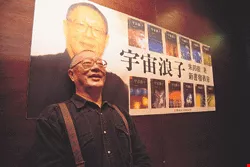
Chu Bong-foo, who has been deeply influenced by the fantasy novels of Li Shoumin, seems like a knight-errant of old, caring nothing for fame or fortune, but fighting to realize his ideals.
Wealth and rank an illusion
"What people admire most about Mr. Chu is how he allows others to use all the results of his research free of charge," says Lin Tsai-chueh, chief editor at Linking Publishing Company, the Taiwan publishers of Cosmic Drifter. Lin recounts that three years ago, Chu Bong-foo invited Taiwan's publishing world to join him in setting up the "Han-Culture-Infor Union," in the hope that all Chinese-language publications could be made available online. He got an enthusiastic response from publishers such as Yuan Liou, Locus, Senseio, Crown Culture, Cite and San Min. They have formed an alliance and plan to set up a portal web site through which Internet users will be able to purchase and download Chinese-language e-books.
"He is the leader who integrates the whole blueprint, and I work to his blueprint." So says Kuo Hsing-yi, CEO of Wenhsin Information Company, who after seeing media reports about Chu Bong-foo's "crazy" cultural infrastructure project 11 years ago, has followed him to this day.
Chu's revolutionary mission is a heavy burden. While some people see him as a peerless genius, others regard him as a babbling fool. "I'm sure I'll go down in history, so I don't give a hoot what other people think," he says.
Chu comes from an illustrious background. His father was once governor of Hubei Province, and after coming to Taiwan was secretary-general of the Planning Commission for the Recovery of Mainland China. His father's principled and incorruptible style deeply influenced the character of Chu Bong-foo, who cares nothing for money. But Chu also has a rebellious streak that put him at loggerheads with his father, with the result that he wandered far into distant lands.
After graduating from the Taiwan Provincial College of Agriculture (now National Chunghsing University) in Taichung, Chu Bong-foo exiled himself for a decade to Brazil, a country he had previously known nothing about. There he constantly searched for a direction in life, until he began working for a publishing company, and realized the efficiency of Western alphabetic writing systems that allowed a book to be prepared for publication in as little as one day. From then on he was determined to computerize the Chinese language, so that knowledge in Chinese could be disseminated just as quickly.
At age 37, Chu Bong-foo first got involved in research into Chinese indexing systems, and at age 42 he had his first contact with computers, and spent a month studying programming, with the purpose of applying his previously published "form and meaning" character look-up method to computerized characters. As a result, he created the ChangJie character input method.
At age 43, using the concept of breaking Chinese characters down into their constituent elements that underlies the ChangJie input method, he devised a "vector glyph generation device," which he used to make a Chinese-language computer. The next year, in collaboration with the computer company Acer he launched Taiwan's first commercial Chinese-language computer, named Tien Lung. This dispelled the myth that the Chinese language could not be computerized. Since then, Chu has been engrossed in research into Chinese characters, and he is also working to raise the educational level of poor people, and to create Chinese-language information engineering. Whatever else one may say of him, the ChangJie input method that he developed has left an indelible mark on Chinese computer keyboards.
"I'm an 'outsider' who is always divorced from reality. My life has been a rollercoaster ride, and now that my sunset is approaching, I just want to harvest the fruits of my labors," he says.
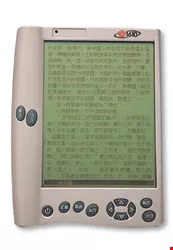
The e-book reader developed by Chu and his team is a low-power, low-cost, user-friendly device. One pair of batteries will last long enough to read 200 e-books.


@List.jpg?w=522&h=410&mode=crop&format=webp&quality=80)


