Trainspotters with a Mission--The Railway Cultural Society
Claire Liu / photos Pu Hua-chih / tr. by Robert Taylor
December 1996


Recently, an exhibition of railway memorabilia at the Shin Kong Mitsukoshi department store awoke old memories in many people. The exhibition was organized by the Railway Cultural Society-a group of young men only 20 to 30 years old with a passion for trains and the desire to introduce more people to their enchantment, so that they too will care about Taiwan's railways, which are now over a century old.
Why are these young people so fond of trains? And how did they become the "guardian angels" of Taiwan's railway culture?
31 October 1996 was the 30th birthday of Taiwan's "Kuanghua" class trains, and the Railway Cultural Society (RCS) put on an exquisite birthday party for them.
On this day 30 years ago, to honor the 80th birthday of then-president Chiang Kai-shek, the Kuanghua diesel multiple unit (DMU) express trains made their proud debut on Taiwan's railways. As the fastest trains running in western Taiwan, they cut the journey between Taipei and Kaohsiung to only 4 hours 40 minutes.
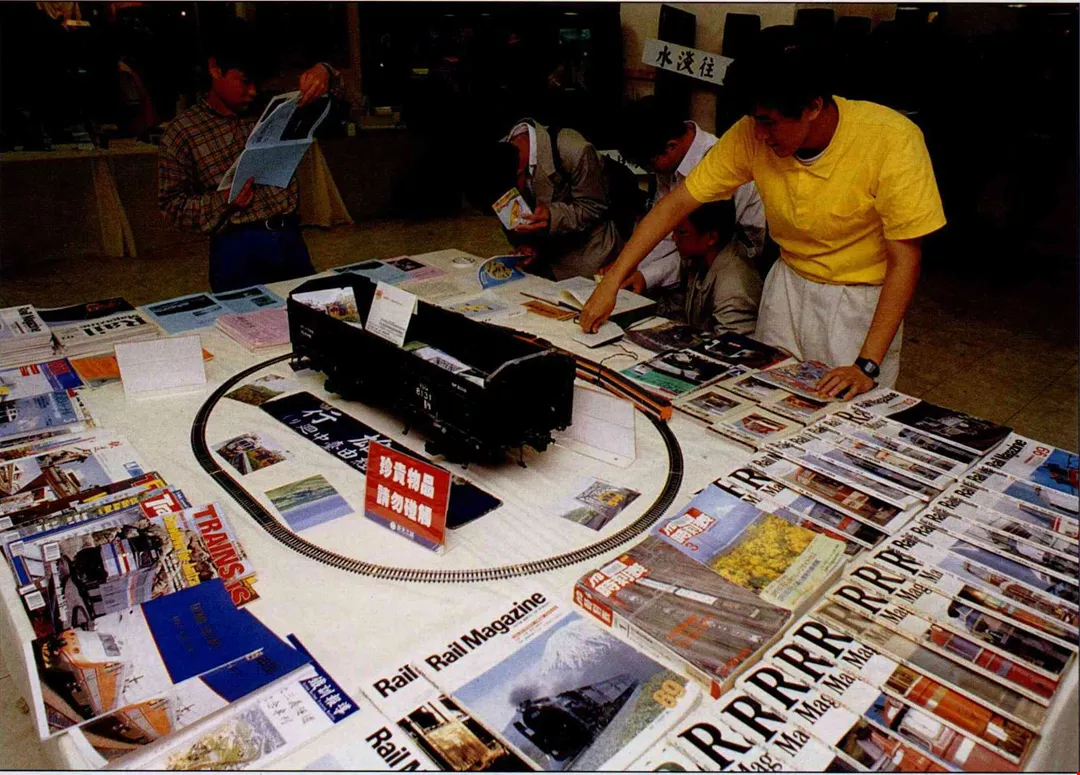
At the railway exhibition in the Shin Kong Mitsukoshi department store, besides the model trains, old photographs and so on, railway magazines from around the world collected by members of the Railway Cultural Society also attracted plenty of attention.
A 30-year-old retiree back in action
Following the launch of the Chukuang and then the Tsuchiang services, the Kuang-hua trains in western Taiwan were relegated to providing local services, and in June of this year they were all transferred to the East Taiwan line. But for their 30th birthday the RCS invited one of them back to its old stamping ground to once again rush along the tracks of the West Taiwan line, hoping that it would reawaken people's feelings for the railways.
This nostalgic journey attracted many members of the public. There were grandmas and granddads reliving old dreams hand in hand, and whole families picnicking on the train. Chen Te-pei, the current director of the Taiwan Railway Administration (TRA), was a special guest on the trip, for 30 years ago he was the first chief conductor of a Kuanghua class train.
One mother said she had come mainly to give her son a taste of "riding in an old-time train like the ones mummy used to ride in." The plump little lad at her side piped up to say that the train sways about "just like the MRT."
Though 30 years old, the train did not let its passengers down. It still sped along at a lively tilt with great gusts of wind blowing in through the wide-open windows. But its old diesel motors clanked and clattered deafeningly all the way.
Inside the carriages, a crowd of young men ran back and forth, not only acting the part of stewards serving snacks and bringing paper towels as in the old days on the Kuanghua trains, but also speaking up to explain the trains' history to the passengers. These young people's average age is about the same as the Kuanghua DMUs, but all the same they can reel off all kinds of stories of the old days, and they know Taiwan's railway history like the backs of their hands. These are the members of the RCS.
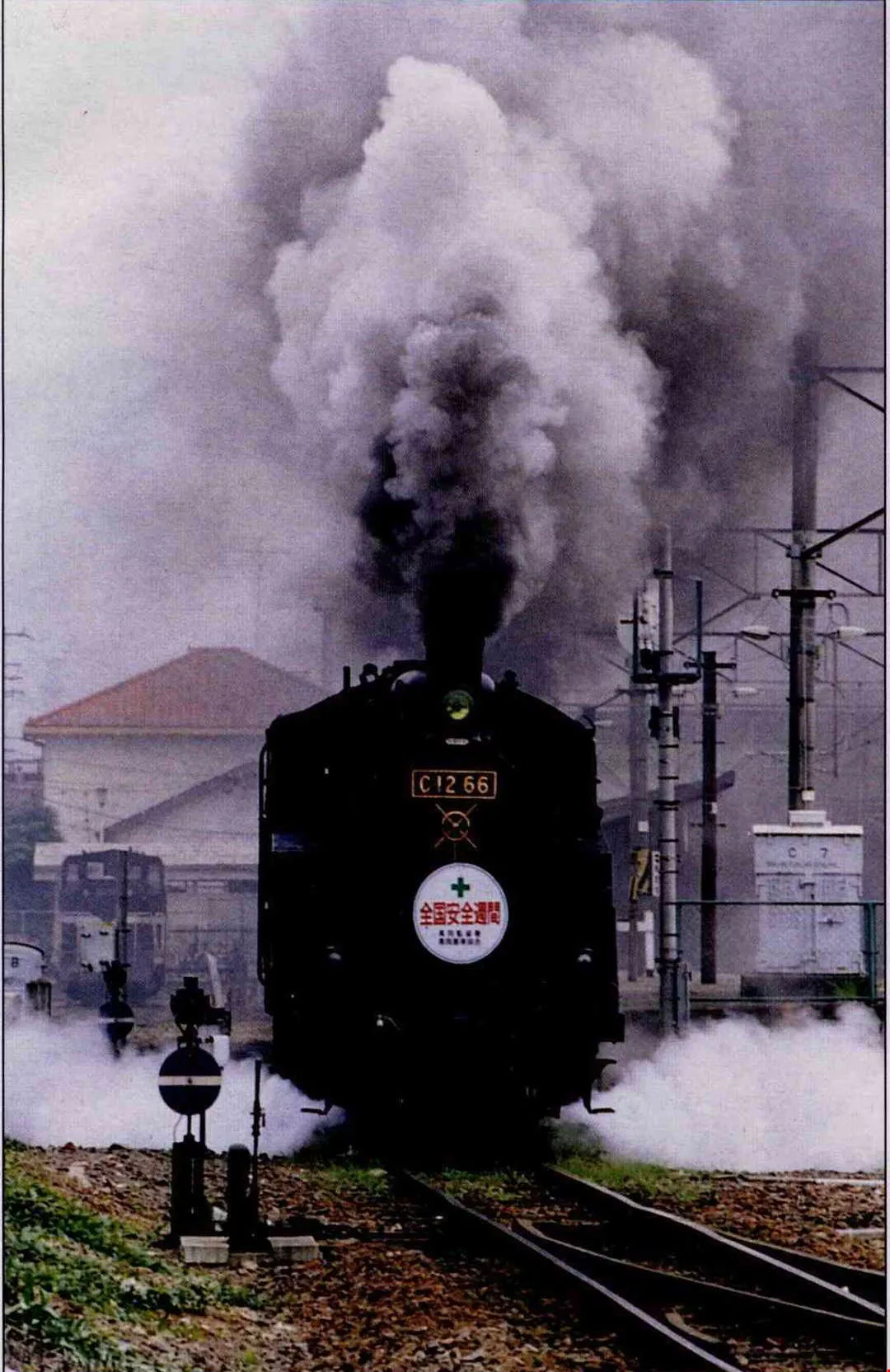
Preservation of working trains is the most ideal way of displaying railway hardware that puffing smoke reawakens so many old memories! Pictured here is a steam train on Japan's Mouka Railway. (courtesy of the Railway Cultural Society)
Born to be trainspotters
Naturally, the first condition for membership is a love of trains-you could even call it an uncontrollable passion. Some have been riding trains "since they were in their mothers' wombs"; some were able to recite the names of all the railway stations between Taipei and Kaohsiung forwards or backwards with equal ease even when they were at primary school. Most of their friends and relatives find their passion extraordinary or even worrying. "It can't be helped, railway mania is something you're born with." One member says this predilection can't be explained, for in the words of Laozi, "The Way which can be spoken is not the eternal Way."
One of the forms this "madness" takes is setting off at the crack of dawn for some faraway place to set up an "ambush"-they lie in wait for some particular train to pass, then click the shutters of their cameras.
They draw their own graphs of passenger train operations, covered in jagged data curves. Ask them when trains pass any given place, and counting off on their fingers they will quickly tell you the times, along with the numbers of the train services and even the types of bogies (wheel sets) the trains have, and whether they give a comfortable ride. When they talk about CK120 steam engines and DR2000 DMUs, semaphore signals and buffers, some people are bedazzled, while others become drowsy.
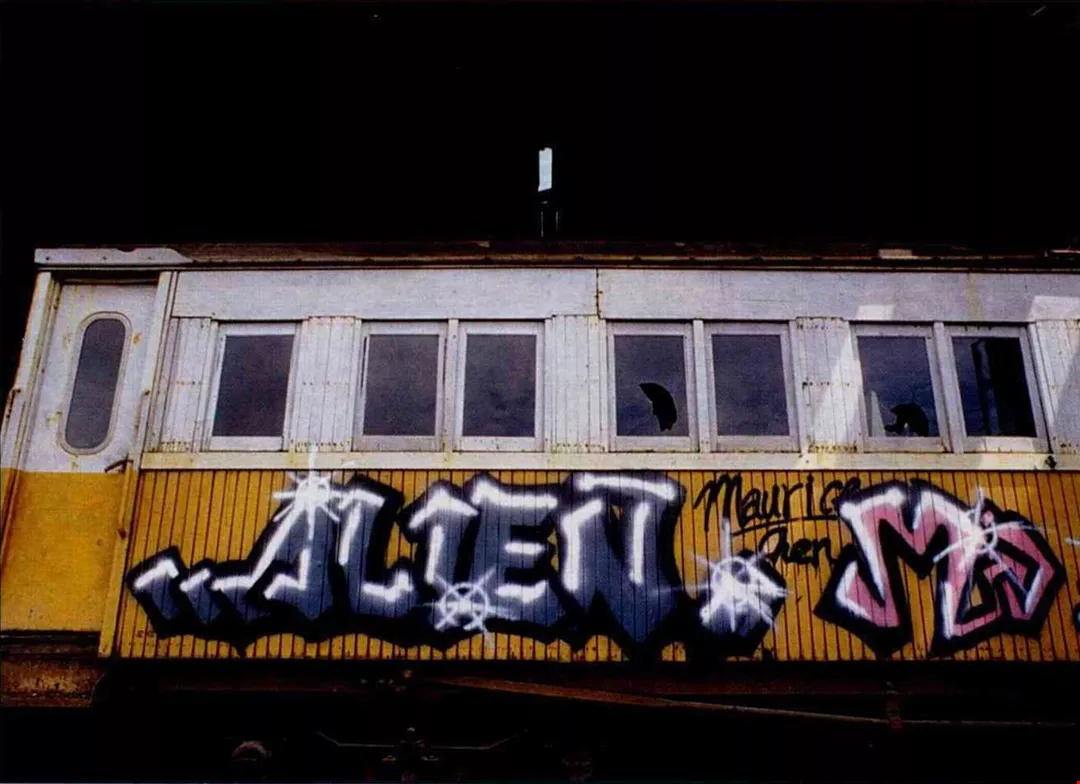
A "Little Ding-Dong" train in the old Hualien Station is in a sorry state after its retirement: its mottled sides have been daubed with graffiti.
A rainbow of talents
Their knowledge of trains and tracks sometimes astounds even railway employees. Perhaps the best known of these enthusiasts is Hung Chih-wen, who is only 26 but already has several books to his name-Taiwanese Railway History and three other works on Taiwan's railways. Hsieh Ming-hsun collects railway tickets, and has written a book about them: the Taiwan Train Ticket Compendium.
Rolling stock historian Tung Chen-chiang once made computer drawings of all the bogie sets used on TRA trains in the past, and knows more about the development of the TRA's passenger and goods rolling stock than the TRA's own engineering staff. Tu Yi-he, who is still a student at National Taiwan University, is the proprietor of the "Yihe Railway Engineering Works," where he has built over 100 model trains the size of toothpaste boxes; the bogies on all of them can turn.
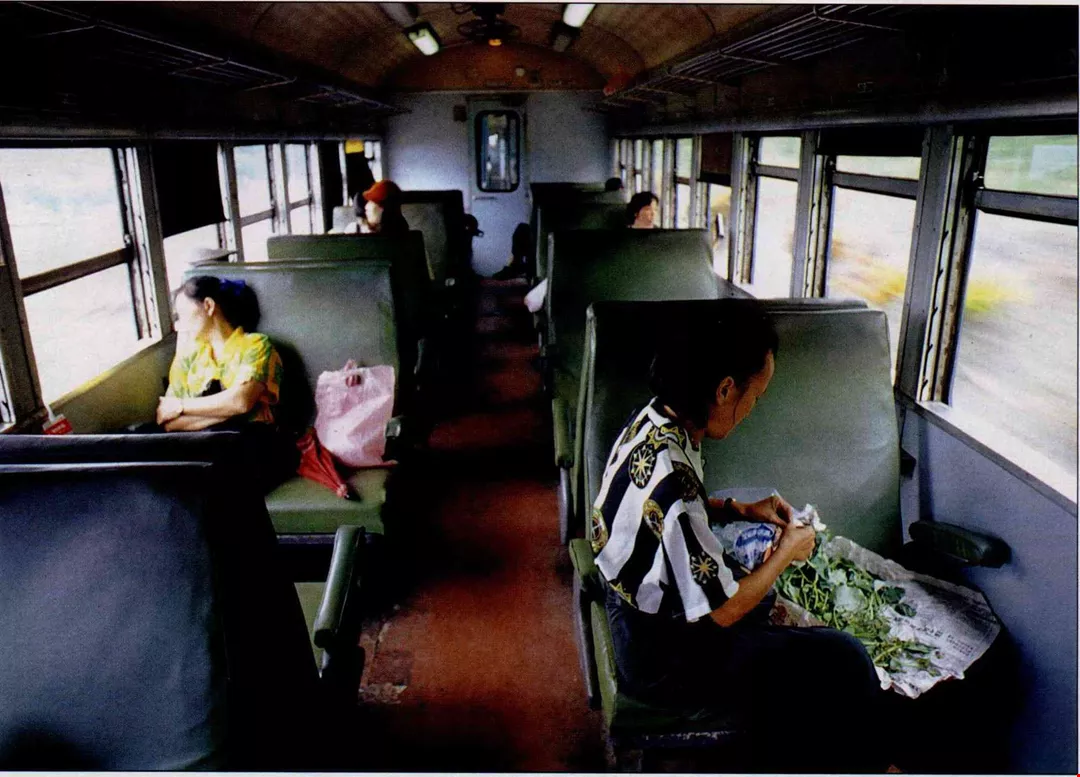
Sitting in an ordinary local train, in no particular hurry, you can still take the time to clean vegetables or grab forty winks. How long is it since you've travel led in this leisurely way?
No mere obsession
In fact, railway buffs can be found all over the world, and there are many railway clubs. Bookshops in such countries as Britain, the USA and Japan all have special sections on railways, full of all kinds of specialist magazines and books about railways. By comparison, things are much harder for Taiwan's train lovers. They have had to find their own way-but this has allowed these young "railway experts" to become pioneers.
For a full 40 years after Taiwan's reversion to Chinese rule in 1945, everything to do with the railways was regarded as a national military secret. Railway tunnels were all guarded by soldiers, and photography was strictly forbidden near railway lines or station buildings. One could only "admire from afar"-one could not get a close look, and still less could one study the railways. Things only relaxed after martial law was lifted in 1987.
Thus the founding of the RCS can be seen as a milestone for railway research in Taiwan. Furthermore, unlike railway clubs overseas which are mainly social in nature, its members are not merely obsessed with trains, but have also taken upon themselves the solemn mission of studying and preserving the cultural heritage of Taiwan's railways.
"In the broadest sense, the object of our research includes all the railway operators, including the TRA, the high-speed railway and the Mass Rapid Transit system," explains RCS president Jen Heng-yi. However, he adds that because most railfans tend to have a nostalgic bent, the society's main aim is to preserve railway culture, and the members' greatest wish is to "assist in the birth of a railway museum for Taiwan."
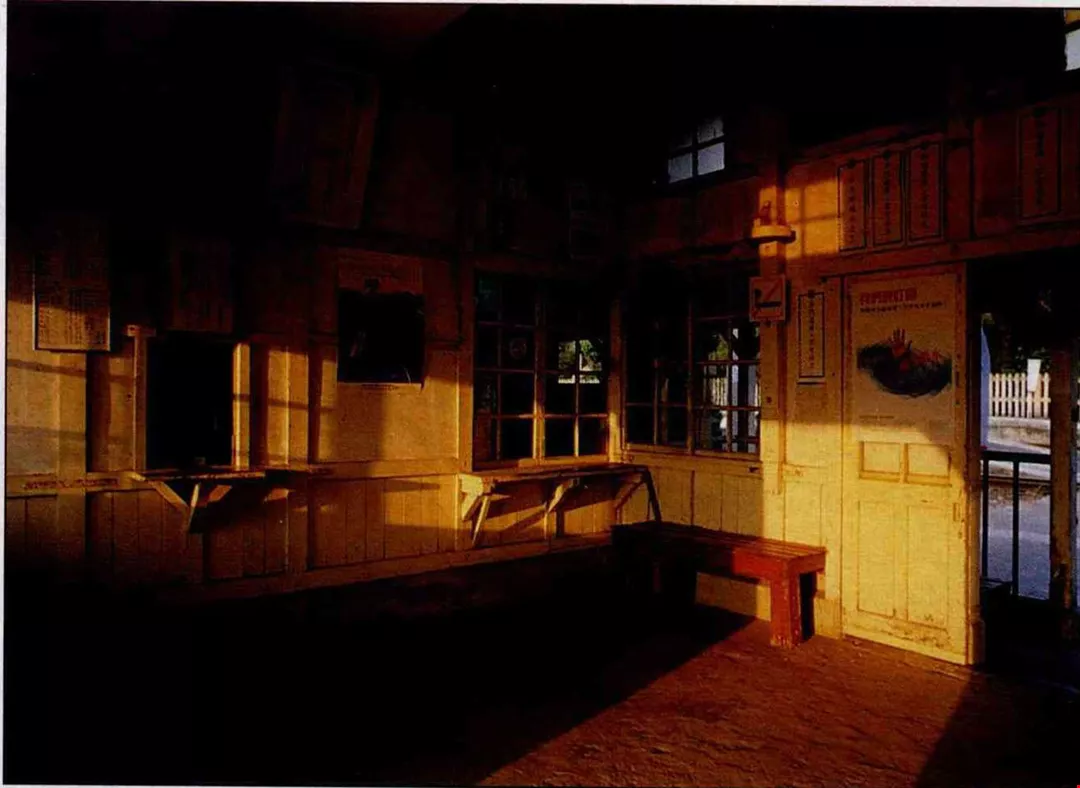
An old station faces its twilight years alone-- these old buildings which have served silently for so many decades still stand valiantly, waiting for passengers.
Youngsters and old-timers
Although the RCS celebrated its first anniversary only this October, many of its members have been sharing their passion for trains for quite some time. Jen Heng-yi recalls how in 1988 he and two fellow students at National Chiao Tung University set up a "Railway Research Society." In those days the time was not yet ripe for railway research, and at first they remained just a "trio." Many people, as well as being inquisitive about their hobby, also jokingly called them the "Sure to Fail Society" (a pun on the society's Chinese name).
To keep their club alive, they made as many contacts off campus as they could, and attracted many "lone warriors" from outside the university. Later, railway-related clubs were set up at NTU, National Cheng Kung University and other schools, and the movement to study railways gradually gathered steam. In 1991, these clubs said goodbye to their student days as their members began preparing to set up a formal association.
The RCS is a very male group: its 250 members throughout Taiwan are almost all men, most of them young. But among them there are also a handful of older enthusiasts in their fifties and sixties, who are highly valued members of the society.
For instance, Chang Hsin-yu was a station master on the Mt. Ali Railway for 50 years, and loves the line as if it were his own daughter. Railway photographer Ku Jen-jung was in the travel business in his youth, and having often been asked by Japanese tourists to show them trains, he himself gradually fell in love with them. But in former times he had to be very cautious when taking photographs. If he was unlucky enough to be noticed by security personnel, he would pretend to be a tourist who didn't understand Chinese. Over the last 30 years he has taken more than 5000 pictures of Taiwan's railways, including valuable historical shots documenting the changes they have gone through.
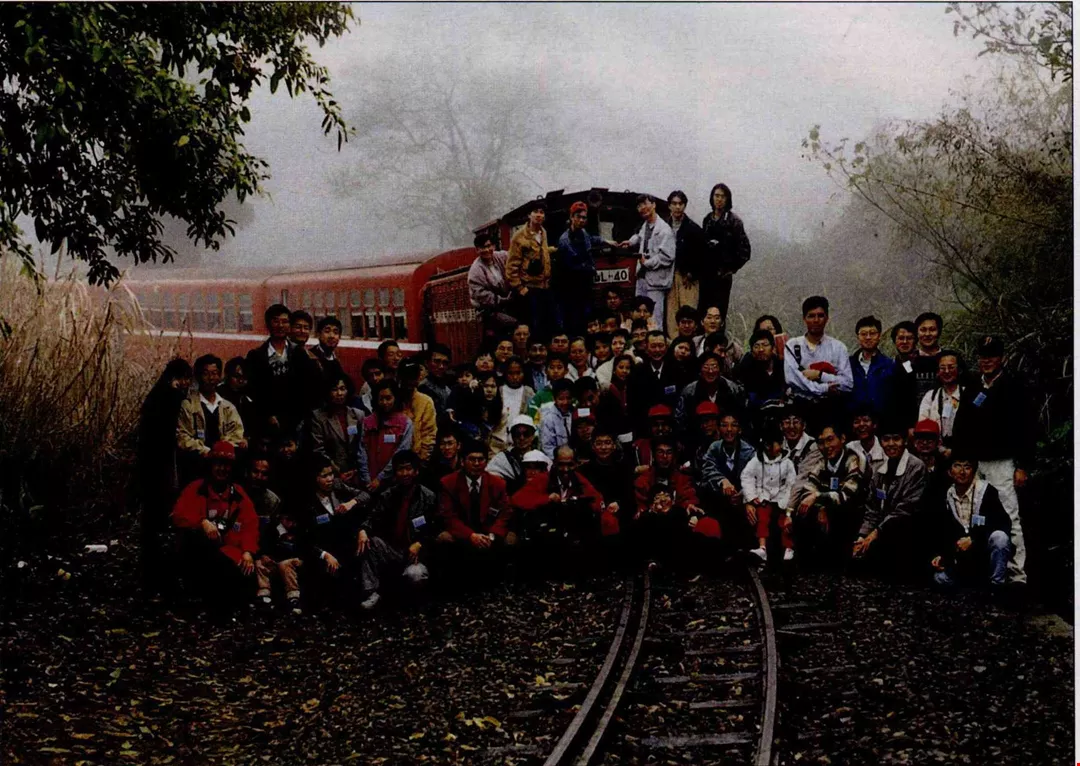
Last year when the Mt. Ali forest railway celebrated its 85th birthday, railfans came from far and wide to wish it well. (photo by Lai Te-hsiang)
Are the railways past their prime?
Taiwan's railways have seen halcyon days when they were not only the motor of Taiwan's industrial development, fulfilling the important task of carrying coals, sugar, salt and timber, but also reached into the cities and small towns to become a major means of public transport. The period from 1950 to 1978 was the golden age of railway operations in Taiwan, with enormous surpluses made every year.
But times changed, and one after another many industrial railways were taken out of service. The forestry railways were all closed down, and the Taiwan Sugar Corporation, as it diversified and was restructured, also went over to road haulage, selling off the land on which its railways had run. The completion of the Sun Yat-sen Freeway in 1980 dealt another heavy blow to the railways, and from that point on road transport became the mainstream. In recent years air transport has also taken off. The railways can neither match aircraft for speed nor road vehicles for convenience, and have continued to lose ground to these other modes of transport.
Although the TRA controls Taiwan's entire rail network, it only has the status of a third-level provincial government department, and because of its unusual personnel structure, it has to bear heavy costs. According to government figures, the TRA has to make pension payments equivalent to more than 80% of its revenue. In other words, it faces costs of NT$20 million every day before a single train has run, and is in the red to the tune of almost NT$100 billion (US$3.7 bn).
Old friends sold for scrap
The tide of change cannot be turned back, and many structural problems cannot be solved overnight. The TRA is not equal to the task of putting its own house in order, and many people lament that it is simply living in the wrong age. But what the young people of the RCS find hardest to understand is the mindset of the TRA itself.
"Railways in other countries have all faced the challenge of restructuring," says RCS standing director Cheng Ming-chang, who is very anxious to see railway heritage preserved. Japan, for example, has developed the Shinkansen bullet trains to provide passengers with a high-speed service, but it also has several railway museums, and steam engines have been restored to pull tourist services.
For instance, Japan's Oigawa Railway, which is twinned with the Mt. Ali Railway, specializes in buying up trains which are due to be scrapped by other railway companies. Its engines include one which once ran on the Burma Railway, crossing the Bridge over the River Kwai. Renovated to pull passenger trains, it attracts huge numbers of tourists.
But in Taiwan, although a railway museum has been planned for many years, it is still nowhere in sight. Yet when one turns over the exquisite souvenirs on sale at any of the USA's numerous railway museums, one finds that they are "Made in Taiwan." This leaves a strange taste in many people's mouths.
While they wait for the museum, much of the historical heritage has been disappearing, particularly over the last decade. Many branch lines have closed, and a number of wooden stations which had great character have been torn down and replaced. Many precious carriages, after being withdrawn from service, have not found a happy retirement home, but have been sold off for scrap at a price of NT$5 per kilogram. "In some cases they didn't even keep one!" The expression on RCS members' faces when they speak of these things is as pained as if they were seeing close friends stricken by sudden misfortune.
Preservation and development
From the TRA's point of view, however, just keeping going as a loss-making concern is a hard enough task, especially with all the operating problems it faces at the moment. Thus it can have little energy to spare for preserving a cultural heritage. "I really admire the perseverance of the RCS as protectors of culture," says TRA Director Chen Te-pei guardedly. "It's just that the public's expectations are based on a different standpoint from ours as an executive agency, and we need to communicate more."
He believes that preservation cannot be approached in the same simple way as preserving ancient monuments, for it is also very important to take urban development into account. As for the railway museum, five years ago the TRA set up a museum planning team to find suitable locations, "but all of the NT$5 million which we had budgeted was cut by the provincial assembly. They thought it was more appropriate for museums to be planned by cultural and educational departments," says Chen Te-pei, spreading his hands in a gesture of frustration.
RCS chief executive officer Wu Yi-han, who takes a keen interest in railway policy, agrees that one cannot call a halt to development for the sake of preservation. The TRA has recently begun to import "push-pull" type electric trains (with a locomotive at each end), and over the next few years will buy over 800 new rail cars to replace aging stock. Parts of the East Taiwan line are also in the course of electrification. For Wu, these are all welcome developments.
But modernization and preservation are not mutually exclusive options. "For instance, when railway stations are moved underground, it's a question of finding a balance between urban renewal and preserving a cultural heritage." In Wu Yi-han's view, when stations are put underground, the old station does not necessarily have to be torn down. If a little thought is given to the design, then both goals can be achieved. Tokyo Station is a good example.
A love-hate relationship
Thus the RCS's relationship with the hundred-year old TRA is full of the tension which comes from regarding the administration both as a friend and as an enemy. On the principle of loving the railways "warts and all," they naturally hope that the TRA can improve in future. But every time they get wind of something the administration is doing, they rush to voice their concern and beg for "mercy."
On the last days of operation of the Tungshih and Tungkang lines, the RCS put on events entitled "Final Journey on the Branch Line" which attracted crowds of people rushing to ride on the last trains. When they heard that Taiwan's last remaining roundhouse (an engine shed built in a part circle around a turntable) at Changhua was to be torn down, they immediately started an emergency campaign to save it, and got a promise from the TRA that it would not be demolished for the time being.
In October last year it was reported that Taichung Station was to be moved underground, and that the old station building, which dates from the Japanese occupation era, might be demolished. The RCS joined with several other cultural and historical associations to put on a campaign to plead for the life of the 80-year-old station, including an event in which groups rode trains from both north and south to meet in Taichung. Finally they managed to get the station building designated a Grade 2 national monument by the Ministry of the Interior.
A race against time
Naturally, not every rescue campaign is successful, and this kind of firefighting approach can never keep up with the flames. For instance, in March 1995 the TRA itself broke up Taiwan's last single, double and triple-bunk sleeper cars and dining cars, and some wooden observation cars over 50 years old.
Apart from being disheartened, "we can only ask the TRA to slow down a bit, and at least keep one example of each representative type of carriage, so that they can be displayed in the museum in the future," says society president Jen Heng-yi. But today they are in a race against time, and he is deeply afraid that if one day the railway museum really is set up, there will be nothing left to put in it.
Some people may ask what value there is in preserving old trains and railway stations. "The trains of the past were the products of new technologies, and the design of many carriages followed the fashions of the day. When we look at them today, they are all representative of their time. Without them, how can we explain the history of Taiwan's railways to later generations?" asks Hung Chih-wen. And the old stations which witnessed people's comings and goings are even more a part of the public's memories.
With funding from private enterprise, to accompany the "30th birthday party" of the Kuanghua DMU trains the RCS also put on an exhibition of railway memorabilia in which it displayed many old photographs of the railways, along with railway lunch boxes, trackside signs, workers' uniforms, model trains and so on, as well as exhibits about the planned high-speed railway and the Taipei rapid transit system. Middle-aged or older visitors stood transfixed in front of the old photographs as memories came flooding back, and they thought back to Taiwan Sugar Corporation's "pint-sized" trains and the days when trains ran parallel to Taipei's Chunghua Road.
Bringing steam engines out of retirement
One of the high points of the event was when representatives of the Taiwan Railway Administration, the Taiwan Forestry Bureau and the Taiwan Sugar Corporation were invited to discuss the question "What kind of railway museum do we need?"
The TSC once also failed to see the value of old trains, but now they have preserved over 30 treasured steam locomotives. The TFB wishes to restore the tourist appeal of the Mt. Ali Railway, and is willing to operate it even at a loss. It plans to build a narrow gauge museum at Fenchi Lake Station, where old forestry railway engines are to go on display, and it would also welcome exhibits from the sugar, salt and mining railways.
But what is the attitude of the big daddy of Taiwan's railways, the TRA? Spokesperson Ma Chung-nan says that from 16 sites throughout Taiwan, including Chichi Station and the Changhua roundhouse, the TRA's planning team has chosen Taichung Station as the location for the future museum, which is to be incorporated into the project to move the station underground. But he freely admits that it will be quite some time before this plan can be realized, and for the time being the TRA will display its railway artefacts in a temporary home in the old railway administration building on Taipei's Yenping North Road.
But in fact, methods of preservation are by no means limited to morgue-like museum exhibits. Professor Timothy Kao, who teaches at an American college, points out that preservation of working trains is a much more attractive option. The Steamtown National Historic Site in Pennsylvania recently spent US$300,000 on an old steam locomotive from mainland China. The engine is greatly prized by local people, and attracts many visitors young and old who get enormous pleasure from riding in the trains it hauls.
Jen Heng-yi has promised his son that one day he will show him a steam train running on Taiwan's main north-south line. But at the moment the surviving old engines are scattered far and wide, and if not standing alone in some square they are shut away out of sight in sheds. With the old skilled maintenance fitters literally dying out, when will he be able to keep this promise?
Apart from calling for the preservation of railway hardware, the RCS is also thinking about how to restore the railways to their "rightful status." "In view of the price paid for road development, many countries have begun to evaluate the possibility of reviving the railways," says Cheng Ming-chang.
In a Japanese book entitled Railways to Save the Earth, the opinion is expressed that trains really have far more advantages than motor vehicles. Not only do the tracks take up less space than roads and blend in better visually with their surroundings-trains also save oil and produce far less emissions and noise pollution than motor vehicles.
"Taiwan is neither large in area nor rich in natural resources, yet we have been continuously building roads. Shouldn't we stop and consider what price we are paying?" asks Wu Yi-han.
The things we do for love
What course future events will take is still far from clear, but the RCS also has many internal problems. Many members have now left behind their carefree student days, when they could travel freely, and begun to raise a family, so they can no longer devote all their energies to the society's affairs. Others who are so obsessed with the railways that they work for the society for a tiny salary are accused by their families of falling down on their responsibilities. And for lack of personnel and funds, the RCS is not able to put on enough activities to satisfy some members.
The work of putting on the Kuanghua event and accompanying exhibition at the end of October rushed everyone off their feet. With these activities over, they have been considering whether to change the nature of the society to a "soft" organization for the time being.
"What we mean by that is cutting personnel costs as far as possible, and reducing the number of members," explains Jen Heng-yi. Only people with a real "cultural mission" could join, while people who are simply railway fans could perhaps consider setting up another club. From that point on the RCS would no longer be mainly concerned with putting on activities for its own members, but would look outward and concentrate on seeking opportunities to preserve railway culture.
A plan drawn up by the RCS for a survey of historic railway hardware in Taiwan has just gained funding from the National Culture and Arts Foundation. "In fact we had already gathered a great deal of material and photographs," says former Railway News editor Lai Te-hsiang, showing us stacks of photographs and files in a filing cabinet. Over the last few years society members have been travelling all over Taiwan and have listed and photographed many steam engines, old stations, facilities and items of equipment worth preserving.
Where are the trains going to?
After many trials and tribulations, Taipei's rapid transit system is now up and running; the western corridor high-speed railway is also now at the planning stage. When the pop song asks: "Train, train, where are you going to?" these young people simply hope that as the railways continue to move ahead, people can also look back along the tracks behind them, and not forget the railways' glory days.


@List.jpg?w=522&h=410&mode=crop&format=webp&quality=80)


