Chen Guan-zhou: Lego Art, Taiwan Style
Cathy Teng / photos Jimmy Lin / tr. by David Mayer
October 2016
Plastic building blocks with round protruding studs—people the world over are familiar with these blocks. Indeed, it’s hard to find anyone who has not played with them during childhood. What you can build with them is limited only by the imagination. Each individual comes up with something different.
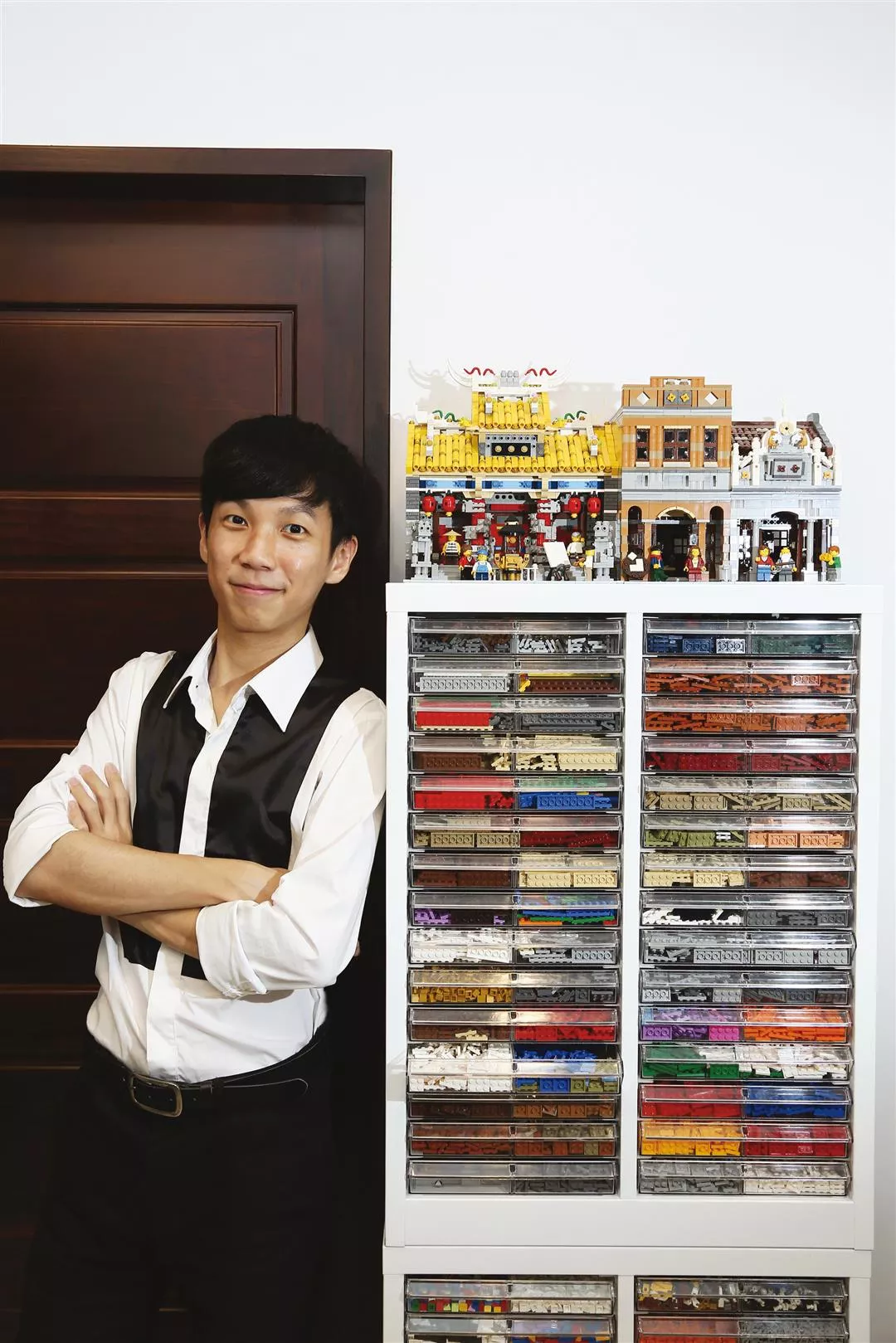
Lego genius Chen Guan-zhou, who goes by the name of “Great B.W.” in Lego circles, entered Longshan Temple, a reproduction of the famed temple in Taipei, in Lego’s 2014 Piece of Peace World Heritage Exhibit—Taiwan. Chen spent three months and used over 40,000 Lego pieces to make his exhibit. Even the highly ornate elements of traditional Taiwanese temple architecture were reproduced using Lego. It was an extraordinary piece of work, and with it Chen rocketed to fame in the field.
When people first play around with a Lego set, they typically attempt only to make what the game maker itself has suggested. But Chen was too competitive and creative for that. He wanted to do something unique. He thought to himself: “Why not reproduce some of the architecture that we’ve got right here in Taiwan?” And so he broke down the Lego structure he had already made and began working on an entire series of the buildings to be found along Taiwan’s old traditional shopping streets.

Known as “Great B.W.” in the Lego world, Chen Guan-zhou likes to refer to Lego as his “mistress.”
Taiwan memories
Chen called his first Lego structure Tofu Shop, and modeled it after shops of the sort that one runs across in the old quarter of small towns such as Daxi. This then expanded into an entire series of buildings from such old-quarter settings, including a traditional apothecary establishment and a tofu shop. The baroque facade and the service counter of Chen’s apothecary shop, the double sliding doors of his tofu shop (they actually slide!), and the big kitchen stove are all strikingly realistic.
Each of the buildings in his “Old Quarter” series rests on a 25 x 25 cm baseplate. Not content just to make the outer shell of the buildings, Chen goes into considerable detail with the interiors, as well. In The Police Station, for example, there is a reception counter on the first floor, and an interrogation room on the second floor. A Lego figure in the form of a tattooed man is handcuffed to a metal rack along the wall, and right next to him is a little holding cell. In The Betel-Nut Beauty, the clear glass betel-nut stall is mounted on wheels so that it can slide back into a bigger building, while the car repair shop right next door has a properly operating vehicle lift.
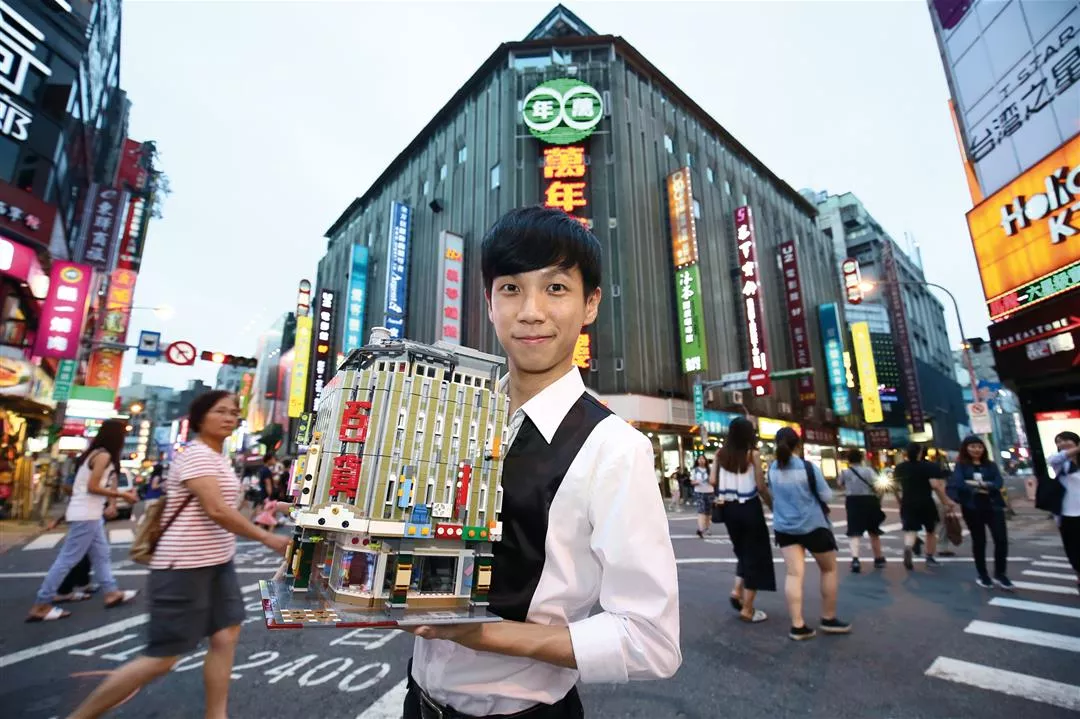
The tenth work in the “Old Quarter” series—The Department Store—is modeled upon the Wan Nian Building, a well-known structure in Taipei’s Ximending area that houses a buzzing warren of little shops. Chen’s Lego structure recreates the Wan Nian Building’s former sixth-floor ice rink where generations spent happy hours in their youth, and Chen hasn’t forgotten to reproduce the building’s distinctive green floors. The escalators actually work, and Lego figures can make their way from floor to floor.

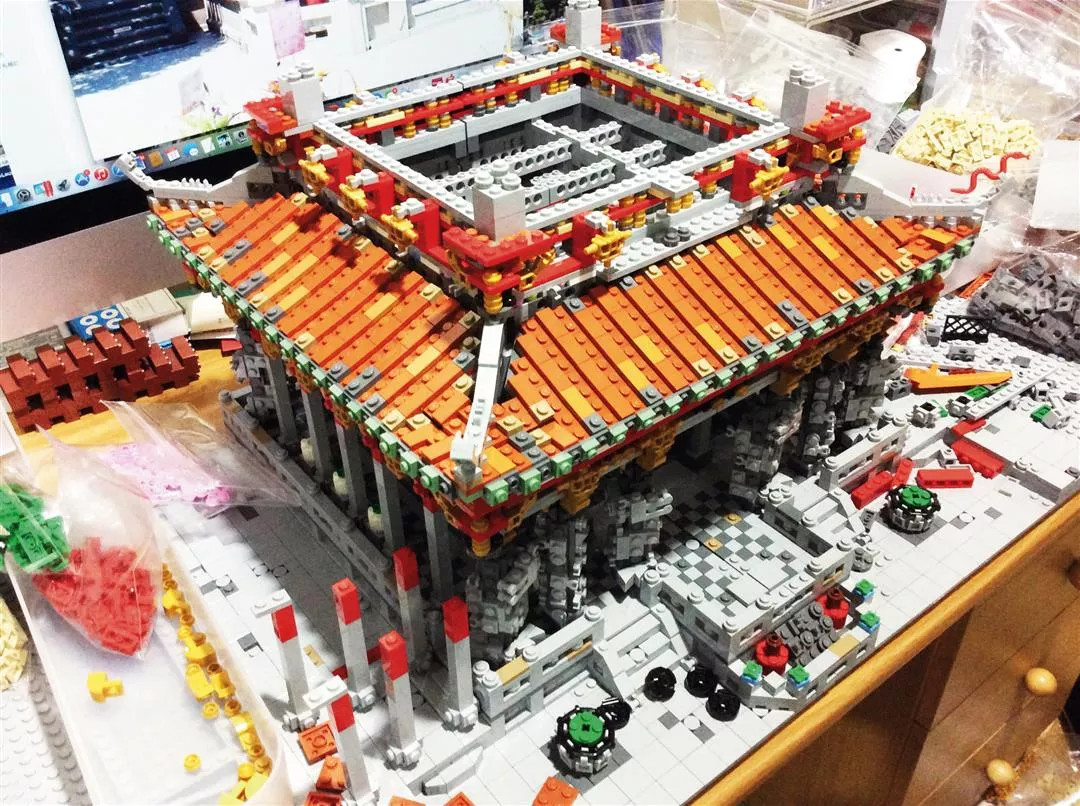
Great B.W. had to overcome all sorts of technical challenges to construct Longshan Temple, his first large-scale work of Lego art, shown here partly built. He had to devise creative ways to represent ornate columns and beams, as well as the corbel brackets that support the eaves in traditional temples throughout the Far East. (courtesy of Chen Guan-zhou)
True to life
Fond of wandering the lanes and side streets of Taiwan to look at old architecture, Chen notices things like exposed wires, splotchy walls, rusty old tin roofs, and the like. Such details are what breathes life into old buildings. In a work titled Wedding in a Military Village, a diamond-shaped Lego piece strikes the Taiwanese eye as a faded old Spring Festival decoration. In The Mom ’n’ Pop Store, the building next door is undergoing renovations. The exposed rebar on the second floor and the bamboo scaffolding covering the facade are just the sort of thing one sees all the time in Taiwan. Chen goes to the trouble of working in such details because he wants to show specifically what life in Taiwan looks like.
Says Chen: “If a building is all one uniform color, it will just look like a model home.” Having dabbled in watercolor painting, Chen is able to employ impressionist color techniques to render the mottled look of an old building that’s been patched and repainted numerous times. He uses sand-blue pieces to build a corrugated tin roof, and combines grooved pieces with brown pieces to achieve a rusty look. At first Chen used this mottling technique simply because there weren’t enough pieces available to do it any other way, but now it’s become something of a personal signature and has even caught on with others in Taiwan’s Lego community.
With his Formosan Sika Deer, Chen sought to create a truly lifelike representation of the animal, not just a loose approximation. The challenges involved in using Lego pieces to portray the fine gradations of color were formidable. Relying mainly on brown pieces for the fur, Chen used dark orange for the brighter parts, plus sand and deep-sand colors for the belly. By combining multiple colors, he got the gradations he needed to create something truly beautiful.

Great B.W. had to overcome all sorts of technical challenges to construct Longshan Temple, his first large-scale work of Lego art, shown here partly built. He had to devise creative ways to represent ornate columns and beams, as well as the corbel brackets that support the eaves in traditional temples throughout the Far East. (courtesy of Chen Guan-zhou)
Getting the dimensions right
Another amazing aspect of Formosan Sika Deer is the care taken to get the correct relative dimensions, and Chen’s technique of making the deer in separate modules. The work was executed at very close to life size, and the deer’s slender legs had to stably support the weight of its large body. This was the biggest technical challenge of the project. In addition, Chen’s decision to have the deer looking off to its right further added to the difficulty. Chen started by stacking Lego pieces into a framework. He then made the hindquarters as a solid piece, thus shifting the center of gravity toward the rear. And in order to make it easier to assemble and disassemble the deer at exhibition venues, he designed it in separate sections.
In 2014, at the invitation of the organizers of the Piece of Peace World Heritage Exhibit, Chen decided to take part with a representation of Longshan Temple, located in Taipei’s Wanhua District. Before ever touching a single Lego piece, he first snapped over 100 photos at the temple and studied Google satellite images of the site to determine the number of beams and columns at the temple and the dimensions of the temple buildings.
Chen first installed pieces around the edges of a baseplate to trace out the periphery of the temple premises before determining the precise dimensions of the temple pavilions. The height of his structures was set at a specific ratio to the height of the human figures.
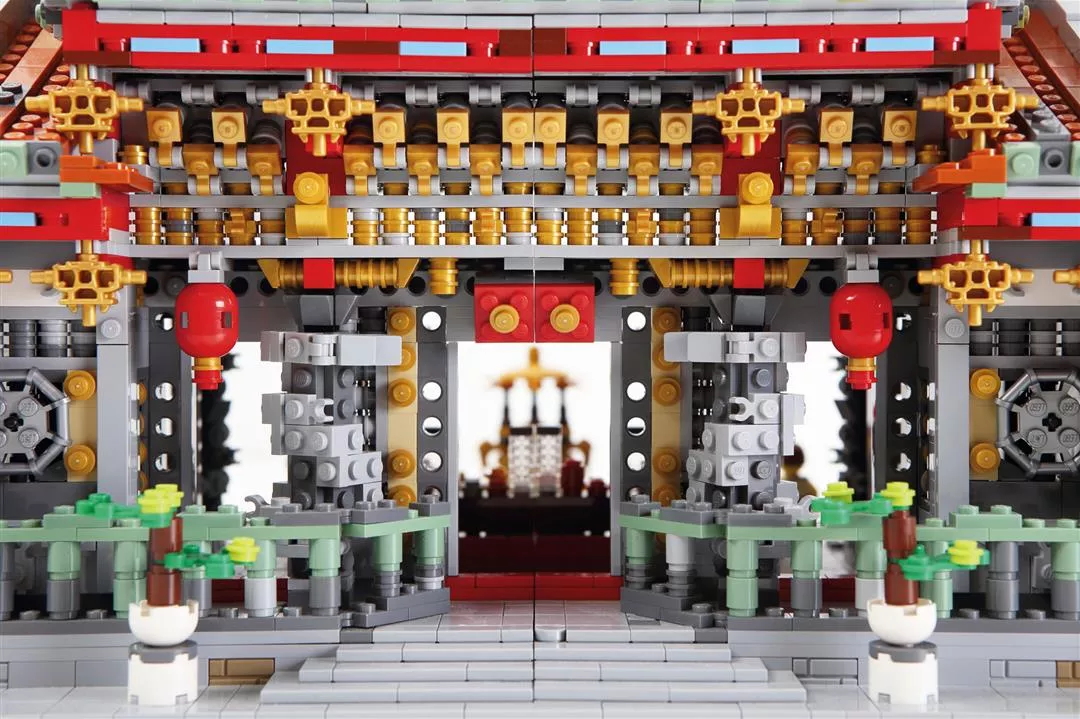
The important details of the temple posed a challenge, for careful thought was needed to craft a Taiwanese-style temple from Western-style Lego architectural pieces. In the process, Chen developed entirely new ways to use the pieces. To represent the cut-and-paste ceramic dragons typically seen on the roofs of Taiwanese temples, Chen made do with snake figures. For the door guardians, he used mosaic techniques. Atop the temple’s carved dragon pillars, he employed jointed pieces to create an impression of the dragons’ heads.
Chen was very exacting with the interior of the temple, as well. He used Lego Oscar statuettes as Buddha statues, and he found ways to use Lego pieces and mosaic techniques to represent votive lamps and wall decorations. The golden glitter of Chen’s temple is every bit as dazzling as at Longshan Temple itself.
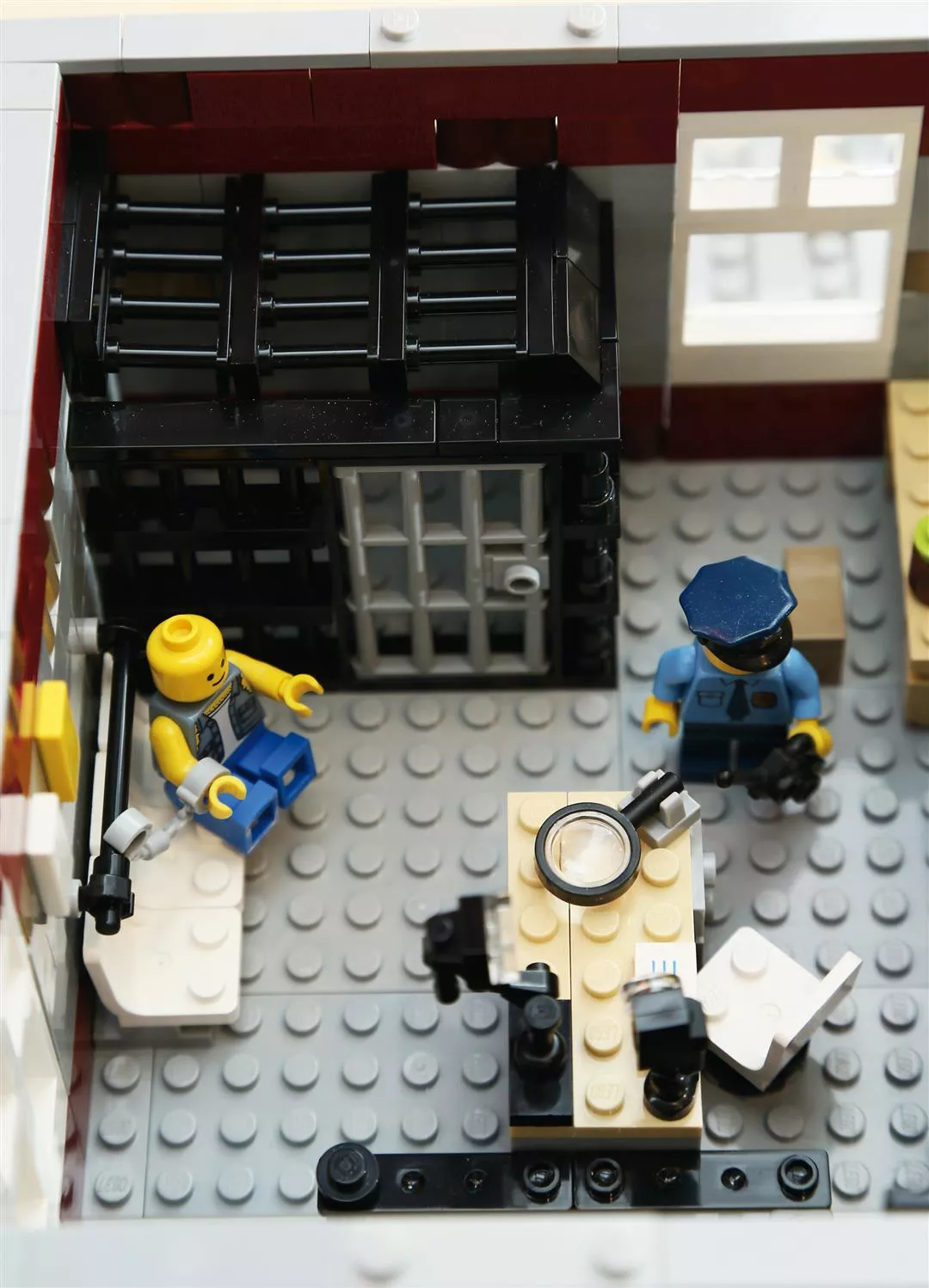
Not content just to make the outer shell of the buildings, Great B.W. goes into considerable detail with the interiors, as well. Shown here is the interrogation room on the second floor of The Police Station, complete with a tattooed man handcuffed to a metal rack along the wall.

Lego as language
In 2014, Chen quit his regular job to devote himself full-time to Lego art. Longshan Temple, which was the piece he finished next, was the first really large-scale work of his career. Since then, his creations have begun to attract a lot of online attention from around the world. Chen laughs that he has problems just speaking and reading in his native language, let alone English, so it’s tough to understand what foreigners say online about his work. Nevertheless, creating things with Lego feels like one way of communicating with the outside world.
A desire to win kudos from an online audience propelled Chen onto the stage of Lego creation, and today he continues to look for new ways to use Lego. He likes to test the limits of what is possible. But what if he’s up on stage playing to an empty house? Chen responds with a quip: “Well, then I’ll just have to build some steps out of Lego so I can get off the stage.”
Asked what his next large-scale work will be, Chen grows quite animated: “I’m going to do the Dragon Pagoda at the Lotus Pond in Kaohsiung. That pagoda is just so cool, don’t you agree? It’s so distinctive, and hard to replicate!” Born in 1988, Chen remains a big kid to this day. He relishes a tough challenge, and feels a sense of mission to use Lego to share the sights of his native Taiwan with a global audience.

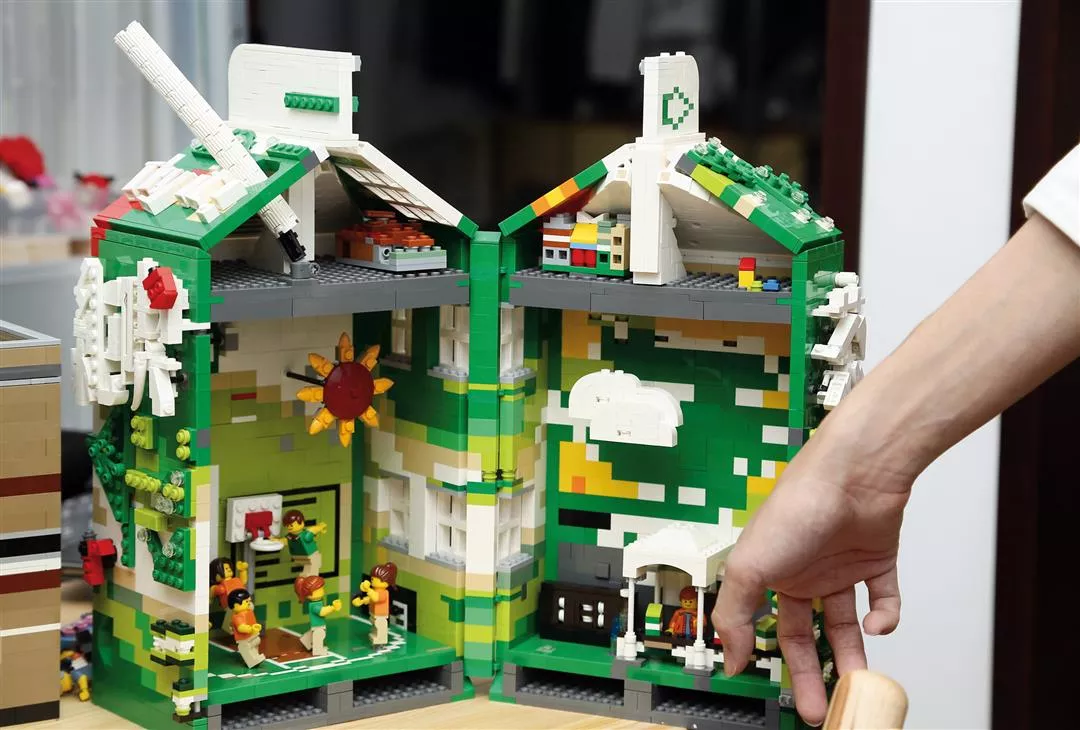
In a perfect melding of personal interest and work, Great B.W. has made a number of works for corporate clients. Shown here is Pure Tea, the Lego likeness of a popular packaged drink. His use of Lego pieces to fashion Chinese characters is an especially creative aspect of this work.

Great B.W. poses in front of the real Wan Nian Building with The Department Store, from his “Old Quarter” series. (photo by Jimmy Lin)