Releasing the Pressure--Wang Wei-chung Stays Young at Heart
Chang Chiung-fang / photos Jimmy Lin / tr. by Scott Gregory
May 2006


The television industry moves quickly--people and trends come and go. But producer Wang Wei-chung is the rare case of someone who's not only lasted but dominated. The former Singaporean prime minister Goh Chok Tong never missed an episode of Wang's show Everybody Speaks Nonsense, and China's Taiwan Affairs Office spokesman Zhang Mingqing loves the impressions of him that Tai Chih-yuan does on the show Public Pressure Cooker--he's even had a picture taken with Tai.
Over his career of 30 years, Wang--who turned 50 this year--has been a giant in the industry. What's the secret to his success?
Place: The sleek, elegant reception room of Digital Production
Time: Evening, around closing time
Scene: Company president Wang Wei-chung, dressed in a form-fitting black suit, gives off a relaxed air as he sits on a sofa, answering a magazine reporter's questions. He's agreeable, but he's got a focused look in his eyes and he's intent on answering the questions. The reporter is surprised by his appearance--it's as if he has drunk from the fountain of youth. It seems he is just getting better with age, as is his career.
Place: SET TV Studio 3
Time: A late March afternoon, as a storm front approaches
Scene: Wang Wei-chung's voice resonates through the air-conditioned studio. The actors from the show Taipei Family practice their lines and take their places. Periodically, Wang is struck by inspiration--one minute he has Ko Wei-ju hold a puppy, and the next he adds lines for Pu Hsueh-liang, who plays a gay man, to speak. He can't help but jump onto the stage and demonstrate how a male stripper acts, causing the set to burst into laughter. Off the set, Wang says that the studio is his stage, and an outlet for his creativity.
In some situations, people call him "Big Brother Wei-chung" out of respect, but behind his back they call him "Old Wang from next door." Some have even referred to him as "the terrorist." With his resume and list of accomplishments, it's no wonder they call him "Big Brother." As for "Old Wang from next door" and "the terrorist," those names just show how he pushes the boundaries every day.
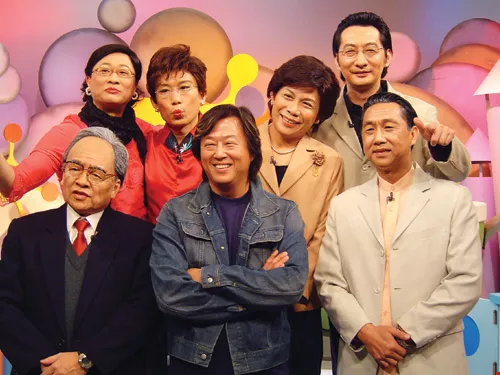
Celebrities, politicians, and other newsmakers are satirized in Public Pressure Cooker, the show perhaps most reflective of Wang's own personality.
Prime time king
With Guess Show on CTV, Public Pressure Cooker and Kang & Hsi Are Coming on CTi, and Taipei Family and Kuokuang Gang Helps Out on SET TV, shows produced by Wang dominate the prime time just about every night and are shown as reruns in the daytime. They're hard to miss.
Not only are his shows popular in Taiwan, they're hot topics of conversation in China, Singapore, Malaysia, and anywhere else there's a Chinese-speaking community.
Even the famed author and dramatist Yu Chiu-yu admits to being a fan of Tsai Kang-yung and Little S, the hosts of Kang & Hsi Are Coming. That show's guests have included Vice President Annette Lu and former KMT chairman Lien Chan. "Kang & Hsi Are Coming is not constrained by any format," says Yu. "It always pushes the boundaries but comes back right before crossing that line. It plays on the borderline to its own advantage."
Yu's assessment of Kang & Hsi Are Coming applies to the other shows Wang produces as well.
Take Public Pressure Cooker, for example. On that show, the cast parody celebrities and discuss current events--sometimes even events from earlier the same day--in a talk show format. It's up-to-the-minute satire and commentary.
People parodied on the show include President Chen Shui-bian, Vice President Annette Lu, Premier Su Tseng-chang, People First Party chairman James Soong, Zhang Mingqing of China's Taiwan Affairs Office, legislator Li Ao, talk show host Clara Chou, former Council of Labor Affairs chairwoman Chen Chu, and stock market analyst Chang Kuo-chih.
Poking fun at the powerful and satirizing the daily news is taking it even closer to the edge. It takes some savvy to pull it off.
"Social satire is Wang Wei-chung's forte," says Chen Hao, executive vice president at CTi. "As soon as somebody becomes the new authority, Old Wang will mess with him." Wang really hit his stride with Public Pressure Cooker. Not only does it reflect his spirit, but each of the stars is precious.
Take, for example, Tang Tsung-sheng, who portrays President Chen Shui-bian. He'll have his hair slicked to the side and he'll wave his hands around as he imitates Chen's Taiwanese-inflected Mandarin. Then a minute later, wearing a red jacket and holding a folder and pen, he's the spitting image of legislator Li Ao, spouting scathing criticism. Kuo Tzu-chien is even more of a master of parody. In his two years on the show, he's done imitations of over 100 personalities, including TV host Li Tao, seasoned entertainer Yu Tien, and Chang Kuo-chih, the stock market analyst who's gained fame recently.
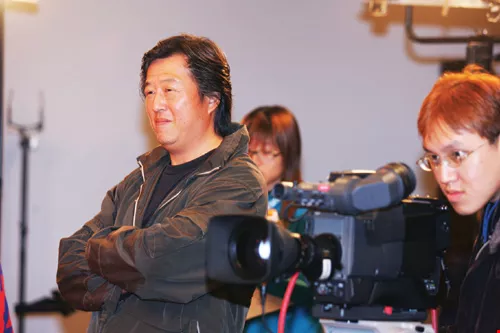
Wang laughs as he watches the actors show their stuff for the camera.
Release the pressure!
The motto of Public Pressure Cooker is "Release the pressure, save Taiwan." That's because Wang sympathizes with the show's primary audience--Taiwan's middle class.
"Taiwan's middle class really has it tough," Wang says. He sees streets full of shops that change owners over and over again. The cost of living keeps going up but salaries are going down. The nation has fallen into bitter fighting between the Green and Blue camps, and the mood is tense.
"Many people are looking forward to the next election, hoping to re-deal the cards then," Wang says. "They don't even care if in the next two years we hit rock bottom." In his opinion, everyone is putting their hopes on an uncertain future, but he believes that such a wasteful, negative attitude just won't do. "Two years can destroy a man!" he says.
Because things have come to this, Wang wants to use comedy to take the pressure off in these turbulent times. "What I hope to do is get people to get a deep grasp of what's happening and turn it around to develop hope," he says. He believes it's important to maintain hope for the future. He hopes the show will promote life and warmth.
What Wang didn't expect, though was for Public Pressure Cooker to become a hit in China as well, allowing China's citizens to "release the pressure" too.
Many Chinese Internet users have posted messages on the show's website saying that it helps them to better understand Taiwan and the concerns of the Taiwanese.
Actually, Public Pressure Cooker isn't the first of Wang's shows to become a hit across the strait. As early as ten years ago, Guess Show was sold to Chinese television stations and host Jacky Wu became a star there. Kang & Hsi Are Coming and Public Pressure Cooker aren't broadcast in China, but many fans watch them over the Internet or by using satellite dishes to pick up Taiwanese broadcasts.
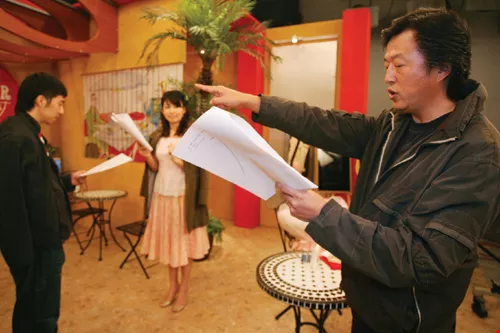
The studio is Wang's stage. On the set of Taipei Family, he watches the actors rehearse and from time to time directs them.
Everyday comedy
Comedy is Wang's specialty and has always been his field. Some people have even said that Wang is using comedy for "revolution."
The sitcom Taipei Family, which takes neighborhood life as its theme, has already been on the air for three seasons and has just started its fourth. It could be said to be Wang Wei-chung's signature work.
What Wang strives for is a comedy of everyday life, where the laughs aren't forced but arise naturally from the characters' personalities. "A lot of stuff is just too fake," he says. He gives the example of the forced humor seen at the Golden Bell Award ceremony. "Insisting on 'comedic' rhythms makes people think it's cheesy," he says. Wang himself is actually pretty funny. From time to time he'll mock people, making faces. He often jumps on the stage to demonstrate what he wants. In one sense, he's a natural comedian, but in another, it has to do with his childhood spent in a village of displaced soldiers.
"My parents had the biggest influence on me," he says. He used to drink and chat with his father back in the village, in Chiayi County. He says he's got the DNA of a soldier and a farmer. He grew up in a happy family, which cultivated his optimistic, positive attitude.
In Wang's eyes, his father--a retired officer who drove a bus for a kindergarten--is capable of doing anything. His father once pretended to be a police officer to take him to the movies for free. Wang laughs that his father would often say, "Things come to a head and change--then you'll get through them!"
A comic book fan and amateur artist since childhood, Wang has a "cartoonish" personality and sense of humor. Growing up in the village gave him a deep awareness of many facets of human nature, and his training at Chinese Culture University's Department of Journalism let him develop an eye for the news. The curious, playful Wang also loves to let his imagination run wild.
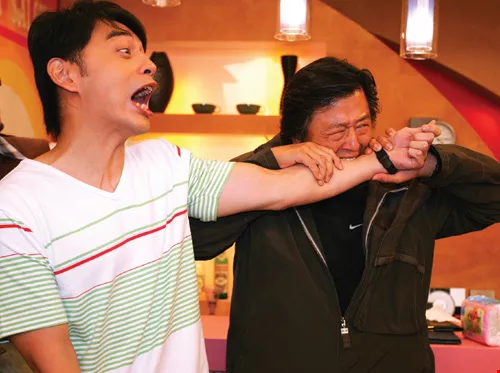
Sometimes Old Wang can't help but to jump onstage and demonstrate just what he wants.
Born rebel
Chen Hao, executive vice president at CTi, has been friends with Wang for over a decade now. Wang calls him "a friend and a teacher."
Actually, they have an earlier connection. "We had crushes on the same girl," confides Chen--though Wang knew her in high school and Chen did in kindergarten.
"Even though he wears head-to-toe designer clothes, his lifestyle isn't aristocratic at all," says Chen, who is the same age as Wang and, like Wang, is the son of mainlander parents. He has a vivid way of describing Wang. "He's a commoner for life, a member of the opposition and a man of the people," he says. According to Chen, Wang will never submit--when he sees something he thinks is unfair, he'll speak his mind: "Wang's being in the television industry has made him a master of incisive satire and lampoon."
Nature and nurture have provided Wang with endless creative resources to rely on when producing a show. He's produced a wide variety of shows--he's done popular shows like Weekenders, children's shows like the old Gaga Oohlala, which was hosted by David Tao, the more recent children's English-learning show Magic ABC, political satire shows like Everybody Speaks Nonsense and Public Pressure Cooker, and the warm-hearted sitcom Taipei Family.
In addition to those, Wang is always looking to try new modes of programming. Kuokuang Gang Helps Out is a recent example. "I thought at 11 at night, we could try a more 'lad culture' type thing," he says. It's his style to keep being creative.
Creativity runs in his blood--it's his personality and his life. Wang says that every day, when he gets up in the morning, he wants to do something fresh. Maybe that's his fountain of youth--there's always something new to keep him feeling young.
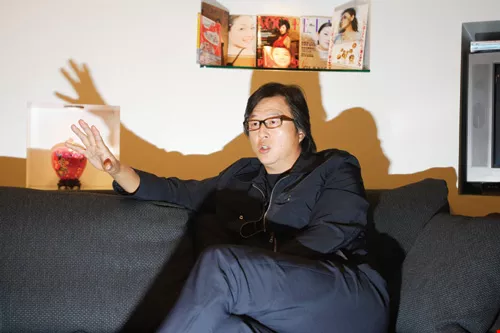
Wang Wei-chung may wear the latest fashions, but he's still the same mercurial talent he's been for 30 years in the television industry.
Controlled chaos
Wang Wei-chung may let his imagination run wild, but there is actually a certain logic behind his thinking. In Kang & Hsi Are Coming, for instance, he paired the wild Little S with the more thoughtful Tsai Kang-yung, a writer, to act as hosts. It may seem like chaos, but Wang will convince you that there's a method behind it all.
"One bold, fresh-faced youngster and one seasoned veteran--when they come together, sparks fly," he says of the hosts. Just the thought of the two together is amusing "When doing a show, you have to have fun for the audience to have fun. You can't just manufacture that sort of atmosphere." That's his secret, and it makes perfect sense. The "Three Links Classroom" segment of the show Funny Very Much, featuring Xia Yi and Ta Ping, is another example of this sort of pairing of opposites--a slightly overenthusiastic Shanghai girl with hypercorrect Mandarin was paired with a parody of Frank Hsieh, playing his Taiwanese drawl for laughs. The girl would sing Shanghainese renditions of classic Taiwanese-language songs and then teach a few words of Shanghainese. At the height of Shanghai fever, with hundreds of thousands of Taiwanese doing business there, the segment was a hit.
In addition to his boundless creativity, Wang Wei-chung also has an eye for people.
"The first time you meet him, Old Wang will no doubt narrow his eyes as he tries to figure you out," says scriptwriter Hsieh Hsiao-mi.
Wang says that he's never "headhunted" talent, and that he never kowtows to big stars, but he's discovered a number of big names. One has to wonder how he does it and what he looks for.
He says it's different for people onstage and off. Onstage, someone needs to be special--whether they're especially beautiful, especially ugly, or especially average, they need to stand out from the crowd. People working behind the scenes need to have a unique vision. "I'm attracted to people who can tell me some things I've never heard of before," he explains.
Perhaps it comes from his childhood in the village. He's always got his eye on people, seeking talent like a miner looking for gold. He's a quick study, too. "All people need is a personality and they'll be attractive and have their own style," he says. He respects everyone and doesn't try to change anyone. He just tries to get them to develop their own natural talents: "You just have to put people in the right places and they'll do well on their own."
Wang can focus that discerning eye not only on people, but on the times as well.
In a scriptwriting meeting for Taipei Family, Wang reminded writers that they can't close themselves off from the rest of society. They have to move along with the people and pay attention to what's going on. Like the recent American show in which black people were made up as whites and vice versa, he says, "People are always envious of people in different situations. Once they are in the other's situation, they have more understanding." He recommended the writers think about current social phenomena, such as the rise of indebted "credit-card slaves" and the controversy over the scrapping of the preferential 18% interest rate for public servants, and write them into the scripts.
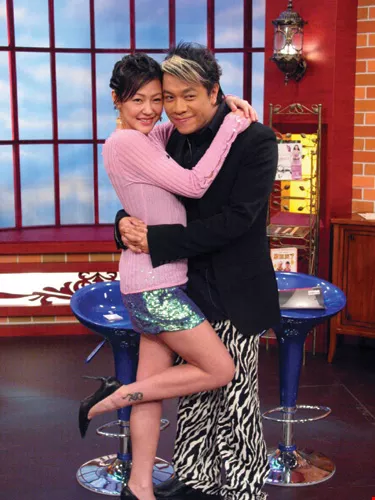
"Bold, fresh-faced youngster" Little S and "seasoned veteran" Tsai Kang-yung make a hilarious team on Kang & Hsi Are Coming.
Keeping that aura
The shows are all about comedy and warmth, but Wang Wei-chung is known for his temper.
On set, Wang doles out scathing criticism. More than one comedian has heard "This table is a better actor than you!" or similar remarks from him. It is said that he's especially hard on the men, and will even occasionally run up and give them a kick. Cursed-out writers are often seen wiping away tears as they edit scripts.
Though Wang has earned this sort of reputation, he's mellowing with age and is no longer the arrogant young man he once was. The edges have worn down, but he's still the subject of gossip.
"That's an aura you've got to have," Wang says. Only when you can "keep the actors' adrenalin flowing" will they turn in a good performance. These days, he doesn't come down to the set of Public Pressure Cooker much but he does phone in occasionally. "I don't show up in person, but I still keep the pressure on," he says with a crafty smile.
In truth, even many actors who've been bawled out by him at one point or another end up feeling thankful toward "Big Brother Wei-chung."
"The hardest thing about collaborating with him is understanding what he's saying," says scriptwriter Hsieh Hsiao-mi with a touch of bluster. She says even if she can communicate with Wang effectively without fear, her "batting average" is only 70-80%--sometimes the entire script gets thrown out. But now she's been working with him for three years, she knows the best way of dealing with him.
"Just don't take it personally," she says--getting yelled at by Big Brother Wei-chung is a kind of honor. "If he yells at you, that means you still have hope," she says. Wang even curses when praising people--he'll say things like "You write pretty goddamn well!" So, Hsieh says, "You just have to think of his rough language as being his way of starting a sentence."
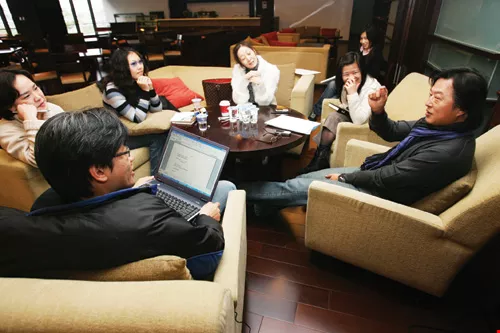
During script meetings for Taipei Family, Wang brings up all sorts of topics. He makes sure the writers are up to date with what's going on in Taiwanese society.
Soft at heart
"Old Wang is my guardian angel and my benefactor," Hsieh says. Most writers only get paid after completing a script, but Wang doesn't want his writers to go hungry so he asks them if they want an advance. Once Hsieh was going through a breakup and lost a lot of weight. She was crying all day even as she wrote her comedy script. Wang noticed she wasn't looking well and made sure the other employees on the show didn't rush her.
They say people like Wang have "a mouth as sharp as a knife but a heart as soft as tofu." He seems tough on the outside, but really he's got a good heart. As a boss, he's always thinking of his employees.
He's creative, funny, and caring--maybe that's the reason young-at-heart Wang Wei-chung has been on top of the television industry for 30 years.

@List.jpg?w=522&h=410&mode=crop&format=webp&quality=80)


