Taichung's Fengjia Night Market: A Culinary Battleground
Teng Shu-fen / photos Hsueh Chi-kuang / tr. by Chris Nelson
December 2010


People = money. Tai-chung's so-called "Golden Triangle" night-market shopping area, bounded by Fu-xing, Wen-hua and Feng-jia Roads, is the big money-maker- among Taiwan's night markets, its half-century tradition of novelty foods, fueled by neighboring schools such as Feng Chia University and Ling Tung University, drawing in visitors and tourists. In this night-market battleground, where crowds of people flow to and fro, the key to success rests in catching people's eyes.
If you wish to try authentic street food, Feng-jia Night Market may not be your top choice. Here, there aren't many stands selling traditional bah oan (minced meat and bamboo shoots deep fried in translucent dough) or oyster omelets. But if you'd like to experience how creative a Taiwanese night market can be, the dazzling variety available at Feng-jia Night Market makes it live up to its name as Taiwan's "most stylish" night market.
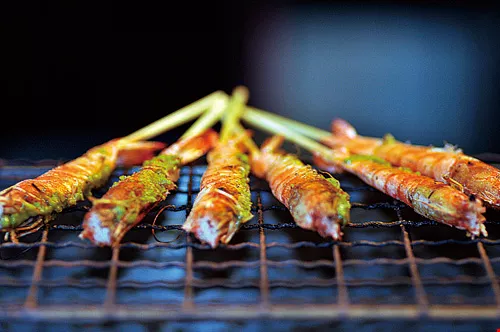
When it comes to barbecued shrimp, most night markets sell similar fare. But at Feng-jia Night Market, one stall owner developed an automatic shrimp grilling machine.
At the teeming Feng-jia market, there are eight stalls selling barbecued shrimp, but only one stall boasts an automatic grilling machine, drawing the attention of scads of people. A year ago, 32-year-old Fu Yuhu spent eight months and NT$600,000 developing an automatic rotisserie. Shrimp skewered on bamboo sticks are placed into hand-like clamps, and the skewers are rotated once through the grill. Seven minutes later, they're ready to eat.
Says Fu, it used to take five minutes to complete the circuit, but it could only grill 37 at a time. But business boomed, with customers often lining up for 40 minutes or so. With his background in metalworking, he narrowed the space between the machine's chains and gears, experimenting. Gradually, the number of shrimp that could be grilled simultaneously grew to 108. By adjusting timing and heat levels, he made great strides in boosting efficiency as well as cleanliness.
Fu and his wife both operate stalls at the night market. His wife sells clothing in the Flagship Night Market opposite his stall.
"With clothing there's the problem of changing seasons. Though it's profitable, business goes up and down," says Fu. Fashion trends change quickly: it used to be that his wife could go to Korea or Japan once a month to buy batches of clothing, but now she needs to import at least two batches of new goods a week to keep her customers coming back. Fu's sales at the shrimp stand are steadier: on the weekdays he sells 2,000 skewers a day (about 18 kilos), and on weekends and holidays the figure rises to 4,000, at NT$40 per skewer of five shrimp.
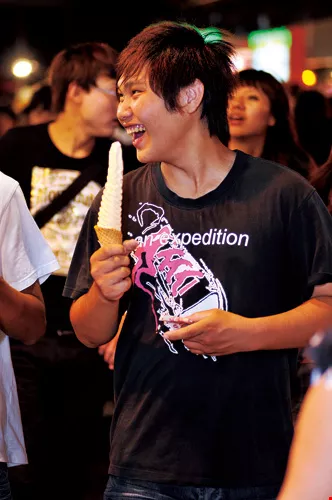
A few stalls down, the Chocolate Banana King sells his patented wares: frozen bana-nas drizzled with a layer of chocolate sauce and dipped in ground peanuts or candy sprinkles. It's a lot like a popsicle: sweet on the outside and crunchy on the inside.
Says middle-aged owner Huang Deng-xun, some years ago he was eating a banana while also eating chocolate, and found that the two flavors went together very well. He tried coating a banana with chocolate but learned it wasn't easy. Later, some friends in the food industry suggested that he first freeze the bananas to -10°C, and the next day lower the temperature to -20°C. He experimented for years before finding the secret, which is that the temperature can't be lowered too quickly, or the bananas will oxidize and turn black. That wouldn't be good for sales.
Huang tried experimenting with other fruits, but found that bananas and chocolate reigned supreme. Some fruits with high water content, like tomatoes or Asian pears, became rock-hard icicles after freezing, not conducive to eating.
A retired food importer, Huang started selling at the Zhongli- Night Market in Tao-yuan for the fun of it. Last year he moved to Feng-jia: "At Zhongli- Night Market, I only sold about two a night when business was at its lowest, because of the conservative tastes of visitors. But at Feng-jia, students are the chief consumer demographic, and are more adventurous when it comes to new things. Foreigners are especially fond of them," says Huang.
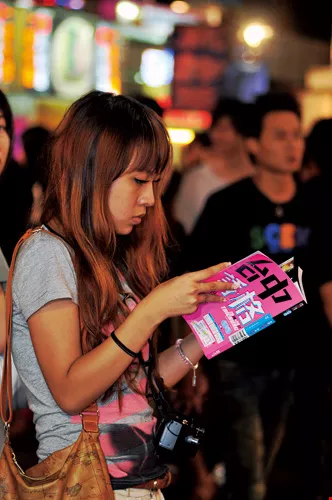
Located near a university, Fengjia Night Market's consumers are mostly young people and tourists. This place is Taiwan's premier birthplace of innovative snacks. At bottom, "one sausage in another" (pig's intestine filled with sticky rice + sausage), and a baked potato meal.
On Friday evening, the crowds start pouring into Feng-jia Night Market, and by 7 p.m., pretty much every stall has a long line in front of it.
From the side entrance of Feng Chia University on Wen-hua Road to the Fu-xing Road intersection, there are over 200 stalls in a short 200-meter section: this is the traditional night market. The shopping area gradually extends outwards, over to Feng-jia and Xi-tun Roads, where there are an estimated 1,700 shops in the shopping area, attracting some 500,000 people a month. In terms of the number of shops, the Feng-jia shopping area is Taiwan's biggest night market, surpassing Shi-lin Night Market in Taipei.
Walking along Wen-hua Road, you'll soon notice a building named Flagship Night Market. This two-story structure, whose exterior wall is rimmed with yellow, red and blue neon lights, boasts roomy, five-meter-wide walkways, with shop spaces on either side ranging from 10 to 30 square meters in area. Altogether there are 130 shop fronts, about 70% of them clothing stores. The food stalls offer oden (fish balls, daikon and other ingredients simmering in broth), luwei (meats, tofu and eggs stewed in soy sauce), stinky tofu, pepper pork buns and steaks: a mix of Chinese and Western fare. The interior is fully air conditioned, offering shelter from the heat and rains, so you can browse around at your leisure.
The first stall inside the entrance is the renowned Japan Boat Takoyaki, which opened at Fengjia Night Market 10 years ago. They do brisk sales, selling over 1,000 boxes a night.
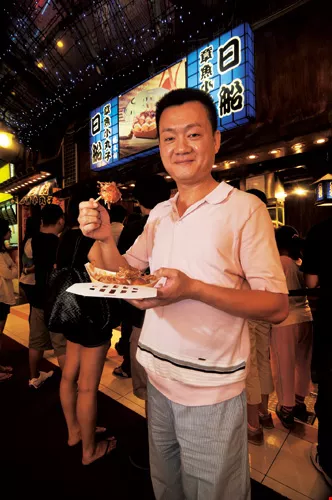
Selling takoyaki at Fengjia Night Market for over a decade, stall owner Zhang Shiren experimen-ted for years to get the perfect crispy texture. To this day, his stall attracts long lines of customers.
The man behind the Japanese-style ta-ko-yaki (octopus balls) enterprise is Taiwan's celebrated Zhang Shi-ren, who is also the owner of Flagship Night Market.
Zhang was born into a well-to-do family, his father a factory owner. Like other night-market stall owners, Zhang loves to experiment. He used to sell his ta-ko-yaki at Wuri- and Tai-ping, and by Ling Tung University, but it wasn't until he came to Feng-jia Night Market that he saw success. Now he's a "night-market hero" with over 200 employees at his main branch, and a global chain of over 400 outlets (including mainland China and even Los Angeles).
In 1995, Zhang visited Osaka, Japan, where he saw a ta-ko-yaki shop with a long line out front, over 100 meters long. He instinctively thought that if he could introduce this to Taiwan, he could make a killing. With the string-pulling of a few friends, he spent several days studying the art of ta-ko-yaki from a Japanese master. After returning to Taiwan, he set up a stall at Wuri-. He had no idea that the Taiwanese couldn't accept the delicate Japanese-style flavor; moreover, the price was too high at six octopus balls for NT$50, and his stall folded several months later.
Unfazed, he tried different locations and adjusted his formulas. To accommodate Feng--jia Night Market's "more-for-less" student culture, he lowered the price to NT$35 (now NT$40), and business skyrocketed. His record sale was 2,800 boxes a day.
"Each time I opened up a new location, business was swift at first, but then it slid back, falling to an unacceptable level. Through constant research, business has leveled out." Sipping tea while smoking a cigarette in his second-floor office, Zhang draws a comparison: Japanese ta-ko-yaki tends toward more of a sweet-and-sour taste, but in Taiwan people like the crisply fried texture, but not too oily. A little wa-sabi gives it some zing.
Zhang, successful in running stalls, now rents out storefronts. The 2000-square-meter Flagship Night Market was once a squat, single-story building. Seeing its potential, Zhang spent two years and NT$100 million buying it up so he could rent out shop spaces. When it opened in 2004, he estimated the annual rental income at tens of millions of NT dollars.
Located near a university, Fengjia Night Market's consumers are mostly young people and tourists. This place is Taiwan's premier birthplace of innovative snacks. At bottom, "one sausage in another" (pig's intestine filled with sticky rice + sausage), and a baked potato meal.
Seeing the stalls with such long lines, a visitor to Feng-jia Night Market may think that just setting up a stall here will lead to success.
"There's a high rate of business failure. If you can't stand the heat, stay out of the kitchen!" says Zhang in a bold manner. Many old shops have gone belly up over the years, such as Tai-chung Bah Oan, Chang-hua Oyster Thin Noodles and one of the first spicy hot-pot shops, because to survive here, food needs to be both tasty and cheap.
Zhang says that there are 1,700 shops and stalls in the Feng-jia shopping area, and stalls without a gimmick are easily overlooked. "Therefore, in the first six months after opening a business you need to compete in terms of appearance. It sounds bad: first you can lure customers in on looks, but after the novelty wears off, you need to survive on prowess and distinctiveness," he says.
In fact, most people know the basic principles of doing business: good location, good decor, cheap and tasty food, but success is in the execution. Zhang brings up the example of the corner windows common in McDonald's locations. But if you can't afford NT$30,000 a month per square meter, you have to settle for less, and rent a space in an alley. Also, because the stiff competition means sales price can't be set too high, you may resort to buying cheap ingredients, resulting in poor-tasting food. This chain of causality dooms businesses to failure.
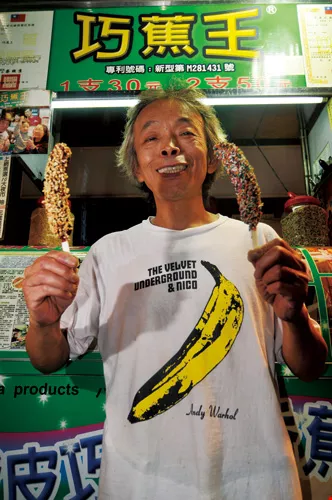
Never seen a chocolate banana treat like this! A frozen banana, dipped in chocolate and crushed peanuts.It's sweet and crunchy, like a popsicle.
"The key is to make customers feel that they're getting their money's worth. The profitability is in food synergy," says Zhang.
Zhang mentions his own restaurant located in the Flagship Night Market: Steak Aka-oni (literally "red devil," the nickname of Ie-yasu To-ku-gawa's general Nao-masa Ii). There's no all-you-can-eat salad bar or highfalutin service; he just gives the customers large helpings of meat, the average steak order coming to about NT$200. Striving to ensure that the ingredients make up 60% of the cost, Zhang doesn't hire high-priced, experienced chefs, because they won't learn anything here and it's hard to retain them. The kitchen at Steak Aka-oni is like a production line, a specialist in charge of cooking, another in charge of placing food on plates, and so forth. The result is fast service with few errors, as well as a high customer turnover rate.
What with ta-ko-yaki, ra-men sandwiches, potatoes au gratin and chocolate bananas, Feng-jia Night Market is a birthplace for innovative dishes where creative drama plays out on a daily basis. Such failure-defying, experimental spirit is one of the charming qualities of this night market that keeps visitors coming back for more.
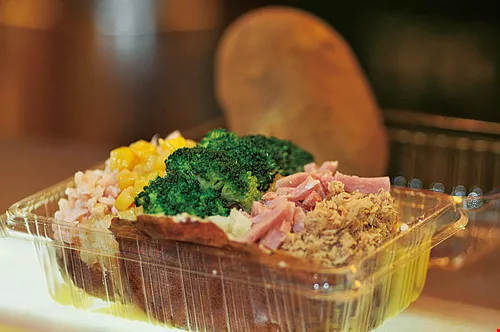
Located near a university, Fengjia Night Market's consumers are mostly young people and tourists. This place is Taiwan's premier birthplace of innovative snacks. At bottom, "one sausage in another" (pig's intestine filled with sticky rice + sausage), and a baked potato meal.
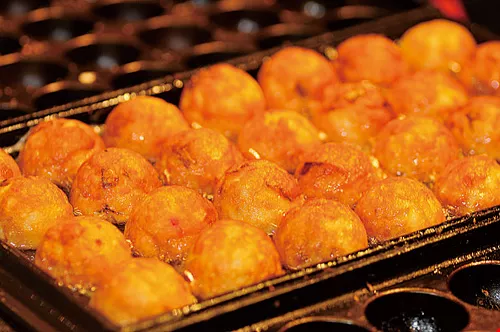
Selling takoyaki at Fengjia Night Market for over a decade, stall owner Zhang Shiren experimen-ted for years to get the perfect crispy texture. To this day, his stall attracts long lines of customers.
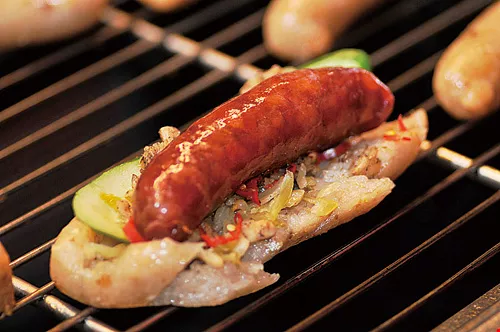
Located near a university, Fengjia Night Market's consumers are mostly young people and tourists. This place is Taiwan's premier birthplace of innovative snacks. At bottom, "one sausage in another" (pig's intestine filled with sticky rice + sausage), and a baked potato meal.
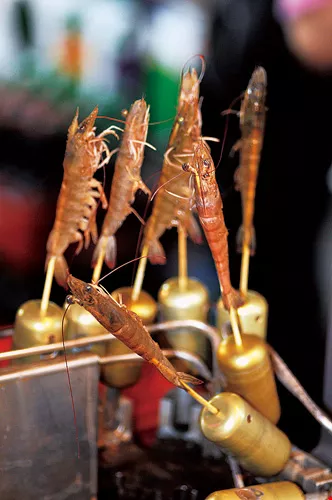
At the fiercely competitive Fengjia Night Market, there are around eight stalls selling barbecued shrimp, but only one has an automatic shrimp grilling machine. Skewered shrimp are placed in clamps, and after one circuit they're cooked and safe to eat.
@List.JPG?w=522&h=410&mode=crop&format=webp&quality=80)

@List.jpg?w=522&h=410&mode=crop&format=webp&quality=80)


